
Features
A sad night to remember


By Capt Elmo Jayawardena
Elmojay1@gmail.om
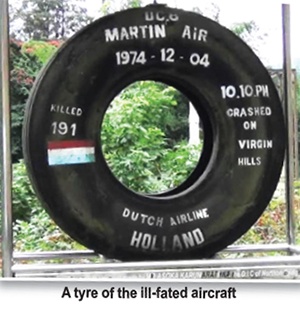
A DC-8 aircraft, belonging to Martinair, crashed into the Anjimalai mountain range, also known as the Seven Virgins, on 04 December 1974. The accident happened around 1015 PM and the location was in the vicinity of Maskeliya. This has been the worst ever air disaster in Sri Lanka; 191 lives were lost with no survivors.
Corona curfews give us time to read, and in my isolation, at home, I have been pulling out ‘bucket-listed’ stories to munch. Most articles I browsed through about the Martinair DC-8 crash had covered all aspects of this horrible disaster. Adequate details were available to re-construct the story and come to reasonable conclusions on what may have happened.
 We know the easy way out as regards most aeroplane crashes has been the first-choice of the hit-parade – PILOT ERROR. The captain is buried beneath the Seven Virgins hills in a shamed silence. So is his First Officer and the Flight Engineer. The case is closed and forgotten. I have no defence to rub on behalf of the crew to give even a shallow coating of an excuse. There, however, is a ‘BUT’ I need to mention here. On one side, we have technology inundated with fancy aviation jargon. Add to that a half-burnt Black Box and communication tapes between the pilot and the controller, plus all the details of the flying records of the crew and what they have done and what they have not done. Then comes a hundred titbits of aeronautical specifics that act as tinsel to an investigation.
All that is fine and valid to be used at roundtable conferences where aviation-related head umpires and leg umpires, third umpires plus match referees discuss and make decisions, taking all the time in the world. It is not the same for the Captain and his crew. No doubt they are professionally competent, but some decisions to be made in an aeroplane are instant. You win some and you lose some and the ones you lose may have devastating repercussions. You may not even be living to tell your side of the story. A few seconds make the difference between life and death. In such calamitous situations we tend to forget that the most lethal ingredient in an aviation disaster is the Human Factor.
The Captain is not an infallible demigod who jumped out of Mount Olympus and sits in the cockpit of his aeroplane. He is human and so are his crew. They are not different from the ordinary people like you and me. I have been a Captain for a considerable number of years. I have made many mistakes flying aeroplanes. I humbly say I was lucky that I escaped without an accident. There is nothing courageous or brilliant about that; it is simply the way fate rolled the dice. Such would be the story of any Captain. Admitted or not, it is the truth, the absolute truth.
Scales of justice
 The scales of justice in an aviation accident investigation is held by competent authorities. In the case of the Martinair DC-8 crash, there were three Civil Aviation Departments associated with the inquiry. Sri Lanka, the Netherlands, and Indonesia, plus there would have been the McDonnell Douglas Company that built the aeroplane and insurance companies that were present to protect their dollar. There were whispers about the Doppler system in this aeroplane having errors that caused inaccuracies in the ‘distance to go’. It was also said that the crew had not been informed of this. There is nothing to substantiate such statements and as such, it is best that I leave them out and let them lie buried along with the aeroplane. I also read that the co-pilot had a traumatic childhood and that could have affected his behaviour when approaching to land. I make no comment on such absurdities.
Let me now take you to the story of the DC 8 that crashed into the Seven Virgins mountain range. The accident tragically killed 191 innocent people (182 passengers + 9 crew). It sure is a terrible night to remember.
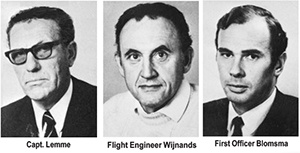
The flight was from Surabaya, Java, to Jeddah via Colombo, which was a re-fuelling stop. This was Muslim pilgrimage time to Mecca for the Haj. Devotees came from all parts of the world. Some flew in on private jets but most travelled on chartered aeroplanes. The flight that took off from Surabaya was a DC-8 55CF aeroplane, owned by Martinair of the Netherlands; it had been leased by Garuda Indonesia to fly the Haj charters. In command was Capt Hendrik Lamme, a 58-year-old very experienced pilot who had flown 27,000 plus flying hours, of which 4,000 were on DC-8s. The First Officer Robert Blomsma had 2,480 hours and was new on the DC-8 type with 47 hours. The third crew member, the flight engineer was Johannes Wijnands, who had flown 3,000 hours on DC-8 type aeroplanes. Back in the cabin there were six crew members, four were Dutch and others Indonesian. The aircraft had a Dutch registration of PH-MBH and was less than 10 years old. The flight plan filed call-sign for the flight was MP 138.
Here, I must explain to the reader something about the navigational instruments that the aeroplane had. I want to make it as simple as possible for a non-aviator to understand.
The route from Surabaya to Sri Lanka is mostly oceanic. It starts with an airway called Red-61 and extends on a North-Westerly direction till it reaches the Sri Lankan Flight Information Region (FIR – 92 East longitude) and follows route Golf-462 to cross the coast at a waypoint located over Yala. This reporting point, unfortunately, had no Radio Aid for the pilots to  cross-check their navigation when flying overhead. The primary navigation system that was in use by Martinair was called Doppler. This was operated worldwide by many airlines, and during that era it was a primary navigational aid for jet aeroplanes flying long haul sectors. Doppler gave the pilots a digital reading of the distance to go to the waypoint it was heading to. However, Doppler system was not overly accurate when flying over water for a long period and had to be updated over a radio beacon or a known geographical position (maybe a river or town) to maintain its accuracy. Flight MP 138’s route initially had radio beacons to update the Doppler. But the final ocean crossing before the coast of Sri Lanka had no radio beacon for the crew to update the Doppler position. That was a long leg, too long to fly without an update.
The last point the DC-8 could have done a navigational cross-check would have been at a waypoint closer to Banda Archi airport, which was about 135 miles right of their track. From there Capt. Lamme still had to fly close to two hours to reach the coast of Sri Lanka. He was navigating now purely by rudimentary ‘dead-reckoning’ and Doppler ‘distance to go’ readouts without any cross-check to update his position.
Flight MP138 crossed the FIR at 8.27 pm local time – six minutes earlier than the estimate. Calculating its speed by distance between two waypoints and time taken, the ground speed would be 478 at eight miles a minute. Six minutes would be almost 50 miles. The FIR was about 850 miles from the Sri Lankan coastal waypoint. Maybe, Capt. Lamme and his crew were getting a wrong ‘distance to go’ reading from their Doppler. It is difficult to fathom whether it was because of the reported fault in this particular aeroplane Doppler or it was because of a very long sea track flown without an update. It could even have been both.
Already there had been a six-minute (50 miles) correction made. Was it correct or was it a Doppler error? There was no way to cross check and update. If it had been a Doppler fault, that could have caused the Martinair DC-8 to fly all the way to its death in Maskeliya.
 Flight MP 138 first contacted the Colombo Air Traffic Control located at Ratmalana at 9.52 PM and reported 130 miles out at 35,000ft. They were only going by the Doppler. The controller answered ‘MP-138 clear descend 10,000 when ready and call 50 miles from Katunayake.” When Capt. Lamme commenced his descent by what his Doppler reading displayed, his actual position would have been 50 miles east of where he thought he was. Unfortunately, Katunayake Airport at that time did not have Approach Radar nor a Distance Measuring Equipment (DME), which would have digitally told the pilot exactly how far he was from the airfield.
Few minutes later the DC-8 called “50 miles” and was cleared to 6,000 and handed over to Colombo Approach Control at Katunayake. The First Officer who was doing the radio called Colombo Approach at 10.08 PM and reported he was ‘one four” (14) miles from the Katunayake airport passing 7,000 for 6,000. Approach Control had no Radar to see him. The controller had to go purely by the MP 138’s estimate of 14 miles from the airfield. He cleared MP 138 to 2000 ft and told him to call “field in sight” or overhead the KAT radio beacon.
“Roger, cleared 2000, to KAT or field in sight.” This was at 1010 by the first Officer.
That sadly was the last communication!
On descent, the DC-8 hit the 5th of the Seven Virgins mountains at a height of 4,354 feet. The impact place was about 65 miles from Katunayake. When F/O Blomsma reported 14 miles from the airport, he was most certainly giving the distance from the cockpit Doppler. He had to read from a possible error-tainted Doppler. If you add 14 miles to the error of 50 miles on the Doppler the answer is 64. Give or take a few miles for the random calculation I am doing, and then perhaps the 64 coincides with the distance from Katunayake to the place where the crash occurred in the Anjimalai hills.
The only other explanation for Capt. Lamme to initiate an early descent could have been a wrongly interpreted weather radar sighting of the eastern coast. These were black and white radar displays and it is possible that a low cloud could have been mistaken for the coast maybe 50 miles before ALGET.
I, in no way, can say what I have written is the gospel truth. I have no crystal-clear facts to ponder on. It is just my opinion I am stating. I do have some knowledge on Doppler matters as I have flown these routes in similar aeroplanes using Doppler navigation. Many opinions are expressed by journalists about this disaster. How true such inferences are is debatable.
I was greatly assisted by Sri Lankan Air Traffic Controllers and communication officers; some of them handled MP 138 arrival. I am deeply grateful to them for their first-hand information.
The possibility remains that Capt. Lamme may have commenced his descent approximately 50 miles before the planned point to leave 35,000.
The aeroplane crashed. There were many factors that left room for or would have contributed to human error.
Capt. Hendrik Lamme was guilty of being a human being!
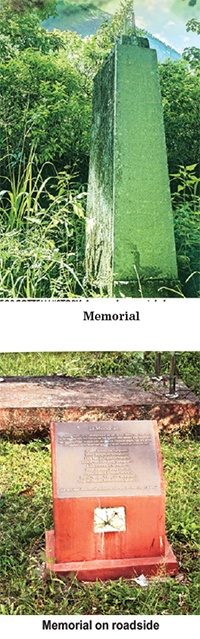
Today, people driving past the Norton Bridge town see a strange sight. A structure displaying a large tyre. It is a wheel from the DC-8 that crashed into the Seven Virgins mountains. It could be all that was left of that magnificent aeroplane owned and flown by the Dutch. If one is interested, there is a place where one should stop on the road from Norton Bridge to Maskeliya. A plaque of remembrance is there, erected in memory of those who are buried around this place at the foot of this hill. The Martinair crew and the Indonesian pilgrims who died on the slopes of the mountain were buried in a common grave by the roadside. People say flowers do get placed, off and on, at the memorial. In remembrance of whom we know, but by whom is the question.
Up in the mountain is the main memorial, a stone pillar-like monument erected at the actual crash site. Wind-swept and rain-soaked it stands in its forgotten loneliness. Perhaps, it whispers its sadness amidst the Seven Virgins mountain range. The column has been erected in remembrance of the 191 innocent people who died there on a sorrowful December night, a long time ago.



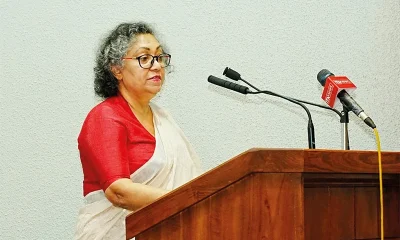



 It was Iran’s first spiritual head of state, the late Ayatollah Khomeini, who singled out and castigated the US as the ‘Great Satan’ in the revolutionary turmoil of the late seventies of the last century that ushered in the Islamic Republic of Iran. The core issue driving the long-running confrontation between Islamic Iran and the West has been religious identity and the seasoned observer cannot be faulted for seeing the explosive emergence of the current war in the Middle East as having the elements of a religious conflict.
The current crisis in the Middle East which was triggered off by the recent killing of Iranian spiritual head of state Ayatollah Ali Khamenei in a combined US-Israel military strike is multi-dimensional and highly complex in nature but when the history of relations between Islamic Iran and the West, read the US, is focused on the religious substratum in the conflict cannot be glossed over.
In fact it is not by accident that US President Donald Trump resorts to Biblical language when describing Iran in his denunciations of the latter. Iran, from Trump’s viewpoint, is a primordial source of ‘evil’ and if the Middle East has collapsed into a full-blown regional war today it is because of the ‘evil’ influence and doings of Iran; so runs Trump’s narrative. It is a language that stands on par with that used by the architects of the Iranian revolution in the crucial seventies decade.
In other words, it is a conflict between ‘good’ and ‘evil’ and who is ‘good’ and who is ‘evil’ in the confrontation is determined mainly by the observer’s partialities and loyalties which may not be entirely political in kind. It should not be forgotten that one of President Trump’s support bases is the Christian Right in the US and in the rest of the West and the Trump administration’s policy outlook and actions should not be divorced from the needs of this segment of supporters to be fully made sense of.
The reasons for the strong policy tie-up between Rightist administrations in the US in particular and Israel could be better comprehended when the above religious backdrop is taken into consideration. Israel is the principal actor in the ‘Old Testament’ of the Bible and is seen as ‘the Chosen People of God’ and this characterization of Israel ought to explain the partialities of the Republican Right in particular towards Israel. Among other things, this partiality accounts for the strong defence of Israel by the US.
For the purposes of clarity it needs to be mentioned here that the Bible consists of two parts, an ‘Old’ and ‘New Testament’ , and that the ‘New Testament’ or ‘Message’ embodies the teachings of Jesus Christ and the latter teachings are seen as completing and in a sense giving greater substance to the ‘Old Testament’. However, Judaism is based mainly on ‘Old Testament’ teachings and Judaism is distinct from Christianity.
To be sure, the above theological explanation does not exhaust all the reasons for the war in the Middle East but the observer will be allowing an important dimension to the war to slip past if its importance is underestimated.
It is not sufficiently realized that the Iranian Islamic Revolution of 1979 utterly changed international politics and re-wrote as it were the basic parameters that must be brought to bear in understanding it. So important is the Islamic factor in contemporary world politics that it helped define to a considerable degree the new international political order that came into existence with the collapsing of the Cold War and the disintegration of the USSR .
Since the latter developments ‘political Islam’ could be seen as a chief shaping influence of international politics. For example, it accounts considerably for the 9/11 calamity that led to the emergence of fresh polarities in world politics and ushered in political terrorism of a most destructive kind that is today disquietingly visible the world over.
It does not follow from the foregoing that Islam, correctly understood, inspires terrorism of any kind. Islam proclaims peace but some of its adherents with political aims interpret the religion in misleading, divisive ways that run contrary to the peaceful intents of the faith. This is a matter of the first importance that sincere adherents of the faith need to address.
However, there is no denying that the Islamic Revolution in Iran of 1979 has been over the past decades a great shaper of international politics and needs to be seen as such by those sections that are desirous of changing the course of the world for the better. The revolution’s importance is such that it led to US political scientist Dr. Samuel P. Huntingdon to formulate his historic thesis that a ‘Clash of Civilizations’ is upon the world currently.
If the above thesis is to be adopted in comprehending the principal trends in contemporary world politics it could be said that Islam, misleadingly interpreted by some, is pitting a good part of the Southern hemisphere against the West, which is also misleadingly seen by some, as homogeneously Christian in orientation. Whereas, the truth is otherwise. The West is not necessarily entirely synonymous with Christianity, correctly understood.
Right now, what is immediately needed in the Middle East is a ceasefire, followed up by a negotiated peace based on humanistic principles. Turning ‘Spears into Ploughshares’ is a long gestation project but the warring sides should pay considerable attention to former Iranian President Mohammad Khatami’s memorable thesis that the world needs to transition from a ‘Clash of Civilizations’ to a ‘Dialogue of Civilizations’. Hopefully, there would emerge from the main divides leaders who could courageously take up the latter challenge.
It ought to be plain to see that the current regional war in the Middle East is jeopardising the best interests of the totality of publics. Those Americans who are for peace need to not only stand up and be counted but bring pressure on the Trump administration to make peace and not continue on the present destructive course that will render the world a far more dangerous place than it is now.
In the Middle East region a durable peace could be ushered if only the just needs of all sides to the conflict are constructively considered. The Palestinians and Arabs have their needs, so does Israel. It cannot be stressed enough that unless and until the security needs of the latter are met there could be no enduring peace in the Middle East.

The two input gateways of communication, sight and sound, are quite well developed at birth. In fact, the auditory system becomes functional around 24 weeks in the womb, and the normal newborn can hear quite well after birth. However, the newborn’s vision is a little blurry at birth, and the baby sees the world in shades of grey, while being able only to focus on things 20 to 30 cm (8–12 inches) away. Coincidentally, this is perhaps the exact distance to a mother’s face during breastfeeding. By 2-3 months, there are colour vision capabilities and the ability to track. By 5-8 months, there is depth perception, and by 12 months, there is adult clarity of vision.
By the time a child turns five, his or her brain has already reached 90% of its adult size. This astonishing physical growth is not just happening on its own; it is, to a certain extent, fuelled by experience, and the most vital experience a young child can have is communication with his or her parents.
Modern developmental neuroscience has shifted our understanding of how children learn. We used to think babies were passive sponges, slowly absorbing the world. We now know they are active characters from day one, constantly seeking interaction to build the architecture of their minds. This architecture is not built by apps, vocabulary flashcards, or educational television. It is built through simple, loving, back-and-forth interactions with anyone they come across, but mostly their parents.
The Foundation: Serve and Return (0–12 Months)
Communication with an infant from birth to one year of age begins long before they speak their first word. In the first year, the goal is to master a phenomenon called Serve and Return. This is a basic scenario picked up from the game of tennis. At the start of each game of a set in tennis, a player serves, and the opponent returns the serve. Just imagine a tennis match, where a baby “serves” by making a sound, making eye contact, reaching for a toy, or crying. The job of anyone in the vicinity, who very often are the parents of the baby, is to “return” the ball. If they babble, you babble back. If they point at a cat, you look and say, “Yes, that’s a furry cat!” This simple act does two things. The first is Brain Building, which creates and strengthens neural pathways in the language and emotional centres of the brain. The other is Emotional Security, a thing which teaches a baby that he or she has some help in the learning processes. The baby absorbs the notion that when he or she signals a need, his or her world will respond. This forms the basis of a secure attachment. Scientists have advocated that during this stage, people, especially the parents of a baby, should embrace what is called ‘parentese’. It is the use of a somewhat high-pitched, exaggerated voice. Research has shown that babies pay more attention to parentese than to regular adult speech, helping them to map the sounds of their native language more quickly.
The Language Explosion: Toddlers (1–3 Years)
When a child starts speaking words, the game changes considerably and quite profoundly. This period is defined by a rapid increase in his or her vocabulary and the beginning of grammar. It is very important to narrate everything. The people around, especially the parents, need to become kind of sports commentators for your life. While dressing them, one could say, “First we put on the red sock. After that, we put the other red sock on your left foot.” What we are doing by this is to give them the labels for the world they see.
It is also important to expand, but not truly correct, whatever the child says. If a toddler points to a car and says “Car!”, don’t just say “Yes.” Expand on it: “Yes, that is a big, fast, red car!” You are adding a new vocabulary and grammatical structure through a natural process. If the child says “Me go,” respond with, “Yes, you are going!” rather than correcting and saying “No…, you should say ‘I am going’.”
Toddlers love reading the same book, even one hundred times. While it may be tedious for those around the baby, it is important to realise that such repetition is vital for their learning. They are predicting what comes next, which is a core cognitive skill.
The Preschooler: Building Stories and Logic (3–5 Years)
By age three, the focus shifts from “what” to “why.” Preschoolers are beginning to understand complex emotions, time, and causality. This is the age at which it is best to ask questions which require thought and understanding. Such indirect open-ended questions would sound like “What was the best part of the park today?” or “How do you think that character in the story is feeling?“
A preschooler’s world is full of “big feelings” they cannot yet manage. When they are upset because they cannot have a cookie, avoid saying “Don’t cry over nothing.” Instead, name the emotion: “Don’t cry, you can have a cookie after dinner“. This teaches them emotional literacy. Parents and others around in the home could share stories about when they were little, or make up fantasy tales together. Storytelling teaches sequential logic (beginning, middle, end) and strengthens their imagination.
The Absolute Master Class: Learning Through Play
If communication is the fuel for brain development, play is the engine. For a child under five, play is not a break from learning; play is learning. It is how they explore physics (stacking blocks), mathematics (sorting shapes), social dynamics (sharing toys), and language (pretend play). We can boost their development exponentially by weaving communication into their play.
When a child is playing with blocks, dough, or puzzles, they are building fine motor skills and spatial awareness. It is also useful to use three-dimensional words: “Can you put the blue block on top of the red one?” “The puzzle piece is next to your knee.” One could also ask them to describe the texture: “Is the dough soft or hard?“
Pretend play, such as acting as a doctor, an engineer, a chef, or a superhero, is one of the most cognitively demanding things a child can do. It requires them to understand symbolic thought and to take on another person’s perspective. Join their world as a supporting character, not the director. If they are the doctor, ask, “Doctor, my teddy bear’s tummy hurts. What should I do?” This encourages them to use vocabulary relevant to the scenario and practice complex social problem-solving.
Playing with water, sand, slime, or safe food products allows children to process sensory information. This is the perfect time for descriptive vocabulary. Use contrasting words: wet/dry, hot/cold, sticky/smooth, loud/quiet.
A few special words for parents. You do not need an expensive degree or specialised toys to build your child’s brain. The most powerful tool you have is your own responsiveness. Modern science tells us that the basic recipe for a thriving child is simple: Look at them when they signal you. Respond with warmth and words. Narrate their world and Join their play.
You are not just talking to your child; you are building his or her future, even via just one conversation at a time. So, go on talking to your child and even make him or her a real-life chatterbox.
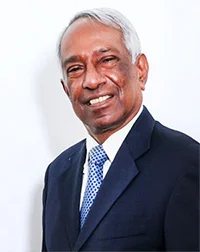 Dr B. J. C. Perera
MBBS(Cey), DCH(Cey), DCH(Eng), MD(Paediatrics), MRCP(UK), FRCP(Edin), FRCP(Lond), FRCPCH(UK), FSLCPaed, FCCP, Hony. FRCPCH(UK), Hony. FCGP(SL)
Specialist Consultant Paediatrician and Honorary Senior Fellow, Postgraduate Institute of Medicine, University of Colombo, Sri Lanka.

 Tourism is very much in the news these days and it’s certainly a good sign to see lots of foreigners checking out Sri Lanka.
With this in mind, Ruki’s Model Academy & Agency recently had a spectacular event to select Mrs. Tourism Sri Lanka in order to promote Sri Lanka in the international scene.
Nimesha Premachandra was crowned Mrs. Tourism Sri Lanka 2026.
She says she owes her success to Ruki (Rukmal Senanayake), the National Director and model trainer, and personality and advocacy trainer Tharaka Gurukanda.
Nimesha is a school teacher by profession, an actress and TV presenter by passion, and an entrepreneur by spirit.
She believes in balancing grace with purpose, and using her platform to inspire women, while promoting the beauty and culture of Sri Lanka to the world. And this is how our Chit-Chat went:

Nimesha Premachandra: Mrs. Tourism Sri Lanka 2026
01. How would you describe yourself?
I am a passionate, disciplined, and people-oriented person. I love learning, performing, and guiding others, especially young minds, through education.
02. If you could change one thing about yourself, what would it be?
I would probably try to be less self-critical and allow myself to celebrate achievements more often.
03. If you could change one thing about your family, what would it be?
Nothing major. I am grateful for my family’s love and support, which has shaped who I am today.
04. Is Mrs. Tourism Sri Lanka your very first pageant?
No. I have been part of pageants before, but Mrs. Tourism Sri Lanka is very special because it represents purpose, culture, and global representation.
05. What made you take part in this contest?
I wanted to represent Sri Lanka internationally and use this platform to promote tourism, culture, and women’s empowerment.
06. Obviously, you must be excited about participating in the grand finale, in Vietnam; any special plans for this big event?
Yes, I am extremely excited. My focus is to showcase Sri Lankan elegance, hospitality, and authenticity, while building meaningful connections with participants from around the world.
07. How do you intend promoting tourism, in Sri Lanka, during your rein?
I plan to highlight Sri Lanka’s diverse experiences in culture, heritage, wellness, nature, and local hospitality through media appearances, digital storytelling, and tourism collaborations.
08. School?
Kaluthara Balika. School life played a big role in shaping me. I actively participated in sports and performing arts, which later helped me build confidence as an actress and presenter.
09. Happiest moment?
Being crowned Mrs. Tourism Sri Lanka 2026 and seeing the pride in my family’s eyes – definitely one of my happiest moments.
10. What is your idea of perfect happiness?
Peace of mind, good health, and being surrounded by the people I love while doing work that has meaning.
11. Which living person do you most admire?
I most admire Angelina Jolie because she beautifully balances her work as an actress with meaningful humanitarian efforts. She uses her global platform to support refugees, advocate for human rights, and inspire women to be strong, compassionate, and independent.
12. Which is your most treasured possession?
My memories and experiences because they remind me how far I’ve come, and keep me grounded.
13. Your most embarrassing moment?
Like everyone, I’ve had small on-stage mishaps, but they always taught me to laugh at myself and move forward confidently.
14. Done anything daring?
Participating in pageants while balancing teaching, media work, and family life has been one of the boldest and most rewarding decisions I’ve made.

Keen to use her title to promote Sri Lanka globally
15. Your ideal vacation?
A peaceful destination surrounded by nature; somewhere I can relax, reconnect, and experience local culture.
16. What kind of music are you into?
I enjoy soft, soulful music because it helps me relax and stay inspired.
17. Favourite radio station:
I enjoy stations that blend good music with meaningful conversation and positive energy.
18. Favourite TV station:
Sri Lanka Rupavahini Corporation. It’s where it all began for me. It played a significant role in my journey as a TV presenter and helped shape my confidence and passion for media.
19 What would you like to be born as in your next life?
Someone who continues to inspire others because making a positive impact is what matters most.
20. Any major plans for the future?
I hope to expand my work in media and entrepreneurship while continuing my role as an educator and using my title to promote Sri Lanka globally.

Afternoon showers expected in the Uva and Sabaragamuwa provinces and in Hambantota, Nuwara-Eliya and Ampara districts

Trump administration launches US military operation in Ecuador

US sinks Iranian warship off Galle returning from Indian naval exercise

Justice Kumudini complains of male domination at senior levels, absence of a woman head of BASL

No qualified printer to head Government Printing Department

Wildlife Dept. fails on elephant fence management: Withanage

‘Dates have the highest sugar content to fight Coronavirus’

Sunday Island 27 December – Headlines

#SundayIsland 17th December – Headlines

Sunday Island – 28th March

Sunday Island Headlines – 21 March

Sunday Island – 21st February – Headlines
-
 Features3 days ago
Brilliant Navy officer no more
-
 Opinion6 days ago
Jamming and re-setting the world: What is the role of Donald Trump?
-
 Features6 days ago
An innocent bystander or a passive onlooker?
-

 Opinion3 days ago
Sri Lanka – world’s worst facilities for cricket fans
-

 Business6 days ago
An efficacious strategy to boost exports of Sri Lanka in medium term
-
 Features4 days ago
Overseas visits to drum up foreign assistance for Sri Lanka
-
 Features4 days ago
Sri Lanka to Host First-Ever World Congress on Snakes in Landmark Scientific Milestone
-

 Features3 days ago
A life in colour and song: Rajika Gamage’s new bird guide captures Sri Lanka’s avian soul