
Business
A plastic intervention in Arugam Bay

The beach and the ocean are both idyllic escapes for many. It can appeal to one’s senses, from swimming in the sea to exploring sea life or pressing one’s feet against the wet beach sands. However, enjoying such pleasures becomes problematic when the beaches and ocean are polluted due to anthropogenic activities.
A study submitted to the Marine Pollution Bulletin in 2020 stated that factors contributing to Sri Lanka’s pervasive environmental issues stem from fisheries, mismanaged harbour operations, and tourism. There are people and organizations in Sri Lanka involved in mitigating and providing solutions to improper plastic waste management by reversing these misdoings.
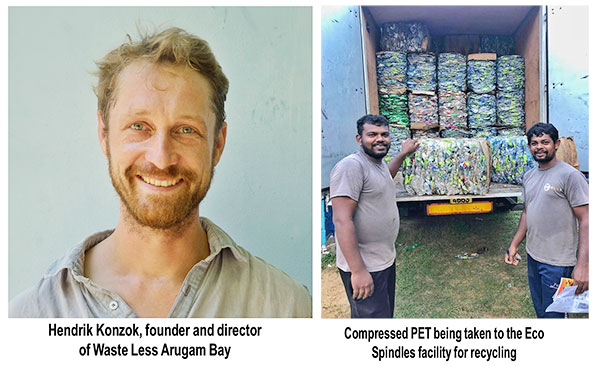
Waste Less Arugam Bay (WLAB) is one such entity focused on building a green and sustainable tourist destination in Arugam Bay. Founded in 2018, Hendrik Konzok, founder and director of WLAB, was operating a manufacturing company, Rice and Carry, making bags and fashion accessories from upcycled materials. During this time, businesses and tourists in Arugam Bay suggested that WLAB upcycle discarded plastic bottles.
 Henry and his team saw the value in collecting plastic bottles for recycling. WLAB was then established to educate and collect plastic waste disposed of improperly. “Tourism is one of the largest contributors to the waste plastic issue. The increase in plastic pollution in A’bay is due to the rise in the need for bottled water consumption by tourists,” stated Hendrik.
He also noted that before the COVID-19 outbreak, over 5000 tourists traveled to Arugam Bay per day. Henry’s team would find about 5000 – 15,000 PET bottles discarded irresponsibly onto roads and waterways. COVID-19 has drastically reduced the amount of PET waste discarded in Arugam Bay, owning to a drop in tourism and island-wide travel restrictions.
A WLAB truck is deployed every day to collect plastic from all across Arugam Bay. Waste is then brought back to the facility for bailing before sending it to Eco Spindles, Sri Lanka’s largest plastic recycler. Henry and other collectors like him also earn by handing waste plastics for the recycling giant. “WLAB is an intervention. We want to educate tourists on waste management so they know the importance of ensuring that plastic waste is disposed of properly. We are in the business of changing people’s behaviour through awareness,” noted Hendrik.
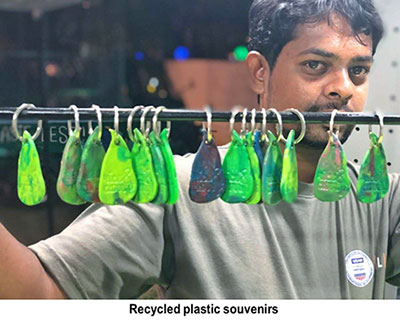
Tourists are shown how bottles are compressed before transportation. They are also invited to use the machinery at the WLAB facility to make products such as surfboard wax combs and key tags. These are made out of shredded and melted plastic bottle lids, which creates value perception.
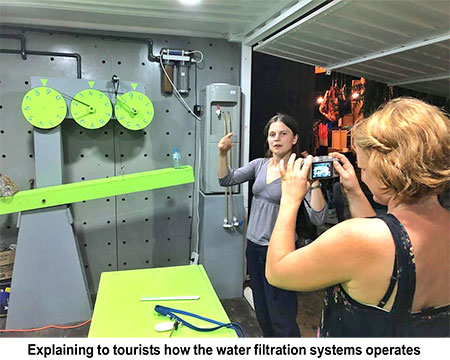
Their mission to educate does not stop there. WLAB houses a water filtration system in their facility where tourists can refill their bottles. The bottle is placed on a balance, and when it is refilled to one litre, the balance tips. Then the opposite end of the balance shows that by filling a bottle, they have mitigated using seven litres of water, 200 grams of oil, and other resources needed to manufacture one PET bottle. “We noticed between 2018 and 2019 that businesses offering refills grew from 8 places to 20 places, which is great to see,” remarked Hendrik.
 Knowing the value WLAB creates in Arugam Bay, Eco Spindles also provides recycled polyester yarn that WLAB sources to make tote bags out of recycled plastic. “Though we are still in the product development phase, we thank Eco Spindles for sending us polyester yarn to test. This provides opportunities to the cottage and village level industries in craft, to create jobs and build livelihoods,” praised Hendrik. Using discarded plastics, Eco Spindles produces value-added products. This includes polyester yarn for global apparel brands and monofilaments for some of the world’s biggest brush producers.
WLAB also looks at innovatively combatting pollution through a plastic credit system when plastic is collected by working with Pristine Ocean and Empower.eco. “Any company in the world with a plastic footprint who wants to become plastic neutral can measure how many kilos they are releasing to the environment. These companies can then buy the same amount of plastic to be removed from the environment through organizations like mine. This money then enables us to do commercial level beach clean-ups in Arugam Bay,” noted Hendrik.
This is the story of an organization that is educating and offering solutions to waste-related issues. The efforts of Henry’s team will be fruitless if strides are not taken to have stronger legislation. Corporations and people need to be held accountable for the mismanagement of plastic waste. Governments and local authorities must have proper infrastructure and incentives to improve the collection and disposal of plastic. We need to be conscious, and we need your support!


Factory output rises, but many remain outside the labour market
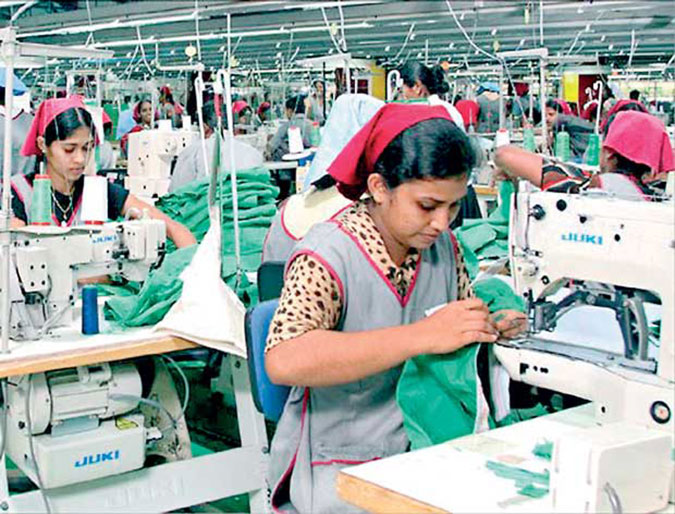
Sri Lanka’s latest economic indicators point to a curious numerical puzzle as industrial production is rising while labour force participation has not moved in tandem.Data for January 2026 show that the Index of Industrial Production (IIP) rose 4.4% year-on-year to 99.3, signalling a modest improvement in manufacturing activity compared with January 2025. The expansion was led mainly by food products, which grew 10.6%, wearing apparel which increased 12.5%, and other non-metallic mineral products, which recorded 3.6% growth.
Ordinarily, such growth in factory output would be expected to draw more people into the workforce. Yet Sri Lanka’s labour market statistics tell a slightly different story.
The labour force participation rate has been in the high 40% range in recent years. Latest estimates show it at around 46.9%, compared with about 49.9% in an earlier period, suggesting that a noticeable segment of the working-age population has remained outside the labour market even as production has begun to pick up.
In other words, factories appear to be producing more, but the pool of workers actively participating in the labour market has not expanded at the same pace.
Meanwhile, the unemployment rate has remained relatively low, just above 4%, indicating that those who are actively seeking employment are generally able to find work.
Business sentiment indicators also point to continued momentum in the real economy. The Purchasing Managers’ Index (PMI) for manufacturing has remained above the 50 point threshold, signalling expansion in factory activity, though slightly less than the stronger readings recorded toward the end of last year. The services sector PMI, meanwhile, continues to reflect steady business activity.
An economic analyst told The Island that taken together, the numbers suggest that Sri Lanka’s productive sectors are slowly regaining their footing after the severe economic stresses of recent years, but the gap between rising industrial output and subdued labour force participation would raise a question for economists and policymakers if they put their mind to the matter,
“If factories are producing more, where are the workers? Where is more hiring?”, he asked.
“One could argue that workers who exited the labour market during the economic crisis through migration or shifts to informal activity may not yet have fully returned. And the gap is unlikely to be explained by automation in factories. If that is the case, a sustained revival in export-oriented industries such as apparel and food processing should gradually draw more people back into the workforce,” he explained.
“So, the numbers underline a simple but important challenge for policymakers to ensure that improvements in industrial production are matched by broader participation in the labour market. Until more people return to the workforce, Sri Lanka’s recovery may continue to show this curious numerical puzzle of factories producing more, but fewer people showing up in the labour statistics,” he argued.
By Sanath Nanayakkare
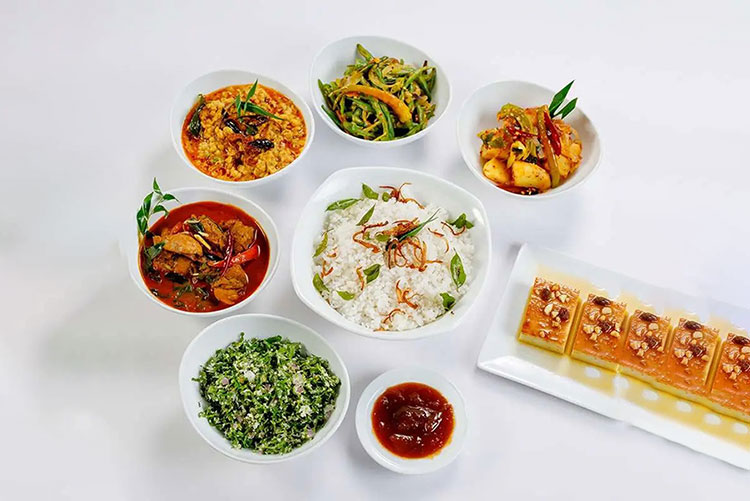
As Sri Lanka searches for new sources of foreign exchange and sustainable economic reform, an unexpected opportunity may lie in something as simple as the food on its plate. According to Andrea Diaz, Executive Director of Dharma Voices for Animals (DVA), Sri Lanka could strengthen tourism revenue, improve public health and advance environmental resilience by positioning itself as a vegetarian- and vegan-friendly destination rooted in its Buddhist heritage.
“Compassion is not only a moral value,” Diaz says. “It can also be an economic strategy.”
Sri Lanka occupies a unique place in the global Buddhist world, having preserved the Theravada tradition for more than two millennia. Diaz believes this heritage gives the island a distinctive moral authority to demonstrate how Buddhist principles such as non-harming and compassion can shape modern policy and everyday life. Dharma Voices for Animals promotes plant-based food systems that protect animals, safeguard the environment and support human health. In Sri Lanka, the organisation frames its work as an effort to reconnect contemporary lifestyles with longstanding cultural values.
Historically, many Sri Lankan communities relied heavily on plant-based diets before colonial influences altered food systems. Even today, much of the island’s traditional cuisine – dhal curry, mallung, jackfruit dishes and coconut-based preparations – remains naturally vegetarian or easily adaptable. Diaz argues that this culinary foundation gives Sri Lanka an advantage that many countries struggle to build.
Rather than reinventing its food culture, she says, Sri Lanka could highlight its existing culinary traditions and present them to the world as part of a compassionate and sustainable national identity.

Andrea Diaz, Executive Director of Dharma Voices for Animals (DVA)
DVA’s work on the ground focuses on translating these ideas into practical change. A network of volunteer regional coordinators conducts educational programmes at temples, Sunday schools, community centres, women’s groups, medical clinics and even army facilities, encouraging people to reflect on how daily food choices align with Buddhist ethics. According to Diaz, the organisation’s outreach in 2025 alone reached more than 146,000 individuals through lectures, discussions and community events.
Education is paired with practical tools aimed at making plant-based eating accessible. The organisation has published Sri Lanka’s first vegan cookbook using locally available ingredients, while cooking classes broadcast on cable television and community cooking competitions demonstrate that plant-based meals can be affordable, nutritious and culturally familiar.
By highlighting that many rice-and-curry combinations already meet nutritional needs, advocates hope to dispel the perception that dietary change requires dramatic lifestyle adjustments.
The economic implications extend beyond cuisine. Diaz notes that global tourism trends are shifting toward values-driven travel. Visitors from Europe, North America and Australia increasingly seek destinations where vegetarian and vegan food is readily available and clearly labelled. Countries that accommodate this demand often benefit from longer stays and strong word-of-mouth promotion among conscious travel communities.
Sri Lanka, she suggests, could tap into this market with relatively modest policy steps – clearer menu labelling, plant-based certifications for hotels and targeted marketing highlighting the island’s naturally vegetarian culinary traditions.
Positioning Sri Lanka as a compassionate culinary destination could also strengthen its broader tourism brand. Modern travellers increasingly consider sustainability, ethics and wellness when choosing destinations. A national identity linking Buddhist values with environmentally responsible food culture could help differentiate Sri Lanka from competing tropical tourism destinations while supporting farmers who produce rice, lentils, vegetables, spices and coconuts.
Beyond tourism, Diaz believes dietary shifts could contribute to climate resilience and food security. Animal agriculture requires significant land, water and grain while producing comparatively high greenhouse gas emissions. Redirecting more crops directly to human consumption improves efficiency and allows more people to be fed from the same land base.
For a country already rich in plant-based staples, strengthening these agricultural systems could reduce reliance on imported animal feed while supporting smallholder farmers and protecting natural resources.
Public health represents another potential benefit. Many of the world’s most costly diseases including cardiovascular disease, diabetes and hypertension are strongly linked to diet. Diets rich in legumes, vegetables, fruits and whole grains are associated with lower rates of these conditions. Encouraging plant-forward diets, Diaz argues, could help governments reduce long-term healthcare costs while improving workforce productivity.
Dietary change, she emphasises, does not require universal adoption to produce meaningful social impact. Research on social movements suggests that when roughly 3.5 percent of a population actively supports a cause, broader cultural and political change can begin. In Sri Lanka’s case, that would mean about 800,000 people visibly committing to compassionate food choices and discussing the values behind them.
Yet while discussions about compassion and sustainability are gaining attention, Sri Lanka’s legal framework for animal protection remains outdated. The country still operates under a law dating back to 1907, a colonial-era statute widely viewed as inadequate for modern welfare standards. A proposed Animal Welfare Bill – developed through years of consultation and legal drafting – has twice received Cabinet approval but has never been presented to Parliament.
If enacted, the legislation would replace the colonial-era statute with modern welfare standards, establishing clearer definitions of cruelty and neglect, stronger penalties and improved investigative powers. It would also formalise internationally recognised welfare principles such as adequate food, shelter, medical care and humane handling of animals.
Advocates also emphasise that the growth of plant-based industries need not threaten farmers currently involved in livestock production. Instead, they see opportunities for gradual diversification. With appropriate training and policy support, farmers could transition toward crops central to plant-based diets or participate in value-added food production, strengthening rural livelihoods while reducing environmental strain.
For Sri Lanka, the broader message is that compassion, sustainability and economic development need not be competing priorities. A food system that emphasises plant-based traditions already embedded in local culture could simultaneously strengthen tourism, improve public health, enhance climate resilience and support rural agriculture.
Seen through that lens, the humble rice-and-curry meal may represent more than a culinary tradition. In a world searching for more sustainable ways to live and travel, Sri Lanka’s oldest food traditions may yet become one of its most modern economic opportunities.
by Sanath Nanayakkare

City of Dreams Sri Lanka has partnered with FitsAir and Cinnamon Hotels & Resorts to launch direct scheduled passenger flights connecting Ahmedabad and Colombo, enhancing connectivity for Indian travellers to South Asia’s first integrated resort.
Sri Lanka’s first private international airline, FitsAir, will operate the service three times weekly from May 15, catering to Gujarat’s growing outbound travel market. The route positions Colombo as an attractive luxury getaway for Indian travellers while strengthening ties between the regions.
Guests can stay at Cinnamon Life at City of Dreams or explore other Cinnamon properties in Colombo, with curated holiday packages combining the resort experience with multi-destination itineraries across the island, including cultural experiences in Kandy and beach stays.
Kamal Munasinghe, Senior Vice President at Cinnamon Hotels & Resorts, noted India remains one of their most important markets, with Gujarat showing strong interest in Colombo as a leisure destination.
FitsAir Director Ammar Kassim added that the overnight departure from Colombo arrives early morning in Ahmedabad, giving travellers a full day ahead and opening smooth onward connections through Colombo across their growing international network.
Packages start from INR 55,555, including return airfare, two nights’ accommodation with breakfast at Cinnamon Life, and private airport transfers.

A new curriculum will be introduced for preschools in 2027, while steps will also be taken to train teachers accordingly – PM

Be mindful of the accuracy of information before sharing it on social media – PM

Heat Index at ‘Caution level’ at some places in the Western, Sabaragamuwa, Southern and North-western provinces and in Monaragala, Mannar, Anuradhapura and Vavuniya districts

Showers expected at several places in the Central, Sabaragamuwa, Southern, North-western, Eastern and Uva provinces after 2.00 pm.

Fuel rationing begins: Police deployed as queues return

GMOA warns fuel quota could disrupt health services

‘Dates have the highest sugar content to fight Coronavirus’

Sunday Island 27 December – Headlines

#SundayIsland 17th December – Headlines

Sunday Island – 28th March

Sunday Island Headlines – 21 March

Sunday Island – 21st February – Headlines
-

 News6 days ago
Prof. Dunusinghe warns Lanka at serious risk due to ME war
-

 News4 days ago
Historic address by BASL President at the Supreme Court of India
-

 Sports5 days ago
Royal start favourites in historic Battle of the Blues
-

 Sports4 days ago
The 147th Royal–Thomian and 175 Years of the School by the Sea
-

 Business5 days ago
BOI launches ‘Invest in Sri Lanka’ forum
-

 News5 days ago
CEBEU warns of operational disruptions amid uncertainty over CEB restructuring
-

 News4 days ago
Power sector reforms jolted by 40% pay hike demand
-

 Features5 days ago
Indian Ocean zone of peace torpedoed!