
Latest News
A mechanism that goes beyond the normal state apparatus is needed to restore public life – President


President Anura Kumara Dissanayake emphasised that a unified operational mechanism, which goes beyond the normal state administration, is required to restore public life after a disaster.
The President stated this while participating in the Kandy District Coordinating Committee meeting held at the Kandy District Secretariat on Saturday (06).morning
During the meeting, the President separately reviewed the progress of the programmes underway to restore essential infrastructure in the district, including the roadways, electricity, water and fuel supply, irrigation systems and communication facilities.
The President instructed officials to utilise the allocated provisions for the next 25 days to complete road clearing activities swiftly, until the permanent reconstruction of roads is completed.
The President also instructed that water supply in the district be fully restored within three days. Until then, the water requirements of the public should be met through bowsers and such activities must be carried out as an emergency measure beyond the usual procedure, with technical support from the Tri-Forces.
Further, he instructed that the cleaning of household wells be carried out under the coordination of Divisional Secretariats and that electricity supply in the district be restored by 31 December through temporary repairs, while major reconstruction work will be carried into the second phase.
The President pointed out the need to identify arable lands and give priority to cultivation. He instructed that cultivable paddy fields be identified urgently and supplied with the required irrigation water and highlighted the importance of coordinated action by the Department of Irrigation, Provincial Irrigation Department and the Department of Agrarian Development.
He also instructed officials to expedite the payment of the Rs. 200,000 compensation allocated to identified farmers and fields and to submit a report on the extent of vegetable cultivation affected in the district within two weeks. Accordingly, Rs. 150,000 per hectare will be paid as compensation to the affected vegetable farmers and necessary amendments will be made to provide the same compensation for losses incurred in banana cultivation.
The impact on the livestock sector due to the disaster was also broadly discussed. The President highlighted the need to maintain updated data regarding the number of farms and livestock.
He explained the need to restart damaged livestock farms swiftly, to restore income sources for the farmers and to meet the country’s food needs, including milk, poultry and eggs.
Discussions were also held regarding restoring fuel supply in the district. Due to road blockage, fuel supply has been disrupted in Pussellawa and Meetalawa. The President instructed that, through coordination between the Road Development Authority, the Tri-Forces and the Police, fuel be supplied to these areas by Saturday [06] evening.
The resumption of schools in the Kandy District was also discussed. The President instructed officials to minimise delays in reopening schools to ensure that examinations are held as scheduled.
The President also examined in detail the steps taken to restore the district’s health services, railways and communication facilities.
Discussions were held regarding housing damage and the resettlement of affected people. The roles of the Geological Survey and Mines Bureau and the required staffing needs were considered.
The President stated that state-owned lands in adjacent areas will be identified and presented for resettlement activities and necessary interventions will be made to release such lands through discussions with relevant institutions. He emphasised that the government’s objective is to resettle people safely and continuous assessment must be carried out to ensure that compensation provided for destroyed and partly damaged houses is used properly for reconstruction.
As all compensation payments will be made under the 2025 Budget, the President stressed the need to complete all payments before 31 December, to avoid a burden on the 2026 Budget. He said the dedication of all state officials is essential to successfully implement the programmes initiated to restore public life.
Attention was drawn to the garbage disposal problem in Gampola. As a long-term solution, the President instructed that, until the relevant Mahaweli land is released, land belonging to the Ceylon Electricity Board be temporarily allocated for the purpose.
Attention was also paid to the damage caused to state institutions due to the disaster situation.
While noting that natural disasters such as floods, storms and landslides cannot be prevented, the President emphasised that the loss of lives and property can be minimised. He stated that a proper study of the Central Highlands is needed and a long-term plan must be prepared to restore the eroding ecological system.
He further highlighted the need to enforce the powers of local authorities to prevent similar disasters in the future, stating that no room should be given for illegal constructions hereafter. He also noted that Ceylon Electricity Board should not provide electricity to such unauthorised locations.
The President stated that although some expected it would take a long time for the country to recover after the disaster, the government has already been able to restore public life to normalcy within a very short period. He added that by working together for a little longer, the desired goals can be achieved.
The President expressed special appreciation for the dedication shown by state officials and the Tri-Forces in carrying out these tasks.
Minister of Agriculture, Livestock, Land and Irrigation K.D. Lal Kantha, Deputy Minister of Transport and Highways Prasanna Gunasena, Deputy Minister of Health Hansaka Wijemuni, Members of Parliament Jagath Manuwarana and Thanura Dissanayake, as well as Central Province Governor Professor Sarath Abeykoon, Chief Secretary G.H.M.A. Premasinha, Kandy District Secretary Indika Udawatta and officials representing all line agencies including the Road Development Authority, Ceylon Electricity Board and the Irrigation Department attended the occasion.

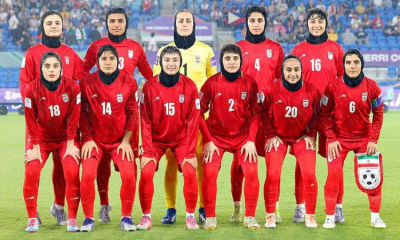


Five members of the Iranian women’s football team have been granted humanitarian visas in Australia after their elimination in the Asian Cup, the government in Canberra says.
Immigration Minister Tony Burke said the women “were moved to a safe location” by Australian police. He said other squad members had been told they are welcome to stay in the country.
The women had been due to fly home, but supporters had raised fears for their safety after the team declined to sing the national anthem ahead of their match against South Korea last week.
This prompted criticism in Iran, with one conservative commentator accusing the team of being “wartime traitors” and pushing for harsh punishment.
Australia’s humanitarian visa programme grants permanent protection to refugees and people in humanitarian need. Visa holders can live, work and study in the country.
Speaking early on Tuesday, Burke said the five players were happy for their names to be confirmed as Fatemeh Pasandideh, Zahra Ghanbari, Zahra Sarbali, Atefeh Ramazanzadeh, and Mona Hamoudi.
“They want to be clear they are not political activists. They are athletes who want to be safe,” he said, adding that talks had been going on over several days.
He said that on Monday “it was made clear that there were five women who wanted to be able to stay in Australia”.
The group left their hotel the same day and were moved to a safe location by police.
Burke said he met the women at that location and then signed off for their applications to go onto humanitarian visas – a process completed at about 01:30 local time on Tuesday (15:30 GMT Monday).
“I say to the other members of the team, the same opportunity is there. Australia has taken the Iranian women’s soccer team into our hearts. These women are tremendously popular in Australia.
“But we realise they are in a terribly difficult situation with the decisions that they’re making,” the Australian minister said.
Australian Prime Minister Anthony Albanese later confirmed that the five players had been given humanitarian visas.
On Sunday evening, hundreds of supporters surrounded the Iranian Lionesses’ coach as it left the stadium on the Gold Coast, with chants of “save our girls”.
On Monday, the BBC witnessed dramatic scenes inside the team’s five- star hotel when several players left the lobby in a group after speaking to activists.
Shortly after they departed, a second group – including a translator and the head coach – burst in looking panicked, and rushed through the hotel before returning to their rooms.
A family member of one of the women – speaking on condition of anonymity – told Australian news site ABC they were being protected by police, and intended to claim asylum.
“I want to kiss the hands of everyone who helped,” the unnamed relative told ABC.
On Monday, US President Donald Trump took to his Truth Social platform to demand action.
Australia should “give asylum” to the women, Trump said in his initial post. “The US will take them if you won’t,” he added.
Around an hour later, Trump posted again to say he had spoken to Australia’s Prime Minister Anthony Albanese and “five have already been taken care of, and the rest are on their way”.
Trump’s post appeared to also suggest some of the team feared for the safety of their families back in Iran and so felt they must “go back”.
“In any event, the Prime Minister is doing a very good job having to do with this rather delicate situation. God bless Australia!” Trump said.
The Trump administration put all asylum decisions on hold at the end of last year, and has stopped issuing immigrant visas for citizens from dozens of countries including Iran. It has said the administration wants to bring “an end to the abuse” of the system.
Last year, two groups of Iranians – including people whose asylum applications had been unsuccessful – were deported from the US back to Iran. The groups reportedly included members of the LGBT community,who face severe legal and social repercussions in Iran.
[BBC]
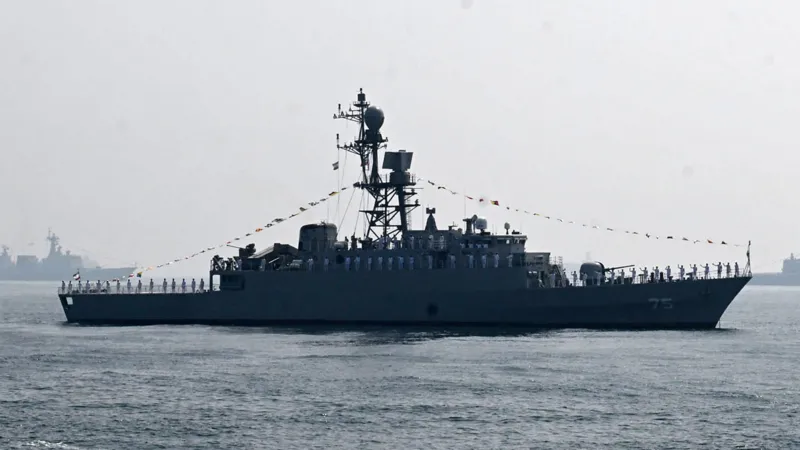
The Iranian warship Iris Dena was given permission by India to dock three days before it was torpedoed by a US submarine, India has said.
Foreign Minister S Jaishankar said Iran had sought permission for three of its ships to dock at Indian ports on 28 February – the day the US and Israel began a war on Iran – and permission was granted by India on 1 March.
The ships’ movements between 1 and 4 March are not clear and nor is why only one of them made it to India.
The sinking of the Iris Dena, with 130 sailors on board, in international waters off Sri Lanka’s southern coast on 4 March marked a dramatic widening of the war – and raised questions about India’s authority in its backyard.
It was the first military strike outside the Middle East since the US and Israel launched their war on Iran. President Donald Trump has said destroying Iran’s navy is one aim of the assault.
The three Iranian ships – Iris Dena, Iris Bushehr and Iris Lavan – had all participated in a military exercise hosted by India between 15 and 25 February in the coastal city of Visakhapatnam.
They left Indian waters on 25 February and were likely to have been in international waters on 28 February – when the US and Israel began attacking Iran.
“The Iranian side had requested permission on 28 February for three ships in the region to dock at our ports. This was accorded on 1 March,” Jaishankar told parliament on Monday. “Iris Lavan actually docked on 4 March in Kochi. The crew is currently in Indian naval facilities. We believe that this was the right thing to do.”
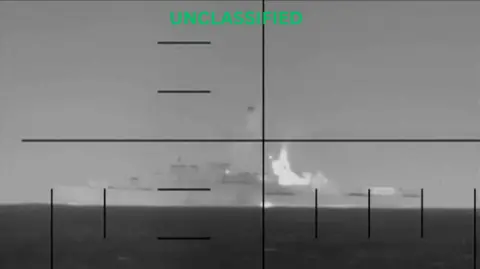
On 4 March, Iris Dena sank after being hit by a torpedo fired from a US submarine, killing at least 87 of its crew members.
According to the Indian Navy, the Iris Dena was operating about 20 nautical miles – roughly 23 miles (37km) – west of Galle in waters that fall under Sri Lanka’s designated search-and-rescue zone on the day it was struck.
The US tracks vessels across the world’s oceans, and a quarter of its submarine fleet of 65-70 is at sea at any given time, according to analysts.
Iran’s Foreign Minister Abbas Araghchi said last week the US had “perpetrated an atrocity at sea, 2,000 miles away from Iran’s shores” and that the warship was “struck in international waters without warning.”
Later, Sri Lanka said it had provided sanctuary for Iris Bushehr on 5 March, a day after it requested for docking following an engine malfunction.
Eventually, India also confirmed that Iris Lavan was docked in its southern city Kochi.
The BBC has written to the Iranian embassy in India and India’s external affairs ministry seeking clarification on the movements of the three Iranian naval vessels after Delhi granted them permission to dock.
US Defence Secretary Pete Hegseth has touted the attack on Iris Dena as an example of America’s military prowess, claiming it was “the first sinking of an enemy ship by a torpedo since World War Two”.
While it is the first time since 1945 that an American submarine has sunk an enemy ship this way, the UK and Pakistan have both sunk vessels using torpedoes since then.
The Iris Dena was one of about 20 Iranian navy vessels destroyed since Israel and the US launched co-ordinated strikes on Iran.
[BBC]

The white ball series between Afghanistan and Sri Lanka, scheduled to be held in the UAE from March 13 to 25, is likely to be postponed indefinitely due to the ongoing military conflict in West Asia.
While neither ACB nor SLC has issued an official statement, ESPNcricinfo has learned that both boards have agreed the series cannot take place in the UAE, keeping the ongoing crisis in mind. While both boards are still discussing alternatives, the bilateral series is unlikely to be shifted elsewhere due to logistical challenges.
The series comprising six white-ball matches was scheduled to start on March 13 starting with the three T20Is. The T20I leg was scheduled in Sharjah – on March 13, 15 and 17 – while the three ODIs were scheduled in Dubai on March 20, 22 and 25.
The series was set to be Afghanistan’s first under Ibrahim Zadran’s leadership, with the opener taking over the reins from Rashid Khan after a group-stage exit in the World Cup.
Last week, six matches of the ICC Men’s Cricket World Cup League 2 in Nepal involving Oman, UAE and the hosts were postponed because of the conflict.
The travel plans of several teams that were in India and Sri Lanka for the men’s T20 World Cup have also been disrupted owing to airspaces being closed or limited in West Asia.
Despite being knocked out over the last week, the contingents from West Indies and South Africa have been stuck in Kolkata, and received clarity only on Sunday, that they will be flying out on Tuesday.
[Cricinfo]

Five Iranian footballers granted Australian visas after anthem protest

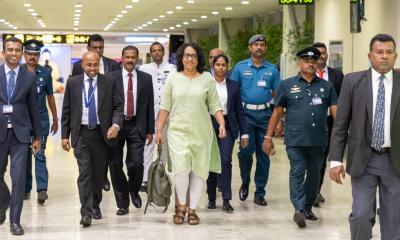
Prime Minister on official visit to Manila, Philippines

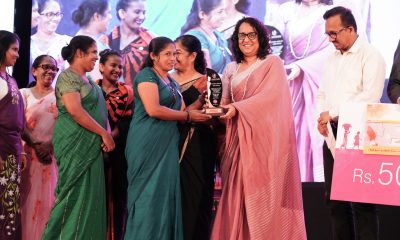
It is the government’s responsibility to ensure women’s rights are realized in everyday Life, and are not confined merely to Laws – PM

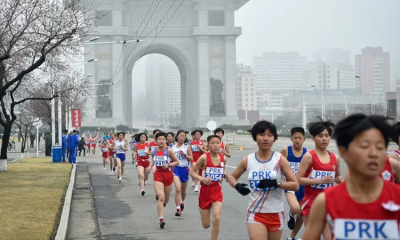
North Korea cancels Pyongyang Marathon for ‘some reasons’

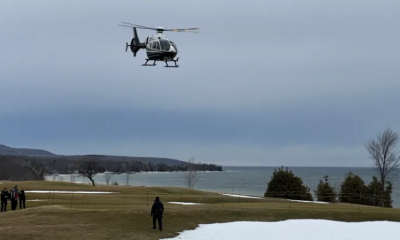
Canadian officials rescue 23 people who floated away on ice sheet

India offered sanctuary to Iranian ship three days before US sank it

‘Dates have the highest sugar content to fight Coronavirus’

Sunday Island 27 December – Headlines

#SundayIsland 17th December – Headlines

Sunday Island – 28th March

Sunday Island Headlines – 21 March

Sunday Island – 21st February – Headlines
-

 News4 days ago
University of Wolverhampton confirms Ranil was officially invited
-

 News5 days ago
Legal experts decry move to demolish STC dining hall
-

 News4 days ago
Female lawyer given 12 years RI for preparing forged deeds for Borella land
-

 News3 days ago
Peradeniya Uni issues alert over leopards in its premises
-

 Business5 days ago
Cabinet nod for the removal of Cess tax imposed on imported good
-
 News4 days ago
Library crisis hits Pera university
-

 News3 days ago
Wife raises alarm over Sallay’s detention under PTA
-

 Business6 days ago
War in Middle East sends shockwaves through Sri Lanka’s export sector