
Business
A global gathering in SL with a focus on food sovereignty and security


Sri Lanka will host the Third Nyéléni Global Forum from September 5 -14, 2025 at the National Institute of Cooperative Development (NICD), Polgolla, Kandy. For the first time since its inception in Mali, the Forum will move outside Africa, drawing over 600 delegates from more than 120 countries, including policymakers, academics, trade unionists, and global agriculture leaders. The agenda will feature, among other things, food security and sovereignty.
This high-profile gathering arrives at a critical juncture for Sri Lanka, as it attempts to restructure an economy battered by the 2022 sovereign default, inflationary spikes, and food insecurity. The government’s reliance on agricultural imports — worth over USD 2.4 billion annually — has exposed vulnerabilities in supply chains, while currency depreciation has made basic staples increasingly unaffordable for millions.
Sri Lanka’s agricultural sector contributes 7.8% of GDP but employs nearly one in four workers, making it a cornerstone of the economy. Yet the country remains highly import-dependent for essentials, including wheat, pulses, sugar, and dairy.
According to Central Bank data, agricultural imports surged from USD 1.9 billion in 2019 to USD 2.7 billion in 2023, even as foreign reserves collapsed. During the peak of the 2022 crisis, food inflation skyrocketed to 94.9%, underscoring the dangers of relying on global markets for staples.
“The Nyéléni Forum is not just about agriculture — it’s about economic resilience, said Hemantha Withanage, chairperson of the Centre for Environmental Justice (CEJ). “We need to rethink an economy that prioritises imports and export monocultures while undermining small farmers. Food sovereignty is a financial security strategy as much as a social movement.”
Food security, a long-standing national goal, focuses on access to adequate food. Food sovereignty, however, emphasises domestic control of agricultural production and distribution, empowering communities rather than corporations.
Globally, countries are realising the cost of an over-reliance on agrochemical-intensive monoculture farming. In Sri Lanka, decades of policy favouring export-oriented crops like tea, rubber, and coconut left the island dependent on imports for wheat, lentils, and dairy.
“The financial model of cheap imports collapsed when the rupee depreciated sharply in 2022, Withanage noted. “This is a lesson in economic sovereignty: no amount of foreign reserves can insulate you if your food systems are outsourced.”
Sri Lanka’s seed market illustrates this imbalance. While government agencies control roughly 10% of paddy seed distribution, the private sector dominates most other crops, limiting farmers’ choices and increasing production costs.
“Farmers are paying heavily for seeds and inputs, yet farmgate prices remain low. The seed monopoly and lack of regulation leave small-scale farmers vulnerable, said Chinthaka Rajapakse, Operations Manager of the Movement for Land and Agricultural Reform (MONLAR).
Compounding this are land-use policies that prioritise commercial agriculture and infrastructure projects over smallholder farming. Land acquisition for renewable energy — such as floating solar farms in irrigation reservoirs — is affecting both agriculture and inland fisheries.
“Climate change is magnifying these pressures. Rural farmers face rising debt, unpredictable weather, and shrinking arable land, while agribusiness consolidates resources, Rajapakse added.
Experts argue that agroecology — integrating ecological science into farming practices — offers a competitive advantage for Sri Lanka, particularly as global demand for sustainably produced goods grows.
Agriculture remains a heavily feminised sector in Sri Lanka, with women dominating tea plucking, vegetable farming and informal food markets. Yet their contribution is undervalued, said Gayani Gomez of the Women’s Centre.
“Economic policies are designed around corporations, not communities. The neoliberal system rewards large-scale agribusiness but disempowers the rural women who sustain food systems, she said.
Thilak Kariyawasam, Executive Director of FIAN Sri Lanka, highlighted that lessons from the 2022–23 economic crisis should inform future policy.
“The pandemic and economic collapse revealed that food imports are not a guarantee of security. When currency reserves fell, supermarkets emptied overnight, Kariyawasam said. “The Nyéléni Forum will provide actionable models from across the globe on how to localise supply chains and reduce exposure to currency and commodity shocks.”
As 600 delegates converge on Kandy this month, the message is clear: food sovereignty is no longer a niche ideal but a strategic economic priority. For Sri Lanka, aligning agricultural policy with resilience rather than dependency could mark a turning point in the country’s path to economic stability.
By Ifham Nizam

Business
Lanka’s largest solar park set to transform energy landscape and local economy in Hambantota

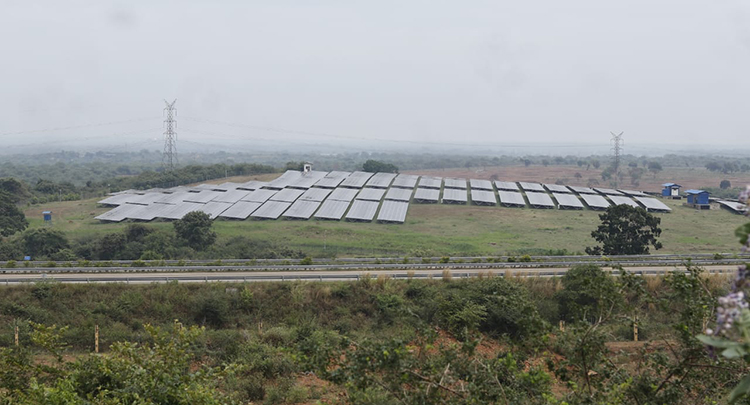
A new era in Sri Lanka’s renewable energy is unfolding in the Gonnoruwa Division of Hambantota District, where construction has begun on the country’s largest solar power park. Spanning 450 acres and designed to generate 150 megawatts (MW) of electricity, the US$150 million private-sector-led project is poised to become a cornerstone of the nation’s sustainable energy ambitions.
Officials say the solar park, guided by the Sustainable Energy Authority and the Mahaweli Authority, will make its first contribution to the national grid by the end of this year, with full capacity expected by 2026. Once completed, the facility will rank among Sri Lanka’s largest renewable energy installations, second only to the 210 MW Victoria Dam and the 150 MW Upper Kotmale hydropower project.
The initiative is being framed as a strategic response to recurring power cuts in the Southern Province during annual drought periods. With a projected 20% contribution to the country’s daytime electricity demand, the solar park is expected to significantly stabilize the grid, reduce reliance on fossil fuels, and contribute to the country’s renewable energy targets.
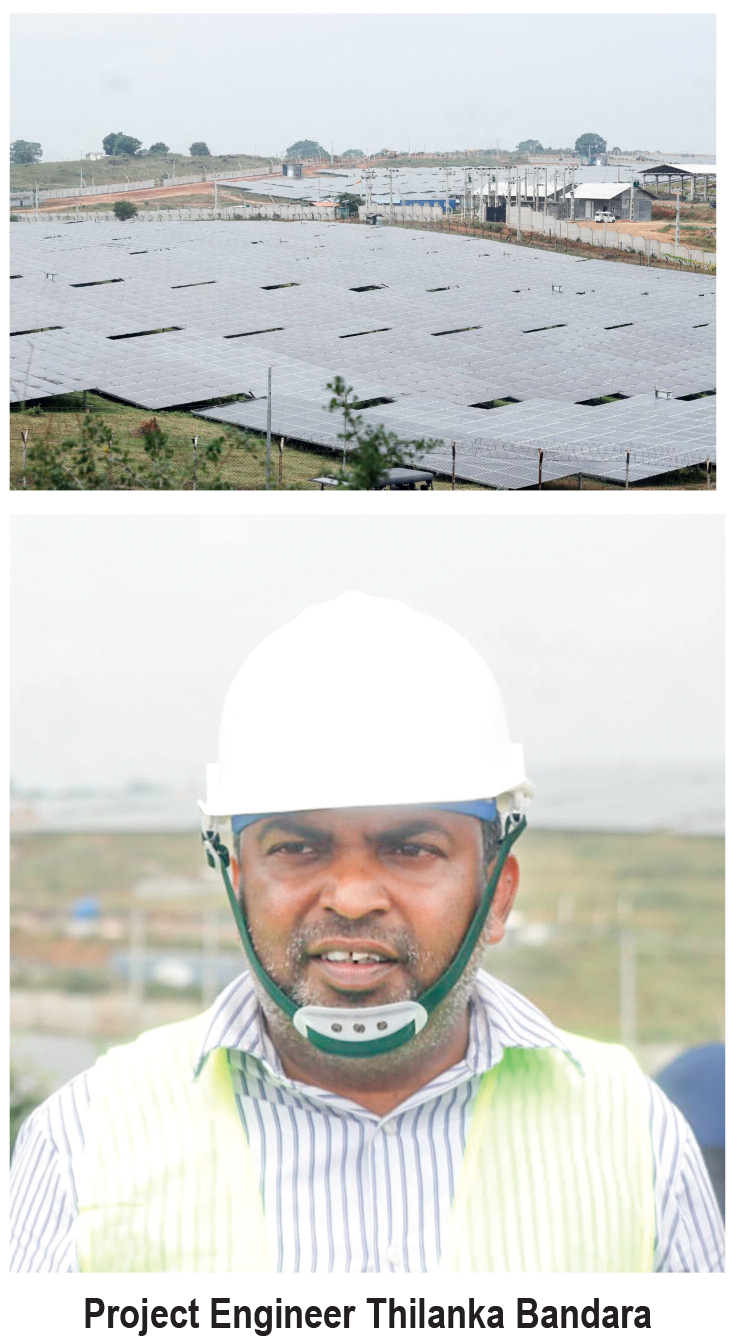
Project Engineer Thilanka Bandara confirmed that preliminary land preparation and boundary works have been completed, with 50 MW already feeding into the national grid. The investment, fully funded through foreign direct investment, local bank loans, and equity capital, requires no government funding. Two private firms are sharing the development, contributing 70 MW and 80 MW respectively.
Bandara highlighted a unique feature of the project: the transmission infrastructure, estimated at US$16 million, is entirely financed by the investors, marking a departure from conventional grid-connected projects. The park will also employ state-of-the-art ground-mounted solar technology, considered the most advanced currently deployed in Sri Lanka.
In a first for Sri Lanka, the solar panels will be installed five feet above the ground, allowing partial-shade crops to be cultivated underneath. Technical Officer Sithmina Bandara explained that this setup will enable the cultivation of food plants such as mushrooms, which thrive in shaded conditions, creating a model for integrated solar-agriculture systems. Agricultural experts have already provided guidance on implementing this initiative, which combines energy production with local food security.
The project is expected to generate 750 to 1,000 direct and indirect jobs, with 400–500 already employed in the initial phase. Long-term maintenance work will provide further employment opportunities, offering a substantial economic boost to the Hambantota region. Environmental management measures are also in place to prevent elephants from entering nearby villages, ensuring harmony between development and wildlife.
All necessary approvals and permits were obtained by February 2025, aligning the project with the Ceylon Electricity Board’s national generation plan. Officials confirmed that upon completion, the total output of the Solar Energy Park will rise to 200 MW, combining existing installations with the new 150 MW facility.
Experts say the Hambantota solar park represents more than just a power generation project. Its innovative design, private-sector financing, and integrated agricultural approach position it as a template for future renewable energy projects in Sri Lanka, reflecting a new model of sustainable development that balances energy, economy, and environment.
By Sirimanta Ratnasekera

The Battle of Esoftians, an annual cricket encounter organized by ESOFT Uni Kandy, concluded with a spectacular display of cricketing prowess as the Kandy team secured a massive 245-run victory over ESOFT Metro Campus, Kurunegala. The match was held on the 15th at the University of Peradeniya Grounds.
Winning the toss and electing to bat first, the ESOFT Uni Kandy batsmen dominated the field from the outset. They showcased an explosive batting performance, posting a formidable total of 280 runs for the loss of 5 wickets in their allotted 20 overs.
In response, the Kurunegala ESOFT Metro team struggled against a disciplined bowling attack. The Kandy bowlers dismantled the opposition’s batting lineup, bowling them all out for a mere 35 runs, sealing a historic win for the Kandy campus.
The event was graced by the presence of key officials from the ESOFT management: Amila Bandara – Chief Operating Officer (ESOFT Uni), Dimuthu Thammitage – General Manager (Central Region), Lakpriya Weerasinghe – Deputy General Manager, ?Lahiru Diyalagoda
Centre Manager-Degree Division, ESOFT Metro Campus Kurunegala and Dushantha Sandaruwan – Master in Charge (ESU Kandy Cricket Club)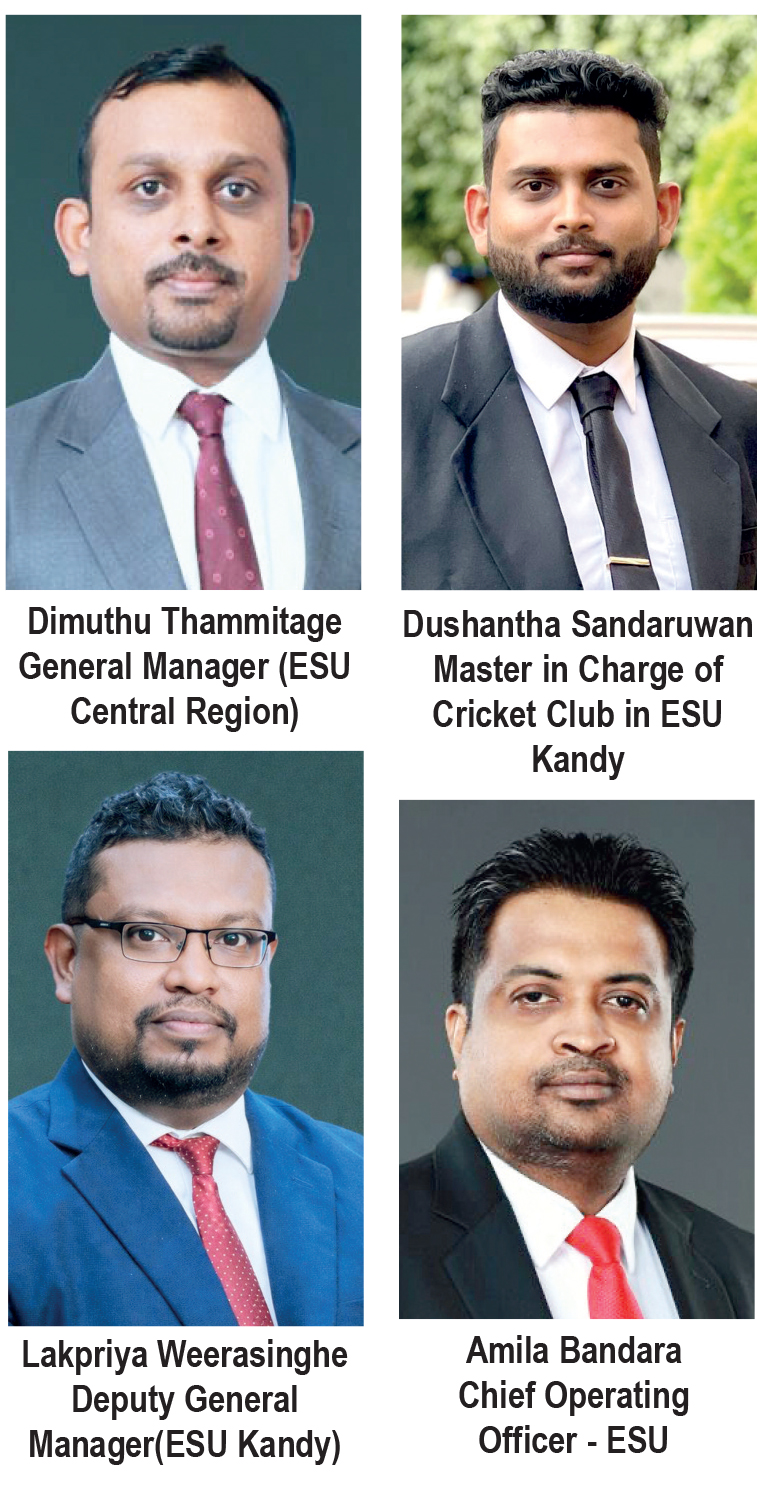
Team Lineups
ESOFT Uni Kandy (Winners)
Chamath Ekanayake (Captain), Dinuka Tennakoon (Vice Captain), Dushantha Sandaruwan (MIC), Chalitha Rathnayake, Pulasthi Bandara, Isuru Dehigama, Kesara Nuragoda, Aadhil Sherif, Isuru Pannala, Achintha Medawatta, Ahamed Shukri, Gowtham Hari Dharshan, Danushka Sahan, Eranda Bandara, and Damith Dissanayake.
ESOFT Metro Campus Kurunegala (Runners-up)
Adeesha Samarasekara, Savishan Madusha, Lahiru Diyalagoda, Hirun Damayantha, Naveen Madushanka, Daham Pothuwewa, Senuda Thewnaka, M.R. Abdulla, Arunodya Dasun, Mohamad Afri, Desith Perera, Lasitha Ranawaka, Anton Dilon, Shenuka Thirantha, and Kavindu Bandara.
Text and Pix By S.K. Samaranayake

HNB PLC, Sri Lanka’s leading private sector bank, has joined as the Official Banking Partner for the 147th edition of the historic “Battle of the Blues,” the Royal–Thomian cricket encounter between Royal College, Colombo, and S. Thomas’ College, Mt. Lavinia. Commenting on the partnership, HNB’s Managing Director/CEO Damith Pallewatte highlighted the bank’s long-standing connection with cricket, including sponsorship of Sri Lanka’s first Test match against England in 1982, and emphasized HNB’s commitment to nurturing young talent and promoting school cricket. The three-day clash for the Rt. Hon. D. S. Senanayake Memorial Shield will take place from March 12–14 at the SSC Grounds, with the Mustangs Trophy one-day match following on March 28 under lights. HNB’s inaugural involvement marks a milestone in the bank’s sports marketing journey, strengthening its role in the school cricket ecosystem. The bank will enhance the spectator experience by introducing digital and cashless banking solutions, modernizing the event while preserving its rich heritage and sporting tradition.

England limp to 146-9 against Sri Lanka

Advisory for Heavy Rain issued for the Central, Uva, Sabaragamuwa, Eastern and North-central provinces and in Galle and Matara districts

Sri Lanka opt to chase against England in Pallekele

More than 1,500 Venezuelan political prisoners apply for amnesty

Six races, six golds – Klaebo’s historic Olympics

India, South Africa meet in the final before the final

‘Dates have the highest sugar content to fight Coronavirus’

Sunday Island 27 December – Headlines

#SundayIsland 17th December – Headlines

Sunday Island – 28th March

Sunday Island Headlines – 21 March

Sunday Island – 21st February – Headlines
-

 Business7 days ago
Ministry of Brands to launch Sri Lanka’s first off-price retail destination
-
 Features15 hours ago
Why does the state threaten Its people with yet another anti-terror law?
-

 Features15 hours ago
Victor Melder turns 90: Railwayman and bibliophile extraordinary
-

 Features14 hours ago
Reconciliation, Mood of the Nation and the NPP Government
-

 Latest News2 days ago
New Zealand meet familiar opponents Pakistan at spin-friendly Premadasa
-

 Latest News2 days ago
Tariffs ruling is major blow to Trump’s second-term agenda
-

 Latest News2 days ago
ECB push back at Pakistan ‘shadow-ban’ reports ahead of Hundred auction
-

 Features7 days ago
Giants in our backyard: Why Sri Lanka’s Blue Whales matter to the world