
News
A day at the Royal-Thomian (2025)

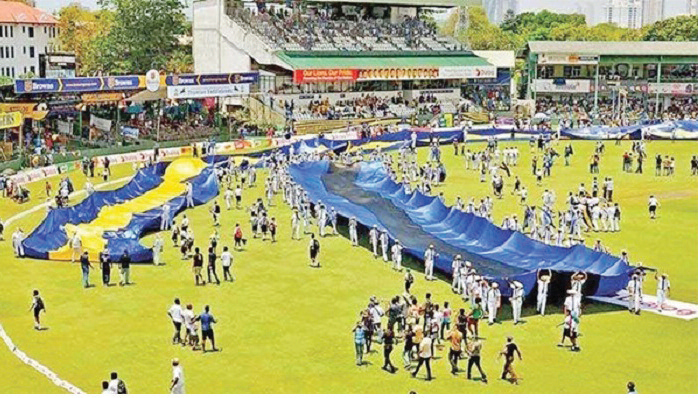
I attended the ‘BIG MATCH’ on March 7, 2025 after an absence of seven years. Sadly I couldn’t go the next day to witness a splendid Thomian victory, last achieved in 2016. I was inconsolable; but my mates comforted me. “Machan (mate), with cricket it’s always come or go Chicago;” that was schoolboy slang for the glorious uncertainties of cricket. “Just have a shot and drown your sorrows,” they said. But memories kept on flooding.
I last saw a Thomian win in 1953 under the captaincy of P.I (Ian)Peiris; a lanky light skinned youth, a demi-god to us kids. Neville Cardus famously said “we remember not the scores and results in after years, it is the men who remain in our minds, in our imagination.”
Strangely, I remember not only the men but also the scores. We were only 13 runs for four wickets when PIP along with GL( Konnapu) Wijesinghe resurrected our innings with a 187 run partnership. PIP scored 123, GLW’s contribution being 63; a final total of 290. We went onto win the match by an innings.
This revived the myth that Thomians aren’t dead till they are buried. Perhaps on the strength of this single innings PIP went on to play for Ceylon against the visiting Australians. Brian Claessen, a Wesleyite teenage all-rounder also played in the same match.
PIP later won a Cambridge blue in cricket and the same year another Thomian captain, Dan Piachaud, got an Oxford blue. Our Warden R.S. de Saram proudly announced the fact at the regular Wednesday general assembly; his nasal twang exaggerated that day due to his justifiable pride. PIP’s contemporaries at Cambridge included Ted Dexter and Gamini Goonesena. In an unofficial Test against a star studded West Indies team, PIP partnered Neil Chanmugam in a last wicket century stand; his share was 46, but he rated this as one of his best performances.
Many years later, I met him at a Ceylon Wildlife Society meeting. He was very affable and related many Thomian anecdotes. But there was an underlying sadness in his demeanour; he had just lost control of Richard Peiris & Co founded by his father and uncle. Both of them were regular spectators seated on the hard wooden benches at the old pavilion in the Big Club grounds at Mount Lavinia.
This ramshackle building was graced even by Mr D.S. Senanayake, Ceylon’s first prime minister. It was here too that my good friend Vernon stroked DS’s bald patch which went unnoticed . DS being the benign man he was, wouldn’t have taken offence. His son Dudley similarly obliged my friend who asked him for a light for his cigarette.
My first Royal – Thomian was in 1950 at the Oval in Wanathamulla. It felt like being in a strange country, a dry and dusty land. But the playing fields and the wicket were a lush green and the covered stands unique in that era were a welcome refuge from the harsh unrelenting sun. The vendors’ stands selling ice cold Portello and popsicles to accompany mother’s homemade sandwiches drew us repeatedly like magnets.
STC was captained by Roger Inman in the absence of the widely adored and respected Chandra Schaffter; he had a minor ankle injury and had been declared unfit by the coach in spite of CS’s vehement protests. The match ended in a draw.
The next year, 1951, was the centenary of the founding of our school. Even the most perfidious among us prayed devoutly for a Thomian victory. But it ended in disaster.
We were captained once again by Roger Inman and Royal by T Vairavanathan. Royalists batted first and were all out for 146. The skies opened then and play was abandoned.
Next day on a proverbial sticky wicket Thomians bravely declared at 61 for 7; Royalists replied with 105 for 8. The Thomians fought back with their famed grit but lost by five runs. Heads down and faces crumpled, we crawled back to our buses, pictures of misery.
An indelible memory from the Royal Thomians of that era is the melodious song (El Negro Zumbon) from the movie Anna, sung so seductively by Silvana Mangano. This was blared repeatedly over the loud speakers, captivating both young and the old. Years later, I played this back to a pretty Ukrainian nurse who worked with me, also named Anna.
When I murmured I dedicate this to you she blushed modestly but radiantly.
The 1954 match was made memorable by two unique individuals. One was my uncle Amitha Abeysekare, journalist, cartoonist , humorist and quintessential jester. His moniker at school was Pissu Abey and he lived up to it in full measure. He made a grand entrance to the Thomian tent with his cohort, puffing a Groucho Marx type cigar and waving a bottle which would have contained the nation’s favourite poison – arrack.
He was also a master of the obscene baila. Even after a biblical lifespan, their hilarity and vulgarity continues to stagger me. Everyone moved aside for the Grandmaster.
A cameraman from the Government Film Unit filmed him in all his glory and it was flashed in their weekly newscast. Unfortunately this was seen by the Warden who gave him six of the best.
Two decades later they met in the Bandarawela bazaar while shopping for vegetables.
Abeysekere went up to him sheepishly and said ” Sir, sir, do you remember me?”. “Remember you Abeysekare?” retorted the Cannon, “I have been trying to forget you for the past 20 years.”
The other was my dear friend PN. He and I and another bosom pal shared the last bench in the Upper Four C form ( the seventh standard). His nickname was ‘Veddah’ which he and all brothers inherited from their eldest sibling. It was a term used deprecatingly for forest dwellers and hunters. But PN was in reality a sophisticated and charming friend.
On the day of the match, he invited me home for a sumptuous lunch, after which we joined the Old Crocks rally. These were supposed to be vintage cars, but in reality the engines in their last legs were not even roadworthy. I’m not sure what miracle got us to the Oval but we did arrive whole and unscathed.
The era of girls school invasion had not dawned. In any case our old croc may not have lasted the extra mile. My good friend of later years, the elegant and charming Ladies College alumnus Rohini, said that they actually looked forward to the invading hordes and would bring their own rattles to add to the din. At the Oval however they sat demurely, pictures of virtue and innocence but glamorous nevertheless. Our sister College Bishops alumni were in a separate enclosure, no less glamorous.
Once inside PN got onto his ‘black magic’. When the Royalists were batting he would light his magic lamp and mutter incantations. Unbelievably Royalist wickets fell at regular intervals and his back was thumped vigorously. He stopped soon; perhaps he had enough of the back slapping, or in his wisdom wanted to quit while ahead. Regardless, he had achieved cult hero status.
For the 1957 match our legendary teacher LGB Fernando taught us Latin bailas to prove that his class was a cut above the others. However as soon as he was out of range our lot started on the ballad of the randy Burgher boy who seduced the doctor’s daughter, was neutered and made dysfunctional. Intellectual prowess was no match for ribald humour.
1957 too was notable for the first of our classmates playing in the senior team; the late Lareef Idroos played the first of his four Big Matches. How proud were we of him; the diminutive lad who mesmerized the best batsmen with his leg spinners and googlies.
BACK TO 2025
My brother in law Anuruddha and I arrived in style in his magnificent Mercedes at the pavilion gate No. 2 of the SSC grounds. We were the Warden’s invitees courtesy of another brother in law Nalin Welgama. Having decided to take the small elevator instead of the stairs, what happened next was serendipitous in the fullest sense of the word. Another gentleman who was already in smiled at me.
I introduced myself as Kumar G old Thomian. “Oh my God , I’m Nihal Seneviratne whom
you spoke to last week.” He turned to Anu and said “my father, Dr Robert Seneviratne,
delivered Kumar at the Elpitiya hospital.”
Nihal was the very distinguished retired Secretary General of Parliament. We were related but strangers. I had called him after reading an article he had written in the Island newspaper about his father with an attached photograph. At last I had seen the doctor who had brought me into this world though just in a picture. We parted shortly afterwards, he to the Royalist enclave and we to the Thomian wing.
We got good seats with uninterrupted panoramic views of the play. A pleasant young girl was just a couple of seats away. Perhaps an expatriate Burgher or a richly tanned Caucasian. I asked her whether she liked cricket; yes she nodded. “Do you know George Bernard Shaw said that cricket was a game played by 11 and watched by 11,000 bigger fools?” ‘Wasn’t he Irish?’ she asked. Obviously a sophisticated colleen.
Our luck continued. A school mate and cricketing colleague Ashley de Vos joined us. He was of course the distinguished architect and archaeologist. We were classmates, played in the under 16 cricket team together and lived not far apart in Hill Street, Dehiwala.
With our animated conversation cricket had to take second place. There was so much else to talk about.
His knowledge of ancient Sinhala history was encyclopedic and his admiration for the achievements of the Kings and also the ordinary people was unbounded. I reminded him of our trip to Anuradhapura; he was a consultant then to the Cultural Triangle project which was restoring the glory of our ancient capital cities. His interest in ancient history was stimulated by our venerable Sinhala teacher Arisen Ahubudu.
Ashley laughed heartily when I reminded him of his partiality to Kimbula Bunis. Of course the chat had to allude to our juvenile adventures at the school by the sea. Our conversation did touch on the trivia of our youth. He recalled our infrequent visits to the Aleric’s ice cream outlet near our school ogling the young receptionist. Anu piped in saying Aleric Wimalaratne the founder of Alerics was his father and the young girl was his aunt!
Most of us could afford either ice cream or jelly, not both. But some of our friends from affluent backgrounds did have both although they never flaunted their riches.
The cricket whenever we watched was of a high standard. The batting was classical and the pacemen fast and accurate. The only misgiving was their long run ups. My mind’s eye went back to Frank ( Typhoon) Tyson the English speed merchant of the 1950s, who according to Richie Benaud was the fastest bowler he had ever seen. He started off with a very long run up but little success. With a shortened approach on the advice of his captain Len Hutton he ran through the Australian team again and again.
There were many little reminders of those glory days. Prefects trying to palm off match souvenirs, only the bravest confronting teenage girls; no such compunction with us gray haired geriatrics: little boys selling flags and the ubiquitous vendors attempting to get rid of impractical headgear. Tireless boys running out to the park at the fall of each wicket and regular parades along the boundary line with ludicrously large banners. All these may have been ridiculous but in some ways at least, to some of us sublime too.
The lunch break came too soon. Ashley adjourned to the Mustangs tent; we went to the SSC restaurant downstairs. It was better than expected, spacious with the tables set wide apart. The service was prompt , the food delicious but pricey. We ordered three Lion lagers and fish and chips. The fish was ‘ Modha’ (Barramundi in Australia), accompanied by a white sauce and a small helping of salad. The chips were firm and dry and ample.
Anu went to bring ice creams and I noticed a young employee nearby with a brush and pan to sweep the rubbish – a pleasant girl with a timid smile in a clean uniform which accentuated her slender figure. She looked more elegant than many of the overdressed over-sized girls who paraded past us. I felt guilty having squandered on one meal a sum which could have been her weekly pay.
Involuntarily I asked whether she had had lunch. “Yes.” “What did you have?” Rice and curry”. Feeling penitent, my hand went to the wallet for a tip. But wiser counsel prevailed as my gesture may have been misinterpreted by the management and onlookers. It would have been acceptable had my
wife been there. The ice cream somehow did not taste as delicious as it should have.
On returning to our seats, we talked less and watched more. But soon fatigue and sleep
overtook us and we left shortly after the tea interval. Altogether it was a delightful day reliving the heady days of our youth.
by Kumar Gunawardane
STC Circa 1949-1961

News
Establishment of a Spectrum Management and Monitoring System and a Quality of Service and Quality of Experience System for the Telecommunications Regulatory Commission of Sri Lanka

Approval was granted at the Cabinet meeting held on 2025-10-21 for the Ministry of Digital Economy and the Department of External Resources to work with the Asian Development Bank as an international development partner for the “Digital Transformation Development Project”.
As a main implementing agency of that project, the Telecommunications Regulatory Commission of Sri Lanka (TRCSL) requires a Spectrum Management and Monitoring System as well as a System for Quality of Service and Quality
of Experience). It has been identified that the external funding estimate for this requirement has been identified as USD 9.25 million.
Accordingly, the Cabinet of Ministers has approved the resolution furnished by the President in his capacity as the Minister of Digital Economy to obtain a “Spectrum Management and Monitoring System” and a “System for Quality of Service and Quality of Experience” for the TRCSL under the ADB-funded Digital Transformation Development Project.
Under Articles 7 and 13 of the UNESCO 1970 Convention on the Means of Prohibiting and Preventing the Illicit Import, Export and Transfer of Ownership of Cultural Property, rights are conferred upon a state to request the return of cultural property belonging to it that is currently held abroad.
According to a proposal presented by the then Minister of Buddhasasana, Religious and Cultural Affairs, Phase 1 of the
restitution of Sri Lankan cultural heritage was executed in 2023, where 06 artifacts—including the Lewke Disawa’s Cannon, 02 large cannons, 02 Kasthanes (swords) with scabbards, and a knife with scabbard kept at the Rijksmuseum in Amsterdam, Netherlands—were officially handed back to Sri Lanka.
It has been recognized as appropriate to appoint a steering committee to directly exchange views further with the Dutch committee regarding the artifact restitution process and to advise the Government of Sri Lanka on restitution work regarding cultural property taken from Sri Lanka during the colonial era.
Accordingly, the Cabinet of Ministers has approved the resolution furnished by the Minister of Buddhasasana, Religious and Cultural Affairs to appoint a committee titled the “Committee for the Restitution of Sri Lankan Cultural Heritage Held Abroad”, chaired by the Additional Secretary (Cultural Promotion and Foreign Affairs) of the Ministry of Buddhasasana, Religious and Cultural Affairs, to provide necessary advice to the Government of Sri Lanka during the restitution process of artifacts taken from Sri Lanka.
Approval has been granted at the Cabinet meeting held on 22-07-2024 for Sri Lanka’s National Social Protection Policy.
The National Social Protection Strategy was presented to the Cabinet meeting held on 2025-09-15 to practically implement the aforementioned policy, and the Cabinet of Ministers has
determined to order all secretaries to the ministries to take necessary steps to act in accordance with the aforementioned strategy.
The mentioned National Social Protection Strategy is based on four main pillars: social subsidies, social protection, social insurance, the labor market, and productive inclusion.
Accordingly, the National Action Plan (2026-2035) on the social protection sector has been prepared as a tool for the practical implementation of the said strategy. Accordingly, the Cabinet of Ministers has approved the joint resolution furnished by the Minister of Labour, Minister of Women and Child Affairs,
and Minister of Rural Development, Social Protection, and Community Empowerment to implement the National Action Plan on the Social for the Social Protection Sector (2026-2035) in line with the National Social Protection Strategy.

Establishment of a Spectrum Management and Monitoring System and a Quality of Service and Quality of Experience System for the Telecommunications Regulatory Commission of Sri Lanka
Appointment of a Committee for the Restitution of Sri Lankan Cultural Heritage Held Abroad
Ten-Year National Action Plan on the Social Protection Sector (2026–2035)
Implementation of Revised National Curriculum Framework under the Education Reforms

Sri Lanka to face India in semi-finals after washout

Bangladesh to take on Pakistan in semis after another washout

‘Dates have the highest sugar content to fight Coronavirus’

Sunday Island 27 December – Headlines

#SundayIsland 17th December – Headlines

Sunday Island – 28th March

Sunday Island Headlines – 21 March

Sunday Island – 21st February – Headlines
-
 News6 days ago
Mastermind Naufer Moulavi among 15 found guilty
-
 Midweek Review6 days ago
Thileepan’s fast unto death: An authentic narrative that many missed
-

 Latest News5 days ago
Showers above 100 mm are likely at some places in the Western, Sabaragamuwa, Central and North-western provinces and in Galle and Matara Districts
-

 Editorial6 days ago
Big Bad Bills
-
Editorial5 days ago
Crimes punished and unpunished
-

 Features4 days ago
Beyond traditional jobs: Why Sri Lanka needs to facilitate the gig economy
-

 News6 days ago
One clause in Anti-Corruption (Amendment) Bill requires referendu: SC
-

 News6 days ago
No referendum needed for passage of 22 A: SC