
Business
A cut tree, a dead elephant, is a lost tourism dollar in the future

by Michel Nugawela and Pesala Karunaratna
(Continued From Last Week)
To increase occupancy rates and avoid economic losses during off-peak seasons, mass tourism suppliers also rely heavily on all-inclusive packages. By inviting tourists to leave their wallets at home and remain within the hotel (typically, the pool, bar and restaurant), they inhibit the dispersion of economic benefits to wider communities or the economically disadvantaged.
For example, mass tourists venturing out of their segregated enclaves to ‘do’ Sigiriya, Polonnaruwa, or Anuradhapura shuttle point-to-point between iconic sites and resorts in the round tour circuit. Individuals and businesses (such as the restaurants, shops, and local transportation services in the vicinity) that aren’t fortunate enough to be part of a package that grants access to this self-contained world receive zero to limited economic benefits. (Studies of all-inclusive packages internationally show that only about 10% of tourism spending directly benefits the local economy.)
Most – if not all – mass tourism suppliers in Sri Lanka also acquire the majority of their business through foreign operators, whose tactics of choice include pitting hotels and resorts against each other to secure the cheapest room rates. It’s much the same with destinations. For example, Lonely Planet’s ‘Best In Travel’ listing ranks its top destinations, regions and cities to visit each year. Sri Lanka took the top spot in 2019 – much to the sectors elation – and yet bear in mind that no single destination is featured in any two consecutive years. Countries are elevated one year, only to be tactically removed in the next. Foreign tour operators also promote destinations to prospective customers – once again, a different destination (or list of destinations) each year – ensuring bargaining power against suppliers/destinations remain stacked in their favour (and with it a high dependency on their global brands, markets, and channels).
Even as the tourism sector languishes through the Covid crisis – which, if anything, should motivate a meaningful search to curtail its own unhealthy overreliance on mass tourism markets – there is still no specific strategy or objective to address the non-differentiation of Sri Lanka’s tourism product. This is not entirely surprising; when footfall is high, the mass tourism sector replicates more of the same; when demand is low, it discounts prices instead of differentiating the product. In a crisis, it simply has no response to the need for better tourists, and a better distribution of tourist by season or location, for the destination.
The untapped potential of alternate tourism
The global tourism sector is expected to return to pre-pandemic tourism levels by 2024 – a slow and lengthy recovery period that has significantly impacted the mass tourism segment. Many consumers have lost wages or jobs, and since travelling will take a larger share of their disposable income, it is extremely unlikely that a rebound in visitor flows will equate with a recovery in visitor spending (expect more cheap all-inclusive packages to lure more cheap tourists). According to international research, the travel behaviour and preferences of the mass tourist will also look different in the future as they take fewer, more memorable trips, with a greater demand for experiences in the outdoors away from crowds.
Meanwhile, high value travellers – the segment Sri Lanka has consistently overlooked in its drive for ‘more’ (volume over value/quantity over quality) – will continue to travel in significant numbers as global mobility returns in 2021. Yet here too, their motivations and behaviours converge on the need for unique and meaningful experiences in nature and wildlife – again, where Sri Lanka has failed to develop and differentiate its product.
Many countries have used the pause this year to rethink their business as usual model and search for answers to important questions such as: will the post-Covid tourists be the kind of visitor we want? Will they improve seasonal spend, stay longer, and disperse economic benefits further into local communities? New Zealand, for example, is ‘reimagining tourism’, with key stakeholders arguing for a value over volume approach to managing tourism numbers while they await an industry recovery. Tourism is New Zealand’s biggest export industry, contributing 20.4% of total exports or 5.8 % of its GDP in 2019.
Meanwhile, Tourism Australia has identified a market opportunity of 80m high value travellers globally, of whom 32mn consider Australia as a destination to visit in the next four years. ‘Nature & Wildlife’ is the #1 driver of destination choice for this demographic from their 14 key inbound markets. This bears repeating: 72% Chinese, 73% Indians, 63% Indonesians, 76% Japanese, 66% Singaporeans, 67% South Koreans, 79% British, 63% US, 74% Germans, 68% Hong Kongers, 65% Malaysians, and 73% New Zealanders from the high value traveller segment visit Australia to experience its nature and wildlife assets.
Malaysia acknowledged the natural wealth of its country to drive revenue even earlier. In 1996, it published its National Ecotourism Plan to attract more visitors and increase visitor spend by developing competitiveness in its nature and wildlife assets. In 2002, nature and wildlife tourism established 10% of the country’s tourism sector; by 2019, this had tripled to 30.4%.
$11m is a wild elephant’s lifelong intrinsic value to tourism
We can no longer be blind to what we are most blessed with. Instead of playing to our strengths, we continue to run a race in a global tourism market where the ten major destinations attract 70% of the worldwide tourism market. It is now time to match our best assets – nature and wildlife – with the best tourists – the high value traveller. And this can be done. Our natural landscapes and attractions boast of the richest species concentration in Asia and one of the highest rates of biological endemism in the world, for both plants and animals.
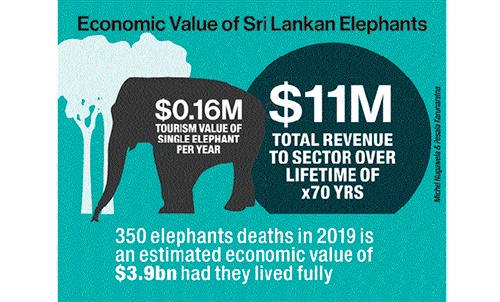
Consider the wild elephant population: 70% roam outside the protected areas, offering the best viewing opportunities in Asia and representing a huge revenue stream for the tourism sector. We determine the tourism value of a single elephant, alive, to contribute $0.16mn per year. Since elephants live for up to 70 years, the total revenue that a single elephant can generate is immense – $11mn over its lifetime to our hotels, resorts, airlines, travel companies, and – potentially – local economies.
We say potentially, because the value per elephant is significantly diminished under the mass tourism model, where the asset is perceived as an irrelevant pest rather than an important generator of profits. (Conversely, these assets are precisely what high value travellers – who outspend mass tourists by 3-4 times – value most). As global demand rises, therefore, Sri Lanka’s supply diminishes: 350 elephants perished in 2019 – an estimated commercial loss of $3.9bn to the sector, which is the value the animals would have distributed among the recipients in the tourism sector had they lived their lives fully.
Deforestation also dismantles the very assets – animal or plant, elephant or forest – that are required for a product differentiation strategy. When ancient migratory corridors are disrupted, elephants will die. When forests are uprooted, we will no longer be ‘green’ – a fundamental driver of destination choice for high value travellers. When the damage is done – when our natural assets are stripped away – Sri Lanka will no longer be able to position itself as anything other than a cheap destination for sun-sea-sand tourism. The entry of international budget hotel chains over the past half-decade point to our destination relevance in the future.
Amid the increase in deforestation, the silence from the mass tourism sector is deafening, revealing, firstly, just how disconnected its suppliers are from the wider ecology within which they operate, and secondly, the poverty of their vision for the sector and country.
It should come as no surprise, then, that disruption to the mass tourism model has come from the market’s edges rather than any single operator within the mass tourism sector. Dilmah has brought its compelling vision and business strategy to compete against commoditization in the tea industry to the tourism sector. Its luxury offering can generate eight times more revenue per tourist than the mass tourism offering, indicating the potential Sri Lanka has to pivot from mass to class and drive revenue as a destination.
We would question whether it is even possible to carve out other profitable niches without building on Sri Lanka’s strengths in nature. Consider the wellness segment which reconnects consumers to nature through the restorative benefits of ayurvedic medicine and Hela Wedakama, the mindfulness meditation techniques of Buddhism, and yoga retreats. In a short span of time, the segment already accounts for $180mn export revenue (while the spices sector, which has existed for centuries, accounts just $300mn).
A reality check
Sri Lanka is weak or entirely lacking in the underlying enablers of export competitiveness. Without improved FDI flows, the government remains incapable of single-handedly investing in infrastructure and injecting working capital to promote export-driven businesses.
Allocating forest-land to export development (and as the twelve BOI export processing zones remain largely unutilized) dismantles the only competitive advantage Sri Lanka has to compete in international markets and become the primary source of foreign exchange for the country.
By stripping away our nature and wildlife assets, we are left with only our beaches and reputation for cheap sea-sun-sand tourism. The tourism sector is therefore not a fringe player in what happens next – it is right at the centre, because it is these very assets that enable its future competitiveness. We must now urgently commit to a diverse tourism portfolio targetting different tourism segments. A cut tree, a dead elephant, is a lost tourism dollar in the future.

Business
Inflation curbed by govt. fuel subsidy introduction and surcharge on vehicle import tax – CBSL Governor

By Hiran H. Senewiratne
The government’s decision to introduce the fuel subsidy and the surcharge on the vehicle import tax helped curb inflation to a great extent, Central Bank Governor Dr. Nandalal Weerasinghe said.
‘The government this week approved a Rs. 40 billion fuel subsidy for the next three months on top of Rs. 57 billion provided from April-June, Governor Weerasinghe told the media yesterday at the Central Bank head office in Colombo at the CBSL’s monthly monetary policy review meeting.
‘If not for fuel subsidy and surcharge on the vehicle import tax, the inflation would have been higher than the current level, the Governor said.
‘There could have been higher imports and reserve building up would have been difficult. Inflation has risen beyond the Central Bank’s upper band of 7 percent since July, he said.
‘The country’s inflation hit a 37-month high of 8 percent in August after the government raised fuel prices more than 50 percent following the Middle Eastern escalation by end February, Dr Weerasinghe said.
The Central Bank’s inflation target for the past three years have been 5 percent with lower band of 3 percent and higher band of 7 percent, Governor said.
The Governor added: ‘The government provided Rs.57 billion as a fuel subsidy mainly for diesel. The latest Rs.41 billion has been allocated only for diesel as it is used for public transport.
‘The government also imposed a temporary 50 percent surcharge on Customs Import Duty on new personal vehicles on May 16 and has extended it until December 31, a move that will help to prevent outflow of foreign currency.
‘The Central Bank also tightened the monetary policy in May, raising the key monetary policy rate by 100 basis points, to curb excess demand in the economy to control demand-driven inflation.’
Meanwhile, head of the CBSL’s Economic Research Department L.R.C. Pathberiya said, ‘Credit growth has slowed to 24.5 percent year on year in August from a higher level of 30 percent a few months ago, after the Central Bank’s monetary policy tightening in May.
‘However, the Central Bank is optimistic about the current credit growth, he explained.
Pathberiya added: ‘The credit to the private sector from commercial banks has slowed, but we believe it is sufficient for economic growth.
‘The nation’s economic growth slowed to 4.2 percent year-on-year, its lowest in 11 quarters’’.
By Ifham Nizam
Prime Minister Dr. Harini Amarasuriya warned that Sri Lanka’s worsening waste-management crisis, particularly the uncontrolled accumulation of plastic waste and poorly managed landfills, was a “disaster waiting to happen”, urging scientists, researchers and policymakers to help the government find practical solutions before the problem reaches a critical point.
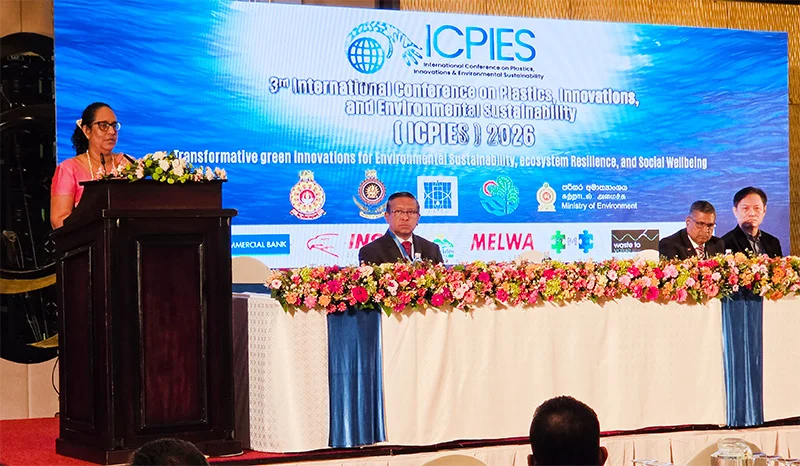
Addressing the launching of the Open University of Sri Lanka organized, ‘International Conference on Plastics, Innovations and Environmental Sustainability’ (ICPIES 2026) as Chief Guest, at the Cinnamon Lakeside Hotel yesterday she said waste management, waste reduction and recycling had become national priorities, with the government placing greater emphasis on the issue in its preparations for the 2027 Budget.
‘This is becoming a critical issue and something that, at any moment, if we don’t manage it properly, could become a huge disaster. It’s a disaster waiting to happen, Dr. Amarasuriya said.
She said unregulated and poorly managed landfills, particularly in and around Colombo, posed serious environmental and public risks, while increasing urbanisation was extending the waste-management challenge beyond the capital to other parts of the country.
‘As a member of Parliament for the Colombo District, I can tell you that one of the biggest challenges we are facing is waste management and actually managing the recycling of waste, and particularly of plastic products. This is something that we are battling every day, she said.
The Prime Minister said the government could not regard economic development as meaningful if it came at the expense of the country’s environment and natural resources.
‘If we are to speak of a beautiful life, we must first ensure that the air we breathe, the water we drink, the soil on which we live, the food we eat is clean and secure, she said.
She pointed to the scale of the global plastics crisis, noting that around 400 million tonnes of plastic waste are generated worldwide each year, while between 19 and 23 million metric tonnes of plastic waste enter natural ecosystems annually.
Plastic waste eventually breaks down into microplastics, which can enter aquatic organisms and subsequently the human food chain, she said.
Dr. Amarasuriya also linked plastic consumption and environmental degradation to the wider climate crisis, warning that the consequences of climate change were already being experienced by communities around the world.
She referred to devastating floods and landslides in the Himalayan region and said the impacts of climate change demonstrated that environmental damage could have consequences far beyond national boundaries.
Coastal clean-up projects and other waste-separation and recycling initiatives are also being implemented, while the government is working with the Western Provincial Council on a refuse-derived fuel project at Karadiyana.
The third ICPIES, held under the theme “Eco-Driven Innovations,” brings together researchers, policymakers, industry representatives and other stakeholders to examine plastic pollution, microplastics, circular-economy approaches, waste-management policy, technological innovation, artificial intelligence and smart environmental monitoring. The conference ends today.
Senior Professor P. M. C. Thilakarathne, Vice Chancellor of the Open University of Sri Lanka, was the Guest of Honour.

By Hiran H. Senewiratne
Stock investors were worried yesterday following Central Bank Governor Dr. Nandalal Weerasinghe’s mention at the CBSL monthly monetary policy review meet of possible future inflation pressures that may impact the economy.
The All Share Price Index went down by 4.89 points, while the S and P SL20 rose by 16.1 points. Turnover stood at Rs 1.55 billion with four crossings.
Those crossings were; Access Engineering crossed 1.5 million shares to the tune of Rs 119.8 million; its shares traded at Rs 79.60, Sampath Bank 450,000 shares crossed tfor Rs 63 million; its shares sold at Rs 140, Sunshine Holdings 750,000 shares crossed to the tune of Rs 21.4 million; its shares traded at Rs 28.50 and Softlogic Life 290,000 shares crossed for Rs 20.4 million; its shares sold at Rs 70.40.
In the retail market companies that mainly contributed to the turnover were: Access Engineering Rs 150 million (1.9 million shares traded), JKH Rs 113 million (six million shares traded), Softlogic Life Rs 80 million (one million shares traded), Softlogic Capital Rs 64.7 million (6.7 million shares traded), Lanka Realty Rs 64.3 million (1.3 million shares traded), Colombo Dockyard Rs 53.7 million (452,000 shares traded) and Sierra Cables Rs 50 million (1.43 million shares traded). During the day 58.9 million share volumes changed hands in 13536 transactions.
It is said that mixed market reactions were noted especially in manufacturing while banking, insurance and FMCG sectors performed well. Further, construction sector counters, especially Access Engineering, and banking sector counters, especially Sampath Bank, performed well.
People’s Leasing & Finance PLC announced its allotment basis for 100 million listed debentures it issued to raise Rs 10 billion, after receiving applications for the full amount.
Yesterday the rupee was quoted at Rs 330.68/75 to the US dollar in the spot market from Rs 330.70/90 the previous day, while bond yields were quoted steady to lower, dealers said.
An auction of Rs 80,000 million Treasury bills was ongoing.

England call up Crane and rest Archer for Pakistan series

ICC introduces pink-ball daytime Test trial, new time-wasting penalties

Discussion on Anuradhapura Sacred City Development Plan

India enter Asian Games final after Kishan and Bumrah ride roughshod over Sri Lanka

I extend my heartfelt wishes to all the sons and daughters of our country for a Happy World Children’s Day – President

Sri Lanka bowl first in semi final clash against India

‘Dates have the highest sugar content to fight Coronavirus’

Sunday Island 27 December – Headlines

#SundayIsland 17th December – Headlines

Sunday Island – 28th March

Sunday Island Headlines – 21 March

Sunday Island – 21st February – Headlines
-

 Editorial6 days ago
Birth of a bad law
-

 News4 days ago
Police remove Thileepan statue in Jaffna
-

 Features7 days ago
Beyond traditional jobs: Why Sri Lanka needs to facilitate the gig economy
-
 News6 days ago
TIN mandatory for key transactions from Nov. 1
-

 Latest News7 days ago
Kusal, Wellalage star as Sri Lanka defend 322 in Headingley thriller
-

 Features4 days ago
The 22nd Amendment, constitutional recovery and illiberal slippage
-

 Features4 days ago
Of foreigners as CEOs of Lankan ventures
-

 News4 days ago
Sajith rejects Jt. Opp. protest sabotage claim; SJB TU chief demands remedial action