
News
Buyers ditched as developer abandons proposed ‘CM Towers’ condominium project

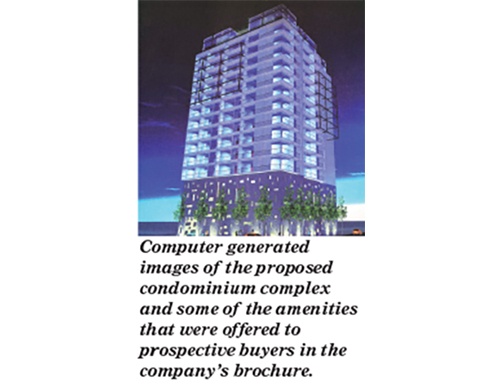
‘A Rs. 600mn rip-off’
by SURESH PERERA
Scores of prospective buyers of housing units at a proposed condominium project in the outskirts of Colombo have been ripped off for at least Rs. 600 million in, what was been described, as a “major scam” by a developer whose company now remains shut.
In the backdrop of a private sector bank announcing moves to auction the 42-perch site of the envisaged condominium complex as the developer had raised Rs. 120 million in capital financing against the property, distraught victims of the swindle bemoaned that they have now “lost all their hard-earned savings”.
“There are around 52 prospective buyers, most of whom dished out anything between Rs. 5 and 10 million each as downpayment for the apartments”, says Gehan Samaranayake, president of ‘Ramanathan Avenue CM Condo Buyers’ Association’.
He said the developer M/s Civi-Mec Construction (Pvt) Ltd., started selling apartment units for the proposed CM Towers condominium project at No. 14, Ramanathan Avenue, Dehiwala, in 2014 and began construction the same year with the approval of the Dehiwala Mount Lavinia Municipal Council.
At that juncture, approval was given to the developer for a G+17 storied housing complex encompassing 112 middle class apartment units with four floors for parking vehicles. The developer of the project, M/s Civi-Mec Construction, had only one director with a registered office at W. A. Silva Mawatha, Colombo 6. The land earmarked for the housing project was mortgaged to a private sector bank to raise funds for the proposed condominium, Samaranayake noted.
“After entering into sales agreements, we paid a considerable downpayment and continued honoring the subsequent monthly installments to meet the balance as the developer laid the foundation with piling in line with the approved G+17 floor building’, he recalled.
“However, with the change of government in 2015, we were told the new administration restricted the number to nine residential floors, and the reason adduced was that some officials responsible for granting approvals were demanding substantial inducements to give the green light for the original plan of G+17 floors”, the Association’s president asserted.
He said at that point, the private bank, which agreed to finance the 112-housing unit project, stopped further funding as it was considered non-viable to invest on heavy foundations and have only nine residential floors with 64 condominium units, instead of 17 floors.
The developer abandoned the project at this stage in 2018 and stopped paying the loan installments to the bank, closed his office and went into hiding. The desperate buyers made complaints to the Police, CID and the Fraud Bureau, with some opting for civil cases as well. Subsequently, the CID arrested the director of Civi-Mec, who was remanded and later released on bail by the Mount Lavinia Magistrate’s Courts, Samaranayake noted.
“There are many of us in the Association, who have paid more than Rs. 10 million each for apartments and according to our records, the developer has collected from the known buyers alone Rs. 600 million, without any interest calculated”, he claimed.
He further said that the bank, citing the default of Rs. 120 million loaned towards the project, exercised the powers vested on its board of directors and initiated the process of recovering the loan by auctioning the property by the end of this month.
Vacating an earlier stay order, the Commercial High Court has allowed the bank to auction the property to recover an accumulated Rs. 160 million, inclusive of other costs, he said, while adding that the bank has already given notice of the auction on October 28, 2020.
“Most of the prospective buyers of this proposed middle-class condominium complex are retirees, who had invested their life’s savings on what they thought would be their ‘dream home’. All their hopes have now been shattered”, Samaranayake stressed.
Repeated attempts by The Sunday Island to contact the
director of Civi-Mec Construction on the phone number listed on its website were futile as there was no response.
As indicated by the ‘Ramanathan Avenue CM Condo Buyers’ Association’, the developer’s office in Colombo 6 remained closed. As a result, there was no possibility of contacting the director concerned for comment on the issues raised by those who have now been left in the lurch after forking out millions of rupees.
“If the buyers of the condominiums had entered into sales agreements, we can initiate legal action against the developer”, says Sarana Karunarathna, Chairman, Condominium Management Authority.
“They can write to the Authority so that we can pursue the matter”, he noted, while adding that he was unaware of the developments until The Sunday Island brought the matter to his notice.

News
Establishment of National Trade Negotiation Committee (NTFC) and Trade Policy Consultation Committee.

Approval has been granted at the cabinet meeting held on 24-08-2026 to implement the recommendations submitted by the committee appointed to review Sri Lanka’s current Free Trade Agreements and future course of Free Trade Agreements in Sri Lanka.
Taking into account these recommendations, it has been
recognized the necessity of establishing a National Trade Negotiation Committee and Trade Policy Consultation Committee enabling Sri Lanka to follow a more targeted, sequential, and evidence-based approach in conducting negotiations for Sri Lanka’s future Free Trade Agreements and to ensure a sustainable and meaningful stakeholder consultation process.
The Cabinet of Ministers has approved the resolution furnished by the Minister of Trade, Commercial, Food Security, and Cooperative Development to act as follows.
• Establishment of a National Trade Negotiation Committee to guide trade discussions conducted with potential bilateral or regional trade partners
• Appointment of the Secretary to the Ministry of Trade, Commerce, Food Security, and Cooperative Development as the Chairman of the National Trade Negotiation Committee and
the Chief National Trade Negotiator.
• Establishment of 12 subject specific sub- committees with the required technical working groups under the National Trade Negotiation Committee
• Appointment of Trade Policy Consultative Committee comprising of trade experts, researchers engaged in research relevant to trade field, business community, unions, civil societies and relevant public officers to instruct the National Trade Negotiation Committee on active and technical sectors, to submit the policy recommendations to the Cabinet of Ministers regarding the matters relevant to the trade agreements, to inquire sustainable ideas regarding the Free Trade Agreements, and to ensure the communication mechanism.
• The Minister in charge of the Subject international trade and the Minister in charge of the subject of Industry to serve as Co-Chairpersons of the Trade Policy Advisory Committee.
By Saman Indrajith
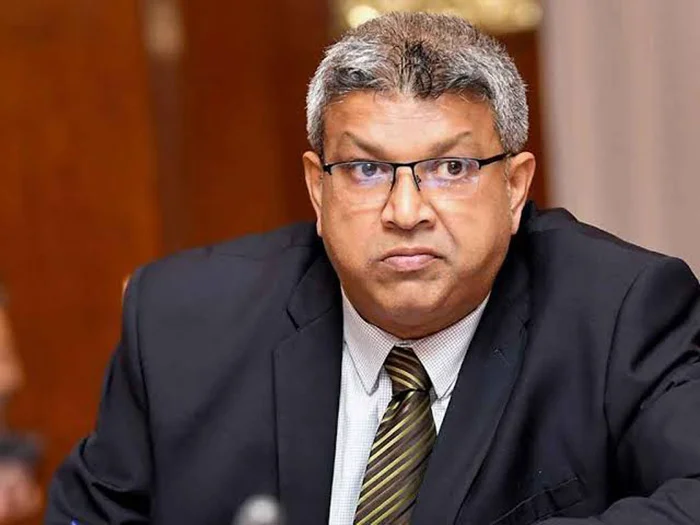
Justice Minister Harshana Nanayakkara yesterday told Parliament that the Commonwealth Lawyers’ Association (CLA) was not an organisation officially recognised or registered under the Commonwealth Secretariat, but a fee-levying private association.
Responding to a question by Opposition and SJB Leader Sajith Premadasa on why he had failed to meet CLA representatives, who recently visited Sri Lanka, Nanayakkara said he had offered them a date and time for a meeting, but they had been unable to attend.
The Commonwealth Lawyers Association (CLA) has questioned procedural fairness and other matters of concern in a report that deals with the Supreme Court hearing petitions against the 22nd Amendment to the Constitution. Among the issues raised by CLA President Steven Thiru, is the composition of the five-member bench.
The Minister said the CLA representatives subsequently requested another date, but he had already scheduled official engagements for the proposed day.
Nanayakkara said it was, therefore, incorrect to claim that he had refused to meet the CLA delegation.
“The CLA is not an official body accepted or admitted into the Commonwealth of countries. It is a private club whose members pay fees for membership,” he said.
However, the Minister said he was not suggesting that the organisation was “a bad organisation”, adding that the accuracy of several statements made by CLA members during their visit to Sri Lanka had yet to be established.
Nanayakkara identified lawyer Upul Jayasuriya as the CLA’s local representative and said Jayasuriya had sought a meeting with him.
“I gave him the opportunity, but he came up with the excuse that he could not make it as he was not in Colombo. Therefore, it is wrong to state that I did not give them time,” the Minister said.
By Shamindra Ferdinando
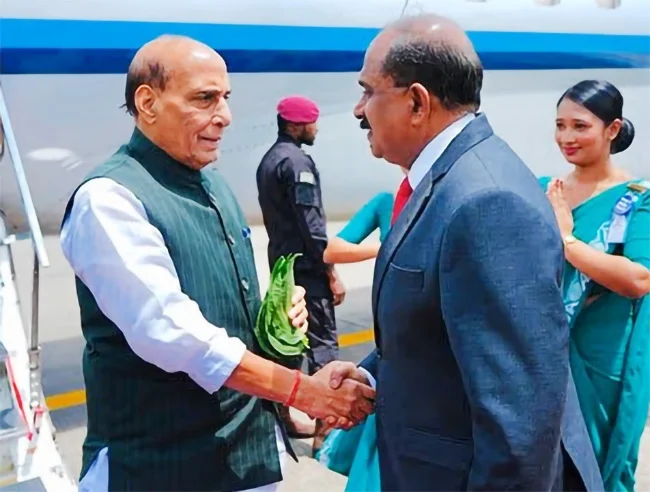
Indian Defence Minister Rajnath Singh is in Colombo on a three-day official visit, the first by an Indian Defence Minister since the 1988 visit by K.C. Pant, during Rajiv Gandhi’s tenure as the Prime Minister.
The Indian Defence Ministry declared that the visit would further strengthen the traditionally strong and friendly bilateral relations in mutually beneficial areas, including a strong maritime and defence partnership.
The visit takes place in the wake of Sri Lanka and India signing seven MoUs, including one on defence, in April 2025. Communist Party General Secretary Dr. G. Weerasinghe told The Island that the government should set the record straight regarding the rapidly developing military relations with the US and India. The acquisition of Colombo Dockyard Ltd., by Indian Defence Ministry-run Mazagon Dock Shipbuilders Limited, soon after the finalisation of MoUs, underscored New Delhi’s strategy, Dr. Weerasinghe said. Responding to another query, Dr. Weerasinghe said that the government should take this opportunity to discuss the Tamil Nadu fishing fleet poaching on Sri Lankan waters.
Pant visited during the Indian Army operations against the Liberation Tigers of Tamil Eelam (LTTE) in the Northern and Eastern Provinces here, while Pranab Mukherjee visited Colombo, in August 2005, to pay last respects to assassinated Foreign Minister Lakshman Kadirgamar.
Indian and Sri Lanka governments said that the visit was meant to strengthen cooperation between the two neighbouring countries in the fields of defence, economic engagement, maritime affairs and regional security.
An Indian warship arrived at the Colombo harbour ahead of the Defence Minister’s visit, reminiscent of old gunboat diplomacy. INS Udayagiri’s visit coincided with the Defence Minister’s visit. The Defence Minister’s delegation included senior officials from Ministry of External Affairs.
During the visit, the Indian Defence Minister is scheduled to hold high-level discussions with President Anura Kumara Dissanayake who also holds the Defence portfolio, Prime Minister Dr. Harini Amarasuriya and Defence Secretary Sampath Thuyacontha. He is also expected to meet members of the Indian community, residing in Colombo.
Dr. Weerasinghe said that the NPP government conveniently extended the moratorium on foreign research vessels imposed during Ranil Wickremesinghe’s tenure in 2024. The CP official said that the media alleged that that decision was taken at the behest of the US and India but nearly two years after the last presidential election the ban remains.

Avindu makes history with first World University gold for Sri Lanka

Establishment of National Trade Negotiation Committee (NTFC) and Trade Policy Consultation Committee.

Showers will occur in the Western and Sabaragamuwa provinces and in Galle and Matara districts

Justice Minister hits back at CLA

First visit by an Indian Defence Minister since IPKF deployment

“I’m not a war criminal, I fought for my country”: Shavendra Silva

‘Dates have the highest sugar content to fight Coronavirus’

Sunday Island 27 December – Headlines

#SundayIsland 17th December – Headlines

Sunday Island – 28th March

Sunday Island Headlines – 21 March

Sunday Island – 21st February – Headlines
-

 News6 days ago
Denied of promotion to SC despite vacancies, justice Gurusinghe retires
-

 Latest News7 days ago
Grade 5 scholarship exam results released
-

 News6 days ago
22A: SC urged to suspend hearing, appoint full bench
-

 News4 days ago
Namal remanded until Sept. 18 over Airbus deal investigation
-

 Latest News3 days ago
Tharanga creates history with Diamond League crown in Brussels
-

 News6 days ago
Govt. seeks NATO assistance
-

 Editorial6 days ago
Strange arithmetic goes unchallenged
-

 News3 days ago
Dispute which triggered listed company director being detained at BIA resolved