
Business
HIP to aggressively promote afloat repairs in 2023

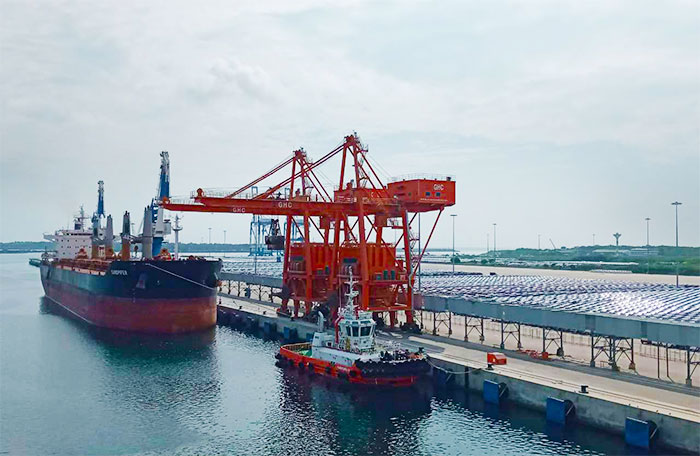
The Hambantota International Port (HIP) is supporting Colombo Dockyard PLC (CDPLC) to handle running repairs to vessels while they remain afloat in the harbour. The majority of vessels directed to HIP for afloat repairs come with damages experienced below the water line. CDPLC carries out permanent repairs on these ships with service assistance from HIP.
“Usually repairs of this nature require us to bring the vessel into dry docks, but we are confident of doing such operations efficiently at HIP. HIP has the berthing capacity and capability to handle afloat repairs along with our expert team. Handling dry docking services afloat is a valuable saving of time for our vessels, especially when they are carrying cargo and incurring demurrage costs. The facilities available at HIP makes this complex service possible, and we are able to carry out our permanent repairs without the ship having to go elsewhere with a temporary fix,” says Praneeth Rajapakse, Head of Afloat Repairs, CDPLC.
Recently, CDPLC directed MV Sandpiper for afloat repairs at HIP. The Sandpiper had damaged its stern tube aft seal unit during a cargo operation in Bangladesh and sought dry docking services. However, CDPLC recommended afloat repairs at HIP which was a much more convenient and cost-effective solution.
“HIP being the closest in the region to east west shipping lanes, makes the port an ideal destination for ships requiring any type of repairs and we have the necessary skills, and deep draft berthing capacity to handle afloat services, which will be a value addition to the shipping industry. We plan on aggressively promoting this service in the coming year,” says Tissa Wickramasinghe, COO of Hambantota International Port Group (HIPG)
The MV Sandpiper which completed the repairs successfully, is now back in operation. An equally complex repair was handled by CDPLC on MV Sunny Hill, while she was berthed at Hambantota International Port in March this year.


Sri Lanka’s long-discussed electricity grid connection with India is gaining renewed momentum, as the Asian Development Bank (ADB) intensifies efforts to promote cross-border energy integration across the region.
At the ADB Annual Meetings in Samarkand, Senior Director for Energy, Priyantha Wijayatunga, identified the proposed India–Sri Lanka grid interconnection as the most promising avenue to strengthen the island’s power sector. The concept dates back to the 1970s, when Sri Lanka, following the completion of the Mahaweli Development Project, even explored the possibility of exporting electricity. However, rapid economic growth and rising domestic demand shifted the country toward energy imports.
Today, with energy security and cost pressures mounting, the idea has regained urgency. “The time is right,” Wijayatunga said, stressing that political will and financing will be decisive. While undersea transmission cables make the link technically viable, costs remain a major challenge. The ADB, he confirmed, stands ready to support Sri Lanka as a development partner in advancing the project.
Sri Lanka’s prospects are closely tied to a broader regional vision being advanced by the ADB through its Pan-Asia Power Grid Initiative (PAGI). The initiative aims to transform how energy is produced, shared, and consumed across Asia and the Pacific by promoting cross-border electricity trade and grid connectivity.
PAGI is designed not merely as a collection of projects, but as a systems-level integration platform that connects national grids into subregional and eventually continent-wide networks. Its core objectives include bridging energy gaps, enhancing energy security, integrating large-scale renewable energy, and strengthening resilience across interconnected systems.
A key pillar of PAGI is leveraging the region’s resource complementarity. Countries in South Asia, for instance, possess uneven but highly complementary energy resources—hydropower in Nepal and Bhutan, and solar and wind potential in India. By linking grids, countries like Sri Lanka could tap into these diverse energy sources, reducing dependence on costly fossil fuel imports while improving reliability.
ADB estimates suggest that deeper regional power trade in South Asia could yield substantial economic benefits, including lower system costs and more efficient energy distribution. The initiative also envisions mobilizing up to $50 billion in investments by 2035, expanding transmission infrastructure, and improving electricity access for millions.
For Sri Lanka, integration into such a regional grid could be transformative. A connection with India would allow the country to import affordable electricity during shortages, stabilize supply, and support its transition toward cleaner energy. It could also open the door to future participation in a wider South Asian power market.
With feasibility studies and policy discussions already underway, and with ADB backing firmly in place, Sri Lanka’s long-envisioned grid connection with India now appears more achievable than ever.
As the Samarkand meetings underscore the urgency of regional cooperation in an increasingly uncertain energy landscape, Sri Lanka stands at the threshold of a new chapter—one where energy security is strengthened not in isolation, but through connection.
by Sanath Nanayakkare in Samarkand, Uzbekistan

Sri Lanka this week finds itself at the centre of a deepening global ocean crisis, as leading scientists, policymakers and conservationists gather in Colombo for Sharks International 2026—a high-profile summit unfolding against mounting evidence that the world is rapidly losing control of its marine ecosystems.
The conference, now underway at the Bandaranaike Memorial International Conference Hall, marks the first time the prestigious forum has been hosted in Sri Lanka. But beneath the diplomatic language and scientific exchanges lies a far more urgent reality: the collapse of shark and ray populations is no longer a distant environmental concern—it is an unfolding economic and food security emergency.
More than 100 million sharks and rays are being wiped out globally each year, largely due to overfishing and illegal, unreported and unregulated (IUU) fishing. In Sri Lanka, the situation is particularly acute. Of the 105 species recorded in local waters, nearly 70 are now threatened with extinction, a statistic that scientists warn should set off alarm bells far beyond conservation circles.
Deputy Minister of Environment Anton Jayakody did not mince words when addressing the gathering, framing the issue not just as an ecological tragedy but as a looming economic shock.
“This is not just about saving species. It is about protecting the foundation of our fisheries, our food systems, and the livelihoods of thousands of Sri Lankans. If shark and ray populations collapse, the consequences will ripple through the entire marine economy,” he said.
Sharks and rays sit at the top of the ocean food chain. Their disappearance disrupts the delicate balance of marine ecosystems, triggering cascading effects that can decimate commercially valuable fish stocks. For a country like Sri Lanka—where coastal communities depend heavily on fisheries—this is not an abstract threat but a direct challenge to economic stability.
Yet despite years of warnings, critics argue that global action has been dangerously slow, fragmented, and often undermined by competing commercial interests.
By Ifham Nizam

SriLankan Airlines led with two wins in the Airline Award category for South Asia, securing both Best Overall Passenger Experience and Most Improved Airline at the PAX International Readership Awards 2026 held recently in Hamburg, Germany. The awards celebrate the industry’s best and brightest, with winners determined by votes from PAX’s global readership.
The Best Overall Passenger Experience – South Asia award recognises an airline that delivers an exceptional onboard experience to passengers across multiple service areas, including meal service, inflight entertainment and seating. At SriLankan Airlines, this entails meticulous planning at every stage of the passenger journey, supported by collaboration among multiple teams and continuous monitoring and refinement.
Maria Sathasivam, Manager Product Development of SriLankan Airlines, commented on the achievement, stating, “we are incredibly honoured to receive yet another independent endorsement of the service we deliver. Every interaction matters to us, and we are committed to consistently meeting and exceeding passenger expectations, and it is truly rewarding to see these efforts recognised.”
SriLankan Airlines continues to enhance the end-to-end travel experience, from booking through to arrival. Ongoing digital upgrades, including improvements to the airline’s website and app, are designed to deliver a more intuitive and seamless customer experience, supported by AI-driven features and expanded ancillary offerings. At its hub, the Bandaranaike International Airport in Colombo, the airline has also expanded self-check-in and bag drop facilities for added convenience.

Man charged with attempted Trump assassination indicted for assaulting Secret Service officer

Vivek Ramaswamy wins Republican nomination for Ohio governor

Trump says US to pause operation to guide vessels through Strait of Hormuz

Samson, Kartik, spinners set up Chennai Super King’s clinical win

State Banquet Hosted by the President for the Maldivian President and Delegation

Heavy showers above 100 mm are likely at some places in the Sabaragamuwa, Central, Uva and North-central provinces.

‘Dates have the highest sugar content to fight Coronavirus’

Sunday Island 27 December – Headlines

#SundayIsland 17th December – Headlines

Sunday Island – 28th March

Sunday Island Headlines – 21 March

Sunday Island – 21st February – Headlines
-

 News6 days ago
Rooftop Solar at Crossroads as Sri Lanka Shifts to Distributed Energy Future
-

 News5 days ago
“Three-in-one blood pressure pill can significantly reduce risk of recurrent strokes”
-

 News1 day ago
CJ urged to inquire into AKD’s remarks on May 25 court verdict
-

 News2 days ago
USD 3.7 bn H’tota refinery: China won’t launch project without bigger local market share
-

 News5 days ago
Alarm raised over plan to share Lanka’s biometric data with blacklisted Indian firm
-

 News3 days ago
Easter Sunday Case: Ex-SIS Chief concealed intel, former Defence Secy tells court
-

 News4 days ago
Ten corruption cases set for court in May, verdict ordered in one case – President
-

 News5 days ago
USD 2.5 mn fraud probe: Interdicted MoF official found dead at home