
News
Poland missile attack: US President says ‘unlikely’ that missile fired from Russia


Poland said early Wednesday that a Russian-made missile fell in the country’s east, killing two people, though U.S. President Joe Biden said it was “unlikely” it was fired from Russia.The blast, which Ukrainian President Volodymr Zelenskyy decried as “a very significant escalation,” prompted Biden to call an emergency meeting of G-7 and NATO leaders.
A deliberate, hostile attack on NATO member Poland could trigger a collective military response by the alliance.But key questions around the circumstances of the missile launch remained amid the confusion caused by a blistering series of Russian airstrikes across the nearby border in Ukraine, none larger than who fired it.
Russia denied any involvement in the Poland blast.Three U.S. Officials said preliminary assessments suggested the missile was fired by Ukrainian forces at an incoming Russian one amid the crushing salvo against Ukraine’s electrical infrastructure Tuesday.
The officials spoke on condition of anonymity because they were not authorized to discuss the matter publicly.That assessment and Biden’s comments at the Group of 20 summit in Indonesia contradict information earlier Tuesday from a senior U.S. Intelligence official who told the AP that Russian missiles crossed into Poland.
The Polish government said it was investigating and raising its level of military preparedness. Biden pledged support for Poland’s investigation.A statement from the Polish Foreign Ministry identified the weapon as being made in Russia.President Andrzej Duda was more cautious, saying that it was “most probably” Russian-made but that its origins were still being verified.
“We are acting with calm,” Duda said. “This is a difficult situation.”
Biden’s decision to convene the emergency meeting upended schedules for the final day of the Group of 20 meeting in Indonesia.Biden, who was awakened overnight by staff with the news of the missile while attending the summit, called Polish President Andrzej Duda to express his condolences. On Twitter, Biden promised “full U.S support for and assistance with Poland’s investigation,” and “reaffirmed the United States” ironclad commitment to NATO.
Meanwhile, NATO Secretary-General Jens Stoltenberg called the meeting of the alliance’s envoys in Brussels.The U.N. Security Council also planned to meet Wednesday for a previously scheduled briefing on the situation in Ukraine. – PTI









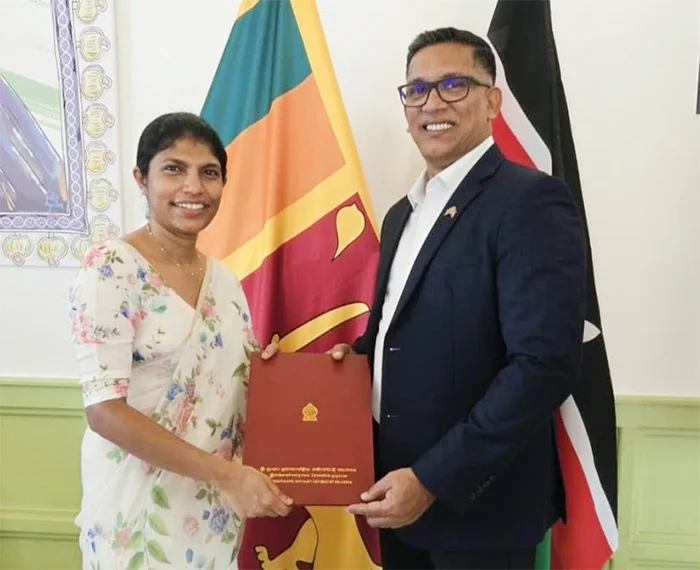
Acting High Commissioner of Sri Lanka to Kenya Ruvini de Silva, formally handed over the renewed appointment of Prageeth Seneviratne as Honorary Consul of Sri Lanka in Mombasa.
On the occasion, the Acting High Commissioner commended Seneviratne for his outstanding service, dedication and valuable contribution towards advancing Sri Lanka’s interests and supporting the Sri Lankan community in Mombasa and Kenya’s wider coastal region.
Seneviratne, a long-standing resident of Mombasa and a Director of EFL Logistics, will continue to provide consular assistance to Sri Lankan nationals while promoting stronger trade, investment, tourism and people-to-people relations between Sri Lanka and Kenya.
His reappointment reflects Sri Lanka’s continued commitment to strengthening its presence in Mombasa, one of East Africa’s most important commercial, logistics and maritime gateways.
With his extensive experience and strong engagement in the region, Seneviratne is expected to further enhance Sri Lanka’s economic, commercial and consular outreach along the Kenyan coast and contribute to the steadily expanding partnership between the two countries.
Discussions are underway to integrate the National Defence Fund and the ‘Api Wenuwen Api’ Fund. The Defence Ministry said yesterday that this was discussed at the Presidential Secretariat, under the Chairmanship of Deputy Minister of Defence Major General (retd.) Aruna Jayasekara.
The Ministry said the focus was on the appointment of an expert committee to study the possibility of integrating the National Defence Fund and the ‘Api Wenuwen Api’ Fund and other special welfare programmes implemented for the Tri-Services.
The proposed initiative is expected to streamline the provision of assistance through the aforementioned funds while expanding the number of members of the armed forces and their families eligible to receive such welfare benefits.
In addition, the possibility of providing financial assistance to members of the armed forces to settle loans obtained from financial institutions was discussed. Preliminary discussions were also held on identifying feasible mechanisms and an institutional framework to provide such assistance.

Sri Lanka Podujana Peramuna (SLPP) General Secretary Sagara Kariyawasam has delivered a scathing critique of the NPP administration during the launch of the party’s Yukthiya Wenuwen Nagitimu (Rise Up for Justice) nationwide seminar series, in Kalutara, accusing the government of systematically weaponising state institutions to target political rivals. The former lawmaker said that the government action caused erosion of the sacrosanct rule of law.
Speaking at the inaugural event, organised by former Member of Parliament Sanjeeva Edirimanne and local party organisers, Kariyawasam asserted that state institutions tasked with maintaining justice, including the Police, the Commission to Investigate Allegations of Bribery or Corruption (CIABOC), and the Department of Prisons, were no longer impartial and were carrying out political directives.
Kariyawasam pointed to a series of recent appointments and administrative actions as evidence of growing institutional bias. He criticised the reinstatement of a retired police officer, via a Cabinet paper, to head the Criminal Investigation Department (CID), alleging that the officer had previously campaigned on the National People’s Power (NPP) platforms.
Commenting on the CIABOC, Kariyawasam cited statements by the late former JVP General Secretary Nandana Gunathilake regarding the Director General’s past political affiliations.
Kariyawasam alleged that witnesses had been coerced under threat to sign false statements implicating former President Mahinda Rajapaksa and SLPP National Organiser Namal Rajapaksa.
Kariyawasam condemned the Ministry of Justice for failing to execute a Human Rights Commission order issued nearly six months back, which called for the reinstatement of former Prisons Commissioner General Thushara Upuldeniya after concluding his removal was unlawful.
Focusing heavily on the detention of Namal Rajapaksa, Kariyawasam described the legal proceedings surrounding a 13-year-old incident as a clear departure from standard judicial process. He stressed that Rajapaksa remained remanded without formal charges, an official charge sheet, or a concluded trial. “We are not whining,” Kariyawasam said, “but there is an established legal procedure, investigate, inform of the charges, present a charge sheet, and conduct a fair trial. If evidence emerges, punish the accused. But holding someone in prison without charges or trial is the very definition of injustice.”
Drawing parallels to the lawlessness and social terror experienced during the 1987–1989 second JVP insurrection, Kariyawasam warned that when state power is abused and politically biased local committees dictate law enforcement, the personal safety of ordinary citizens, youth, and families is directly threatened.
Concluding his address, he recited Pastor Martin Niemöller’s iconic post-war poem on the dangers of public silence during selective oppression, urging citizens to stand up not merely for the SLPP or individual politicians, but to preserve democratic rights and the fundamental integrity of the law.

Sri Lanka renews Honorary Consul appointment in Mombasa

Govt. plans to amalgamate NDF and ‘Api Wenuwen Api’ Fund

SLPP Gen. Secy. alleges political persecution and institutional decay

World Bank puts USD 110m into climate-resilient road rebuilding

Fifty days in Pakistan

Iranian sailors trapped between Scylla and Charybdis

‘Dates have the highest sugar content to fight Coronavirus’

Sunday Island 27 December – Headlines

#SundayIsland 17th December – Headlines

Sunday Island – 28th March

Sunday Island Headlines – 21 March

Sunday Island – 21st February – Headlines
-

 Latest News6 days ago
Gold winner Tharanga gets brand-new Honda Vezel from SLAAJ
-

 Features6 days ago
Why Sri Lanka needs an Inclusive Civic Nationalism – urgently
-

 News5 days ago
US-assisted ‘Ice’ detection: NPC to examine IGP’s move to transfer drug-busting team
-

 Editorial4 days ago
Colombo Port drug bust: The plot thickens
-

 News6 days ago
Civil society activist accuses govt. of favouring Ven. Gnanasara
-

 News7 days ago
PAFFREL raises concerns over Anti-Corruption (Amendment) Bill
-
 Editorial6 days ago
When crime bosses rise above law and shrines
-
 Midweek Review6 days ago
Dappula’s Easter Sunday ‘grand conspiracy’ claim demolished