
News
UN: Cost of living crunch threatens to sink millions of Lankans already facing hard choices

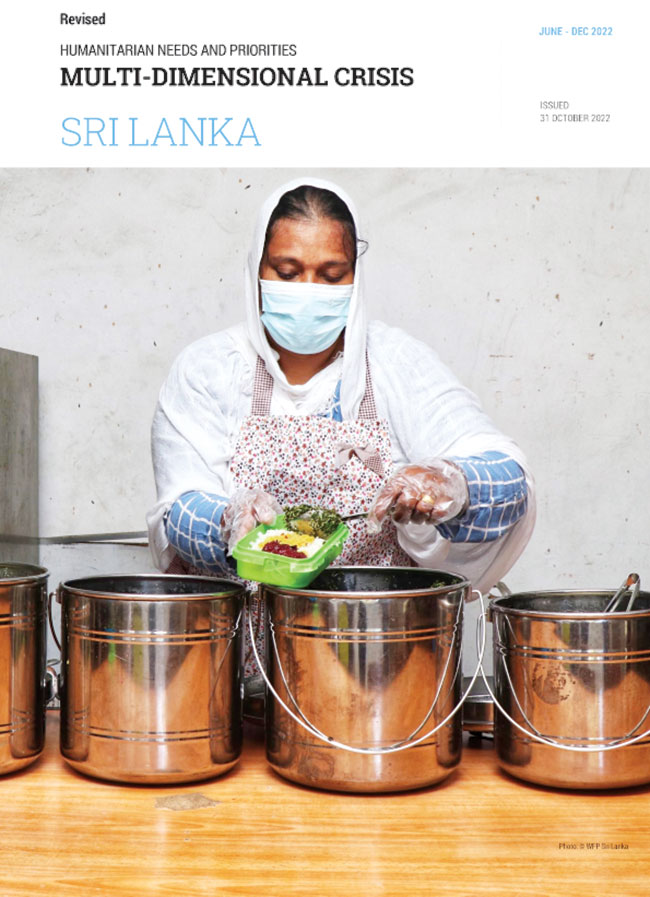
ramps up humanitarian appeal for life-saving assistance to 3.4 million people
More than one half of Sri Lanka’s population, currently making use of food-based coping strategies and livelihood coping strategies since they do not have enough food or money to buy food, are likely to “resort to means that will have a higher negative impact on their medium long-term capacity to generate income,” says a UN report.
The report, titled ‘Sri Lanka: Multi-dimensional crisis – Humanitarian needs and priorities JUNE – DEC 2022’, by the United Nations Office for the Coordination of Humanitarian Affairs (OCHA), on behalf of Humanitarian Country Team and partners, says that an estimated 13.5 million, or 61.1 percent of the population, are using food-based coping strategies, and 47.7 percent of households use livelihood coping strategies.
The food and livelihood coping strategies, being adopted in response to the situation by the Lankans, include cutting the number of meals consumed in a day, reducing meal sizes, spending savings, and purchasing food on credit, says the report, originally published on Nov 8, 2022.
“About 5.3 million people, or 24 percent of population, are reducing the number of meals, and the same percentage of the population are reducing adults’ consumption so that children can eat, with women being the last to eat in the household. The proportion of households, with unacceptable diets, is 10 times higher, compared to the end of 2021. About 8.7 million people in the country are reported as not consuming adequate diets; nearly 32.2 percent of these households are in urban areas. The livelihood-based coping strategies, that households are resorting to, include spending savings, selling productive assets, reducing essential healthcare expenses, withdrawing kids from school, buying food on credit, borrowing money or pawning jewels. Once these least severe strategies are exhausted, households would likely resort to means that will have a higher negative impact on their medium long-term capacity to generate income and their food security. Informal income earners, unskilled casual laborers, and those who do not have home gardens, or livestock, are among the most vulnerable to food insecurity,” says the report.
It says: With the reduction in domestic agricultural production, during the Yala 2022 season, the prices of food are expected to increase further and reliance on imported food will intensify. This, in turn, would continue to drive a severe reduction of food availability and food access, with negative effects on food and nutrition security during the upcoming lean season, which starts in October 2022. Unless there is a significant turnaround on field cultivation and intensified agricultural support is mobilized, the upcoming Maha 2022/2023 season will remain a challenge. Without a solid domestic production base, food insecurity will likely continue and those who will suffer the most are the poor and already vulnerable families.
“Prices of most commodities have increased considerably since the end of 2021, and food inflation was measured at 94.9 percent in September 2022 compared to a year before, a further increase from 93.7 percent in August. Based on the recently concluded Crop and Food Security Assessment Mission by WFP and FAO, nationally, 6.3 million people, or 28 percent of the population, are found to be moderately or severely food insecure. Of particular concern are 66,000 people who are severely acute food insecure, 18,000 of whom are living in the estate sector, such as tea plantations. In total, 57.1 percent of severely insecure people in the country are in the estate sector, and 41.6 percent in the Central Province. Characteristics most strongly associated with moderately food insecure households include female-headed households (at 39.8 percent), heads of household with no education (at 43.1 percent), households of Indian Tamil ethnicity (at 50.3 percent) and beneficiaries of the Samurdi programme (at 41.3 percent).
A slightly different set of characteristics are associated with severe acute food insecurity, which include the estate sector (at 2 percent), high dependency ratio11 (at 2.3 percent), “assistance” as the main source of income (at 1.4 percent) and having at least one member living in the household with a disability12 (at 1.2 percent).”


The Indian Naval Ship (INS) Sharda arrived at the port of Colombo on 10 Jun 26 for an Operational Turnaround.
In keeping with time-honoured naval customs, the Sri Lanka Navy extended a traditional welcome to the visiting ship upon her arrival.
The Offshore Patrol Vessel (OPV) is under the command of Commander Kartik Sachdeva.
During the ship’s stay in the island, its crew is scheduled to take part in several programmes organised by the Sri Lanka Navy, aiming to foster camaraderie and professional interaction.
Additionally, the Indian naval personnel will explore several prominent tourist attractions of Sri Lanka.
News
The government is implementing a comprehensive programme to restore the livelihoods of fishermen and businesses affected by Cyclone Ditwah – PM

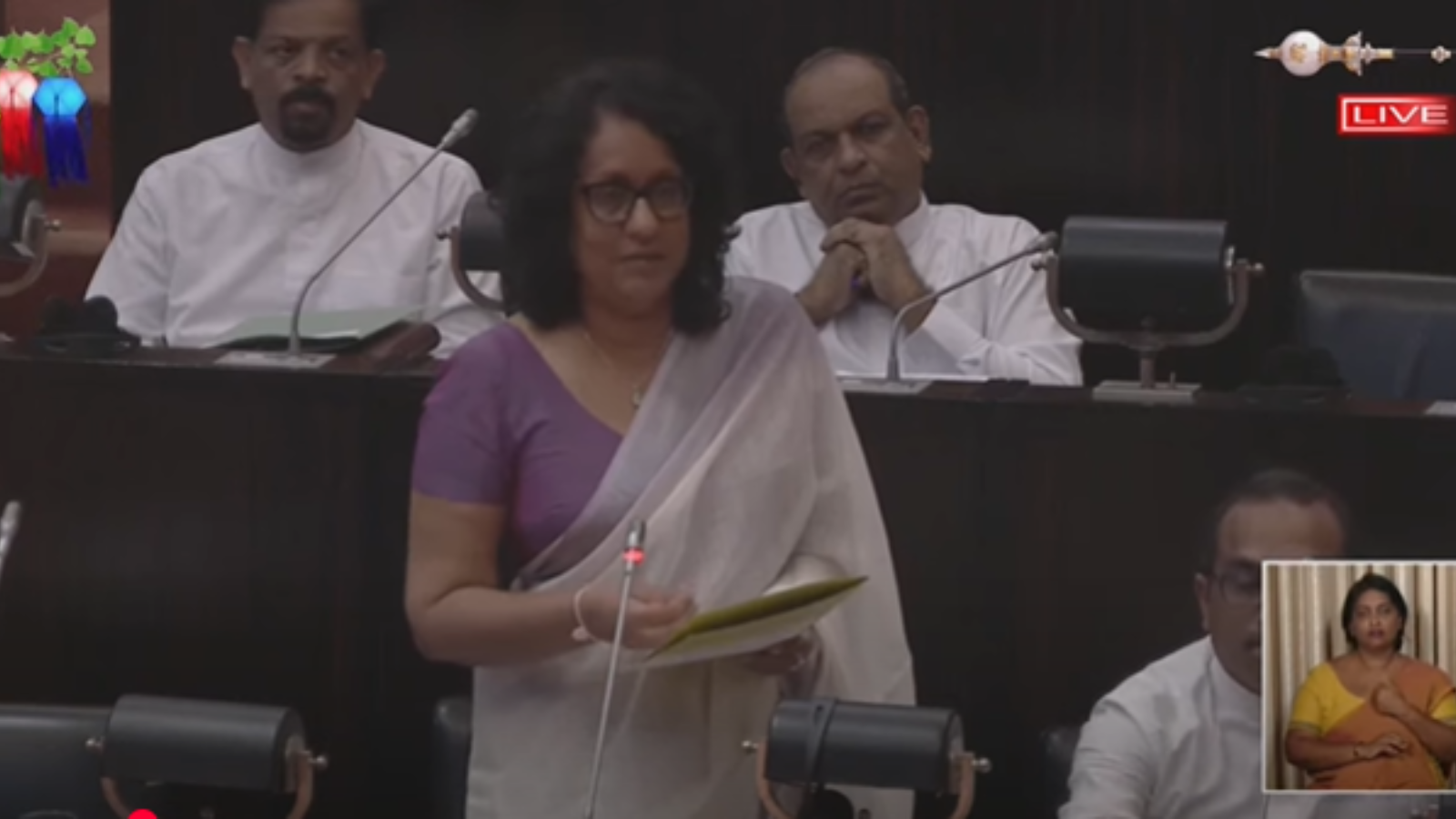
Prime Minister Dr. Harini Amarasuriya stated that the Government has implemented a comprehensive programme to assist the fishing community and micro, small, medium, and large-scale entrepreneurs affected by Cyclone Ditwah in rebuilding their livelihoods.
The Prime Minister made these remarks while responding to questions in Parliament on Tuesday (09) regarding the relief measures introduced for those affected by the disaster.
Prime Minister Dr. Harini Amarasuriya stated:
“The Ministry of Fisheries, Aquatic and Ocean Resources has initiated a special assistance programme for both marine and inland fishermen affected by Cyclone Ditwah. Under this programme, new fishing vessels will be provided to replace those that were completely destroyed, while partially damaged vessels will be repaired. The distribution of fishing nets to eligible fishermen has also commenced.
To support the recovery of businesses damaged by the cyclone, the Government has introduced a concessional loan scheme carrying an annual interest rate of 3 per cent. The programme, with a total allocation of Rs. 10,000 million, is being implemented through 15 banks. As at 28 April 2026, loans amounting to Rs. 3,812 million had been disbursed to 2,800 entrepreneurs. The scheme offers a repayment period of up to three years, including a six-month grace period, with the objective of enabling businesses to resume operations without delay. Applicants are required to obtain recommendations from the Grama Niladhari and the Divisional Secretary certifying that the business was operational before the cyclone and that it was affected by the disaster.
The Prime Minister further stated that, on the instructions of the Central Bank of Sri Lanka, licensed banks have granted a moratorium on loan repayments and waived penalty interest until 31 January 2026. The Prime Minister also emphasized that compensation payments to affected entrepreneurs are continuing in accordance with the relevant ministerial circulars and disaster relief guidelines.
[Prime Minister’s Media Division]
News
Formulation of a Draft Economic Development Bill to expedite the process of Digital Transformation and Digital Economic Development

It is essential to establish an institutional framework with legal powers to ensure the effective implementation of national digital policy and guidelines.
Quality human capital should be attracted to this institutional framework for the compilation of policies, implementation of policies, regulation, and empowerment of operations. The continuous participation of the private sector should also be considered in establishing a strong institutional framework.
It has been further identified that attention should also be
drawn to new fields of digital innovation, including support for artificial intelligence and related activities.
Taking into consideration the aforementioned matters, a concept paper has been formulated to prepare a Draft Economic Development Bill for the establishment of a new institutional framework.
Accordingly, the Cabinet of Ministers has approved the resolution furnished by the President in his capacity as the Minister of Digital Economy to instruct legal draftsman to formulate a Draft Economic Development Bill based on the aforementioned concept paper.

INS Sharda arrives in Colombo

India’s Sri Lanka Test tour set to begin in Galle on August 15

US strikes Iran in response to downing of military helicopter

The government is implementing a comprehensive programme to restore the livelihoods of fishermen and businesses affected by Cyclone Ditwah – PM

Air Canada pilot accused of flying for 17 years without proper licence

Rana and Mosaddek star as Bangladesh end 21-year wait with crushing win

‘Dates have the highest sugar content to fight Coronavirus’

Sunday Island 27 December – Headlines

#SundayIsland 17th December – Headlines

Sunday Island – 28th March

Sunday Island Headlines – 21 March

Sunday Island – 21st February – Headlines
-

 Latest News7 days ago
Kusal Mendis, Pathum Nissanka, bowlers put Sri Lanka 1-0 up
-
 News7 days ago
New US tariffs proposed on 60 countries, including Sri Lanka
-

 Features6 days ago
Power crept into the Sangha and is now tearing it apart
-

 Features6 days ago
Kondachchi wind farm and battery storage project to boost energy security, says Power Ministry Secretary
-

 News4 days ago
Women’s T20 World Cup 2026 warm-up: Chamari Athapaththu’s 94 helps Sri Lanka beat Pakistan
-

 Features6 days ago
Saudi Arabia sets new benchmark in Hajj management as 1.7 million pilgrims complete sacred journey
-

 News5 days ago
Asst. Manager, security officer arrested over Rs 30 mn snatch at Horana PB branch
-

 Editorial3 days ago
Probe Sallay’s complaint