
Business
SL’s IT/BPM industry targets USD 5 bn. Exports by 2025

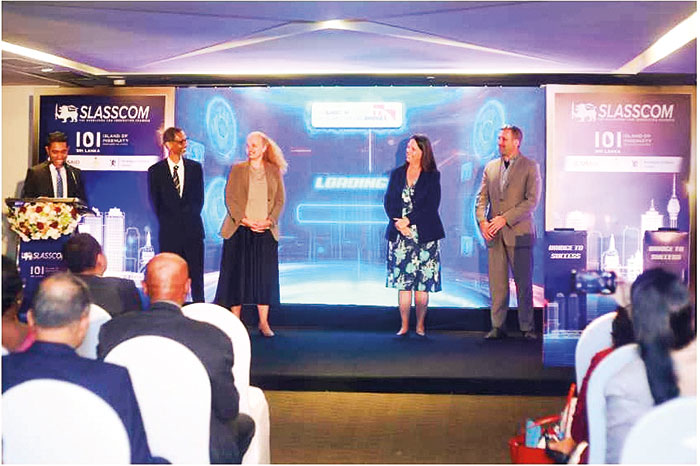
Careers bridge launched to create more opportunities for youth
The Sri Lanka Association for Software Services Companies (SLASSCOM), the apex body representing the IT/BPM Industry, officially relaunched its Future Careers Bridge (FCB) website recently. The 2.0 version of the FCB platform comes with a range of new features and an improved user experience as part of its plans to attract more Sri Lankan youth to join the ICT sector, a news release said.
The event, held at Cinnamon Grand Colombo, was attended by Trine Jøranli Eskedal – Norwegian Ambassador to Sri Lanka, Debra Mosel – Deputy Mission Director USAID Sri Lanka and Maldives and representatives from SLASSCOM, USAID, Royal Norwegian Embassy, YouLead and key industry sectors including ICT and higher education, it added. The releaded explained Sri Lanka’s IT/BPM industry is pushing to cross USD 5 billion in export revenue by 2025. The industry is, however, facing a skills shortage due to the limited number of IT graduates emerging out of the local education system.
“One of the primary objectives of SLASSCOM is to identify, enable and develop ready and employable talent in the industry. The revamped SLASSCOM FCB platform allows students to complete online challenges under diverse IT career paths, build a profile based on their performance and compete on the FCB Leader boards,” it said.
“Students can also find mentors and request assistance from industry experts through FCB. Top-performing students will be selected for interviews by partner companies and provided with internship opportunities.”
FCB was created in 2019 to channel school leavers who lacked graduate-level qualifications but were interested in joining the sector to find employment in the IT/BPM industry. The platform was developed with the support of USAID’s youth employment and entrepreneurship project YouLead, along with the Royal Norwegian Embassy as Project Partner, HCL Lanka and Dialog Axiata PLC as Corporate Sponsors, and through the voluntary contribution of ideas, support, and expertise from over 50 IT/BPM companies in Sri Lanka.
“Even with the IT/BPM industry on track to become Sri Lanka’s number one export revenue contributor, the sector grapples with recruiting skilled graduates into the ecosystem. This has become a primary reason for slowing our growth momentum. With FCB 2.0, SLASSCOM has built a pathway for Sri Lanka’s talented youth to hone their skills further and to be employed by best IT/BPM companies in the country to pursue their dream career in a sector that has a significant global presence,” said Ashique M. Ali, Chairman of SLASSCOM and Director at Talliance.
“On behalf of SLASSCOM, I thank all the sponsors and volunteers who have made this platform a reality.”
SLASSCOM FCB allows public and private educational institutions, including universities and tertiary educational institutes, to enable their students to manage and track their learning and career progress. This will add further value to the platform. The platform has also enlisted 15 of Sri Lanka’s leading IT/BPM companies as SLASSCOM FCB Partners. They will support training and employment opportunities for youth emerging through the program. The vision of SLASSCOM is to provide all companies in Sri Lanka access to FC Bridge for their youth talent recruitment.
“The technology industry is one of the fastest growing industries in the world. As many governments and companies move forward to digitize their businesses, there is an evident shortage of global talent which opens up many opportunities. In this context, the new Future Careers Bridge platform launched by SLASSCOM is significant as it will open new paths in ICT careers for many Sri Lankans, particularly for the youth,” said Trine Eskedal, Norwegian Ambassador to Sri Lanka.
Debra Mosel, Deputy Mission Director USAID Sri Lanka and Maldives, said, “It is a great milestone today to launch Future Careers Bridge 2.0, which opens up more training and learning opportunities for Sri Lankan youth in the ICT sector. I am also delighted that almost half of the users registered to the programme are women.
“Supporting young women who choose a career in ICT is not just good for them and their families. It is a major accelerator of the socio-economic development of Sri Lanka. As the world faces a major skill shortfall in the ICT sector, we should equip and inspire young women with the skills they need to become ICT professionals. Strong women leaders are critical in helping women access the ICT sector’s rich employment and leadership opportunities.”
Arjuna Nanayakkara, Director of SLASSCOM, CEO at GTN Technologies and Head of Shared Service at GTN Group, said, “A platform like Future Careers Bridge allows Sri Lankan youth to join the global ICT industry. It will infuse better-prepared graduates into the industry as FCB 2.0 enables them through well-curated coursework and soft skill training modules.
“Furthermore, the Capacity Forum at SLASSCOM provides additional complementary learning solutions to FCB 2.0 so that local ICT companies able to attract skilled talent. To make this a tremendous success, numerous stakeholders have helped. With their assistance, this has today become a national success story. This is the way forward. I also believe this is a great case study for all corporates in the country to make a paradigm shift in how they recruit talent and build competencies when giving career opportunities for graduates.”
SLASSCOM has been the catalyst of growth for the Sri Lankan IT and BPM industry by facilitating investments and market access, talent development and employment, encouraging research and innovation, promoting ESG best practices, and supporting the creation of a forward-thinking and progressive national policy. SLASSCOM’s membership comprises over 420 member companies, encompassing an employee base of 115,000+ people. It accounts for approximately 90% of the export revenue of Sri Lanka’s IT/BPM industry.



Business
CMTA warns of further Rs. 40 billion revenue leakage in 2026, calls for urgent removal of 15% depreciation

The Ceylon Motor Traders’ Association (CMTA), the senior-most automotive association in Sri Lanka affiliated with the Ceylon Chamber of Commerce, has issued an urgent appeal to the government to abolish the 15% depreciation currently granted on used vehicle imports, warning that the concession is causing massive revenue leakages at a time when the country can least afford them.
The Association estimates that the existing depreciation mechanism resulted in approximately Rs. 40 billion in lost government revenue in 2025 alone. If corrective action is not taken immediately, a similar level of revenue leakage could occur in 2026, further impacting the government’s fiscal position and depriving the country of much-needed funds for national development and public services.
The Association notes that loopholes within the existing system have created opportunities for misuse, resulting not only in unfair advantages for certain importers but also in substantial losses to government revenue. Addressing these abuses, alongside the removal of the 15% depreciation concession, is essential to ensuring greater transparency, strengthening regulatory oversight, and protecting the integrity of Sri Lanka’s vehicle import sector.
While no official announcement has yet been made regarding the removal of the 15% depreciation, the CMTA has consistently highlighted the issue through multiple budget proposals submitted via the Ceylon Chamber of Commerce. The Association has repeatedly maintained that there is no viable justification for the continued application of this concession on used vehicle imports.
Currently, used vehicles receive a 15% depreciation on their Cost, Insurance and Freight (CIF) value for duty calculation purposes. However, the vast majority of vehicles entering the country through the used vehicle market are virtually zero-mileage units, with CIF values that are often comparable to those of brand-new vehicles. In such circumstances, the CMTA argues that granting a blanket 15% depreciation creates an unfair and unjustifiable tax advantage while significantly reducing government revenue collections.
The Association acknowledges that if the objective through this concession is making vehicles more affordable for consumers, then the CMTA stresses that affordability cannot be achieved through arbitrary concessions that create market distortions and substantial losses to the Treasury. If the intention is to reduce vehicle prices, similar policy considerations could be extended to brand-new vehicles rather than selectively benefiting one segment of the market.
Consumers who purchase brand-new vehicles benefit from manufacturer warranties, which help mitigate maintenance and repair costs during the warranty period. As a result, vehicle owners are less likely to incur additional expenses associated with importing replacement parts, providing greater long-term value, reliability, and peace of mind.
The CMTA further notes that as far back as 2013, a structured depreciation framework was implemented based on the age of a vehicle, rather than a flat-rate concession. Under this proposal, depreciation would be calculated according to a defined scale and capped at a maximum of 10%, ensuring greater fairness, transparency and alignment with the actual value of the vehicle.
The Association stated that the continued application of a blanket 15% depreciation is resulting in significant and unnecessary revenue leakages for the government. At a time when every rupee of revenue is critical to the country’s economic progress, this issue requires immediate attention and decisive action.
The CMTA therefore strongly urges the relevant authorities to take swift action to abolish the current 15% depreciation concession and close this avenue of revenue leakage without delay. The Association emphasises that every month of inaction increases the risk of further losses to the state and undermines efforts to strengthen public finances.
Should the government determine that some form of concession should continue to be extended to the used vehicle market, the CMTA maintains that it must be implemented through a structured and transparent framework based on vehicle age and capped at a reasonable level. Such an approach would ensure fairness while safeguarding government revenue and maintaining a level playing field across the automotive industry.

Businesses in Sri Lanka risk severe financial and operational disruption unless they urgently invest in climate adaptation and resilience measures, leading climate experts warned at a high-level dialogue on “Climate-Proofing Business Sri Lanka” held on Wednesday at Genesis – The Dilmah Centre for a Sustainable Future.
The event, jointly organized by Genesis and the Ceylon Chamber of Commerce, brought together corporate leaders, sustainability professionals, policymakers and climate specialists to discuss how climate change is rapidly emerging as one of the biggest risks facing Sri Lanka’s economy.
Climate Change and Disaster Risk Management Specialist Rohan Cooray said climate-related disasters were already exacting a heavy economic toll globally and locally.
He noted that climate-induced losses divert resources that could otherwise be invested in economic development and business growth and stressed the need for stronger adaptation measures to protect investments and livelihoods.
Delivering the keynote address, internationally renowned climate lawyer and governance specialist Dr. Lalanath de Silva said climate change was no longer a future threat but a present-day economic reality that businesses could not afford to ignore.
“The impacts are coming whether we like it or not,” he said. “The question is whether we prepare now or pay a much higher price later.”
Dr. de Silva explained that while global efforts have largely focused on mitigation—reducing greenhouse gas emissions—adaptation has become equally important, particularly for vulnerable countries such as Sri Lanka.
“Sri Lanka contributes less than one percent of global greenhouse gas emissions, yet we are among the countries most vulnerable to climate impacts,” he said.
He warned that climate change would alter rainfall patterns, intensify floods and droughts, increase the frequency of extreme weather events and place growing pressure on infrastructure, agriculture, water resources and businesses.
“We are very good at producing plans in Sri Lanka. What we have not been good at is implementing them.”
Calling for stronger institutional coordination, Dr. de Silva proposed the establishment of a high-level climate coordination mechanism operating at the highest level of government to ensure coherent action across ministries and agencies.
Providing scientific context to the discussion, Cooray presented projections based on global and regional climate models adopted by Sri Lanka’s Department of Meteorology.
According to Cooray, rainfall patterns across Sri Lanka are expected to become increasingly erratic.
The wet zone is projected to receive more intense rainfall events while many dry-zone regions could experience prolonged drought conditions interspersed with extreme rainfall episodes.
“The danger is not simply that some places become wetter and others become drier. The danger is the increasing variability and unpredictability of rainfall,” he said.
While mitigation projects often generate measurable returns, adaptation investments require innovative financing mechanisms and stronger public-private partnerships, speakers noted.
The event also featured contributions from Dilhan C. Fernando, chairman of Dilmah Ceylon Tea Company PLC; Shiran Fernando, Secretary General and CEO of the Ceylon Chamber of Commerce; and Yasangi Randeni, Chief Sustainability Officer of Aitken Spence PLC.
Speakers agreed that climate-proofing businesses is no longer simply about environmental responsibility but about safeguarding assets, maintaining competitiveness, protecting supply chains and ensuring long-term economic sustainability.
The consensus emerging from the forum was clear: while mitigation remains important, Sri Lanka’s immediate priority must be preparing businesses, communities and institutions for climate impacts that are already unavoidable.
By Ifham Nizam
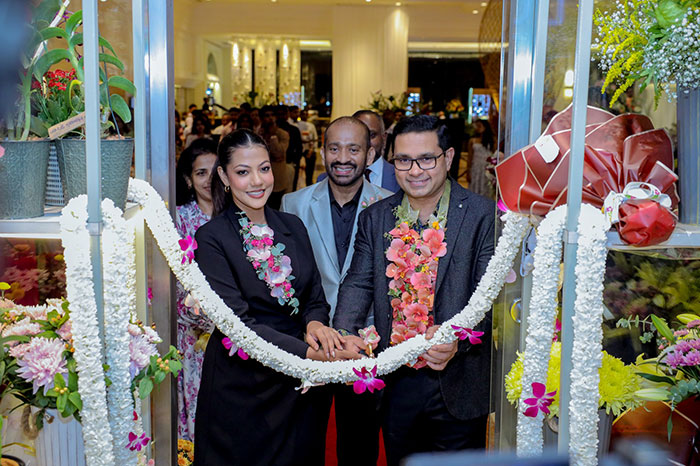
Lassana.com, Sri Lanka’s leading floral and gifting brand, officially unveiled its newest flower shop at Cinnamon Grand Colombo recently. The move strengthens the brand’s presence in Colombo’s hospitality and lifestyle sector, offering customers convenient access to premium floral gifting and floral wedding experiences.
The new shop was ceremonially declared open by the Chief Guest Sanath Manatunge – CEO of Commercial Bank of Ceylon, together with the Guest of Honour, Lassana.com Brand Ambassador and former Miss Sri Lanka World Anudi Gunasekera. Dr. Lasantha Malavige – Chairman & Managing Director, Piet De Jong – Head of Flower Division, both of Lassana Group of Companies, Nazoomi Azhar – General Manager of Cinnamon Grand Colombo, Yoosuf Sirajudeen – Manager-Luxury Weddings at Lassana Flora Weddings, together with a large gathering of distinguished guests and well-wishers were also present at the occasion.
The new Lassana.com outlet has been designed to offer a carefully-curated selection of fresh flowers, floral arrangements and gifting solutions, providing hotel guests, corporate clients, residents, and visitors with convenient access to high-quality floral gifting in the heart of the city. Located in the lobby of one of Colombo’s most iconic hospitality destinations, the new flower shop combines elegance, convenience, and the trusted quality that customers have come to associate with the Lassana.com brand. The outlet will also serve as a showcase for the company’s floral artistry and wedding expertise.

Landslide Early Warnings issued to the districts of Kalutara, Kandy, Nuwara Eliya and Ratnapura

Showers expected in the Western, Sabaragamuwa and North-western provinces and in Galle, Matara, Kandy and Nuwara-Eliya districts

Wife, counsel seek regular access to ex-Spy Chief Sallay held under President’s detention order

CIABOC summons Yoshitha over his participation in British Navy training programme

Communist Party condemns ill-treatment of Sallay, calls for review of PTA

Justice Minister responds to social media claims he represented Easter Sunday ringleader

‘Dates have the highest sugar content to fight Coronavirus’

Sunday Island 27 December – Headlines

#SundayIsland 17th December – Headlines

Sunday Island – 28th March

Sunday Island Headlines – 21 March

Sunday Island – 21st February – Headlines
-

 News5 days ago
Women’s T20 World Cup 2026 warm-up: Chamari Athapaththu’s 94 helps Sri Lanka beat Pakistan
-

 News6 days ago
Asst. Manager, security officer arrested over Rs 30 mn snatch at Horana PB branch
-

 Editorial4 days ago
Probe Sallay’s complaint
-

 News5 days ago
Lankan-Canadian inducted to Toronto Sports Hall of Fame
-
 News2 days ago
Local firms move millions of dollars overseas for phantom imports: Govt.
-

 Editorial5 days ago
Prez in the dock
-

 Features5 days ago
Entering MIT for my Ph.D program, coping with harsh Boston winter and breasting the tape
-

 News6 days ago
No blanket ban on musical performances; only those promoting LTTE