
Sports
T-20 becoming most popular brand of cricket

by Rex Clementine
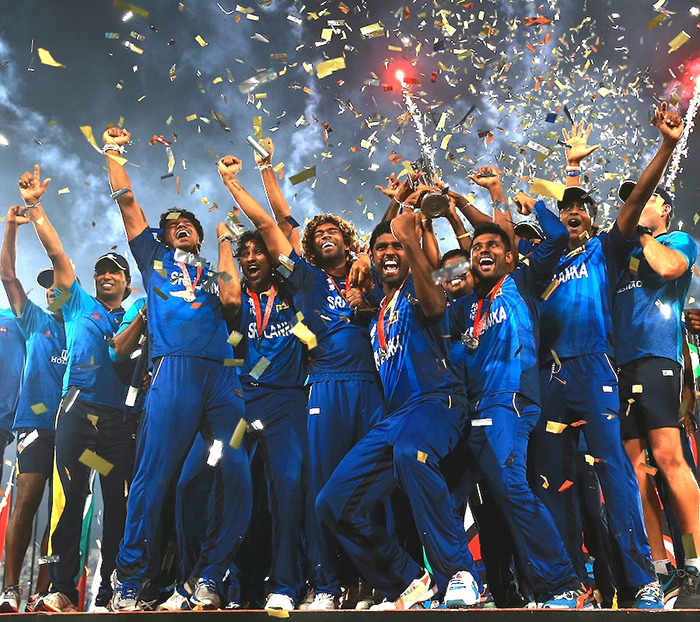
Test cricket being the highest form of the game and a real test of character are all true no doubt but T-20 cricket has become the most popular format of the game for a variety of reasons. There’s more money being invested by sponsors for T-20 cricket as that’s where you see the younger generation getting involved. In a fast paced world, after five days of Test cricket, younger generations find it difficult to come to terms with the fact that games can still end in no results. They are more comfortable with the fact that three hours of T-20 entertainment gives them a result.
The eighth edition of the event is taking place in Australia for the first time and the Aussies are known to be fabulous hosts and put up grand shows. Their government is giving the fullest backing with visa fees and biometrics exempted for players, officials and even journalists. With some entertaining finishes and new heroes, this tournament is expected to take the popularity of T-20 cricket further.
There’s an increasing trend for teams to engage in more T-20 cricket than Test matches. For example, Pakistan and England recently played seven T-20 Internationals but there’s only room for three Tests. Australia and Sri Lanka have ended up playing eight T-20s this year alone but their Test series won’t stretch beyond two games.
It is true that the money is in T-20 cricket, but it shouldn’t be at the expense of Tests. In reality, the tendency to play fewer Tests has become the norm as most boards end up incurring huge costs playing Tests and they make little money.
Countries like Sri Lanka need to be aware of the dangers of playing fewer Test matches. England, Australia and even India will not cut down on the number of Tests they play a year as they can sustain it even when they don’t make profits. Sri Lanka’s red ball players were involved in a Test series in July this year and need to wait till march next year for their next series.
It has only taken two decades for T-20 cricket to expand beyond imagination. The financial riches T-20 cricket has brought in is such that Sri Lankan cricketers now can afford to buy acres of prime land. No not just around Colombo, but even in places like Melbourne and Manchester. Yes, that’s correct, acres of prime land. T-20 cricket was first introduced in England in 2003. Lord Ian MacLaurin, the boss of UK’s most successful supermarket chain Tesco was the head of England and Wales Cricket Board and he brought in much needed change for the game.
ECB Marketing Executive Stuart Robertson had been told to look into ways that would make cricket appealing to younger fans in Britain again. It had been observed that there was this notion that cricket was a sport for the wealthy. The sport was being played while most men and women in UK were at work.
Robertson noted that even in limited overs cricket, it took seven hours for a game to end. Furthermore, 50 overs cricket at that point was losing interest. The first 15 overs with field restrictions were on was exciting and then the last five with batters cashing in towards the end of the innings. Between overs 16 and 44 was considered as a boring phase of the game. So he decided to take off the period between overs 16 to 44 and condense it to a 20 over game hoping the excitement was there.Activities where children can come over and enjoy the game were introduced too like bouncy castles and swimming pools and the idea was immensely popular in England.
India brought into the argument reluctantly. Jagmohan Dalmiya, cricket’s most powerful man at that point walked into the Durban press box during the 2003 50 over World Cup semi-final and the British media told him about the success of T-20 cricket in UK and asked whether international cricket could accommodate another format. Dalmiya said that in his part of the world the game was thriving. His famous quote was, ‘when there’s a Test match in Calcutta, there are 100,000 people inside the ground and 100,000 people outside the ground.’
But all that changed four years later when India won the first T-20 World Cup in South Africa in 2007. BCCI hadn’t taken the tournament seriously and sent a second string team. But that team had a smart leader, a certain M.S. Dhoni. Once India won the title beating arch-rivals Pakistan, the interest for the new format went through the roof.
Cricket landscape was also changing in India at that point and more dynamic and young businessmen like Lalit Modi and N. Srinivasan were taking charge. They saw the huge potential a domestic T-20 tournament would have and the IPL was launched. Rest of the world followed suit with their own lucrative T-20 league and the rest as they say is history.









Boualem Khoukhi scored an equalising goal on a header in the fourth minute of stoppage time, and Qatar spoiled a dominant day by Switzerland in a 1-1 draw in Group B of the World Cup.
Several of the Qatari players fell to the ground on Saturday in celebration of the late goal, as others ran to each other to embrace.
Breel Embolo scored for Switzerland from the penalty spot in the first half just over a week after being cleared to enter the US following a visa delay, but the Swiss failed to capitalise on multiple other scoring chances.
In the 13th minute, Embolo was fouled by Qatar goalkeeper Mahmoud Abunada, who received a yellow card on the play. Abunada lay face down and appeared motionless for a couple of minutes before he began to move his legs and was able to stand up again.
When Embolo calmly sent his penalty into the upper left corner in the 17th minute, it sent the red-clad Swiss fans into a dancing frenzy in the stands of San Francisco Bay Area Stadium.
The 29-year-old forward applied for an urgent visa at the United States embassy in Bern on June 3, one day after he was denied boarding the team’s flight to travel for his third World Cup because of a 2018 criminal conviction that was only finalised in April.
Switzerland dominated the possession game on an unseasonably warm June afternoon — with sprinklers running during a first-half break.

There were thousands of empty seats scattered throughout Levi’s Stadium, home of the NFL’s San Francisco 49ers. Brazil and Colombia drew 70,971 two years ago in a group match at the Copa America. The stadium in Santa Clara staged the Super Bowl only four months ago.
(Aljazeera)
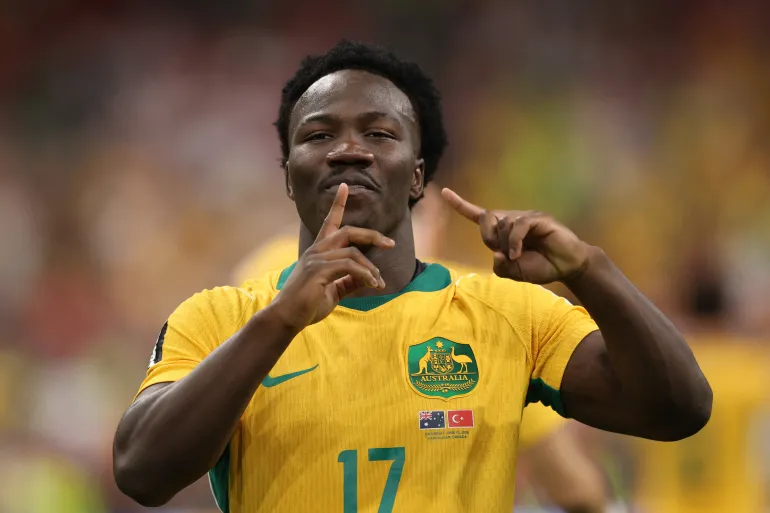
Nestory Irankunda and Connor Metcalfe have scored as Australia have spoiled Turkiye’s return to the World Cup for the first time in 24 years with a 2-0 victory.
Goalkeeper Patrick Beach made eight saves for the Socceroos in their group opener on Saturday night as FIFA President Gianni Infantino looked on in Vancouver, Canada.
Australia coach Tony Popovic pulled off a huge shock in his starting lineup, dropping experienced captain and goalkeeper Maty Ryan in favour of Beach, winning only his third cap.
Vice captain Jackson Irvine was also dropped in favour of 21-year-old midfielder Paul Okon-Engstler in a starting XI that featured 10 World Cup debutants.
Both of those selections proved to be inspired as Beach pulled off a string of fine saves to deny Turkiye, who dominated possession and territory but could not find a way past the Australian goalkeeper.
Okon-Engstler, meanwhile, was instrumental in setting up the opening goal in the first half, unleashing a long ball that split the Turkish defence and sent Irankunda racing in on goal to score.
Turkiye – playing in the World Cup for the first time since finishing third at the 2002 tournament – arrived in North America dreaming of making a serious run in the knockout rounds.
But their talented team, made up largely of players who regularly compete in the European Champions League, were unable to get to grips with a well-organised Socceroos lineup.
One of Turkiye’s best chances came in the 27th minute when Real Madrid’s Arda Guler forced a smart save from Beach with a rasping shot.
Just seconds after that chance, though, Australia took the lead.
Beach picked out Okon-Engstler deep in the Australia half, and the midfielder pumped the ball upfield for Irankunda.
The Australia winger still had plenty to do, but a clever first touch took him clear of the covering defence before he tucked away a low finish.
Irankunda celebrated by sprinting to the edge of the pitch and pretending to box the corner flag, mimicking former Australia skipper Tim Cahill’s signature goal celebration.
Turkiye thought they had equalised three minutes later after Abdulkerim Bardakci’s pile-driver from outside the area hurtled towards goal.
But Beach got the slightest of fingertips on the ball to divert it onto the post, and Australia survived again.
Beach kept up his commanding form in the second half, turning a Guler free kick wide for a corner on 57 minutes.
With Beach continuing to make save after save, Australia made the game safe in the 75th minute when Metcalfe picked the ball up in midfield, advanced on goal and shot home from 23 metres (25 yards).
“Unreal. It is a dream come true. We have got the win now,” said Irankunda, the youngest men’s World Cup scorer for Australia and not a definite starter before kickoff.
“It feels amazing. You have got to thank the staff, thank the nation. They have got the belief in me.
Australia are playing in their sixth straight World Cup and seventh overall.
The Socceroos fell to France in the opener in Qatar four years ago, but then beat Tunisia and Denmark in their group before getting knocked out by eventual champions Argentina in the round of 16.
It is the third World Cup appearance for Turkiye, who reached the tournament for the first time in 1954.
The teams are in Group D with the United States and Paraguay. The Americans thrashed Paraguay 4-1 in their group opener on Friday in Los Angeles.
(Aljazeera)
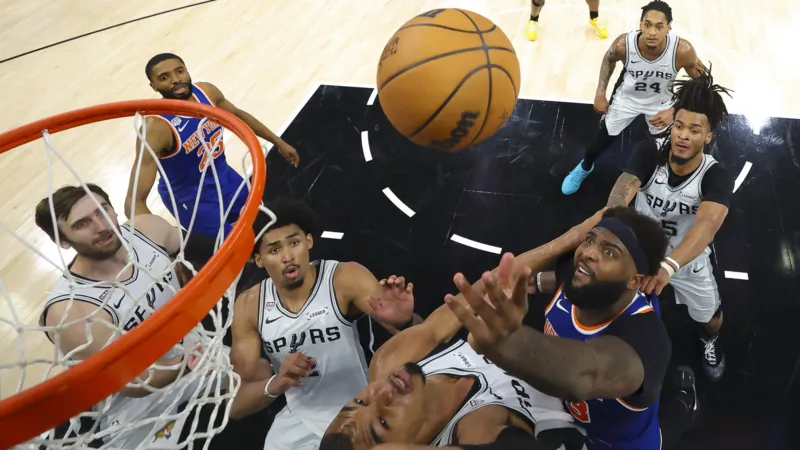
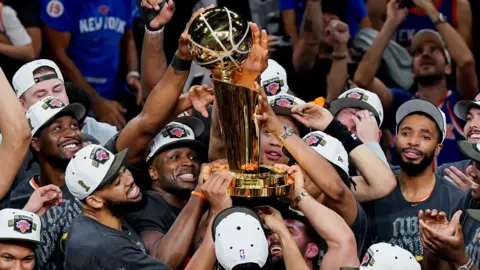
The New York Knicks won the National Basketball Association championship for the first time in over 50 years, sending the city and fans into a frenzy after the long-awaited victory.
The Knicks clinched the title on Saturday night against the San Antonio Spurs, 94-90, in the fifth game of the best-of-seven series.
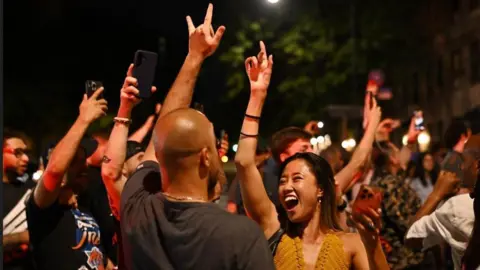
While the game was in Texas, New Yorkers took to their hometown streets in droves to watch and celebrate the milestone for fans and the city.
Some fans also made their way to Texas where the two teams faced off at the Frost Center, the Spurs’ home arena.
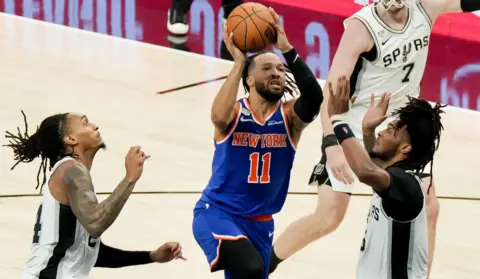
Elizabeth Madigan flew to San Antonio from New York Friday night ahead of Saturday’s game.
“I’ve been waiting for this, honestly most of my life. The last time the Knicks won, I was 6 months old, and so I can’t begin to describe how excited I am. It’s been unbelievable,” she said.
“I definitely had my doubts. But we did pull it off. Knicks forever.”
This season has represented a stunning reversal of fortune for the Knicks after decades as one of the worst teams in the league. The last time they made it all the way to the finals was in 1999, also against the Spurs, who ultimately beat them. Their last finals win was even earlier, in 1973.
They held a 3-1 lead in the series heading into Saturday’s game.
One fan who only gave his first name, Max, said that winning the game away from the Knicks’ home arena in New York, Madison Square Garden, isn’t important.
“I don’t think it matters [that they won in Texas]. New York is going crazy right now and there’s a million Knicks fans here right now, so it doesn’t matter.
US President Donald Trump posted congratulations to the team and Knicks owner Jim Dolan, who invited him to game 3 of the series in New York.
“What a year it has been but, even more so, what incredible playoff wins we have all witnessed, especially the last four – Maybe the greatest in the history of basketball,” the post read.
Fans’ anticipation before the game was like a champagne bottle about to pop.
“This city is electric,” said Jake Minicucci, while waiting with friends at a Manhattan sports bar for the game to start. “I’ve never gotten so many head nods, everybody knowing we are in it for the Knicks together.”
The 50-plus year drought was very much on the minds of some Knicks fans including Daniel Brown who said the evening had the potential “to be one of the best nights in the history of this city.”
“I’ve lived here all my life, I’ve never experienced anything like this,” said the 24-year-old.
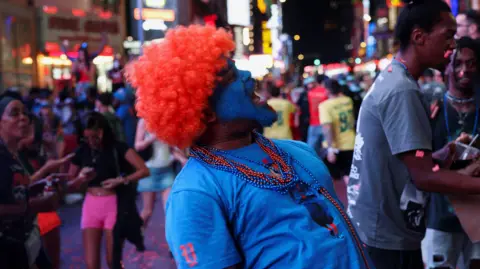
Fans celebrated into the early hours Sunday morning with crowds taking over parts of Midtown Manhattan, including several blocks near Times Square. Some subway lines were altered with trains skipping stations due to the large crowds.
“HISTORY,” New York City Mayor Zohran Mamdani wrote on social media.
A ticker-tape parade and ceremony at City Hall to celebrate the team’s victory is scheduled for Thursday.
Ahead of the game, Mamdani said in a post that the city was working with the Knicks to host watch parties at the Garden, Radio City Music Hall and Wollman Rink.
“As we celebrate, be responsible, look out for one another, stay safe, be smart, and make this a night that reflects the very best of our city,” the mayor said.
His call for safety came after a few instances of violence in New York against Spurs fans, including one assault that landed a fan in the hospital and another in which a fast food worker wearing a Spurs jersey was attacked, according to local reports.
Madigan said that in San Antonio, even as a Knicks fan, she felt welcome.
“Honestly, the San Antonians have been so loving and welcoming despite the obvious competition,” she said.

Ahead of Saturday’s Game 5, fans travelling to San Antonio from New York for the game were furious about possibly getting locked out of the arena.
In a note on its website for the game, Ticketmaster said purchases by those living farther than 150mi (241km) from the San Antonio arena would be cancelled and refunded without notice.
Later Ticketmaster assured fans that no tickets purchased on its platform “have or will be canceled”.

(BBC)

USS Canberra departs Colombo

The use of local organic Agricultural products in the Bakery Industry will strengthen both local farmers and the tourism industry – PM

Prime Minister meets with UNICEF delegation

Qatar net late against Switzerland to secure historic first World Cup point

Australia stun Turkiye 2-0 in counterattacking masterclass

Five Indian air force staff killed as transport plane crashes in Assam

‘Dates have the highest sugar content to fight Coronavirus’

Sunday Island 27 December – Headlines

#SundayIsland 17th December – Headlines

Sunday Island – 28th March

Sunday Island Headlines – 21 March

Sunday Island – 21st February – Headlines
-

 Editorial7 days ago
Probe Sallay’s complaint
-

 News3 days ago
CIABOC summons Yoshitha over his participation in British Navy training programme
-

 News5 days ago
Local firms move millions of dollars overseas for phantom imports: Govt.
-
 Midweek Review5 days ago
July 09: An inexcusable overall security failure and exceptional contingency plan
-

 Opinion6 days ago
Could Sri Lanka once again face an economic crisis similar to 2022?
-

 News5 days ago
AI raises concerns over arrest of Sallay and rapper under PTA
-
 News6 days ago
Sallay refuses to end hunger strike unless probe is taken out of CID led by Shani
-
 Latest News6 days ago
Iran and Israel say they will pause strikes but warn of retaliation if ceasefire breached again