
News
22 A: Amendments accepted at ‘committee stage’ should be subjected to SC approval


Nalin de Silva highlights major constitutional flaw
By Shamindra Ferdinando
Sri Lanka’s former Ambassador to Myanmar, Prof. Nalin de Silva, has said that whatever amendments introduced to a particular Bill at the committee stage should be definitely subjected to the approval by the Supreme Court.
The one-time Mathematics Don has stressed that the Speaker shouldn’t endorse the amended Bill until the Parliament obtained the Supreme Court’s consent.
Prof. De Silva said so commenting on a simmering controversy over Justice Minister Dr. Wijeyadasa Rajapakse, PC, manipulating the committee stage process to introduce new amendments which may not be in line with the Supreme Court ruling on the original Bill on the 22nd Amendment to the Constitution.
Prof. de Silva dealt with the issue at hand as sections of the ruling SLPP, including dissidents, warned against any moves to dilute executive powers to enable the full operationalisation of the 13th Amendment to the Constitution.
The outspoken retired academic has urged the Parliament to introduce an amendment to prevent the Speaker from endorsing an amended Bill, till the Supreme Court approves it.
Prof de Silva last served as Sri Lanka’s top envoy in Myanmar, from 2020 to 2021.
The activist described the absence of provision for the Supreme Court to examine a Bill, following the committee stage, as a major flaw in the Constitution. This loophole should be closed, Prof de Silva said, recalling how successive governments had exploited the committee stage of controversial Bills to pursue their agendas. Prof de Silva cited the passage of the 19th Amendment to the Constitution as a case in point.
Prof de Silva stressed that the Justice Minister’s approval of amendments were certainly not sufficient. Therefore, Supreme Court approval should be a prerequisite for the Speaker’s endorsement, he said.
Having pointed out that the 22nd Amendment had been presented to the public, through Gazette notification, Prof de Silva emphasized that the executive, the legislature and the judiciary were involved in the overall process.
Prof de Silva said that all amendments proposed to the 22 A that would be taken up for vote tomorrow (07) should be defeated. In fact, future attempts to introduce amendments at committee stage of a particular Bill, too, should be thwarted as the Speaker and the Justice Minister whichever party/alliance in power didn’t have the competence to examine the constitutionality of the proposals, Prof de Silva said.
The former diplomat said that the move to dilute executive powers should be examined against the backdrop of President Ranil Wickremesinghe’s failure to secure the required international financial assistance. Declaring that the incumbent government couldn’t obtain at least loans from Western powers let alone grants, Prof de Silva questioned the status of Sri Lanka’s much-touted Staff-Level Agreement with the International Monetary Fund now being contradicted by the government.
Prof de Silva was commenting on Premier Dinesh Gunawardena’s declaration in Parliament on Tuesday (04) that there was only a draft agreement and they were yet to finalize the Staff-Level Agreement with the IMF.
Prof de Silva said that before the finalization of the agreement, the draft agreement should be submitted to the Parliament.
The retired academic said that the government owed an explanation regarding the efforts to introduce constitutional amendments at a time political parties, represented in Parliament, should be concentrating on a tangible economic recovery plan. Prof de Silva asked whether they genuinely expected the introduction of 22 A to the Constitution would really enhance political stability.
Prof de Silva expressed serious concerns about how the powers that be could propose certain amendments at the committee stage of the 22 A with a view to appeasing the Tamil National Alliance (TNA) as well as the Sri Lanka Muslim Congress (SLMC), a constituent party of the main Opposition Samagi Jana Balavegaya (SJB). The retired University Don pointed out the possibility in the government proposing consultations between the appointing authority (the President) and the Chief Ministers in respect of the appointment of Governors of the Provinces. In terms of the Constitution now, the appointment of Governors is the prerogative of the President.
Prof de Silva said that the President couldn’t dilute executive powers enshrined in the Constitution.





Latest News
Heat Index at Caution Level in the Northern, North-central and North-western provinces and in Kegalle, Trincomalee and Batticaloa districts during the day time

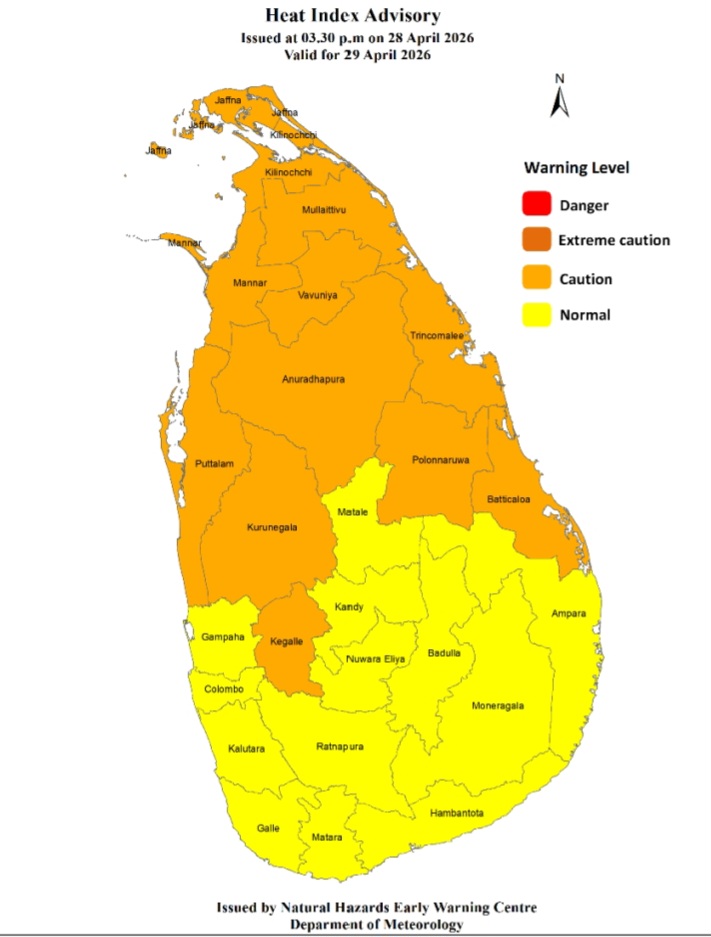
Warm Weather Advisory
Issued by the Natural Hazards Early Warning Centre
Issued at 3.30 p.m. on 28 April 2026, valid for 29 April 2026.
The Heat index, the temperature felt on human body is likely to increase up to ‘Caution level’ at some places in the Northern, North-central and North-western provinces and in Kegalle,
Trincomalee and Batticaloa districts during the day time.
The Heat Index Forecast is calculated by using relative humidity and maximum temperature and this is the condition that is felt on your body. This is not the forecast of maximum temperature. It is generated by the Department of Meteorology for the next day period and prepared by using global numerical weather prediction model data.

Effect of the heat index on human body is mentioned in the above table and it is prepared on the advice of the Ministry of Health and Indigenous Medical Services.
ACTION REQUIRED
Job sites: Stay hydrated and takes breaks in the shade as often as possible.
Indoors: Check up on the elderly and the sick.
Vehicles: Never leave children unattended.
Outdoors: Limit strenuous outdoor activities, find shade and stay hydrated.
Dress: Wear lightweight and white or light-colored clothing.
Note:
In addition, please refer to advisories issued by the Disaster Preparedness & Response Division, Ministry of Health in this regard as well. For further clarifications please contact 011-7446491.
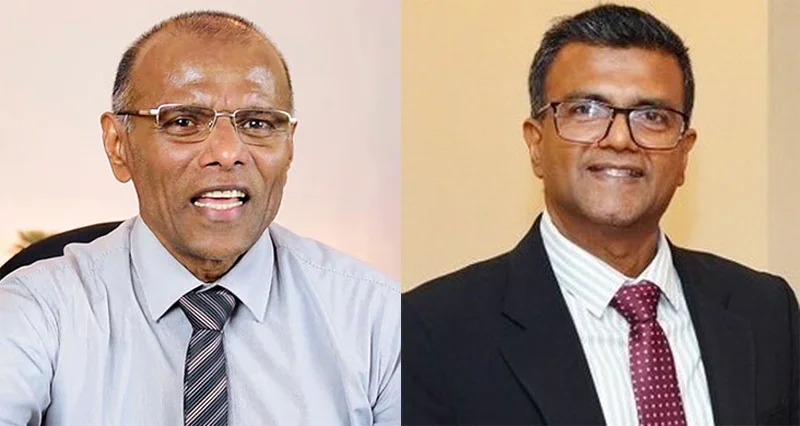
New controversy erupts over missing USD 2.5 mn:
Public interest activist Nagananda Kodituwakku has sought citizenship details of Finance Ministry Secretary Harshana Suriyapperuma from the Department of Home Affairs, Australia.
According to a letter dated 28 April, addressed to the relevant department, Solicitor England and Wales Kodituwakku sought the required information in terms of Section 15 of the Freedom of Information Act No 3 of 1982 of Australia. Suriyapperuma is also the Secretary to the Treasury.
The former Deputy Minister of Finance and Planning Suriyapperuma (from November 2024 to June 2025) is embroiled in a deepening controversy over the theft of USD 2.5 mn from the Treasury.
The leader of the Vinivida Foundation said that he intended to move court against Suriyapperuma for entering Parliament through the NPP National List in violation of the country’s Constitution (Article 91(1)(d)(xiiii).
Kodituwakku said: “This is clearly an accountability and integrity issue and violation of the Constitution of Sri Lanka and also this act contravenes the law of a member in the Commonwealth.”
USD 2.5 mn paid to a third party was meant to be an instalment of a loan taken from Australia. Suriyapperuma neither responded to an SMS nor answered his hand phone.
Geetha Kumarasinghe (UPFA/Galle District) and Diana Gamage (SJB National List) lost their seats in 2017 and 2024, respectively, over citizenship issues.
Meanwhile, public interest group ‘Free Lawyers’ that exposed the theft of Treasury funds questioned the failure on the part of Dr. Harsha de Silva, Chairman of Committee on Public Finance (CoPF), to pressure President Anura Kumara Dissanayake to temporarily remove Suriyapperuma to facilitate unhindered investigations.
On behalf of ‘Free Lawyers’, Rajith Keerthi Tennakoon yesterday expressed concern over the way the CoPF, under SJBer de Silva’s leadership, handled the issue at hand. Issuing an open letter, Tennakoon, urged the CoPF chief to explain his stand on a spate of vital issues which needed to be addressed without any further delay.
By Shamindra Ferdinando
News
President Anura Kumara Dissanayake handing over a sapling of the Sri Maha Bodhiya in Anuradhapura to Ven Bhikku Pannakara
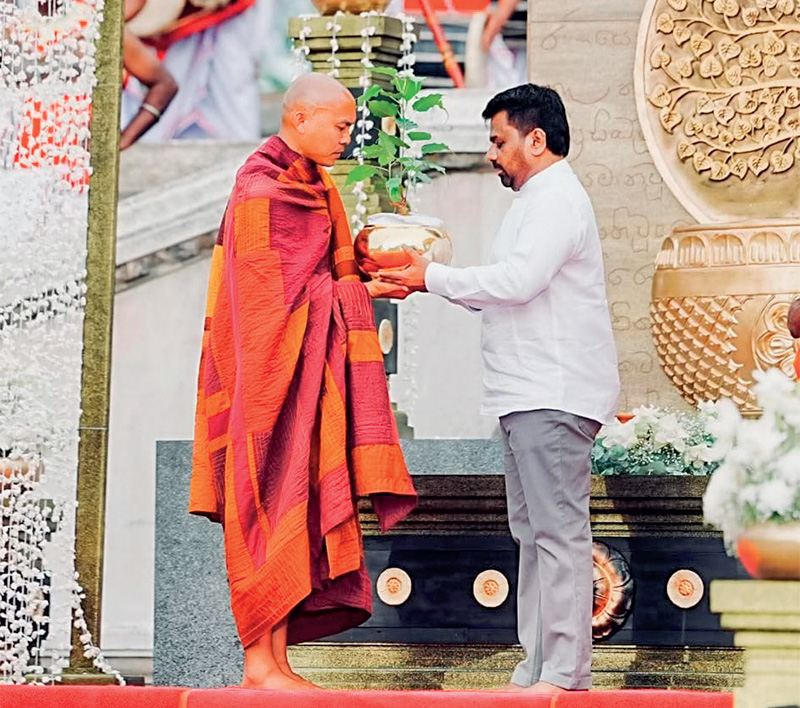
President Anura Kumara Dissanayake handing over a sapling of the Sri Maha Bodhiya in Anuradhapura to Ven Bhikku Pannakara (Sue Tue Nhan) at the conclusion of the 161 km ‘International Peace Walk’ in Colombo yesterday. The Bo-sapling will be taken to the US by the spiritual leader. Pic by Sujata Jayaratne

Ferreira, Shubham, Rajasthan Royals openers hand Punjab Kings their first defeat

Dulani and Samarawickrama set up Sri Lanka’s victory in T20I series opener

Heat Index at Caution Level in the Northern, North-central and North-western provinces and in Kegalle, Trincomalee and Batticaloa districts during the day time

Showers or thundershowers will occur in most parts of the island after 1.00 pm

Treasury chief’s citizenship details sought from Australia

President Anura Kumara Dissanayake handing over a sapling of the Sri Maha Bodhiya in Anuradhapura to Ven Bhikku Pannakara

‘Dates have the highest sugar content to fight Coronavirus’

Sunday Island 27 December – Headlines

#SundayIsland 17th December – Headlines

Sunday Island – 28th March

Sunday Island Headlines – 21 March

Sunday Island – 21st February – Headlines
-

 News6 days ago
Lanka faces crisis of conscience over fate of animals: Call for compassion, law reform, and ethical responsibility
-
 News5 days ago
Whistleblowers ask Treasury Chief to resign over theft of USD 2.5 mn
-

 News5 days ago
No cyber hack: Fintech expert exposes shocking legacy flaws that led to $2.5 million theft
-

 News2 days ago
BIA drug bust: 25 monks including three masterminds arrested
-

 Business3 days ago
Nestlé Lanka Announces Change in Leadership
-

 News2 days ago
Banks alert customers to phishing attacks
-
 News3 days ago
Hackers steal $3.2 Mn from Finance Ministry
-

 News6 days ago
USD 2 mn bribe: CID ordered to arrest Shasheendra R, warrant issued against ex-SriLankan CEO’s wife