
Business
Expolanka Holdings-linked share transaction boosts foreign inflows


By Hiran H. Senewiratne
The CSE fell 0.24 per cent in mid-morning trade yesterday while mixed reactions were noted in both indices due to profit- takings by investors. However, net foreign inflows reported year to date were more than Rs 5.7 billion. The company with the largest market capitalization, Expolanka Holdings, saw the bulk of its shares being bought by its main shareholder S.G Holdings, which was a foreign entity, and this was the reason for increasing foreign inflows to the market, stock market analysts said. The main All- Share Price Index edged down 11.3 points and the S and P SL20 rose by 1.2 points.
Turnover stood at Rs 5.3 billion with four crossings. Those crossings were reported in Expolanka Holdings, which crossed 7.5 million shares to the tune of Rs 1.7 billion, its shares traded at Rs 230, Royal Ceramic four million shares crossed to the tune of Rs 160 million and its shares traded at Rs 40.10, Citizens Development Business Finance 660,000 shares crossed to the tune of Rs 130 million, its shares fetched Rs 200 and Melstacorp 500,000 shares crossed to the tune of Rs 28.7 million, its shares fetched Rs 57.50.
In the retail market top seven companies that mainly contributed to the turnover were Lanka IOC Rs 292 million (1.1 million shares traded), ACL Cables Rs 275.8 million (1.9 million shares traded), Expolanka Holdings Rs 275 million (1.2 million shares traded), Royal Ceramic Rs 193 million (4.7 million shares traded), Lankem Development Rs 191 million (1.7 million shares traded), JKH Rs 185 million (1.2 million shares traded) and First Capital Holdings Rs 164 million (11.3 million shares traded). During the day 136 million share volumes changed hands in 37000 share transactions.
During the day Manufacturing sector share prices appreciated and the Lanka IOC share price also appreciated because a much awaited petroleum price revision did not take place the previous night. It is said high net worth and institutional investor participation was noted in Expolanka Holdings, Sampath Bank and Richard Pieris & Company. Mixed interest was observed in JKH, Lanka IOC and ACL Cables, while retail interest was noted in SMB Leasing, HNB Finance and Browns Investments.
The Capital Goods sector was the top contributor to market turnover (due to JKH and ACL Cables), while the sector index gained 4 per cent. The share price of JKH gained Rs. 12 (8.63 per cent) to close at Rs. 151. The share price of ACL Cables appreciated by Rs. 8.50 (10.66 per cent) to close at Rs. 88.20.The Transportation sector was the second highest contributor to the market turnover (due to Expolanka Holdings), while the sector index decreased by 0.33 per cent. The share price of Expolanka Holdings decreased by 75 cents (0.33 per cent) to close at Rs. 226.25.
Lanka IOC and Sampath Bank were also included amongst the top turnover contributors. The share price of Lanka IOC moved down by Rs. 5 (1.90 per cent) to close at Rs 257.75. The share price of Sampath Bank recorded a gain of Rs. 4.30 (11.81 per cent) to close at Rs 40.70.Separately, Kelani Valley Plantations announced a first interim cash dividend of Rs. 2.50 per share.Yesterday, the Central Bank announced the US dollar buying rate as Rs 358.94 and selling rate as Rs 369.91. Data showed that commercial banks offered dollars for telegraphic transfers at between Rs 369.45 and Rs 370 for small transactions.











‘Market participants appear to be focusing more on underlying vulnerabilities’
Sri Lanka’s banking system continues to show resilience despite mounting domestic and global economic pressures, but developments across financial markets tell a more cautious story, with foreign investors retreating, market volatility rising, and the rupee remaining under pressure despite a major IMF-related inflow.
According to the Central Bank’s latest Financial Sector Performance report, banks and finance companies entered 2026 with strong credit growth, healthy capital buffers, and improving asset quality. Yet the same report points to growing strains in equity, bond, and foreign exchange markets, suggesting investors remain unconvinced that the country’s recovery is firmly on track.
The contrast between financial institutions and financial markets has become increasingly pronounced.
Licensed banks expanded credit by 24.4% year-on-year during the first quarter, while finance companies recorded even stronger growth of 52.4%. Despite this, foreign investors continued to reduce exposure to Sri Lankan assets. Net foreign outflows from the Colombo Stock Exchange reached US$103.4 million during the first five months of the year, extending a trend that has persisted since 2024.
Reflecting this caution, the All Share Price Index fell 1.4% by end-May, while the benchmark S&P SL20 Index managed only a marginal gain of 0.03%. The Central Bank attributed the subdued performance to heightened sensitivity to global risk sentiment, rising domestic inflation expectations, and external shocks, including geopolitical tensions in the Middle East.
An independent analyst told The Island Financial Review that despite Sri Lanka receiving a fresh US$695 million IMF disbursement in late May, the rupee has continued to face volatility and depreciation pressures.
“Market participants appear to be focusing less on short-term inflows and more on underlying vulnerabilities, including a widening trade deficit, higher energy import costs, geopolitical uncertainties, and concerns about the sustainability of external sector gains,” he said.
The analyst noted that the Central Bank itself acknowledged continued volatility in the foreign exchange market amid increasing external pressures. Meanwhile, government securities have also come under strain, with yields rising from March and increasing further after the Central Bank raised policy interest rates in May.
“Such developments indicate that markets are demanding higher returns to compensate for perceived risks, even as macroeconomic indicators show signs of improvement,” he said.
The contrast is particularly striking when viewed against the banking sector’s performance. Non-performing loans continued to decline, with the Stage 3 loan ratio falling to 9.4% from 12.7% a year earlier. Liquidity and capital levels remain comfortably above regulatory requirements, while lending activity has strengthened, pushing the credit-to-deposit ratio above 70% for the first time in three years.
However, the analyst argued that risks may now be migrating elsewhere within the financial system and broader economy. He pointed to the credit-to-GDP gap moving further into positive territory, a development often viewed as an early warning signal of excessive credit expansion and future vulnerabilities. The Central Bank has already tightened lending standards for vehicle financing and gold-backed loans, two segments that have recorded rapid growth.
“While banks remain profitable and well-capitalised, market signals suggest investors are increasingly focused on inflation risks, exchange-rate instability, geopolitical tensions, and the prospect of tighter financial conditions. The banks appear comfortable. Investors, however, are not yet fully convinced,” he said.
By Sanath Nanayakkare
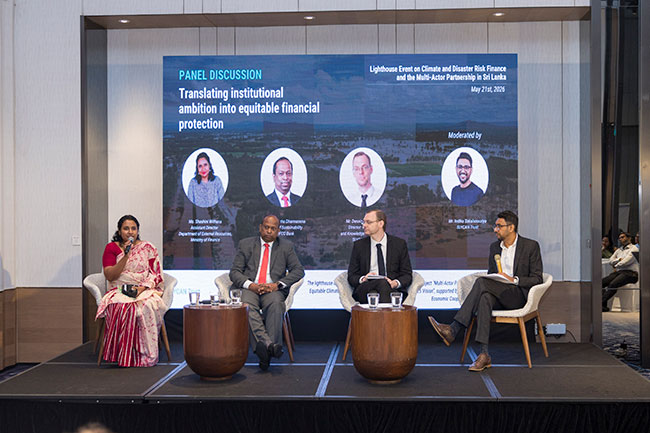
Sri Lanka must strengthen its financial and social protection systems to better withstand climate-related disasters, according to experts and stakeholders who gathered at a climate risk finance event organized by SLYCAN Trust in Colombo.
The Lighthouse Event on Climate and Disaster Risk Finance and the Multi-Actor Partnership (MAP), held on 21 May, brought together representatives from government, the financial sector, development agencies, academia, civil society, and international experts to discuss ways of improving the country’s preparedness and resilience against growing climate threats.
Participants emphasized the urgent need for financial protection mechanisms that can support vulnerable communities, small businesses, workers, and public institutions before and after disasters such as floods, droughts, landslides, cyclones, and extreme weather events. Recent impacts from Cyclone Ditwah were cited as a reminder of the financial strain climate shocks can place on households, businesses, and government agencies.
The event also marked six years of the Multi-Actor Partnership on Climate and Disaster Risk Finance in Sri Lanka, a platform established by SLYCAN Trust under a global programme supported by Germany’s Federal Ministry for Economic Cooperation and Development (BMZ).
Dennis Mombauer, Director of Research and Knowledge Management at SLYCAN Trust, highlighted the importance of improving risk and finance literacy, building trust, strengthening institutional capacity, and addressing gaps in data and coordination. He stressed the need for financial instruments that can protect people not only after disasters occur but also in anticipation of future risks.
CARE Germany’s Programme and Contract Manager for International Programmes, Hanna Bartels, underscored the importance of collaboration among governments, financial institutions, businesses, civil society, and communities. She noted that similar initiatives are being pursued in several countries worldwide.
Discussions also focused on sector-specific vulnerabilities, including heat stress in the apparel industry, climate-related disruptions in tourism, and the need for stronger insurance and financial support mechanisms for farmers and rural communities.
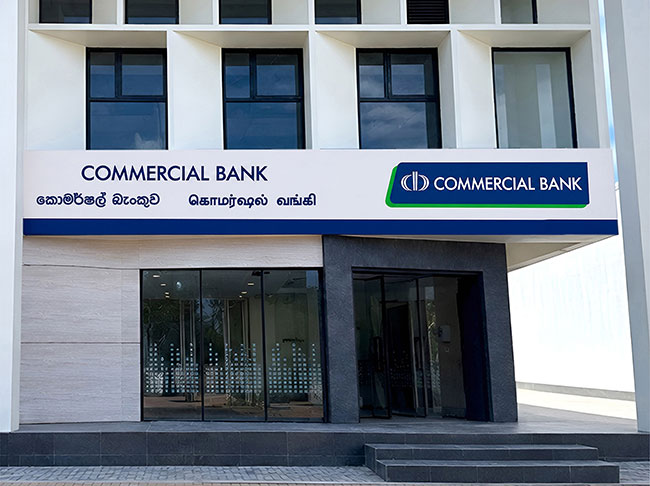
Commercial Bank of Ceylon PLC’s new branch in Port City Colombo is poised to bring world-class banking services to Sri Lanka’s emerging international financial hub.
Located at Building 04 in Area 02 of the Port City Business Centre – Commercial Hub, Commercial Bank’s Port City Colombo branch will function as a fully-fledged banking operation, strengthening the Bank’s presence in one of Sri Lanka’s most strategically significant emerging economic zones. Designed to serve the evolving financial requirements of corporates, investors, businesses, professionals and retail customers within the Port City Colombo ecosystem, the branch offers access to Commercial Bank’s comprehensive portfolio of financial solutions. These include current and savings accounts, fixed deposits, personal and business lending, housing and leasing facilities, credit and debit card services, inward and outward remittances, foreign currency accounts and transactions, trade finance solutions, import and export services, corporate banking, treasury and foreign exchange services, cash management solutions and digital banking facilities.
By combining full-service branch banking with digital capabilities and uninterrupted self-service access, the new branch reflects Commercial Bank’s commitment to delivering future-ready, accessible and internationally aligned financial services in support of Port City Colombo’s growth as a dynamic hub for commerce, investment and innovation.

T20 World Cup: Heavyweights, hopefuls and a debutant headline Group 1

Showers in the Western, Sabaragamuwa and North-western provinces and in Galle, Matara, Kandy and Nuwara-Eliya districts

Diesel replacement costs up to Rs. 4.5 bn in April

Sallay on hunger strike: Counsel warns CID

Opp. questions why Rs 10 bn meant for Ditwah victims held in Treasury account

‘Samurdhi Bank operates without dedicated audit framework’

‘Dates have the highest sugar content to fight Coronavirus’

Sunday Island 27 December – Headlines

#SundayIsland 17th December – Headlines

Sunday Island – 28th March

Sunday Island Headlines – 21 March

Sunday Island – 21st February – Headlines
-

 News6 days ago
Lankan duo emerge winners in Latin dance championship held in Blackpool, UK
-

 Latest News4 days ago
Kusal Mendis, Pathum Nissanka, bowlers put Sri Lanka 1-0 up
-

 News4 days ago
New US tariffs proposed on 60 countries, including Sri Lanka
-

 Features3 days ago
Power crept into the Sangha and is now tearing it apart
-

 News6 days ago
Sri Lankan teen killed in Chennai clash; three arrested
-

 Features3 days ago
Kondachchi wind farm and battery storage project to boost energy security, says Power Ministry Secretary
-

 Features3 days ago
Saudi Arabia sets new benchmark in Hajj management as 1.7 million pilgrims complete sacred journey
-

 News2 days ago
Asst. Manager, security officer arrested over Rs 30 mn snatch at Horana PB branch