
News
Retracing historical and cultural links between Tamil Nadu and Sri Lanka


By T. Ramakrishnan
The recently consecrated Thiruketheeswaram temple in Mannar in Sri Lanka’s Northern Province has come to symbolise close ties between Tamil Nadu and the island nation, thanks to the involvement of the Government College of Architecture and Sculpture, Mamallapuram, in the temple’s restoration.
Regarded as one of the five important abodes of Lord Shiva in Sri Lanka, the temple, said to have been worshipped by Saivite saint Thirugnanasambandar, was damaged during the protracted civil war that ended in May 2009. It had a fresh lease of life following the Indian government’s decision to fund the renovation project and lend its technical expertise. The ‘mahamandapam’ was renovated with the support of the Mamallapuram college and materials, including granites, were procured from Tamil Nadu. While the Indian government provided a grant of LKR 320 million for the restoration, which eventually cost LKR 900 million, the Archaeological Survey of India supervised its execution.
Beyond Thirukeetheswaram, the relationship between the two territories can be traced to the proto-historic times. Marks, similar to graffiti inscribed potsherds discovered during early excavations at Adichanallur, Korkai and many other sites of the Early Historic period, were recovered from places such as Tissamaharama, Kantarodai, Manthai and Ridiyagama in Sri Lanka, according to a 2019 publication of the Tamil Nadu Department of Archaeology on Keeladi. Historians also refer to continuous trade links between the two regions, citing the discoveries in Tamil Nadu of Sinhala Prakrit inscriptions on pottery.
In fact, veteran numismatist, art historian and archaeologist of Sri Lanka Osmund Bopearachchi has even recorded in a 2008 paper on ancient Sri Lanka and Tamil Nadu that Sinhalese traders were present in Tamil Nadu in the same period when Tamil traders were active at Anuradhapura and Tissamaharama in Sri Lanka.
He has also stated that the epigraphic and literary evidence for “the active role played by Tamil merchants in the early phase of Sri Lanka’s history is numerous”. In a conversation with this newspaper in 2017, Dr. Bopearachchi, former Adjunct Professor of Central and South Asian Art, Archaeology, and Numismatics, University of California, Berkeley, said, “The earliest coins found in Sri Lanka were Pandya and Chera coins.”
In K.A. Nilakanta Sastri’s seminal work, A History of South India, one can find numerous accounts of battles between rulers of southern India and Sri Lanka. A significant account of them pertains to how Rajendra Chola-I (1012-44 CE) completed the conquest of Sri Lanka begun by his father Rajaraja Chola (985-1016 CE) and Mahinda V’s son, Kassapa, became the centre of Sinhalese resistance to the Tamil power. Sri Lanka’s prominent historian K.M. de Silva, in his landmark work A History of Sri Lanka, points out that Nayakkars, who belonged to the Vaduga caste, “a Telugu-speaking group originally hailing from Madurai,” established marriage ties with the Kandyan royal family during the 17th century. He adds that the accession of the Nayakkar dynasty to the Kandyan throne in 1739 CE was “accommodated with the minimum of disturbance”.
On the side of culture and religion, Kataragama in the deep south, once regarded by people in Tamil Nadu as one of the six abodes of Lord Muruga, has shrines for Muruga, Shiva and Deivanai Amman, making any visitor from Tamil Nadu feel at home. Aimed at attracting a larger number of tourists from Tamil Nadu, the Sri Lankan authorities are planning to launch a Muruga trail, apart from the old Ramayana trail. Rajaraja Chola had got people of Sri Lanka involved in the construction of the Brihadeeswara temple in Thanjavur, says M. Rajendran, former Vice-Chancellor of Tamil University.
G.P.V. Somaratna, former Head of Department of History and Political Science, University of Colombo, in his paper ‘Tamil Buddhism in Sri Lanka’, states that the presence of Buddhism in ancient Tamil Nadu had a “great impact” on Buddhist activities in Sri Lanka and the northern part of the island in particular.
Since the classical period, there have been significant contributions from literary personalities belonging to Sri Lanka’s Tamils to Tamil literature. Tamil scholar of yesteryear Mu. Varadarajan, in his work on the history of Tamil literature ( Tamil Illakkiya Varalaru), records that Eezhathu Poothanthevanar, a poet from Sri Lanka, had composed seven verses of the Sangam anthology.
Ayathurai Santhan, an award-winning Sri Lankan Tamil writer, notes that one of the Tamil classics, Manimekalai, refers to an islet, Manipallavam, which has been identified with the present Nainativu of Sri Lanka. Dr. Rajendran observes that the Pathni cult, the worship of Kannaki, had spread to Sri Lanka from Tamil Nadu.
Prominent scholars Arumuga Navalar (1822-1889) and C.V. Damodaram Pillai (1832-1901) had strong connections with Chennai. Tiruppur Krishnan, editor of Amudhasurabhi, refers to Vipulananda Adigal (1892-1947), who was known not only for his work in the expansion of activities of Ramakrishna Mission in Sri Lanka but also for his contribution to Tamil literature. He recalls how veteran writer-editors such as Ki. Va. Jagannathan (1906-88) and Naa. Parthasarathy (1932-87) made it a point to visit Sri Lanka regularly for mobilising subscriptions for their journals, Kalaimagal and Deepam. Mr. Santhan is of the view that K. Kailasapathy, Karthigesu Sivathamby, Dominic Jeeva and Se. Ganesalingan were among those who left behind a huge impact on the Tamil literary field.
In recent years, the social relationship between people of Sri Lanka and those of India in general, Tamil Nadu in particular, has only grown due to a variety of reasons. Be it the 1983 anti-Tamil pogrom or the present spell of economic crisis, sections of Sri Lankan society have found in Tamil Nadu a safe haven. But, given the historical, cultural and sociological factors, there are deeper reasons for the peoples of the two lands to be closer than what they have been.
(The Hindu)

Latest News
Landslide Early Warnings issued to the districts of Colombo, Galle, Gampaha, Hambanthota, Kalutara, Kandy, Kegalle, Kurunegala, Matara, Nuwara Eliya and Ratnapura

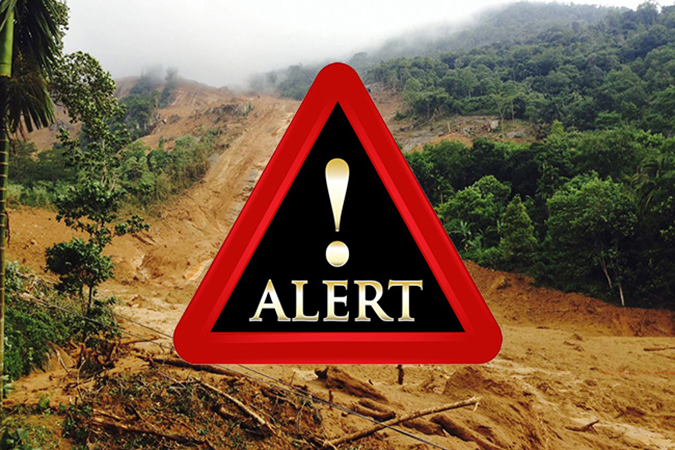
The National Building Research Institute has issued landslide early warnings to the districts of Colombo, Galle, Gampaha, Hambanthota, Kalutara, Kandy, Kegalle, Kurunegala, Matara, Nuwara Eliya and Ratnapura from 16:00 hrs on 25.09.2026 To 16:00 hrs on 26.09.2026
Accordingly,
LEVEL III [RED] landslide early warnings have been issued to the Divisional Secretaries Divisions and surrounding areas of Neluwa, Nagoda, Niyagama and Thawalama inthe Galle district, Ganga Ihala Korale, Udapalatha, Doluwa and Pasbage Korale in the Kandy district, and Kothmale West, Ambagamuwa, Kotmale East and Norwood in the Nuwara Eliya district.
LEVEL II [AMBER] landslide early warnings have been issued to the Divisional Secretaries Divisions and surrounding areas of Elpitiya, Baddegama and Karandeniya in the Galle district, Walallawita in the Kalutara district, Deltota, Udunuwara, Gangawata Korale, Yatinuwara and Panvila in the Kandy district, Aranayake, Dehiowita, Mawanella, Deraniyagala and Yatiyanthota in the Kegalle district, Thalawakelle in the Nuwara Eliya district and Ratnapura and Pelmadulla in the Ratnapura district.
LEVEL I [YELLOW] landslide early warnings have been issued to the Divisional Secretaries Divisions and surrounding areas of Seethawaka and Padukka in the Colombo district, Attanagalla and Mirigama in the Gampaha district, Katuwana and Walasmulla in the Hambanthota district, Ingiriya and Bulathsinhala in the Kalutara district, Hatharaliyadda, Poojapitiya, Medadumbara, Kundasale, Ududumbara, Thumpane, Akurana, Pathadumbara, Harispattuwa and Pathahewaheta in the Kandy district, Warakapola, Bulathkohupitiya, Galigamuwa, Kegalle and Ruwanwella in the Kegalle district, Mallawapitiya, Alawwa, Polgahawela and Mawathagama in the Kegalle district, Pitabeddara, Kotapola and Pasgoda in the Matara district, Nuwara Eliya in the Nuwara Eliya district and Elapatha, Ayagama, Nivithigala, Kuruwita and Kalawana in the Ratnapura district
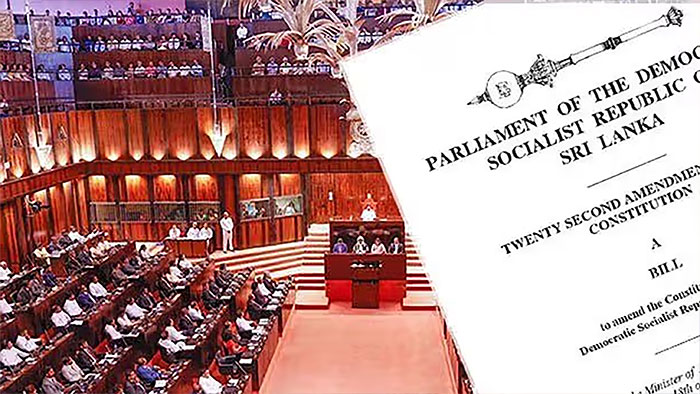
Parliament yesterday passed the Twenty-Second Amendment to the Constitution Bill and the Judicature (Amendment) Bill with two-thirds majorities, with 158 MPs voting in favour and 63 against each Bill.
The Illankai Tamil Arasu Kadchi (ITAK) and Sri Lanka Muslim Congress (SLMC) voted with the SJB against the Bills.
NDF MPs Ravi Karunanayake and Faizer Musthapha and SJB Badulla District MP Nayana Wasalathilaka were not present when the votes were taken.
The final vote on the Judicature (Amendment) Bill was announced at around 8.08 p.m. after Opposition MPs called for divisions on its clauses during the Committee Stage.
The votes followed a two-day debate which commenced on Thursday (24), after Justice and National Integration Minister Harshana Nanayakkara presented the Bills for their Second Reading.
The Supreme Court’s determination on the Bills was presented to Parliament on Tuesday (22) by Speaker Dr Jagath Wickramaratne. The Court determined that the 22nd Amendment Bill did not require approval at a referendum and could be passed by a special two-thirds majority in Parliament.
The amendment provides for raising the mandatory retirement age of Supreme Court judges from 65 to 67 and that of Court of Appeal judges from 63 to 65. It also provides for the Chief Justice to retire at 67 or after completing six years in office, whichever comes earlier.
The Speaker informed Parliament that the Judicature (Amendment) Bill could be passed by a simple majority.
The SJB opposed the legislation and its MPs attended Parliament dressed in black yesterday. The party also staged a protest at Polduwa Junction, Battaramulla, under the theme “No to 22, which destroys democracy”, with Opposition Leader Sajith Premadasa and several SJB politicians participating.
A valid Taxpayer Identification Number (TIN) Certificate will be required for a range of key transactions in Sri Lanka from November 1, 2026, the Inland Revenue Department (IRD) has announced.
The requirement, introduced under the Inland Revenue (Amendment) Act, No. 11 of 2026, applies to transactions specified under Section 102(3) of the Inland Revenue Act.
Accordingly, individuals will be required to produce a valid TIN Certificate when opening an account at a bank or financial institution, obtaining approval for a building plan, registering or renewing the licence of a motor vehicle, registering land or title to land, registering a business, transferring shares in a company incorporated in Sri Lanka or obtaining a credit card.
In the case of share transfers, both the transferor and transferee will be required to provide TIN certificates.
The IRD said officials handling such transactions had been instructed to ensure that a valid TIN Certificate was submitted before processing or completing the relevant transaction.
The Department advised those who do not already have a TIN to obtain one in advance through its e-Services platform.
It said a printout of the TIN verification result showing the applicant’s National Identity Card number and TIN could also be accepted instead of the certificate.The IRD also reiterated that obtaining a TIN is mandatory for resident individuals aged 18 and above under the applicable provisions.

Landslide Early Warnings issued to the districts of Colombo, Galle, Gampaha, Hambanthota, Kalutara, Kandy, Kegalle, Kurunegala, Matara, Nuwara Eliya and Ratnapura

Showers in the Western, Uva and Sabaragamuwa provinces and in Galle, Matara, Kandy, Nuwara-Eliya, Batticaloa and Ampara districts.

22A, Judicature Amendment Bills passed with 2/3 majority

TIN mandatory for key transactions from Nov. 1

Navy brings 25 Indonesian fishermen ashore after trawler capsizes

Former Mineral Sands Chairman arrested over recruitment irregularities

‘Dates have the highest sugar content to fight Coronavirus’

Sunday Island 27 December – Headlines

#SundayIsland 17th December – Headlines

Sunday Island – 28th March

Sunday Island Headlines – 21 March

Sunday Island – 21st February – Headlines
-

 News6 days ago
Namal Rajapaksa Buddhist gambit fails, bail denied
-

 Features6 days ago
Why the spelling Sri Lankan names in English vary
-

 Features6 days ago
Three bands, a new identity: Sri Lankan wolf snake recognised as distinct species
-
 Business6 days ago
SLIIT holds largest-ever convocation
-

 News6 days ago
Vehicle prices drop by up to Rs. 1 mn, says importers’ body
-

 News6 days ago
Govt monitors reported Saudi death sentence – Foreign Ministry
-
 Business6 days ago
Lanka’s famed beach shack battles demolition
-

 Business6 days ago
All-new Bolero MaXX Pik-Up unveiled in Lanka