
News
Wide ranging rackets benefiting CEB engineers


By Ifham Nizam
The Ceylon Electricity Board implements most of its power transmission and distribution infrastructure development projects like the construction of new transmission lines, transmission and distribution substations, etc., using loan funds obtained from international lending agencies such as the Asian Development Bank (ADB) and Japan International Cooperation Agency (JICA).
These “concessionary” loans are guaranteed by the government, and projects funded by those loan packages are implemented through specially set up project management units (PMUs).
Engineers attached to PMUs are given special facilities and monetary incentives on the understanding that they will work outside normal working hours and weekends to complete their projects on time and within the allocated budget.CEB often justifies these projects for priority financing citing “great national importance” and the critical needs to improve the power transmission and distribution infrastructure of the country.
Almost all of these project titles carry the words like “green energy”, “clean energy”, “green power”, etc., signifying these investments are primarily aimed at using renewable energy.
However, according to a senior official of the Ministry of Power & Energy, these projects are seldom completed within the given time period or budget. Because of this reason not only the expected benefits of these investments are often lost to the country, but the government incurs heavy losses by way of commitment fees paid to lending agencies.
Once project funds are committed through a loan agreement, the government has to pay this fee to the lending agency, generally computed as a percentage of the loan amount or the “commitment amount”. It is a significant burden to the government, especially in a situation where there is a severe shortage of foreign currency.
If the loan funds are disbursed within the original term of the loan, this “front end fee” is charged at a lower percentage. Hence, when CEB does not complete projects in time, the government ends up paying a higher commitment fee, and is also forced to seek an extension to the original loan disbursement period, thus incurring further costs.
Even more disturbing than long delays in project completion is that some completed projects have turned out to be wasteful investments of foreign funds given to the country.It is understood that the former CEB Chairman M. M. C. Ferdinando had questioned why the new 132kV transmission line between Ambalangoda and Galle, which was completed in 2017 at a cost of Rs. 1,500 million, remained unserviceable to date.
The Sunday Island understands that CEB’s System Control Center is able to switch on this transmission line only when the Samanalawewa Hydropower Plant is running at full capacity.This project had been billed by CEB’s transmission planners as a high-priority investment and solution for the serious transmission bottlenecks in the southern network of the country. Southern areas had been experiencing serious transmission capacity restrictions for decades.It is understood that the CEB General Manager has responded to the Chairman’s inquiry by stating that the commissioning of several new transmission lines that are presently under construction would make the Ambalangoda-Galle transmission line operational.
The 220kV transmission line from Pannipitiya to Polpitiya via Padukka is another example of a costly planning blunder by the CEB. Construction of this long transmission line commenced in 2015 but was delayed owing to many problems, including public protests and court cases filed by some landowners.However, when this ADB-funded project was eventually completed in late 2021 (after a delay of over five years), it has been discovered the power flows in the wrong direction when the line is switched on, causing overloading of the Pannipitiya substation.Hence, this transmission line also remains idle presently. It is understood that CEB planners have explained that power would flow in the right direction once several other transmission lines (being constructed under different loan packages, and already delayed by many years) are completed.
The then CEB General Manager taking part in a national television discussion following the countrywide power outage on August 17, 2020, explained that the unavailability of this critical transmission line was a major contributing factor to CEB’s inability to restore supply for many hours.Another example of colossal waste of funds is the transmission substation at Kappalthurai in the eastern province that has cost the country over Rs. 2,500 million of ADB loan funds. Since there is no high demand for electricity or no future growth in demand in the area, this installation will be idle for the foreseeable future.
According to CEB employees, the existing Trincomalee substation, which is situated about 11 km from this new substation, has ample capacity to serve the electricity demand in the area for many years to come. In the meantime, CEB has made a large investment in increasing the capacity of the Trincomalee substation as well.It is also understood that CEB’s Projects Division has been maintaining several non-functional PMUs for years, spending large sums of money on rented project offices and large project staff, even when no funding has been secured for relevant projects.
CEB employees complain that project directors and their engineers attached to these “white elephants” are allowed to enjoy all benefits, including project allowance (an additional amount equal to one-third of monthly salary) and luxury SUVs because most of them hold important positions in the powerful CEB engineers’ union.They claim that the CEB management never holds to account any project manager responsible for long delays, but they are allowed to continue to enjoy all the perks. According to a senior engineer who works as a consultant on project-related work, this guarantee of “job security” acts as a strong incentive for the project engineers to prolong their projects.CEB employees believe another reason for this lackadaisical attitude of CEB top management is that foreign-funded projects have long been a steady source of luxury vehicles for CEB engineers.
Most vehicles used by top CEB engineers including the General Manager have been provided under different foreign-funded projects, as the existing government guidelines will not allow the purchase of such high-end SUVs having large engine capacity including premium European makes like Audi and Mercedes Benz for government officials.CEB employees complain that the Ministry of Power & Energy generally turns a blind eye to these irregularities mainly because the majority of project managers and their project engineers are top officials of the powerful engineers’ union.
They allege that even the Public Utilities Commission of Sri Lanka (PUCSL,) which has the legal obligation to ensure CEB will not make unnecessary or wasteful investments in its transmission infrastructure, has never questioned CEB regarding assets that are idling for many years after spending billions of rupees of public money.



News
Establishment of an Institutional Framework to Inagurate Upper Hydro Catchment Areas Management Authority

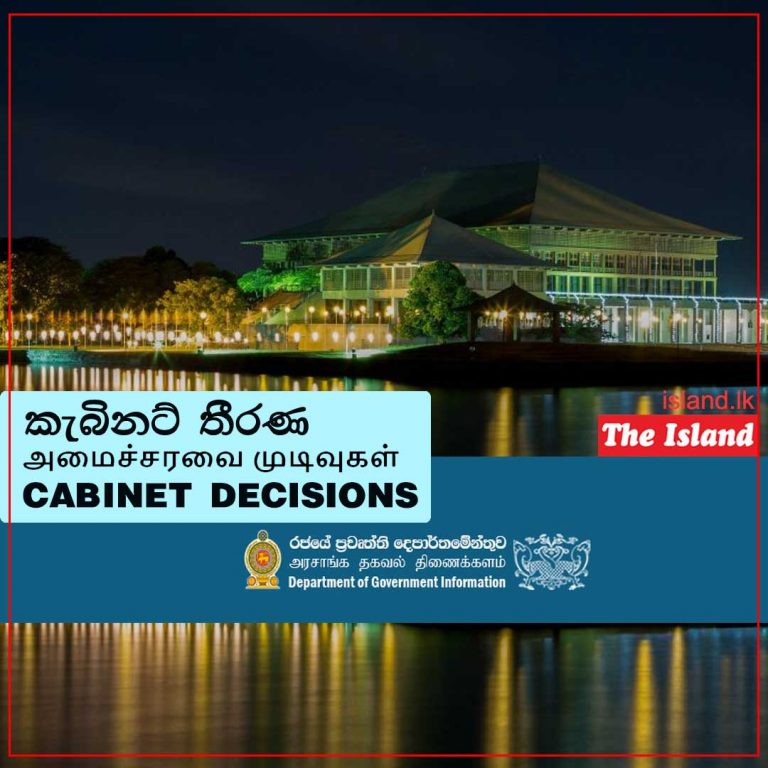
Policy approval of the Cabinet of Ministers was granted at their meeting held on 08.06.2026 to establish the Upper Hydro Catchment Areas Management Authority for identification and
execution of a formal and long – lasting remedy to secure the central hills including the upper hydro catchment areas enabling them to sustain amidst extreme weather conditions
due to natural calamities and human activities as well as to be used for the sustainable development of the country.
Accordingly, a concept paper has been prepared including
institutional structure, activities, powers, active subject area as well as administrative and coordination mechanism for the proposed authority by an expert technical committee appointed by the Secretary to the President.
Based on the said concept paper, the Cabinet of Ministers granted approval to the resolution furnished by the President to instruct the Legal Draftsman to prepare a draft bill including legal provisions required for the establishment of Upper Hydro Catchment Areas Management Authority.
News
Introduction of Flora and Fauna (Regulation of actions of the Indigenous Community within the nominated areas) Regulations
With the objective of securing the traditional livelihood and the eco system of the indigenous community, it has been recognized the necessity of introducing a formal regulation methodology to secure their engagement in livelihood activities by being more sensitive to the existing laws.
Thereby, the Fauna and Flora (regularizing) regulations under the Fauna and Flora Protection Ordinance (Authority 469) have been prepared so that nominated activities within the prescribed area to a member of the indigenous community
who has been registered for securing the rights acquired from law or custom or usage or traditional stance to execute an act within a certain state land that is fundamental to the survival of the indigenous community permission can be granted
Accordingly, the Cabinet of Ministers granted approval to the resolution furnished by the Minister of Environment to publish the said regulations in the government gazette notification and thereby submit to the Parliament for its concurrence.
Latest News
M. M. D. J. Senarathne, appointed Director General of the Department of National Botanical Gardens
The Cabinet of Ministers approved the resolution furnished by the Minister of Environment to appoint M. M. D. J. Senarathne, who is the senior most officer in Grade I of Sri Lanka Scientific Service se

Establishment of an Institutional Framework to Inagurate Upper Hydro Catchment Areas Management Authority
Introduction of Flora and Fauna (Regulation of actions of the Indigenous Community within the nominated areas) Regulations
M. M. D. J. Senarathne, appointed Director General of the Department of National Botanical Gardens

Harmanpreet Kaur steps down as India captain

Turkiye, Pakistan agree Saudi Arabia military deployment under Mecca pact

Rumesh Tharanga among nominees announced for World Athlete of the Year 2026

‘Dates have the highest sugar content to fight Coronavirus’

Sunday Island 27 December – Headlines

#SundayIsland 17th December – Headlines

Sunday Island – 28th March

Sunday Island Headlines – 21 March

Sunday Island – 21st February – Headlines
-

 Latest News7 days ago
Gold winner Tharanga gets brand-new Honda Vezel from SLAAJ
-

 News6 days ago
US-assisted ‘Ice’ detection: NPC to examine IGP’s move to transfer drug-busting team
-

 Features7 days ago
Why Sri Lanka needs an Inclusive Civic Nationalism – urgently
-

 Editorial5 days ago
Colombo Port drug bust: The plot thickens
-

 News7 days ago
Civil society activist accuses govt. of favouring Ven. Gnanasara
-
 Midweek Review7 days ago
Dappula’s Easter Sunday ‘grand conspiracy’ claim demolished
-

 Editorial7 days ago
When crime bosses rise above law and shrines
-
Editorial6 days ago
Drug busting, transfers and trust deficit