
Sports
The areas All Blacks must fix to stop their slide and upset the Springboks


New Zealand will start Saturday night’s Rugby Championship opener against the Springboks in a rare position: As underdogs.That is no surprise given the All Blacks’ recent 2-1 series loss to Ireland on home soil, a defeat that has put the proverbial cat amongst the pigeons in New Zealand rugby circles.
Coach Ian Foster and captain Sam Cane have both been spared the axe, however, and now must set about the task of leading an All Blacks resurgence.But that is easier said than done against the world champion Springboks, who will love nothing more than piling on the pain for their great southern hemisphere rivals.Here are four key areas the All Blacks must improve if they’re to be any chance in Nelspruit on Saturday night.
STUTTERING STARTS
In all three Tests against Ireland last month, the All Blacks conceded the opening points. Keith Earls scored the first try at Eden Park; Andrew Porter in Dunedin, Josh van der Flier in Wellington to leave the All Blacks firmly on the back foot.Only in the first Test did the All Blacks recover from their consistently poor starts. And, worryingly, they got progressively worse, despite identifying the need to rectify this area.
By the third Test defeat in Wellington the All Blacks found themselves trailing 22-3 after a horror first half display. Sure, they mounted a spirited second-half comeback but the hole was too big to overcome.There are no excuses for sleepwalking out of the gate in this fashion, particularly given it was an issue the All Blacks addressed internally on several occasions.
All Blacks coach Ian Foster, speaking after the Wellington loss, struggled to explain the reasoning for his side’s lacklustre starts.
“Not really because we’ve talked a lot about it. For some reason we’re not as calm, particularly defensively. It’s more the defence where we’re getting fidgety early, we’re letting a few holes through. Ireland aren’t a team that you can allow to get behind you. That is when they play an up-tempo game. We’ve done that and it’s hurt us. We’ve worked on it but, again, they got that early momentum.”
The All Blacks cannot afford to repeat their sluggish starts against the Springboks. Playing away from home it is imperative to mitigate the intimidating, hostile atmospheres they will confront in successive tests in Nelspruit and Johannesburg.Gifting the Boks an early lead to fuel the crowd will only amplify the magnitude of the task at hand.
MAUL
Conceding two maul tries in the last Test lost to Ireland was the final straw in regards to John Plumtree’s coaching future with the All Blacks.The struggles of the All Blacks forward pack to lay a consistent platform did not reflect well on Plumtree.
The All Blacks being outplayed at the breakdown, and their failings to repel Ireland’s maul, ultimately cost Plumtree his job as forwards coach.Crusaders guru, and Scott Robertson’s righthand man, Jason Ryan has been swiftly ushered in as Plumtree’s replacement.While Ryan has only been with the team for two weeks, he’s made an immediate impression with his direct honesty and technical nous.
“There’s no hiding from it – the All Blacks pack has been dented, it really has,” Ryan said in his first press appearance since assuming responsibility for the forward pack. “We talked about it in the forwards meeting. We didn’t hide anything. We were really honest. And we have to be. We have to get on with it.”
Whether Ryan has enough time to evoke the major shifts needed from the All Blacks forward pack remains to be seen but ahead of the toughest baptism in Test rugby – confronting the Springboks in South Africa – he is targeting the right areas.
“We’ve got to stop mauls, that’s for sure. There’s a bit of work that needs to go into that and our contact area. We’ve stripped a little bit out and concentrated on a critical few things, getting them to understand what they’re trying to achieve and believe in has been the big one.”
MISFIRING ATTACK
Alongside Plumtree, All Blacks attack coach Brad Mooar was jettisoned following the home series loss to Ireland. Mooar’s dismissal reflects the All Blacks attacking struggles after they managed just two line break assists in their last Test – both coming from Ardie Savea to Will Jordan.
Igniting this once world-leading area of their game is a must for the All Blacks. Their attack has become increasingly predictable, relying far too heavily on individual brilliance such as Jordan and Akira Ioane’s solo efforts in the third Test loss against Ireland rather than any form of creative, constructed potency.
Joe Schmidt’s addition to the coaching team should help. While the former Ireland mentor is not with the All Blacks in South Africa, his role as selector/analyst will see him inject fresh ideas from afar. During his time with Ireland Schmidt’s set-move pet plays were renowned. The All Blacks sure could do with executing one of those this weekend.
In Mooar’s absence, the All Blacks are believed to have approached Blues coach Leon MacDonald to join the team. MacDonald, for now at least, is thought to have rebuffed the offer. That scenario leaves Foster to assume the attacking brief, alongside his head coach duties, as he attempts to save his job in South Africa.
DEFENCE
There are two aspects the All Blacks must fix in their defence. The first is basic one-on-one tackling. Too many times against Ireland, individuals fell off front-on tackles to give up easy metres.
That’s partly due to Ireland’s attacking manipulation – the way Jonathan Sexton controlled their phase play to successfully target the All Blacks props.
The second point is the All Blacks line speed and breakdown work.Former Springboks captain Victor Matfield criticised both aspects this week, noting the All Blacks failed to apply pressure through their defence or slow the breakdown which allowed Ireland to build rapid phases against a scrambling defensive line.
“The New Zealand defence has been one of the slowest in terms of coming off the line,” Matfield said. “That’s what gave the Ireland attack a lot of opportunity over the course of that series.
“New Zealand don’t have the best defence at the moment. The Boks can run at them – and I’m not talking about running from deep within our own half.
“If we get into their half, we can build through our forwards and we can come around the corner. Once we set the platform, we can play a few options. That’s how you can build momentum against them.
“They’re not really stopping the opposition from getting quick ball.”
In some respects the Springboks are easier to plan for than Ireland in that their attack revolves around direct, combative carries; the maul and set-piece. That does not mean it is easy to stop, though.
(ESPN)

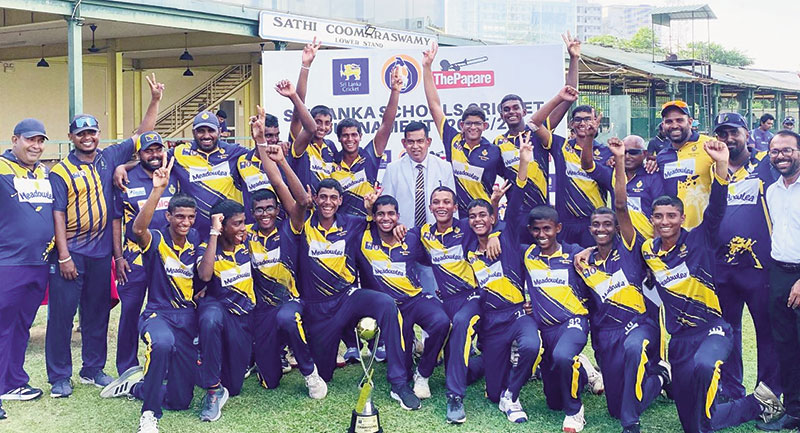
A five-wicket haul by Mahiru Kodituwakku and a fighting unbeaten knock of 92 runs by Manuth Dasanayake were the highlights as Royal College Colombo beat arch-rivals S. Thomas’ College, Mount Lavinia, to win the Under-17 Division I cricket title at P. Sara Stadium on Friday.
Chasing 206 runs for victory, S. Thomas’ lost wickets at regular intervals as Mahiru Kodituwakku led the bowling attack with a five-wicket haul to dismiss them for 133 runs.
Kodituwakku demoralized the Thomian batting lineup by taking early wickets. They lost their first four wickets for 31 runs inside seven overs, before being bowled out in the 33rd over.
Kodituwakku completed impressive figures of 7.5-0-32-5.
The victory looked a distant possibility halfway through Royal’s first innings. Tharul Jayasuriya struck early blows, removing Savain Gamage and Nithesh Jayasinghe cheaply, before Shenuk Fernando accounted for Mudith Gunasekara and skipper Dushen Udawela to leave Royal struggling at 73 for four wickets. However, after being five wickets down at 86 at one stage, Royal recovered to post a competitive total, thanks to an unbeaten 92 from Manuth Dasanayake.
Manuth held the batting lineup together with his dogged knock, which came off 87 balls. He cracked eight fours and five sixes in an entertaining performance.
Scores
Royal 205 for 9 in 50 overs
(Mudith Gunasekara 38, Manuth Dasanayake 92n.o.; Shenuk Fernando 2/20, Tharul Jayasuriya 2/61)
S. Thomas’ 133 all out in 36.5 overs
(Reshon Solomans 38, Tharul Jayasuriya 29; Mahiru Kodituwakku 5/32, Gagan Gamage 2/42) (RF)


Sri Lanka survived an all-time all-round display from Fatima Sana to triumph over a spirited Pakistan and seal a second-straight Asia Cup final berth against India.
Sana, a rare Player of the Match from the losing side, struck 47 off 36 to drag Pakistan to 130 for 5, and then finished with figures of 4 for 38 – inclusive of two double-wicket overs – but Sri Lanka’s all-round excellence eventually overcame Sana’s bloody mindedness.
In their chase, Sri Lanka were reduced to 5 for 2, and then 33 for 4, but a match-defining partnership of 67 off 59 between Harshitha Samarawickrema (36 off 31) and Kavisha Dilhari (33 off 33) turned the tide in Sri Lanka’s favours.
Sana’s second double-wicket intervention saw the backs of both Samarawickrama and Dilhari, but Sri Lanka’s batting depth came to the fore as Nilakshi Silva and Kaushini Nuthyangana saw the game off with eight balls to spare.
As Sri Lanka’s players celebrated on the sidelines as Nilakshika ramped Sana for one final, definitive boundary, the Pakistan skipper was on her haunches, tears streaming down her face. It’s not been an uncommon sight with Sana, but it was yet another example of just how much of herself she had put into the game – just that in this instance, it was simply not enough.
Run-scoring hasn’t been easy in Dubai this Asia Cup, with spinners in particular thriving. And that narrative was not about to change as Sri Lanka put Pakistan into bat – even as the data suggested the team batting first had won nine of the previous 13 games at the venue.
It proved to be the right call as the tournament’s unlikely leading wicket-taker, Chamari Athapaththu, struck early once more, getting Shawaal Zulfiqar and Ayesha Zafar in each of her first two overs. Left-arm spinner Sugandika Kumari meanwhile had removed Muneeba Ali in her first over as well. Seventeen-year-old left-arm spinner Chamudi Prabodha continued the pattern when she completely did an advancing Sadaf Shamas in the flight to have her stumped in the 10th over.
At the halfway point of the innings, Sri Lanka’s plan was going just as envisioned. Pakistan were reeling on 52 for 4 and they would need a minor miracle to post a respectable, if not challenging, target.
The calls for Sana to bat higher up the order seem to grow with every passing day, and when you watch innings like the one she produced on Friday it’s not hard to see why.
For her first six deliveries, she sought to get her eye in – even in a semifinal where her side had nearly lost half the batting – and played out six dot deliveries. With most other players, you might assume this would build pressure. But Sana is made of sterner stuff, a ball of self-belief and willpower.
The seventh ball she faced, she drilled four down through, hard to Chamudi’s left – the youngster perhaps saved some pain by not getting a hand on it. On her 10th she swept Dilhari for four, and then on her 11th she skipped out and launched a maximum over square leg.
And just like that Sana was on her way, and the momentum was shifting.
When Gull Feroza fell at the end of the 16th over, it wasn’t ideal. Feroza had clawed her way to a 32-ball 21, but with the death overs approaching Sana would have been hoping for Feroza to finally unleash. Sana however adjusted her plans and made the most of what was on offer; after a quiet 16th over, she managed a boundary in two of the final three overs, while Tuba Hasan also chipped in with a valuable 12 off 10 to push Pakistan to 130 for 5 with 78 runs coming off the final 10 overs.
An above waist-high no-ball, a first six of her career for Kaushini Nuthyangana, the equation suddenly down to 5 needed off 11. It was cruel irony that that moment had occurred off Sana’s bowling, because up until then she had been the almost solitary barrier between Sri Lanka and a second successive Asia Cup final.
She had removed two of Sri Lanka’s top three – including Athapaththu – in her first spell, and then returned late in the chase to get rid of the set pair of Samarawickrama and Dilhari. But in between Sri Lanka had done just about enough to get across the line in a hard-fought semi-final.
Losing four wickets inside the opening 10 overs is never ideal, and there would have been a time when Sri Lanka would have folded quite easily in such a scenario. But this Sri Lanka side is one with a growing belief that there will always be someone to step up.
Samarawickrama had been the one against Bangladesh, and here she was there again – this time flanked by the always involved Dilhari. With the required rate reaching about eight an over midway through the chase, the pair took to heart the words offered by coach Jamie Siddons during the drinks break and came out with a plan.
With boundaries in front of square not forthcoming, the pair looked behind. Two quick boundaries got the ball rolling, and the indefatigable pair also ran hard between the wickets.
It was a low target, and in that sense only a few good overs were required to keep the rate within touching distance, but Pakistan were bowling well. Sri Lanka however proved once again that they have the wherewithal to weather tough in-game situations and shift pressure back on to their opponents – a skill that will likely come very handy against India on Sunday.
Scores:
Sri Lanka Women 134 for 6 in 18.4 overs (Imesha Dulani 24, Harshitha Samarawickrama 36, Kavisha Dilhari 33, Nilakshika Silva 18*, Kaushini Nuthyangana 10*; Sadia Iqbal 1-21, Fatima Sana 4-38, Umm-e-Hani 1-19) beat Pakistan Women 130 for 5 in 20 overs (Shawal Zulfiqar 24, Gull Feroza 21, Fatima Sana 47*, Tuba Hassan 12*; Sugandika Kumari 1-20, Chamari Athapaththu 2-24, Chamudi Praboda 2-25) by four wickets
[Cricinfo]

Mohammad Rizwan and Imam ul Haq were questioned by Pakistan’s National Cyber Crimes Investigation Agency (NCCIA) in Lahore, as the fallout from Pakistan’s disastrous Test tour of England continued.
The two, who were in the group of seven players who were dropped from the Pakistan squad and sent back home after the defeat in the second Test at Lord’s, were sent summons to appear before the NCCIA. They appeared on Thursday. At least one of the players is believed to have been there for several hours.
It is not clear yet what the questioning was about, or whether it is related to the PCB’s own inquiry, which they announced earlier this week. The board did not name any players then but said it had “initiated an internal disciplinary inquiry following media reports concerning discipline and conduct, which are currently being reviewed internally”. That process, the board said, was being “conducted under PCB regulations”.
Cricinfo understands that at least one of the players has been given a questionnaire to respond to and return to the NCCIA next week.
At the end of the Lord’s Test, which Pakistan lost by 194 runs after losing the first by an innings and 103 runs, seven players as well as the head coach Sarfaraz Ahmed and bowling coach Umar Gul were removed from the squad. In their place, seven other players travelled to England, five of whom were uncapped at international level.
Rizwan’s form with the bat on this tour had been poor, with scores of 12, 41, 7 and 1, following low returns in two Tests in the Caribbean as well. His glovework, however, has been exemplary on both tours and until the West Indies series, he had been Pakistan’s leading Test run scorer since January 2024. But an ungainly hoick to be dismissed for 1 in the second innings at Lord’s attracted plenty of criticism.
Imam, meanwhile, was diagnosed with a grade-1 tear in his left calf after the conclusion of the first day’s play at Lord’s and did not appear on the field during either of Pakistan’s innings. On the final morning, during pre-game warm-ups, he came out to attempt some gentle knockdowns but struggled physically. Aaqib Javed, the PCB’s chief selector and director of high performance publicly questioned Imam’s injury and warned then of an inquiry into it.
In defending the squad changes, the PCB chairman Mohsin Naqvi alluded to wider factors at play, without expanding. “We have had a discussion to ascertain the reasons behind it. They include factors beyond performance and we will get to the bottom of it.”
The selection of both the players for the West Indies and England tours was also the subject of a notice sent by the PCB to selectors after the Lord’s Test. The notice asked for a written explanation outlining the reasons for their selection and the process through which it was arrived at, within 24 hours of the receipt of notice. Misbah-ul-Haq, one of the selectors, resigned from the post following the changes to the squad.
[Cricinfo]

ITS Giuseppe Garibaldi’ departs Colombo

Green Climate Fund (GCF) Regional Dialogue for East and South Asia will be held from 14 to 17 September 2026 at Cinnamon Life at City of Dreams Hotel, Colombo

Showers will occur in the Western, North-western and Sabaragamuwa provinces and in Kandy, Nuwara-Eliya, Galle and Matara districts

Prof. Pieris says Buddha Dhamma recognised as source of law under Constitution

GR leaves FCID after making statement over MiG deal

Dengue cases top 97,000 in 2026

‘Dates have the highest sugar content to fight Coronavirus’

Sunday Island 27 December – Headlines

#SundayIsland 17th December – Headlines

Sunday Island – 28th March

Sunday Island Headlines – 21 March

Sunday Island – 21st February – Headlines
-

 Sports2 days ago
DDS set to lose Test captaincy
-

 Latest News7 days ago
Tharanga creates history with Diamond League crown in Brussels
-

 Features6 days ago
After the parade: What a traffic OIC’s walk-out tells us
-

 News7 days ago
Dispute which triggered listed company director being detained at BIA resolved
-

 Editorial6 days ago
Arrests as theatre
-

 News5 days ago
Thailand shuts door on undesirables from Sri Lanka
-

 Latest News6 days ago
Harshitha’s composed knock seals Sri Lanka’s semi-final berth
-

 News6 days ago
‘Choka Malli’ slips out of country before travel ban