
News
Bribery claims involving Japanese contractor: Lawyer asks govt. to come clean over allegations levelled against Nimal Siripala

By Shamindra Ferdinando
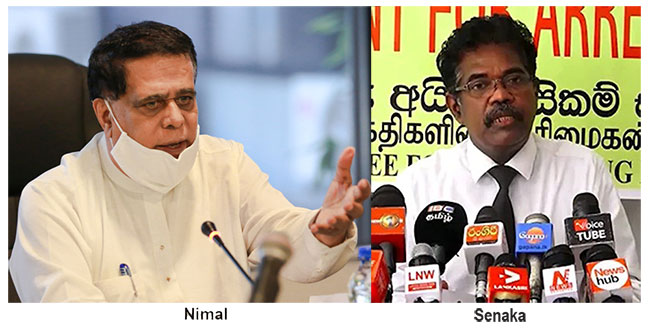
Attorney-at-Law Senaka Perera has alleged that the re-appointment of Nimal Siripala de Silva as the Minister of Ports, Shipping and Aviation proved that the same system is in place, in spite of Gotabaya Rajapaksa’s ouster.
How can the SLFPer clear himself of serious bribery allegations so fast, the civil society activist asked, referring to bribery accusations made, both in and outside Parliament, relating to the Japanese Taisei Corporation.
Samagi Jana Balavegaya (SJB) leader Sajith Premadasa led the campaign against the senior SLFPer after he revolted from the SLFP to accept a portfolio in the planned all-party national government, formed by the previous President.
Then President Gotabaya Rajapaksa asked Minister de Silva to step down, temporarily, pending an investigation into bribery allegations relating to the settlement of contractual issues of $ 570 million with Japanese International Cooperation Agency (JICA) funded Terminal-2 construction work at the BIA Development Project (BIADP) Stage two.
President Gotabaya Rajapaksa’s Office announced de Silva’s stepping down on July 06, just days before, in the guise of peaceful protests, overran the Presidential Secretariat, the President’s House, Temple Trees, PM’s office and torched PM’s private residence, forcing him to leave the country.
Referring to a statement issued by the Presidential Media Division (PMD) on Tuesday (02) late afternoon that dealt with the issue at hand, lawyer Perera said the government owed an explanation how a committee appointed by President Wickremesinghe on July 22 cleared de Silva within 10 days.
The lawyer urged the government to release the report submitted by the three-member committee as the PMD declared that its report cleared the lawmaker of all accusations.
Retired High Court Judge, Kusala Sarojini Weerawardena, PC, chaired the committee. Retired Senior Deputy Inspector-General (DIG) of Police S.M. Wickremasinghe and Retired Special Grade Officer of Sri Lanka Administrative Service (SLAS) S.M.G.K. Perera served as members of the committee.
Lawyer Perera recalled how Gotabaya Rajapaksa’s government obtained a report from another committee, also headed by retired High Court Judge, Kusala Sarojini Weerawardena, PC, following media furore over the then State Minister of Prison Management and Prisoners’ Rehabilitation Lohan Ratwatte’s forcible entry into Welikada and Anuradhapura prisons in Sept 2021.
Alleging that report, too, hadn’t been made public, lawyer Perera said that action taken by the former President and the incumbent President, in respect of lawmaker de Silva, weren’t sufficient. Lawyer Perera said that though the Commission to Investigate Allegations of Bribery or Corruption (CIABOC) hadn’t been able to earn the respect of the public, they felt the need to lodge a complaint with the outfit in this regard. “We like to see CIABOC’s reaction to our complaint,” the civil society activist said.
Facilitated by Lawyer Perera activist S.M. Nishar Moulana lodged a complaint last Saturday (July 30).
Responding to another query, lawyer Perera said that those interested in good governance and financial integrity should reveal their stand on this. How could such serious bribery allegations, directed at a Minister, be dealt by a committee, Lawyer Perera asked.
Reiterating his commitment to ongoing public protest against President Wickremesinghe’s government, lawyer Perera said that the new leader should prove his sincerity. Referring to the President’s maiden policy statement, lawyer Perera said that the Prsident’s promise to implement a national policy to combat bribery and corruption should be examined against the backdrop of lawmaker de Silva’s case.
President Wickremesinghe told Parliament that new rules and regulations and orders in this regard were being prepared by the Ministry of Justice. A consensus would be reached with the International Monetary Fund regarding combating corruption, the President assured Parliament.
Secretary to the CIABOC Apsara Caldera told The Island that complaints received would be examined by a committee consisting of three commissioner – Director, Investigations, legal officer and herself. The committee would decide on the complaint received in respect of lawmaker de Silva.
Asked whether the report prepared by retired High Court Judge, Kusala Sarojini Weerawardena would be perused by the CIABOC, Caldera said that, too, was to be decided. The relevant complaint has been already forwarded to the Committee.


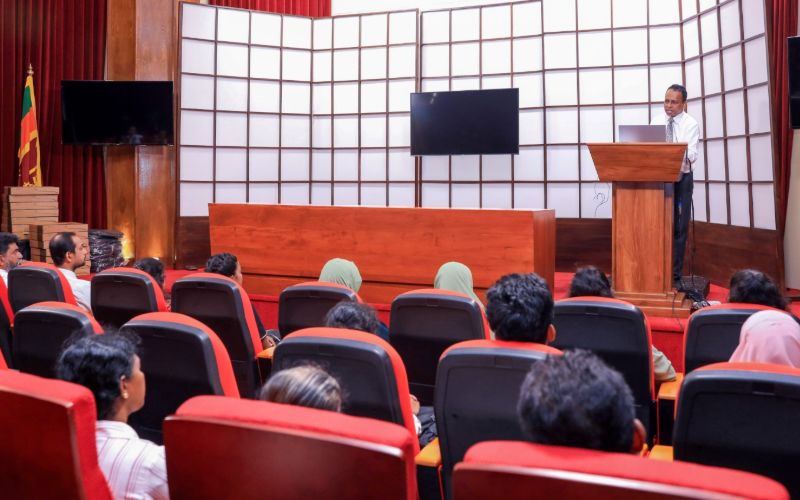
A programme to provide educational equipment to selected university students was held on Thursday (18) morning at the Head Office of the President’s Fund.
During the event, laptop computers were distributed to 14 students selected from applications received through Divisional Secretariat offices across the island. The President’s Fund has allocated Rs. 5.8 million for this initiative.
Accordingly, the President’s Fund has provided educational equipment to approximately 30 university students in 2025 and 2026. More than Rs. 9.8 million has been spent on this programme to date.
The event was attended by Secretary to the President’s Fund and Senior Additional Secretary to the President, Roshan Gamage, along with senior officials of the President’s Fund, parents, and other invitees.
(PMD)


Amidst ongoing accusations that the theft of USD 2.5 mn (nearly 1 bn Rupees) from the Treasury hadn’t been properly investigated, The Island learns that the relevant payments had been made to the actual creditor on the instructions of the Finance Ministry.
Confirming the inquiries made by us, authoritative sources said that payments had been made to several accounts through the US banks. Earlier, Sri Lanka released funds to fake foreign accounts in spite of warnings regarding the suspicions about the process.
The funds were part of a bilateral debt repayment to Australia with a settlement due in September 2025. The payment was part of a $ 22.9 million debt settlement.
The lapses occurred in the wake of far reaching changes regarding the debt management functions. In terms of a particular condition of the International Monetary Fund (IMF), Sri Lanka’s debt management functions that had been previously handled by the Central Bank were transferred to a new institution established under the General Treasury—the Public Debt Management Office (PDMO).
Sources said that regardless of the loss of USD 2.5 mn, Sri Lanka couldn’t have defaulted and therefore payments had been made.
Sources who closely followed the issue said that the government owed an explanation and public apology regarding the loss of USD 2.5 mn and how fresh payments were made.
Sources said that the USD 2.5 mn paid to fake accounts had been lost and could never be traced. CoPF Chairman Dr. Harsha de Silva has said that the NPP government has told the IMF that stolen USD 2.5 mn would be recovered from the public by introducing an amendment to the budget.
By Shamindra Ferdinando
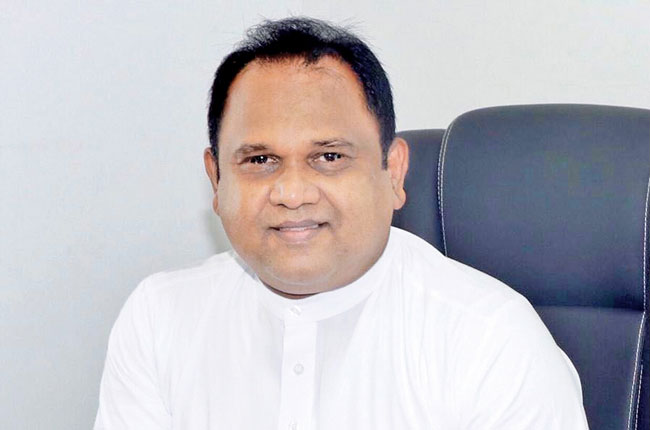
The Court of Appeal yesterday (18) postponed until June 25 the hearing of a petition filed by former Minister Nalin Fernando seeking the dismissal of an indictment brought against him by the Attorney General in connection with the controversial ‘Carrom Boards’ case.
The petition was taken up before a bench comprising Justices P. Kumararatnam and Pradeep Hettiarachchi.
Appearing for the petitioner, President’s Counsel Ali Sabry, instructed by Attorney-at-Law Ramzi Bacha, informed court that Fernando had already been convicted and sentenced to 30 years rigorous imprisonment in a case instituted by the Commission to Investigate Allegations of Bribery or Corruption (CIABOC) arising from the same incident.
Counsel argued that the Attorney General had subsequently filed a separate case based on the same set of charges and maintained that subjecting an accused person to a second prosecution for the same offence was contrary to law.
He submitted that preliminary objections on the issue had been raised before the Colombo High Court but were dismissed by the trial judge.
The petitioner has therefore sought a declaration from the Court of Appeal that the indictment filed by the Attorney General is unlawful and requested that the charges be set aside.
The court directed that the matter be called again on June 25, when the Attorney General is expected to present submissions on the petition.
The case stems from allegations that during the 2015 presidential election campaign, 14,000 carrom boards and 11,000 checkers boards were imported and distributed through Lanka Sathosa outlets for allocation to political offices of former President Mahinda Rajapaksa, resulting in an estimated loss of Rs. 39 million to the State.
Based on those allegations, the Attorney General has instituted proceedings against Fernando before the Colombo High Court under the Public Property Act.

Asia’s richest man Ambani announces what could be India’s biggest share sale

Educational equipment Provided to University Students through the President’s Fund

Fears for US-Iran deal as talks delayed by Israeli strikes on Lebanon

BCCI secretary hints at early start to IPL 2027

Cricket journalist and broadcast legend Qamar Ahmed dies aged 88

Stafanie Taylor, spinners help West Indies overcome Scotland threat

‘Dates have the highest sugar content to fight Coronavirus’

Sunday Island 27 December – Headlines

#SundayIsland 17th December – Headlines

Sunday Island – 28th March

Sunday Island Headlines – 21 March

Sunday Island – 21st February – Headlines
-

 News5 days ago
Release of 2025 O/L results likely to be delayed
-

 Sports5 days ago
Tharanga set for high-profile javelin clash in Ostrava
-

 Features6 days ago
Politics of protected species
-

 News4 days ago
Beijing Capital Airlines to resume flights to Colombo signalling boost to tourism
-

 News5 days ago
Theft of USD 2.5 mn from Treasury: CoPF accused of complicity in NPP cover-up
-

 News7 days ago
Commonwealth lawyers urge Lanka to uphold rule of law
-

 Opinion5 days ago
Decoding Trump’s 12.5% “Forced Labor Tariff” on Sri Lanka
-
 Features3 days ago
Killing of Colombo’s ancient trees — a warning on UN’s World Desertification Day – 17 June