
Business
ComBank ranked among world’s Top 1000 banks for 12th consecutive year


The globally-respected UK magazine ‘The Banker’ has once again included the Commercial Bank of Ceylon in its prestigious ‘Top 1000 World Banks’ ranking, making Commercial Bank the only Sri Lankan bank to be ranked among the elite global giants in banking for 12 consecutive years.
This ranking of the global who’s who of banking is based primarily on Tier I capital, a principal indicator to measure a bank’s financial health.
“These are the most adverse times in memory for banks in Sri Lanka, with the country’s unique issues compounding the continuing impacts of two years of the COVID-19 pandemic. In that context, our achievement of being ranked among the world’s top 1000 banks for the 12th successive year assumes even greater significance,” Commercial Bank Managing Director and CEO Sanath Manatunge said. “This reaffirms the remarkable consistency of the Bank as well as its ability to maintain strong fundamentals in the face of daunting external challenges.”
Commenting on the 2022 ranking, The Banker said: “It has been another turbulent year for the global economy and the banking sector. Yet both have remained remarkably resilient, in no small part due to government and central bank fiscal support programmes. Global aggregate tier 1 capital and assets have continued their onward march upwards. Global pre-tax profits have also bounced back from their slump last year. But the aggregate figures mask some significant regional and country-specific variations. China remains strong, the US has bounced back, for Europe challenges remain. The question now is how the world’s banks will fare as we enter a new period of economic turbulence, with interest rates rising and stimulus being unwound.”
The top five global banks heading The Banker’s list for 2022 are ICBC, China Construction Bank, Agricultural Bank of China, Bank of China and JP Morgan Chase & Co. Commercial Bank of Ceylon is ranked at No 930.
Compiled from a database of over 5,000 of the world’s biggest banks, The Banker’s Top 1000 World Banks ranking is considered the definitive guide to identifying which banks are the strongest in the world, based on more than 120 data points tracked in its database year on year. The magazine analyses results by region, country and benchmark bank to bank, and runs its best-performing bank methodology to help readers identify the banks’ strengths and weaknesses compared to its peers.
The Banker ranks banks from 1 to 1,000, and the regional breakdown is supported with editorial commentary, making the Top 1000 World Banks one of the most industry-recognised rankings available. The model refers to key ratios to score and rank banks, country by country, on their performance in eight categories: Growth, Operational efficiency, Return on risk, Soundness, Profitability, Asset quality, Liquidity and Leverage. Each bank’s performance across these categories is then used to generate an overall ‘best-performing bank’ score and ranking.
Ranked Sri Lanka’s Strongest Bank Brand for the third consecutive year in 2022 by Brand Finance, Commercial Bank of Ceylon ended 2021 with total assets of Rs 1.983 trillion, gross income of Rs 163.675 billion, net profit of Rs 24.29 billion, a deposits base of Rs 1.473 trillion and a loan book of Rs 1.095 trillion.
In terms of Capital Adequacy Ratios, the Bank’s Tier I CAR stood at 11.923% as at 31st December 2021, well above the revised minimum requirement of 9%, while its Total Capital Ratio of 15.650% was also comfortably above the revised requirement of 13%.
Sri Lanka’s first 100% carbon neutral bank, Commercial Bank is the largest private sector commercial bank, and the third largest bank overall in the country in terms of total assets. It is the only private sector bank that has been designated by the Central Bank of Sri Lanka as a higher-tier Domestic Systemically Important Bank (D-SIB). The Bank operates a network of 268 branches and 940 automated machines in Sri Lanka. Commercial Bank is the largest lender to Sri Lanka’s SME sector and is a leader in digital innovation in the country’s Banking sector. The Bank’s overseas operations encompass Bangladesh, where the Bank operates 19 outlets; Myanmar, where it has a Microfinance company in Nay Pyi Taw; and the Maldives, where the Bank has a fully-fledged Tier I Bank with a majority stake.

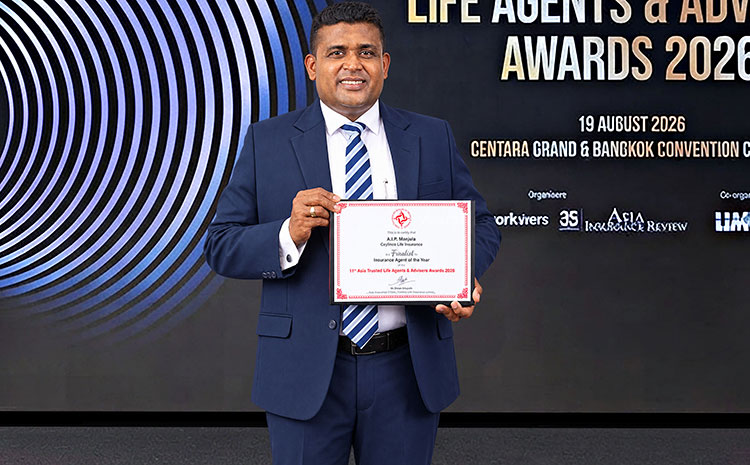
Ceylinco Life’s Ambalantota branch agent AIP Manjula has been named one of three global finalists for the prestigious Insurance Agent of the Year award at the 11th Asia Trusted Life Agents & Advisers Awards (ATLAA) 2026.
The recognition places a Sri Lankan insurance professional among the finalists in a regional field spanning South Asia, Southeast Asia, East Asia and the wider Asia-Pacific region.
Ceylinco Life said the achievement reflected the calibre and customer-focused approach of its agency force, while recognising Manjula’s professionalism and commitment to policyholders.
The award evaluates insurance agents on criteria extending beyond sales performance, including ethical conduct, client service, policy persistency, digital adoption, innovative practices and contributions to the insurance industry and community.
The awards are organised by Asia Advisers Network and Asia Insurance Review, with LIMRA as co-organiser. An independent judging and balloting process is monitored by KPMG as the official scrutineer. The judging panel comprises senior insurance executives, association presidents and industry experts from across the Asia-Pacific region.
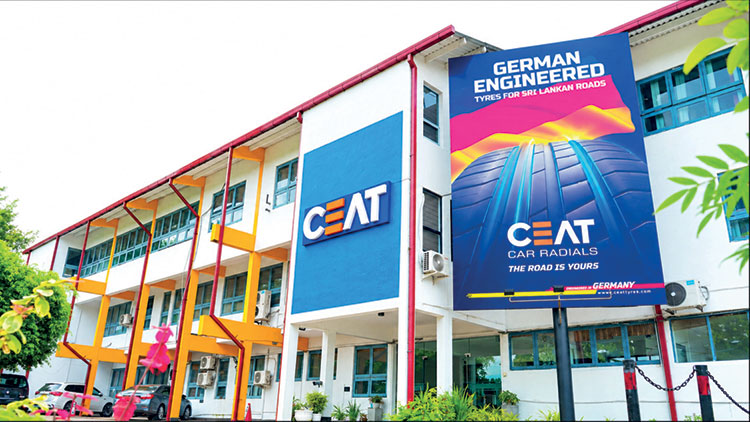
CEAT Kelani Holdings (CKH) has retained its National Long-Term Rating of ‘AA+(lka)’ with a Stable Outlook from Fitch Ratings for the sixth consecutive year, reflecting the company’s financial resilience and leading position in Sri Lanka’s pneumatic tyre market.
The ‘AA+(lka)’ rating, the second-highest on Fitch’s national scale, indicates a very strong capacity to meet financial commitments.
Fitch said CKH’s established market leadership and resilient financial profile remained key strengths, while noting its exposure to price-sensitive, cyclical and highly competitive markets.
The Stable Outlook reflects expectations that the company will maintain its market position despite rising input costs and increasing competition from imported tyres, while preserving adequate credit metrics during periods of weaker earnings and higher investment.
Fitch expects CKH’s established brand, extensive dealer network and adaptive pricing strategies to support its market position. Planned production facility upgrades are also expected to improve product quality, particularly in the radial tyre segment.
The rating agency expects near-term pressure on margins from higher raw material and energy costs but said the company’s low leverage and sound liquidity would provide a cushion.
CKH Chairman Chanaka De Silva said the rating reinforced the company’s focus on disciplined financial management, operational adaptability and long-term investment.
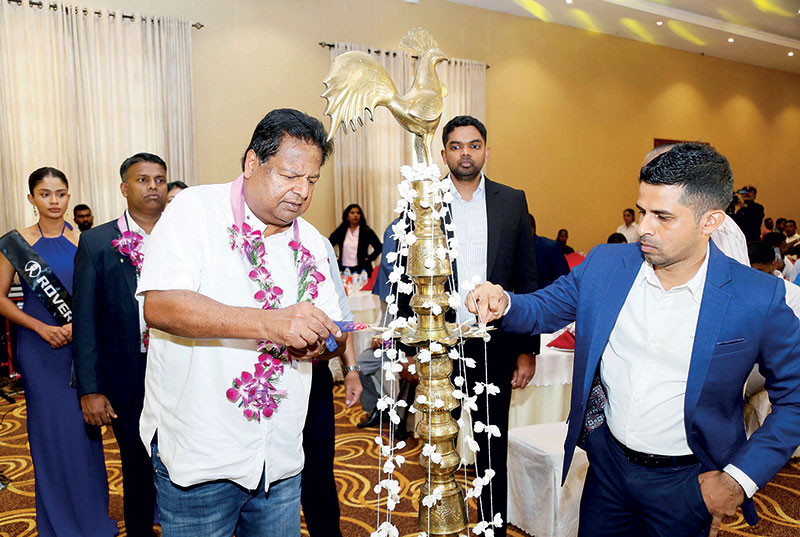
Rivon Agriglobe and Rivon Lanka, affiliated with Celogen Lanka, Assidua Technologies and Kelun Lifesciences, have introduced ZETOR and Agriglobe tractors, the Z-Tukoba power tiller and Rover electric motorcycles to the Sri Lankan market.
The new range was launched at a special event held on September 4 at the Sannasa Hotel in Dambulla, attended by more than 120 dealers from across the country.
The event was graced by Nalin Welgama as Chief Guest, together with Rishi Kumar, Managing Director; WH Roshan, Finance Director; Sadish Kumar, Director; Sumith Nandana, General Manager; Suresh Dhammika, Head of Sales; and Jayasuriya, Operations Manager.
The agricultural machinery range includes the 50-horsepower ZETOR HORTUS 50 and Agriglobe 50 tractors and the Z-Tukoba power tiller, offering what the company described as European-engineered technology for Sri Lankan farmers.
The launch also featured the recognition of Rover E-Bike dealers, highlighting the company’s efforts to expand its island-wide dealer network and promote electric mobility.
The companies said the new models would be available through their growing dealer network across Sri Lanka, providing customers with access to agricultural machinery and electric motorcycles.

Buttler out of Oval decider as Lawrence earns ODI call-up

Showers will occur in the Western, Eastern, Uva and Sabaragamuwa provinces and in Galle, Matara, Kandy and Nuwara-Eliya districts.

Nor’easter brings flooding as New York and New Jersey declare emergency 2 hours ago

Trump rejects Iran deal to reopen Strait of Hormuz in seven days

Govt plans to hire 121,000 state workers, redistribute tax revenue

Parliament clears 22A amid protests

‘Dates have the highest sugar content to fight Coronavirus’

Sunday Island 27 December – Headlines

#SundayIsland 17th December – Headlines

Sunday Island – 28th March

Sunday Island Headlines – 21 March

Sunday Island – 21st February – Headlines
-

 News4 days ago
Mastermind Naufer Moulavi among 15 found guilty
-

 News6 days ago
Hatton youth protest against reported death sentence for Lankan in Saudi Arabia
-
 News5 days ago
Protest against setting up of cement factory in highly populated area near BIA
-

 News6 days ago
Mahaweli rises as heavy rain triggers flood, landslide fears
-

 Latest News7 days ago
Landslide Red Alerts issued to the districts of Kandy, Kegalle and Nuwara Eliya
-

 Midweek Review4 days ago
Thileepan’s fast unto death: An authentic narrative that many missed
-

 Editorial4 days ago
Big Bad Bills
-
 Latest News3 days ago
Showers above 100 mm are likely at some places in the Western, Sabaragamuwa, Central and North-western provinces and in Galle and Matara Districts