
Business
Sustainable fuel bill for road transport

Is there a solution?
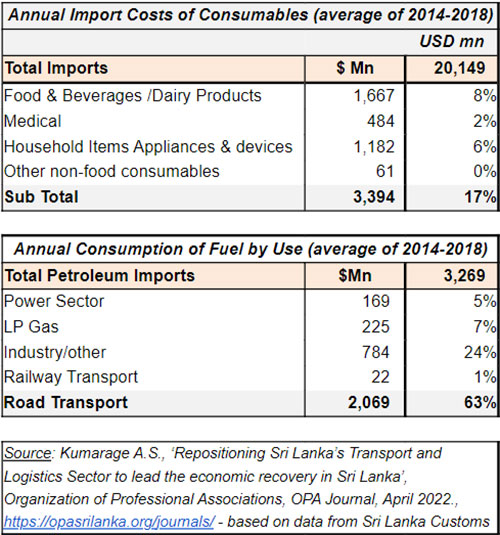
There is a great mismatch in the spend between Sri Lanka’s total imports and fuel imports. According to available data, we have spent 3,269 million US dollars on average annually on fuel imports, between 2014 and 2018. This is as opposed to the 3,394 million US dollars spent on the country’s total imports during the same period, for other essential items like food and beverage, dairy products and medicine. What this means is that Sri Lanka spends more on fuel than food, medicine, and any other essential product. In a nutshell, our fuel bill was almost the same as what we spend to import everything else. What is salient to note is that this huge spend on fuel was at a time when a barrel of oil was at US dollars 50 — things have changed quite a bit from then.
Fuel import bill unsustainable
With the oil price increasing to US dollars 100/- per barrel, our fuel bill automatically doubles. This is entirely unsustainable, especially in light of the country’s current economic woes.
The question then, is how do we reduce this colossal amount to at least some degree? Senior Professor Amal S. Kumarage, Department of Transport and Logistics, University of Moratuwa says it is possible if one is to take a closer look at our road transport sector, which takes up approximately 63% of the total fuel import bill. “Those taking mitigatory steps to correct the current economic crisis, will have to figure out ways to reduce fuel consumption in road transport by at least 25%. Whilst it is a given that transport is the linchpin in developing the local economy, the country needs to rationalise the sector, to help us get out of this situation we are now facing.” He says what we need now is a paradigm shift, especially since Sri Lanka’s petrol price at the pump is still lower than in countries like India, Bangladesh and Nepal, whose per capita income is also 2-3 times lower than ours.
Subsidised fuel no longer
an advantage
The Moratuwa University Don says, there is simply no advantage in providing subsidies for fuel, while consumption remains so high, adding that in any case, it is not the poor who benefit from these subsidies, because the higher percentage of fuel is used by privately owned vehicles. “While fuel imports, unlike other goods, should not be restricted or rationed because it is necessary for production, it is also necessary for local prices to be pegged to world market prices. However, it should be done with a reasonable tax component that would discourage consumption and encourage alternate use. Many countries have successfully implemented this tax to develop and promote less fuel consumption without reducing productivity or convenience. Further, in the current Sri Lankan context, it will allow more funds to be allocated for goods that are vital for daily living.”
Concessionary permits: loss for country, advantage to affluent
While annual car imports keep adding to our fuel bill, another issue is the concessionary permit system provided by the government to certain state officials to import cars with tax benefits. According to statistics, the concessionary permit system is a huge loss annually to the country. “The loss from these concessionary imports of private cars to the Treasury averages Rs. 94 billion per annum. This figure is almost equal to the LKR 97 billion per annum the Treasury gathers from all car imports, which actually makes the taxation process a pointless exercise. Furthermore, because of the tax concession, permit holders tend to go for more expensive vehicles in consideration of the resale value and more often than not, these expensive choices are heavy on fuel consumption.
Need to review transport sector
8% of Sri Lanka’s total import bill has been for road vehicles, and another 10% spent on fuelling them at $50 a barrel (Sri Lanka Customs, Import Data, 2022) and a further 3-4% was spent on road construction. At current oil prices use of road vehicles will take up more than half of our total import cost for consumables. Given that, reviewing the transport sector sooner rather than later is vital and would give Sri Lanka a much needed way out. A streamlined, manageable transport and logistics sector would be a driver for Sri Lanka’s economic revival and long-term regeneration. While it is necessary to find a solution to the immediate issues faced by the people, a sustainable long term plan needs to be put in place to avoid the heavy dollar expenditure of our road transportation and highway network system.
Potential long term plan
Therefore, if rationing fuel is not the answer, how do we manage our fuel bill more effectively in the present? The answer, Professor Kumarage says, is to have less cars on the road by improving public transport. “Sri Lanka’s current public transport carries 50% of trips using just 16% of the fuel used for road passenger transport. Less cars on the road means less congestion, less pollution and less fuel consumption. How we travel and purchase goods has changed with the pandemic situation and with the increased use of cab and delivery services, solutions should also be looked at in these areas. Encouraging short distance deliveries on cycles instead of motorcycles should be considered. Another way we can reduce cars on the road is by making ride sharing systems compulsory. That will reduce private vehicle usage and increase reliable online services to eliminate unproductive physical travel. Introducing a system where cars are allowed on the roads on alternate days, imposing a peak-period minimum passenger occupancy in selected traffic attracting areas such as Fort, Battaramulla and Nawam Mawatha, incentivising company transport services can all help in reducing road traffic.” To start off, Sri Lanka like some other countries can introduce a car free day as a symbol of our policy change, says the professor.
Policy readjustments such as scrapping the concessionary vehicle permit system, allowing concessions only for electric vehicles, modernising our public transport to match the 21st century user, and implementing a moratorium on our highway development system would all work to make a significant impact on reducing the import bill and saving our valuable dollars.



Ceylinco Life’s Ambalantota branch agent AIP Manjula has been named one of three global finalists for the prestigious Insurance Agent of the Year award at the 11th Asia Trusted Life Agents & Advisers Awards (ATLAA) 2026.
The recognition places a Sri Lankan insurance professional among the finalists in a regional field spanning South Asia, Southeast Asia, East Asia and the wider Asia-Pacific region.
Ceylinco Life said the achievement reflected the calibre and customer-focused approach of its agency force, while recognising Manjula’s professionalism and commitment to policyholders.
The award evaluates insurance agents on criteria extending beyond sales performance, including ethical conduct, client service, policy persistency, digital adoption, innovative practices and contributions to the insurance industry and community.
The awards are organised by Asia Advisers Network and Asia Insurance Review, with LIMRA as co-organiser. An independent judging and balloting process is monitored by KPMG as the official scrutineer. The judging panel comprises senior insurance executives, association presidents and industry experts from across the Asia-Pacific region.
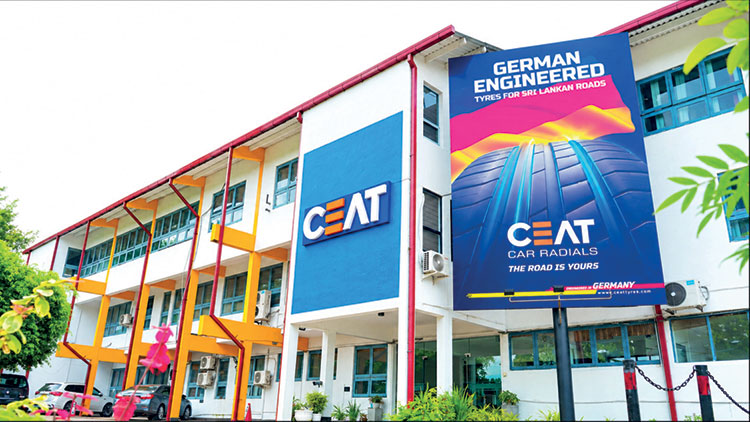
CEAT Kelani Holdings (CKH) has retained its National Long-Term Rating of ‘AA+(lka)’ with a Stable Outlook from Fitch Ratings for the sixth consecutive year, reflecting the company’s financial resilience and leading position in Sri Lanka’s pneumatic tyre market.
The ‘AA+(lka)’ rating, the second-highest on Fitch’s national scale, indicates a very strong capacity to meet financial commitments.
Fitch said CKH’s established market leadership and resilient financial profile remained key strengths, while noting its exposure to price-sensitive, cyclical and highly competitive markets.
The Stable Outlook reflects expectations that the company will maintain its market position despite rising input costs and increasing competition from imported tyres, while preserving adequate credit metrics during periods of weaker earnings and higher investment.
Fitch expects CKH’s established brand, extensive dealer network and adaptive pricing strategies to support its market position. Planned production facility upgrades are also expected to improve product quality, particularly in the radial tyre segment.
The rating agency expects near-term pressure on margins from higher raw material and energy costs but said the company’s low leverage and sound liquidity would provide a cushion.
CKH Chairman Chanaka De Silva said the rating reinforced the company’s focus on disciplined financial management, operational adaptability and long-term investment.

SLT-MOBITEL Enterprise, the enterprise services arm of Sri Lanka Telecom PLC, has launched its Premium Cloud service powered by Nutanix, aimed at helping Sri Lankan businesses modernise their IT infrastructure and accelerate digital transformation.
The service was unveiled at the Lanka Tech Summit 2026 held recently at ITC Ratnadipa, Colombo.
The Premium Cloud combines hybrid multi-cloud capabilities with enterprise-grade performance, enabling businesses to run mission-critical workloads, scale cloud deployments and strengthen business continuity through disaster recovery capabilities.
Hosted on SLT-MOBITEL’s Tier III data centre infrastructure, the platform is designed to provide enhanced security, reliability and flexibility while supporting the growing technology requirements of enterprises.
SLT-MOBITEL Enterprise said the platform would also support organisations seeking to adopt AI-ready capabilities and improve the management and performance of IT workloads.
A key feature of the launch was SLT-MOBITEL Enterprise joining the Nutanix Elevate Service Provider Program (NESPP), which the company said made it the first service provider in the region to join the programme.
Powered by Nutanix’s hybrid multicloud platform, the service enables application and data mobility across on-premises environments, public clouds and edge locations.
The company said the partnership combined Nutanix’s cloud technology with SLT-MOBITEL’s local expertise and support, strengthening its multi-cloud portfolio.

Nor’easter brings flooding as New York and New Jersey declare emergency 2 hours ago

Trump rejects Iran deal to reopen Strait of Hormuz in seven days

Govt plans to hire 121,000 state workers, redistribute tax revenue

Parliament clears 22A amid protests

Sajith likens 22A to ‘Emperor’s New Clothes’

64% of preschoolers spend over 30 minutes on screens

‘Dates have the highest sugar content to fight Coronavirus’

Sunday Island 27 December – Headlines

#SundayIsland 17th December – Headlines

Sunday Island – 28th March

Sunday Island Headlines – 21 March

Sunday Island – 21st February – Headlines
-

 News6 days ago
Hatton youth protest against reported death sentence for Lankan in Saudi Arabia
-

 News4 days ago
Mastermind Naufer Moulavi among 15 found guilty
-

 News5 days ago
Protest against setting up of cement factory in highly populated area near BIA
-

 News6 days ago
Mahaweli rises as heavy rain triggers flood, landslide fears
-

 Latest News7 days ago
Landslide Red Alerts issued to the districts of Kandy, Kegalle and Nuwara Eliya
-

 Midweek Review4 days ago
Thileepan’s fast unto death: An authentic narrative that many missed
-

 Editorial4 days ago
Big Bad Bills
-
Editorial5 days ago
Trouble beginning in earnest