
News
PM: Tax cuts triggered crisis

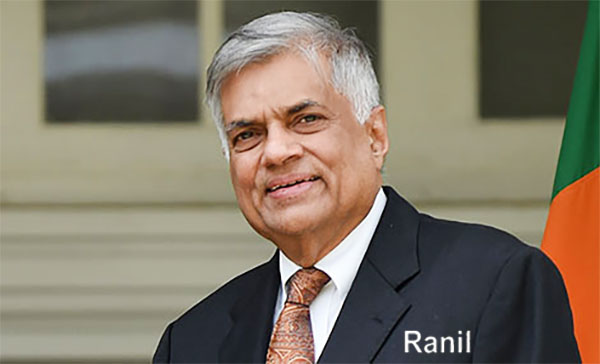
Premier Ranil Wickremesinghe told Parliament yesterday (07) the current economic crisis was due to a combination of reasons, both internal and external.
Addressing the House, the Prime Minister stated “The country spends $500 mn per month on fuel. It should be kept in mind that the current global crisis could lead to increases in oil prices. Some estimate that global oil prices will rise by as much as 40% by the end of this year. In this context, the idea of introducing a coupon system for fuel cannot be ruled out. Somehow, we have to find $ 3,300 mn worth of fuel for the next six months.”
The PM stated that it costs $40 million a month to import gas and that multilateral assistance, local currency and Indian loans, is currently used to import gas.
He said that $250 million is required over the next six months for gas.
Following is the full text of the Prime Minister’s speech.
I hope you all understand the situation we and our country face. We need to find new ways as an alternative to the traditional ways if we are to elevate the country from this position. We must set aside our traditional political ideologies for a short period of time and make a concerted effort to rebuild the country. The people of the whole country should play a role in this effort. We all have a part to play for the country.
The country spends $500 million per month on fuel. It should be kept in mind that the current global crisis risks raising oil prices. Some estimate that global oil prices will rise by as much as 40% by the end of this year. In this context the idea of introducing a coupon system for fuel cannot be ruled out. Somehow, we have to find $3,300 million worth of fuel for the next six months. It costs $40 million a month to import gas. We are currently using multilateral assistance, local currency and Indian loans to import gas. We will require $250 million over the next six months for gas.
The next three weeks will be a tough time for us, as regards fuel. It is time we all must use fuel and gas as carefully as possible. Unessential travel should be limited as much as possible. Therefore, I urge all citizens to refrain from thinking about hoarding fuel and gas during this period. After those difficult three weeks, we will try to provide fuel and food without further disruptions. Negotiations are underway with various parties to ensure this happens. After these difficult three weeks, we are trying to ensure the shortage of fuel and gas will have ended. Let’s face these difficult three weeks united and patiently.
We produce some of the food we require locally. The rest are imported. Our harvest has declined in the past several months. We have to face this situation at and we have to work hard from this point onwards to ensure the next harvest is a success. That harvest, however, will be available by the end of February 2023. In terms of rice, our country’s annual rice requirement is 2.5 million metric tons. But we have only 1.6 million metric tons of rice in stock. This condition is not only restricted to paddy but many other crops. So, in a few months we will have to face serious difficulties and shortages in terms of our diets. We need to import food items to meet our daily requirements. It costs about $150 million a month.
The task of rebuilding our declining agriculture must begin immediately. We are losing the international market for our export crops. Action must be taken to prevent this. Chemical fertilis-ers are needed to boost local agriculture. It costs $600 million a year to import fertiliser for paddy, vegetables, fruits, other major crops, as well as our tea, rubber, coconut and export crops. Since manure has to be applied from time to time from the beginning to the end of a harvest. It is essential that fertiliser is imported without creating any shortages. We must ensure that no money or effort will be wasted.
We are currently involved in various international assistance programmes to import medicines and health equipment required for the country. It has also been planned to seek assistance from various countries. We do not need large amounts of foreign exchange for health for the next six months as those groups and countries have provided substantial support for our health system. We thank them on behalf of the health department.
In this context, we need $5 billion to ensure our daily lives are not disrupted for the next six months.
We need to strengthen the rupee in line with the daily requirements of the citizens. Another $1 billion is needed to strengthen the rupee. That means we need to find $6 billion to keep the country afloat for the next six months.
In the midst of all this we need to develop plans to raise the average national product. We need to implement those plans. According to the Central Bank, the average GDP growth in 2022 will be -3.5 According to the International Monetary Fund, the situation is even worse. According to them, its growth will be -6.5 percent.
The average national output of the global economy will decline next year due to the impact of the war in Ukraine. Recovery is forecast for 2024. We also have to face that global environment issue.
The government has lost Rs. 6.6 billion in revenue with the abolition of the tax system we implemented in 2019. That was the beginning of the decline of our economy. Therefore, we must immediately return to the 2019 tax system. We must begin our resurrection from where we fell.
It is a fact that we all know that money has been printed indefinitely in recent times. Rs. 2.5 billion has been released from 2020 to May 20, 2022.
Many government agencies do not have proper financial management. Therefore, new methods need to be introduced. The Road Development Authority is an example. Although they had the funds, they failed to manage those funds in accordance with Treasury regulations. In the current situation in our country, the government is unable to provide funds to cover the losses of any state-owned enterprises. That debt burden can no longer be borne by the state or state-owned banks.
We are currently in talks with the International Monetary Fund. Our discussions are based on our future economic plan. Accordingly, the year 2023 will see us face all the challenges. We need to achieve economic stability by the end of this year. Then by 2024 we will have the opportunity to create economic stimulus through financial stimulus. By 2025, our goal is to balance our budgets or create a primary surplus. This economic programme must continue to move towards this long-term goal. Even if the individuals, groups and parties in power change, it is imperative that we achieve our national goals and maintain the highest level of efficiency in the country.
In our efforts we must pay close attention to our foreign relations. To increase international support to the country. We are becoming a marginalized country in the world due to poor foreign policies. Changing that position will not be easy. But we have to do it somehow.
I am currently in constant consultation with foreign ambassadors. I had telephone conversations with the Secretary-General of the Commonwealth, the President of the United Arab Emirates, and the Prime Minister of the United Kingdom.
Discussions were held with representatives of international organisations, such as the United Nations, the United Nations Food and Agriculture Organization, the World Food Programme, the United Nations Development Programme and the World Health Organization.
Many representatives of these countries and international organisations have agreed to support our country during this difficult time.
The United Nations has arranged for a worldwide public appeal on the 9th of June. They are seeking support to provide humanitarian assistance to Sri Lanka. Through this project, they plan to provide $48 million over a four-month period to the food, agriculture and health sectors.
India, China and Japan are leading the list of countries that provide us with loans and assistance. Relations with these countries, which have always been strong, are now broken. Those relationships need to be rebuilt.
Some time ago we borrowed under the SWAP facility from the People’s Republic of China. There was a condition regarding that loan. We can use that money only if our country has enough foreign reserves for three months. We have not had foreign exchange reserves for three months since the loan was taken. Our former officials took loans to deceive the country. We will not be debt free under that condition. We have requested the Chinese government to consider removing that condition from the agreement that has been signed with them.
We urge the Chinese government to look into the matter favorably.
Japan is our longtime friend. A nation that has helped our country greatly. But they are now unhappy with us due to the unfortunate events of the past. Our country had failed to formally notify Japan of the suspension of certain projects. Sometimes the reasons for these suspensions were not even stated. According to reports submitted by an individual, some projects undertaken by Japan in our country have been halted midway through.
Japan and India had agreed to supply us with two LNG power plants. The CEB stopped those two projects without any justifiable reason.
Japan had agreed to provide about $ 3 billion worth of projects to our country by 2019. All of these projects were put on hold for no reason.
I urge the Parliamentary Committee on Public Finance to conduct an inquiry into the suspension of such valuable projects granted to us by our longtime allies for unstated reasons.
Despite alienating these friendly nations, India offered to help us in the face of the growing crisis. We express our respect and gratitude to them during this difficult time. We are also working to re-establish old friendships with Japan.
We call on the International Monetary Fund to hold a conference to help unite our lending partners. Holding such a conference under the leadership of India, China and Japan will be a great strength to our country. China and Japan have different credit approaches. It is our hope that some consensus on lending approaches can be reached through such a conference.
We have an obligation to repay the loans taken so far. Many loan instalments received from multilateral importers have to be repaid this month. We did not pay the loan instalments. In the future we will have to take new loans and we have the responsibility to repay the debt of the country.
Once we come up with a loan repayment plan for those that we have obtained from other countries, we need to focus on the personal loans our country has taken. We sought expert advice from Lezard, an international financial advisory firm, and Clifford Chance, an international legal consulting firm.
We absolutely must have foreign exchange to repay the loans that have been taken. The export economy needs to be strengthened quickly to bolster our foreign exchange. Our country is located in a strategically important position. That is a positive factor in terms of regaining a competitive advantage in the global market. Alongside the economic hubs of Singapore and Dubai, we too have the potential to grow into another economic hub. Vietnam is a great example of having undertaken such a task successfully. Different product values must be exported by integration. At the same time, we want to keep the trade surplus as low as possible in our transactions with different countries.
I would like to draw your attention to some of the key areas we are focusing on.
1. Take maximum action to ensure food safety.
A recent study by the World Food Program (WFP) found that 73% of participating households reduced their diet and food intake. We will change that situation and strive to provide food without shortage as per this food security plan. We are working towards ensuring a three-meal situation in the country.
2. Increase in grant limit.
While the economy is in turmoil, people are facing various hardships. We will take action to alleviate their suffering as much as possible. The current annual expenditure on providing various reliefs to the economically backward is $350 million. This amount is expected to increase to US $550 million.
3. Farmers’ loans should be written off one hundred percent.
We know that farming families who cultivate paddy on small lands are in a very precarious position. Farmers’ loans obtained by farmers with less than two hectares of land will be stopped immediately.
4. Free ownership of their lands by residents.
Earlier we had launched a program to provide free government lands to the people through guarantees like Swarnabhoomi and Mahawali. Some provincial councils opposed the move. So this did not succeed. At present, steps are being taken to give the people the right to ownership so that such protests do not arise.
5. Granting the ownership of urban flats to the occupants on concessional basis.
Families live for rent in many of the suburban apartments. There are also long-term interest payments for home ownership. We will take steps to transfer the ownership of all these houses to the residents on concessional basis.
6. Opening of flats built by China for the public.
At the request of the People’s Republic of China when I was previously the Prime Minister, they donated 1,888 apartments to our country. One hundred and eight of these houses are reserved for artists. We will take steps to provide all these houses to the deserving without any political influence. My hope is to set up a program to provide those 1,888 homes for free.
At a time when the country is in decline, we are trying to rebuild the economy and the country without putting too much pressure on the people. Our expectation is to preserve every aspect of our lives and move forward.
We can save the country if we make gradual progress. There is a dangerous situation that goes beyond being a personal issue or a party issue. Let us understand the dangers and seriousness of this. In such a situation, there is no point in looking at the past. For a while let us forget the past. In trying to renew the country, we must think only of the future.


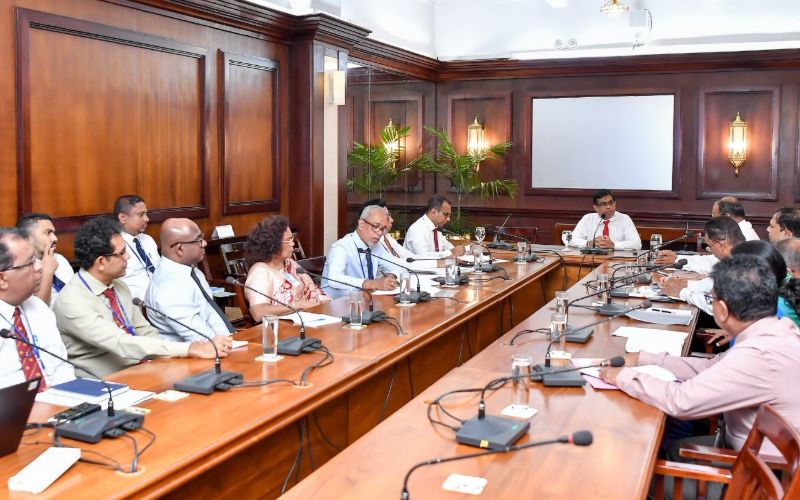
A discussion on the modernisation initiatives required within the Sri Lanka Customs and measures to encourage exporters in support of implementing the National Export Development Plan (NEDP) 2026–2030 was held on Wednesday (17) morning at the Presidential Secretariat under the patronage of Secretary to the President, Dr. Nandika Sanath Kumanayake.
The meeting, organised by the Revenue Administration Reform and Modernization Bureau established under the Presidential Secretariat, focused extensively on the modernisation measures required within Sri Lanka Customs to facilitate the expansion of exports.
During the discussion, the Secretary to the President instructed Sri Lanka Customs to enhance the capacity, facilities and modernisation of the Export Facilitation Centre, where export containers are inspected, in order to create a more efficient and exporter-friendly environment.
Attention was also drawn to developing a programme aimed at encouraging exporters across the country to enter the export sector. The Secretary to the President further emphasised the need to review the Temporary Import for Export Processing (TIEP) scheme currently operated by the Customs Industrial Facilitation Division and to introduce a programme to support small and medium-sized enterprises (SMEs) that have not yet engaged in export activities.
The meeting also explored the possibility of decentralising customs operations to support the expansion of the export sector, with particular attention given to establishing a Customs Export Centre in Jaffna.
Discussions were also held on removing barriers affecting exports conducted through e-commerce platforms. It was decided to hold further discussions with the Department of Posts on measures that could be taken jointly to streamline these processes.
Participants also discussed introducing digital systems to expedite document processing, thereby reducing both, time and costs, as well as implementing a risk-based assessment mechanism that would provide greater facilitation for low-risk exporters.
It was further decided that Sri Lanka Customs, the Sri Lanka Export Development Board (EDB) and other relevant institutions would meet monthly under the leadership of the Revenue Administration, Reforms and Modernisation Bureau of the Presidential Secretariat to review progress, identify challenges faced by exporters and discuss appropriate solutions.
The National Export Development Plan has been formulated in line with the national vision, “A Thriving Nation – A Beautiful Life”, with the objective of enhancing Sri Lanka’s export competitiveness and achieving an ambitious yet realistic export revenue target of USD 36 billion by 2030.
Director General of Customs Wimal Liyanagama, Chairman of the Sri Lanka Export Development Board (EDB) Mangala Wijesinghe, Additional Directors General of Sri Lanka Customs T. Loganathan and L.K.S.D.K. Arewatta, Director of the Sri Lanka Export Development Board Dr. Sanjeewa Rathnasekara, Director of the Revenue Administration, Reforms and Modernisation Bureau of the Presidential Secretariat W.L.C. Thilakasiri and senior officials from Sri Lanka Customs and the Sri Lanka Export Development Board were also present.
[PMD]
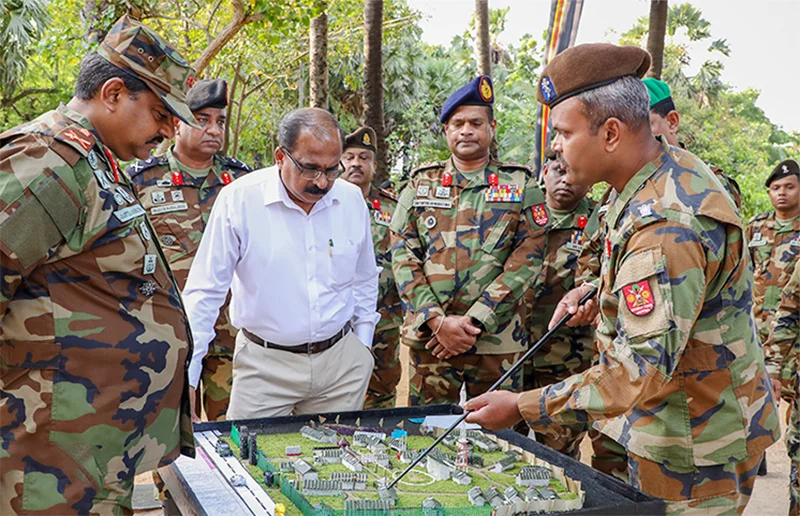
The NPP government is trying to maintain a balance between continuing demands for releasing north-east land held by the military and post-war security requirements, says Deputy Defence Minister Major General Aruna Jayasekera (Retd), who has undertaken a series of visits to the northern and eastern provinces in the recent past to explore ways and means of releasing the land, without compromising national security requirements.
Since the armed forces brought the war to a successful conclusion in May, 2009, releasing of both privately- and state-owned land began cautiously in October, 2009, and by now over 90 percent of both categories have been released. At the height of the war, before the launch of Eelam War IV, in August 2006, Jaffna peninsula had the largest concentration of troops assigned to four Divisions.
In the first week of June, Deputy Minister Jayasekera visited the Trincomalee District to ascertain the situation. The Defence Ministry said that the Deputy Minister had assessed the current status of such lands and received briefings from senior military officers and relevant officials on security and administrative aspects regarding the properties.
Following the field inspection, the Deputy Minister chaired a meeting at the Governor’s Secretariat Office where the discussion focused on what the Defence Ministry called a balanced and practical approach to address land-related issues, protect the livelihoods of the people, and ensure that national security requirements were properly managed.
Jayasekera, with a career spanning well over three decades, retired in November, 2019, after having last served as the Eastern Commander for about a year.
During his June visit, the Deputy Minister visited various security forces establishments, including the 22 Infantry Division.
A senior retired military official said that those who had been demanding that all security forces held land, both state- and privately-owned, be released, have conveniently forgotten that this was made possible due to the eradication of the LTTE.
The Deputy Defence Minister conducted a series of field visits in the Jaffna and Wanni regions to assess the security situation and operational commitments. According to the Defence Ministry, the Deputy Minister addressed senior tri forces personnel at the Security Forces Headquarters – Jaffna (SFHQ-J) and the Security Forces Headquarters – Wanni (SFHQ-Wanni).
The Deputy Minister chaired civil-military coordination meetings in the Mannar and Jaffna districts to the ongoing land ownership issues, fostering socio economic growth, and streamlining local infrastructure layout in close cooperation with the regional administrative mechanism. The Ministry said that the Deputy Minister inspected agricultural zones, private residences and public common areas, presently placed within the operational infrastructure of the Sri Lanka Navy across several locations, in Mullikulam, Silawathura, Talaimannar, Wankalapadu, and Pallimune.
Members of Parliament for the Vanni Electoral District, Selvam Adaikalanathan, Kader Masthan, Thurairasa Ravikaran and the District Secretary for Mannar were also present at the meeting where matters related to socio economic grievances, local infrastructure demands, and land rights of the local residents were central topic in the agenda.
The Deputy Minister of Defence chaired a second meeting at the Governor’s Office in Jaffna where the main focus was existing land issues in the districts of Vavuniya, Mannar, Mullaitivu, Kilinochchi, and Jaffna.
The Jaffna proceedings were co-chaired by the Minister of Fisheries, Aquatic and Ocean Resources and Chairman of the District Coordinating Committee for the Jaffna and Kilinochchi Districts Ramalingam Chandrasekar and Deputy Minister of Co-operative Development Upali Samarasinghe.
The Defence Ministry said that stability depended on striking an optimal balance between prioritising national security obligations and resolving outstanding issues related to both state owned and privately used lands. “We are implementing a transparent mechanism to swiftly transition designated lands back into the hands of local communities for housing, fishing, and agriculture.”
The participation of the Commander of the Army and the Commander of the Navy underscored the importance of the discussions held in the north.
In the Mannar region the focus was on lands, presently used by the Navy, in the areas of Mullikulam, Silawathura, Talaimannar, Wankalapadu, and Pallimunai.
Authoritative sources said that since the end of the war, the military had given up held areas and what remained occupied were essential for security purposes. The depletion of the area under direct control should be examined taking into consideration gradual overall reduction of combined security forces strength over the years. At the end of the war, the Army had approximately 205,000 officers and men, both regular and volunteer. That figure has been reduced to 150,000 to 160,000. In line with the government thinking the Army strength would be brought down to 100,000 by 2030, a plan first announced by President Ranil Wickremesinghe.
By Shamindra Ferdinando

Colombo Chief Magistrate Lahiru de Silva yesterday granted bail to Yoshitha Rajapaksa, second son of former President Mahinda Rajapaksa, on three sureties of Rs. 5 million each, and imposed an overseas travel ban.
The Commission to Investigate Allegations of Bribery or Corruption (CIABOC) arrested Yoshitha yesterday morning when he called over to make a statement regarding an ongoing investigation into his recruitment to the Sri Lanka Navy and training at the UK Royal Naval Academy.
CIABOC said that the arrest had been made in connection with an investigation into the 2006 recruitment of cadet officers to the executive branch of the Sri Lanka Navy.
It has been alleged that individuals were recruited without meeting the required qualifications and state funds were used outside established procedures for their training at the Royal Naval Academy in the UK.

What the Trump-Iran agreement says about Lebanon, Hormuz and Uranium

Scotland face West Indies with a chance to reopen World Cup wounds

Moscow hit by largest Ukrainian attack since start of Russia’s full-scale war

Sooryavanshi to have parents with him on tour of Ireland and England

Luis Diaz, Colombia defeat World Cup 2026 debutants Uzbekistan

Oil prices fall, stocks rally as US, Iran sign framework to end war

‘Dates have the highest sugar content to fight Coronavirus’

Sunday Island 27 December – Headlines

#SundayIsland 17th December – Headlines

Sunday Island – 28th March

Sunday Island Headlines – 21 March

Sunday Island – 21st February – Headlines
-
 News7 days ago
CIABOC summons Yoshitha over his participation in British Navy training programme
-

 News4 days ago
Release of 2025 O/L results likely to be delayed
-

 News7 days ago
Justice Minister responds to social media claims he represented Easter Sunday ringleader
-

 Sports4 days ago
Tharanga set for high-profile javelin clash in Ostrava
-

 Features5 days ago
Politics of protected species
-

 News3 days ago
Beijing Capital Airlines to resume flights to Colombo signalling boost to tourism
-

 News4 days ago
Theft of USD 2.5 mn from Treasury: CoPF accused of complicity in NPP cover-up
-

 News6 days ago
Commonwealth lawyers urge Lanka to uphold rule of law