
News
UNSG adopts Sri Lanka sponsored resolution to declare March 1st as ‘World Seagrass Day’


The United Nations General Assembly adopted a Sri Lanka-sponsored Resolution A/76/L.56, declaring 01 March as World Seagrass Day. The resolution was adopted by consensus, and co-sponsored by 24 countries.
Ambassador Mohan Pieris, Permanent Representative of Sri Lanka to the UN, introduced the resolution under Agenda Item 15: Integrated and coordinated implementation of and follow-up to the outcomes of the major United Nations conferences and summits in the economic, social and related fields.
In his introduction, Ambassador Pieris highlighted Sri Lanka’s interest as a littoral state in bringing attention and awareness on a small but significant aspect of universal importance in combatting climate change. He highlighted the importance of seagrass as a carbon sink, in protection against coastal erosion, in stabilizing the sea bottom, increasing the resilience of the most vulnerable ecosystems, and increasing food stability for a number of marine creatures, and the pivotal role it plays in curtailing the effects of climate change.
The World Seagrass Association closely supported the Government of Sri Lanka in this endeavor.
Seagrasses are one of the most valuable marine ecosystems on earth covering around 300,000 square kilometers in 159 countries and six continents. They provide a range of critical environmental, economic and social benefits. The most significant benefit being the enormous carbon sequestration potential of seagrass, storing up to 18 percent of the world’s oceanic carbon, which is greater than that of rainforests which makes protection and restoration of seagrass a vital tool in efforts to adapt and mitigate the adverse effects of climate change. The vital functions of seagrasses also include its role in stabilizing the sea bottom and providing ecosystem support via food and shelter for a number of marine creatures, including commercial and recreational fish species, as well as endangered and charismatic species such as turtles, dugongs and manatees. However, seagrass ecosystems are being destroyed as a result of human activity. The United Nations Environmental Programme Publication ‘Out of the Blue: the value of seagrasses to the environment and to people’ states that “7 per cent of seagrass marine habitat is being lost worldwide per year, which is equivalent to a football field of seagrass lost every 30 minutes”.



President Anura Kumara Dissanayake has instructed officials to give top priority to restoring the livelihoods of communities affected by the disaster. He emphasized the need to expedite compensation payments for damages and to take immediate measures to revive the agriculture, fisheries and industrial sectors.
The President further directed that all compensation payments for crop damage be completed before December 25.
These instructions were issued during a special District Coordinating Committee meeting held on Saturday (13) morning at the Puttalam District Secretariat.
President Anura Kumara Dissanayake described the recent cyclone as one of the largest disasters the entire country has faced in recent times. He commended the dedicated efforts of the tri-forces, Police and public officials in restoring the lives of affected communities. The President noted that, thanks to their commitment, a significant portion of essential infrastructure including electricity, water supply and roads has already been rehabilitated.
He further emphasized that the Government’s ability to provide such substantial compensation to disaster-affected communities is the result of the strong fiscal discipline of the Government.
Taking into account the challenges that have arisen in the distribution of allowances and aid so far, the President instructed Divisional Secretaries to ensure that compensation is provided strictly to eligible recipients and to fully intervene to prevent any deviation from this policy under any circumstances.
During the meeting, the rehabilitation of damaged highways and bridges in the district was discussed in detail. The President inquired into issues arising during these reconstruction efforts and provided on-the-spot solutions in consultation with the relevant officials.
The construction of the Lower Kala Oya Bridge was also discussed. The President instructed that a temporary bridge be built to meet the needs of the tourism sector. He emphasized that all construction activities should be carried out with a thorough understanding of necessity and proper structural assessments.
The President further highlighted that previous large-scale projects were abandoned without delivering tangible benefits or the intended outcomes. He stressed that future infrastructure development should focus not only on regional needs but also on the broader economic benefits for the country as a whole.
The President inquired about the ongoing efforts to restore electricity supply in the district and emphasized the need to complete these works without delay.
He also reviewed measures being taken to re-establish water supply and instructed provincial authorities to intervene promptly, noting that current well cleaning efforts in the district are insufficient.
Regarding agriculture, the President inquired about preparations by local farmers for the upcoming Maha paddy cultivation. He directed officials to swiftly create a conducive environment for farming, minimize the amount of abandoned land and explore alternative methods to ensure productive use of farmland.
He instructed that all compensation due to farmers be disbursed before December 25, that payments be made regardless of whether the land is in reserves or legally protected areas, and that systematic measures be implemented to prevent cultivation on reserved lands.
The President also highlighted the need for comprehensive soil conservation programmes in areas such as Kalpitiya.
The President emphasized the need to provide fair compensation to those engaged in the livestock sector in order to restore their livelihoods. He also highlighted the importance of obtaining accurate ground-level data and stressed the necessity of introducing legislation to ensure the registration of all livestock farms.
Due to the disaster, 627 houses in the district were completely destroyed, and 20,813 houses sustained partial damage. The President instructed that compensation for the affected families be expedited, emphasizing priority resettlement on government land. Where government land is unavailable, he directed that Rs. 5 million be provided to each family for the purchase of alternative land.
For those whose houses were completely destroyed, the President directed that new housing projects be implemented in a manner that ensures ownership of a house valued at Rs. 5 million for each beneficiary.
Attention was also given to the fisheries sector. Discussions were held on providing assistance for the repair of damaged fishing boats, as well as implementing fair compensation and concessional bank loan schemes for prawn farmers.
President Dissanayake also inquired into the operations at Chilaw Hospital. Authorities informed him that patient admissions and the functioning of several units could resume by next week.
Minister of Public Administration, Provincial Councils, and Local Government and Chairman of the Puttalam District Coordination Committee Chandana Abeyratne, Deputy Minister of Environment Anton Jayakody, North Western Province Governor Tissa Warnasuriya, Government and Opposition Members of Parliament from Puttalam District, Local Government Representatives including the North Western Provincial Secretary, Secretary to the Ministry of Finance Dr. Harshana Suriyapperuma, Puttalam District Secretary, Divisional Secretaries, Government Officials, and Security Forces Representatives were present at the event.

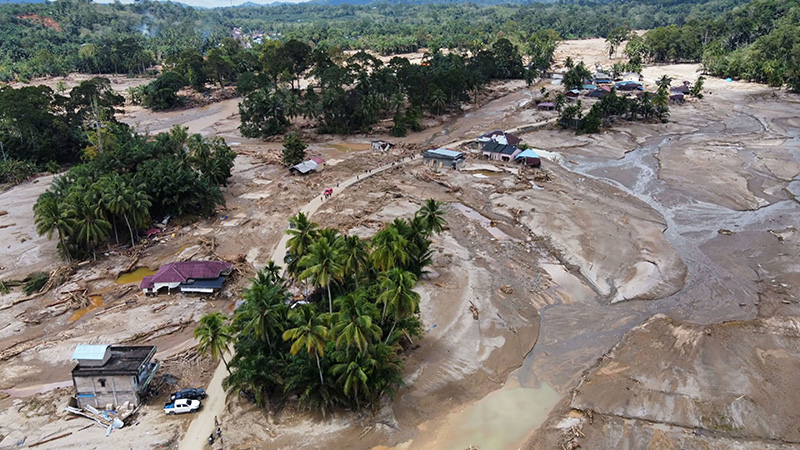
The Disaster Management Centre (DMC) reported yesterday that 211 people had gone missing following the devastation caused by Cyclone Ditwah.
The disaster has left 639 individuals dead, and 84,674 people from 26,563 families are sheltered in 866 safety centres across the country.
The DMC also confirmed extensive damage to houses. It said about 5,588 had been destroyed and 102,246 others damaged.
Authorities continue to coordinate relief efforts as they assess the full scale of the destruction and work to provide shelter and aid to thousands of displaced persons.
by Chaminda Silva

The government has decided to convene Parliament on 18 December to secure legislative approval for emergency funding for disaster relief.
The special session has been called to allocate funds for relief efforts for those affected by Cyclone Ditwah and for repairs to infrastructure and property damaged by the severe weather.
Officials said the government would submit a supplementary estimate seeking parliamentary approval for the required funds.
A debate will be conducted before the estimate is endorsed by the House.
Parliament adjourned until 06 January, 2026, following the passage of Budget 2026.
by Akitha Perera

Prioritize rebuilding the livelihoods of disaster-affected communities – President

A few showers may occur in the Northern, North-Central, Eastern, Uva and Central provinces

Ditwah Disaster: 211 people still missing

Parliament to have special sitting to approve emergency funding

Why Sri Lanka Still Has No Doppler Radar – and Who Should Be Held Accountable

Public urged to avoid non-essential travel in disaster-prone areas

‘Dates have the highest sugar content to fight Coronavirus’

Sunday Island 27 December – Headlines

#SundayIsland 17th December – Headlines

Sunday Island – 28th March

Sunday Island Headlines – 21 March

Sunday Island – 21st February – Headlines
-

 Features4 days ago
Finally, Mahinda Yapa sets the record straight
-

 News6 days ago
Over 35,000 drug offenders nabbed in 36 days
-

 News5 days ago
Cyclone Ditwah leaves Sri Lanka’s biodiversity in ruins: Top scientist warns of unseen ecological disaster
-

 News6 days ago
Rising water level in Malwathu Oya triggers alert in Thanthirimale
-

 Features4 days ago
Handunnetti and Colonial Shackles of English in Sri Lanka
-
 Business3 days ago
Cabinet approves establishment of two 50 MW wind power stations in Mullikulum, Mannar region
-

 Business6 days ago
Sri Lanka betting its tourism future on cold, hard numbers
-

 News6 days ago
New landslide alerts as Ditwah aftermath worsens