
Business
CBSL implements extraordinary measures to support banking sector

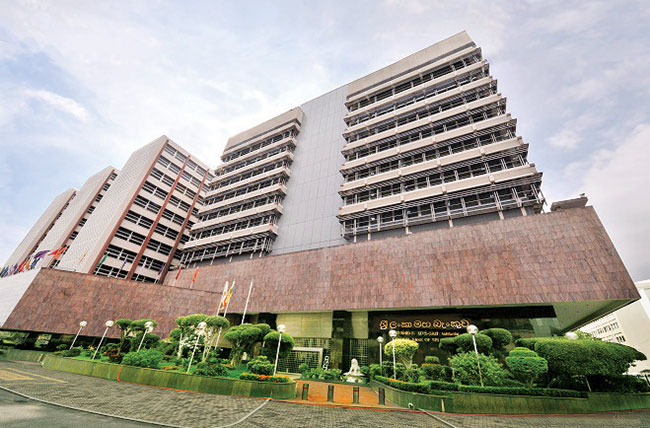
The Central Bank of Sri Lanka, considering the prevailing macroeconomic conditions and its impact on the banking sector, has decided to implement the following regulatory measures to support the banking sector to facilitate effective financial intermediation and the flow of credit to the economy, whilst ensuring the soundness of the banking sector.
• Sri Lankan banking sector maintains a Capital Conservation Buffer (CCB) of 2.5% to ensure that banks have an additional layer of usable capital that can be drawn down during stress times. An industry wide flexibility is granted for banks to drawdown the CCB (up to 2.5%), if needed, subject to restrictions on distribution to shareholders/ repatriation of profits and submission of a capital augmentation plan to rebuild CCB during a period up to three years.
• The current deadline for licensed banks to meet the enhanced minimum capital requirement (31.12.2022) is extended up to 31.12.2023. Licensed banks which are unable to meet the minimum capital requirement by 31.12.2022, need to submit their capital augmentation plan, including plans to consolidate or merge with suitable financial institutions, by 31.12.2022 and these licensed banks too shall refrain from distribution of dividends/ repatriation of profits until the minimum capital requirement is met.
• Licensed banks are encouraged to move to approaches such as The Standardised Approach (TSA) or alternative TSA for computation of risk weighted assets for operational risk for the purposes of computing the Capital Adequacy Ratio, subject to supervisory review.
• Licensed banks are given the flexibility to stagger the unrealised mark to market loss on Government Securities denominated in LKR on account of the recent interest rate hike for Capital Adequacy purposes until Q2 of 2024, subject to conditions.
• Licensed banks are granted flexibility on the treatment for Other Comprehensive Income (OCI) for Capital Adequacy purpose in line with the International Standards.
• The deadline for licensed banks to submit the document on Internal Capital Adequacy Assessment Process (ICAAP) for 2022, to the Central Bank of Sri Lanka is extended by one month, until 30.06.2022.
• As a short-term measure to support licensed banks to adjust their liquidity profiles, licensed banks are provided with the flexibility to operate maintaining the Liquidity Coverage Ratio (LCR) and Net Stable Funding Ratio (NSFR) not lower than 90% up to 30.09.2022. Furthermore, the Central Bank of Sri Lanka, on 06 May 2022 decided to restrict certain discretionary payments of licensed banks, such as declaring cash dividends and repatriation of profits, until the financial statements for the year 2022 are audited by its External Auditor, engaging in share buy backs, increasing management allowances and payments to the Board of Directors until 31 December 2022 with a view to strengthening the liquidity and capital positions of licensed banks under these exceptional circumstances.
The above measures were introduced with the aim of providing the licensed banks with more flexibility and opportunities to operate in these challenging conditions and support economic recovery, while taking measures to improve their safety and soundness. The Central Bank of Sri Lanka will periodically review the implementation of these policy measures and expects licensed banks to avail these measures in the best interest of the customers and the economy at large, while supporting the banking sector to remain resilient.

Business
ABC Trade & Investment – All-China Environment Federation partner to drive Sri Lanka’s green infrastructure and investment


ABC Trade & Investments (Pvt) Ltd, a leading homegrown conglomerate in Sri Lanka’s ICT distribution and diversified business landscape, has formally entered into a strategic Memorandum of Understanding (MoU) with the All-China Environment Federation (ACEF). The partnership establishes a collaborative framework aimed at accelerating new-energy development, water management, and environmental protection projects across Sri Lanka.
The agreement bridges advanced Chinese engineering capabilities, equipment, technical expertise, and investment resources with ABC Trade & Investments’ local operational strength, market insight, and project implementation skills. By pairing international technology with on-the-ground execution, the initiative is designed to address Sri Lanka’s long-term environmental and civil infrastructure priorities.
The MoU was signed by Amalrajah Jayaseelan, Director/CEO of ABC Trade & Investment (Pvt) Ltd, and Shi Xiang, Secretary-General of the Belt & Road Eco-Industry Cooperation Working Committee of ACEF. The signing took place during the China–Sri Lanka Environmental & Energy Exchange and Cooperation Meeting at the Nondescripts Cricket Club Grounds in Colombo, held under the theme “Empower Green Development, Jointly Build a New Pattern of China–Sri Lanka Environmental & Energy Industry.”

By Hiran H. Senewiratne
The CSE yesterday was very active at the outset but later slowed down due to heavy buying interest noted for select stocks.Amid those developments both indices moved upwards. The S and P SL20 went up by 23.73 points. Turnover stood at Rs 2.44 billion with 10 crossings.
The crossings were: Renuka Foods 19 million shares crossed for Rs 502 million; its shares traded at Rs 25.30, Dipped Products 1.9 million shares crossed to the tune of Rs 117 million; its shares traded at Rs 60.50, JKH 3.9 million shares crossed for Rs 78 million; its shares sold at Rs 19.70, Dialog Axiata 1 million shares crossed to the tune of Rs 46.6 million; its shares traded at Rs 46.40, Tokyo Cement 500,000 shares crossed for Rs 39.5 million; its shares sold at Rs 79 and Watawela Plantations 800,000 shares crossed for Rs 34 million; its shares were Rs 42.50 each.
In the retail market companies that mainly contributed to the turnover were; Vallibel Finance Rs 281 million (3.3 million shares traded), Dipped Products Rs 114 million (1.9 million shares traded), Haycarb Rs 90 million (424,000 shares traded), Alumax Rs 42 million (2.6 million shares traded), HNB Rs 38.5 million (102,000 shares traded), Swisstec Rs 30 million (506,000 shares traded) and Sierra Cables Rs 34 million (880,000 shares traded). During the day 118 million share volumes changed hands in 17802 transactions.
It is said that mixed market reactions were noted during the day. Financial sector, especially Vallibel Finance, performed well, while the manufacturing sector, especially JKH and Hayleys , performed significantly.
Meanwhile, Co-operative Insurance Company announced the redemption of 1,100,000 cumulative redeemable preference shares issued in December 2020 to the Health Department Co-Operative Thrift & Credit Society.
The total redemption consideration of Rs 16.61 million, including a 9 percent per annum cumulative dividend, is set for settlement on August 31, 2026.
Yesterday the rupee was quoted at Rs 328.25/35 to the US dollar in the spot market, stronger from Rs 328.30/60 the previous day, while bond yields were somewhat steady, dealers said.
Business
Beyond tariffs: How Sri Lanka’s own border procedures are becoming a non-tariff barrier to apparel export competitiveness

Efficiency on the factory floor is no longer enough to get an order out on time. Fabric and trims need to reach the factory on schedule, and once production is done, finished garments still need to clear the port or airport within the buyer’s window. What matters to an international buyer is simple: does the shipment arrive when promised. A few extra days lost to a customs clearance inside Sri Lanka mean nothing to that schedule. Apparel competitiveness today isn’t decided by wages and tariffs alone. Time spent within the port and the regulatory system has become part of the cost of the export itself.
Sri Lanka’s export policy conversation revolves around new trade agreements, GSP+ and market access. All of it matters. But a more basic question deserves equal attention: how much extra time, cost and uncertainty do our own border procedures create for exporters? This isn’t confined to apparel. It’s a hidden, domestic barrier running through Sri Lanka’s entire export economy. Sri Lanka has made progress. The UN Digital and Sustainable Trade Facilitation Survey shows our index rising from 43.01% in 2015 to 63.44% in 2025. But that same year, India recorded 93.55%, Malaysia 90.32%, Thailand 88.17% and Vietnam 77.42%. We’ve moved forward. Our competitors have moved faster. Committing to the WTO Trade Facilitation Agreement on paper and an exporter actually experiencing faster service are not the same thing. The question now isn’t whether reforms were announced, but whether they’ve cut real time and cost.
The most significant reform underway is the National Single Window, one digital submission instead of repeating documents to multiple institutions. In the 2025 UN survey, Sri Lanka’s system was still at the planning stage. By 2026, the OneTRADE/TNSW programme is redesigning and connecting processes across 18 institutions, a step that should be judged by fewer documents and faster clearance, not by its launch date. Sri Lanka Customs’ pilot paperless CusDec programme, using electronic signatures instead of physical documents, is a solid parallel step. But if a document submitted online to one institution still has to be printed and handed to another, digitisation loses its point. The goal should be a system that never asks for the same information twice, and one where multiple agencies function, from a business owner’s view, as a single connected government.
Checking documentation before goods physically arrive means the process doesn’t need to halt until the vessel reaches port. Pre-arrival processing and risk management are still not fully operational here, and that matters most for apparel: a delayed fabric shipment can derail a production schedule, forcing a costly switch from sea to air freight just to meet the shipping date. An extra day at port isn’t administrative delay. It’s a production cost. Inspecting every container identically isn’t efficient either. An exporter with years of clean compliance and a high-risk trader shouldn’t be treated the same. That’s what the Authorised Economic Operator (AEO) system is for, faster clearance for trusted operators, freeing Customs to focus limited inspection resources on genuine risk. Even a good digital system fails if containers sit for days in a physical examination yard. Limited space, poor infrastructure, a shortage of scanning equipment and manual inspection all cause delay, and delay means damage risk, storage costs and higher production costs. None of it is a tax paid to government. But it hits exporters’ bottom line the same way a tariff would.
Apparel factories plan orders and shipping months ahead. A sudden change to a border procedure creates real uncertainty. The answer isn’t freezing regulation, necessary reforms should happen, but with industry consultation, advance notice and clear transition guidelines. Progress also needs data: average clearance times, permit processing times, the share of consignments physically inspected. Publishing this regularly would show exactly where delays occur, turning trade facilitation from a promise into a measurable public service. None of this is apparel asking for special treatment. A single window, paperless documentation, risk-based inspection and faster clearance would benefit every exporter, tea, rubber, electrical goods, processed food, not apparel alone. Trade facilitation isn’t a subsidy. It’s economic infrastructure, no different from roads, ports or electricity.
In the next six to twelve months, a public dashboard on clearance times, pre-arrival processing for compliant exporters, simpler AEO enrolment, and an end to submitting the same document to multiple institutions would make a real difference, alongside minimum notice periods for new regulations. By 2027, the priority should be making OneTRADE/TNSW’s results tangible: redesigned processes across all 18 institutions, fewer documents, connected systems, and paperless approvals. Moving a manual process onto a screen isn’t reform. Simplify first. Digitise second. Looking to 2030, the single window shouldn’t be the final goal but the foundation for the next stage, electronic exchange of trade documents with trading partners, backed by stronger risk analysis and mutual AEO recognition.
Sri Lanka’s apparel industry faces real challenges ahead, foreign tariffs, sustainability rules, regional competition. We can’t control all of it. But whether an exporter submits the same information three times, or whether clearance times are ever made public, these are decisions entirely within our own hands. If we want greater access to foreign markets, we owe our own country the same commitment to making it easier to get goods out of it. A foreign tariff is beyond our control. The tax of time, delay and procedure we impose on our own exporters is not. Gaining a new market matters. But before we can win it, we have to clear the obstacles at our own border first. If we can’t, our exports won’t move quickly through the door a trade agreement opens. If we can, trade facilitation becomes Sri Lanka’s next competitiveness reform.

This curse of partisan politics in Sri Lanka

Developing markets for fruits, vegetables and flowers in the Gulf

Japan donates refurbished buses

ABC Trade & Investment – All-China Environment Federation partner to drive Sri Lanka’s green infrastructure and investment

‘His Last Bow’

Beyond the bookshelf: Sarasavi’s mission to make Sri Lankan stories heard

‘Dates have the highest sugar content to fight Coronavirus’

Sunday Island 27 December – Headlines

#SundayIsland 17th December – Headlines

Sunday Island – 28th March

Sunday Island Headlines – 21 March

Sunday Island – 21st February – Headlines
-

 News7 days ago
Eight politicians in drug kingpin probe
-

 Features5 days ago
“Wrap Me Up in My Blazer”— A Gentlemanly Bradby Reminiscence
-

 Business7 days ago
Sri Lanka opens up: A new season of direct connectivity
-

 Features4 days ago
When Sri Lankan stories find their own voice
-

 Features7 days ago
Redefining ageing in Sri Lanka
-

 Editorial7 days ago
The toxic legacy of two lakes
-
 Business7 days ago
Jaffna Teaching Hospital secures lifeline water supply via ADB-funded Thalaiyadi sea water desalination plant
-

 Features5 days ago
JVP/NPP government as seen from outside by Lionel Bopage now domiciled in Australia