
News
NJC sets preconditions for abolition of Executive Presidency


The National Joint Committee (NJC) has said that the Executive Presidential system should not be abolished unless the 13th Amendment to the Constitution is abolished. The NJC also called for the introduction of ‘the first-past-the-post system.’ The nationalist group declared a set of preconditions.
The following is the full text of the NJC statement:
The SJB has proposed an amendment to the Constitution to abolish the Executive Presidential system without changing the current electoral system or repealing the 13th Amendment. The Bar Association proposal to abolish the Executive Presidential System is on similar lines.
The Need to Change the Electoral System.
The proportional representation system was introduced by the UNP to fulfil their political aspirations. Under the existing proportional representation system so introduced there is no space for honest and independent professionals and intellectuals to contest an election. Even though the popular demand is that all existing 225 members of Parliament should “go home”, with the expectation of electing honest men and women there is no way that an honest citizen can contest outside the existing party system at the next General Election. There is no internal democracy in any of these parties and only those who are supported by the corrupt leaders of these political parties could get nominations. The public have now unequivocally expressed the view that they have no faith in the existing party system. Therefore it is a sine qua non that we revert to the “First-Past-the-Post System” that existed prior to the promulgation of the present Constitution so that independent candidates not representing any political party could contest. At least 2/3rd of the Members of Parliament should be elected to represent electorates if we are to change the colour and culture of the legislature and ensure a cleaner Parliament.
Abolition of Executive Presidency
SJB and BASL proposes the abolition of the Executive Presidency, introducing a clause to the effect that the President should “always act on the advice of the Prime Minister” (not the Cabinet). What difference would it make by replacing the President with a Prime Minister? Although it may be said that when executive power is vested with the Cabinet of Ministers the Prime Minister implement the collective will of the Cabinet. We know however that the reality is that when a powerful party leader is appointed Prime Minister he runs the show. The Ministers of the Cabinet will be beholden to the Prime Minister for appointing them and it would be unlikely, that any Minister would go against the Prime Minister’s decisions.
In the seventies, over 20,000 youth got killed and, the country was governed under emergency without any press freedom not under a Presidential system but under a Cabinet form of Government. Many a country, particularly in East Asia, recorded remarkable economic and social advancement under various forms of Presidential systems. Therefore, it is evident that the autocracy, mismanagement and corruption in Government stem not from the Presidential system, but due to the lack of an appropriate legal framework to curb corruption, and concentration of power in one power centre, without appropriate checks and balances. The abolition of the Executive Presidency, in effect, is synonymous to concentrating all executive and legislative power in one power centre, namely the Parliament, which the NJC considers as inappropriate.
Besides, it is now obvious that, after the next General Election, it is likely that there would be a hung Parliament, with which, a future Prime Minister will be compelled to satisfy the political demands of his coalition partners and will not be acting in the national interest. This will be an ideal environment for extremists to flourish, and take control of the State as it has happened in the past. In this respect, it may be pertinent to underline that the Provincial Council System has given Provincial Councils powers with regard to 73 different subjects and functions of Government, including Police and Land powers. If any of these provincial administrators act in a manner detrimental to the national interest, it could not be possible to rectify any mischief with no Executive President and a hung Parliament manipulated by extremists.
Therefore, we are strongly of the view that the Executive Presidency should be retained.
A set of 13 proposals have been submitted by the BASL. We appreciate their initiative to bring the Opposition to the negotiation table to resolve the present crisis. We understand that at an emergency meeting of the Bar Council had been hurriedly called and these set of proposals, including the Proposal to abolish the Executive Presidency, had been adopted without adequate notice to the members. The proposals were issued under the signature of the President of the Bar Association Mr. Saliya Peries, President’s Counsel and former Chairman of the controversial office of missing persons established by the Yahapalana Government. Whether a country needs an Executive Presidential System or a Cabinet form of Government cannot be decided by the Bar Association. The general membership of the Bar Association had no opportunity of expressing their views on this question. Whilst we recognise that the Bar Association should be vigilant to safeguard the rights of the ordinary citizen it has no role to play in deciding disputed political issues in the country. We would not be surprised if the present management of the Bar Association would next agitate to convert Sri Lanka from a unitary form of Government to a federal form of Government, a project which the Yahapalana Government was carrying through so enthusiastically. The Bar Association should stop pursuing objectives of political parties their leaders sympathise with.
No Attempt to Seriously Address Corruption
The SJB through their proposed Constitutional Amendment has proposed the reintroduction of the provisions in the 19th Amendment. We have not forgotten the mess it created. The National Procurement Commission created by the 19th Amendment had no teeth they have no power to stop a corrupt deal. Corrupt deals continued under the 19th Amendments. The Hambantota port was handed over for 99 years without competitive bidding.
The conduct of the Election Commission and the Bribery and Corruption Commission was equally repulsive. Although allegation after allegation is made against the Rajapaksa administration not a single successful prosecution was done. The reason for its failure is because the 19th Amendment in fact created politically motivated Commissions replacing Public Officers from the SLAS. Their sole objective was to satisfy the political needs of their masters and not to address corruption.
Therefore the National Joint Commission wish to reiterate the following;
(i)
The Presidential System of Government should not be changed. Any constitutional reform to abolish it, should be adopted only if
(a) The 13th Amendment is abolished and
(b) The “First-Past-the-Post System” introduced to enable a Member of Parliament to represent an electorate. However not more than 1/3 of the Members of Parliament can be accommodated under the proportional representation system to accommodate minority interest.
(ii)
Police and Land powers should be removed from the Provincial Council List
(iii)
Provincial Statutes should be subject to laws enacted by Parliament.
Parliament should be able to repeal Provincial Statutes if they so wish.
(iv)
Alienation of State land to foreigners, foreign states and foreign companies should be prohibited.
(v)
No Government contract or agreement relating to strategic enterprises and land should be permitted without approval of the Supreme Court and the Parliament. However, when such contracts or agreements on
strategic assets or lands being considered would have effective duration beyond the unexpired legitimate tenure of an incumbent Government, such contracts or agreements should also obtain 2/3rd majority of the Parliament, in addition to the approval of the Supreme Court, where the latter may even instruct to refer the matter for a referendum, if the said deal/contract/agreement could possibly have national (economic or political) sovereignty implications.
(vi)
All Government procurement contracts which fall within the categories, referred to under (v), should be based on competitive bidding, but with a transparent margin of local preference given for Sri Lankan bidders, stipulated to encourage domestic industrialization and national economic value addition.
22nd Amendment of 11 Parties
We also observe that the 22nd amendment proposed by the Group of 11 parties (submitted on their behalf by Mr. Wijeyadasa Rajapakse) fortifying the 13th Amendment and to ensure that the Provincial Police Commissions introduced by the 13th Amendment is untouched. The PHU, JNP and Yuthukama
Sansandaya was against the 13th Amendment. It is unfortunate that they have forgotten these principles in such a short period.
Therefore, we urge the proponents of the 21st and 22nd Amendments to reconsider these proposals without taking this country towards further ruination.
In an address to the Nation yesterday the President said that he will take necessary action to abolish the executive presidency. However as for the present Constitution he does not have the mandate to do so.


At least 26 people, including five prison officers and 20 inmates, have been confirmed dead following violent unrest at Negombo Prison, hospital sources said yesterday, as authorities struggled to restore full control over the facility.
According to unconfirmed reports the prison officers were killed by rioters yesterday morning, in retaliation, and weapons carried by those officers were grabbed by them.
Negombo General Hospital Director Consultant Dr. Pushpa Gamlath said nearly 100 injured persons had been admitted, following the clashes, and eight of the critically wounded had been transferred to the National Hospital, in Colombo, for further treatment.
The violence, which initially broke out on Sunday (5) between remand prisoners and convicted inmates, left two inmates dead and 38 others injured before being temporarily brought under control.
However, tensions flared again on Monday (6), with prison officials reporting renewed unrest inside the facility despite earlier assurances that the situation had stabilised.
Police said the initial confrontation was triggered by a dispute linked to the exposure of an alleged drug trafficking network, operating within the prison, and was reportedly orchestrated by a drug trafficker, identified as Suresh, who is said to have links to an underworld figure known as ‘Booru Moona’.
The violence rapidly escalated, with female inmates staging a protest on the Prison roof in support of those involved in the clashes, while relatives gathered outside demanding information on detainees. Police later facilitated visits for selected family members to hospitalised inmates.
The Negombo Prison, which houses around 1,800 remand and convicted inmates, descended into widespread disorder as rival groups clashed, with reports indicating that the violence later spread beyond the initial confrontation.
Authorities said rioting inmates had allegedly seized firearms during the renewed unrest on Monday, prompting heightened security measures.
The Sri Lanka Air Force deployed drones for aerial surveillance and a Bell 412 helicopter to monitor the situation, while additional military personnel were sent to reinforce security around the prison.
Prisons Department spokesperson A.C. Gajanayake said a special investigation team had been appointed, under the direction of the Commissioner General of Prisons, to probe the incident, while a separate police investigation is also underway.
Justice Minister Harshana Nanayakkara told The Island that he had called for a detailed report on the disturbances.
By Norman Palihawadane
News
Cleaner, cheaper electricity gathers momentum with rapid progress in 50 MW Mannar wind power project

Sri Lanka’s drive towards cleaner and cheaper electricity gathered fresh momentum with the reported rapid progress in the 50 MW Mannar Wind Power Project, which is expected to produce the lowest-cost wind-generated electricity in the country’s history while saving billions of rupees in annual fuel imports.
The Ministry of Energy announced that the first wind turbine for the project had already arrived in the country, while the remaining turbine components have reached the Port of Trincomalee and are currently being unloaded, signalling a major milestone in the construction of one of the country’s key renewable energy ventures.
The project, inaugurated by President Anura Kumara Dissanayake, in January this year, is expected to become a cornerstone of the government’s strategy to transform Sri Lanka’s electricity sector by expanding renewable energy generation and reducing dependence on imported fossil fuels.
According to the Ministry, electricity generated by the Mannar wind farm will be purchased at USD 0.0465 (approximately Rs. 14.37) per unit, making it the lowest tariff ever secured for wind-generated electricity in Sri Lanka.
Energy experts say the competitive tariff demonstrates the growing economic viability of renewable energy and could help stabilise future electricity prices.
The Ministry also estimates that once the wind farm is connected to the national grid, Sri Lanka will save approximately Rs. 4.7 billion annually by reducing the import of fossil fuels required for thermal power generation, easing pressure on the country’s foreign exchange reserves.
The Mannar project is expected to support the government’s ambition of substantially increasing the contribution of renewable energy to the national electricity mix, by 2030, while helping Sri Lanka move towards its long-term goal of achieving net-zero carbon emissions by 2050.
Hayleys Fentons PLC, selected through an international competitive bidding process, is responsible for the installation and maintenance of the wind turbines.
The National System Operator (NSO), operating under the Ministry of Energy, will oversee the integration and management of electricity generated by the project within the national grid.
By Ifham Nizam
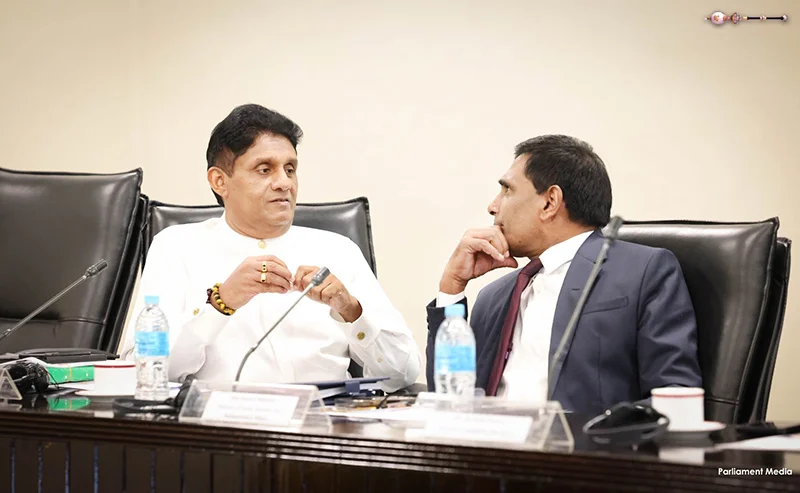
Human trafficking has become increasingly sophisticated, with deceptive overseas employment offers, fraudulent recruitment practices and technology-enabled recruitment emerging as major threats that require a coordinated national response, Members of Parliament were told at a special awareness programme held in the House recently.
Addressing the programme, Secretary to the Ministry of Defence and Chairman of the National Anti-Human Trafficking Task Force, retired Air Vice Marshal Sampath Thuyacontha, said trafficking in persons had evolved significantly over the years and was now closely linked to organised transnational criminal networks.
He warned that fake foreign employment opportunities, fraudulent recruitment agencies, online recruitment platforms, forced labour, sexual exploitation and, in some instances, the use of victims for forced criminal activities had become key challenges confronting authorities.
The awareness programme organised jointly by the National Anti-Human Trafficking Task Force of the Ministry of Defence and Parliament, was aimed at strengthening legislators’ understanding of emerging trafficking trends, the legal and policy framework governing the issue, and the role of Parliament in strengthening anti-trafficking legislation.
MPs were also briefed on the National Strategic Action Plan on Combating Human Trafficking (2026-2030), which focuses on preventing trafficking, identifying and protecting victims, strengthening the criminal justice response and improving coordination among State institutions.
Special emphasis was placed on the growing use of digital platforms for recruitment, deceptive migration practices, labour exploitation and the coercion of victims into criminal activities.
The programme featured presentations by Additional Solicitor General Haripriya Jayasundara, PC, and State Counsel Sajith Bandara of the Attorney General’s Department.
The event, held under the patronage of Deputy Chairperson of Committees Hemali Weerasekara, was attended by Opposition Leader Sajith Premadasa, Public Security and Parliamentary Affairs Minister Ananda Wijepala, Deputy Defence Minister retired Major General Aruna Jayasekara, Members of Parliament and senior officials of the Ministry of Defence, the National Anti-Human Trafficking Task Force and Parliament.

Prison mayhem leaves at least 26 dead; five officers killed in revenge violence

Cleaner, cheaper electricity gathers momentum with rapid progress in 50 MW Mannar wind power project

Tech-enabled trafficking, fake foreign jobs pose growing threat, MPs told

National programme to conserve 1,000 archaeological sites across the country

England no match for ruthless Australia

Soaring mercury and need for caution

‘Dates have the highest sugar content to fight Coronavirus’

Sunday Island 27 December – Headlines

#SundayIsland 17th December – Headlines

Sunday Island – 28th March

Sunday Island Headlines – 21 March

Sunday Island – 21st February – Headlines
-

 News2 days ago
Singapore-based Buddhist monk marks nearly four decades of humanitarian service
-

 News3 days ago
Freedom 250: US Embassy celebrates America’s 250th Independence Day through magic of American cinema
-

 News4 days ago
CIABOC to question Harak Kata on Rs. 200 mn bribery allegation
-
 News4 days ago
SLAF conducts successful rescue mission under UN command in Central African Republic
-

 Midweek Review6 days ago
H’tota port’s strategic status remains focal point of geopolitical scrutiny
-

 News1 day ago
AI concerned over proposed SL military deployment in Haiti
-
 News4 days ago
UNEP support pledged to strengthen Sri Lanka’s Environmental Priorities
-

 Features2 days ago
The NPP’s New Challenge: Balancing Easter Lawfare and Economic Welfare