
News
Sabry names culprits, asks for system overhaul

Economic crisis: ‘Money printing cannot be stopped completely’
By Shamindra Ferdinando
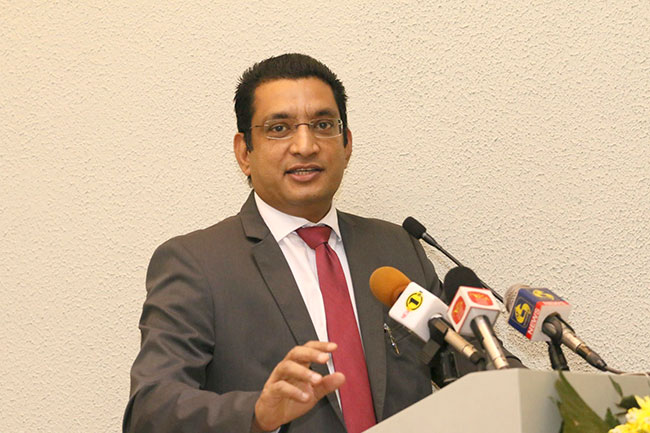
Finance Minister Ali Sabry, PC, has said that the Secretary to the Treasury, Governor of the Central Bank, and senior economic advisors to the President, misled the Cabinet as regards the economic situation.
They repeatedly assured that the situation was well under control, despite difficulties, lawmaker Sabry has said. That team expressed confidence that issues could be successfully dealt with, lawmaker Sabry said.
Sabry said so in a live interview on Swarnavahini Monday (02) night, the first since his return from Washington, where he led the government delegation at talks with the International Monetary Fund (IMF) and the World Bank.
Sabry said that the Cabinet-of-Ministers had realised the gravity of the situation in August 2021.
However, he was not asked about his predecessor Basil Rajapaksa who was blamed for aggravating the economic crisis.
By the time the Central Bank floated the rupee in March this year even without bothering to inform the Cabinet-of-Ministers of its decision, irreparable damage had already been caused, Minister Sabry said.
He said those who managed the national economy had prevented the country seeking IMF’s intervention well over a year back. Had President Gotabaya Rajapaksa and the Cabinet-of-Ministers received proper advice, Sri Lanka would not have been in the current predicament, Minister Sabry said.
Prof. W. A. Lakshman (Dec 2019-Sept 2021) and Ajith Nivard Cabraal (Sept 2021-March 2022) served as Governors of CBSL, S.R. Attygalle was as Secretary, Ministry of Finance (Nov 2019-April 2022) whereas Dr. P. B. Jayasundera functioned as Secretary to the President (Nov 2019-Dec 2021).
Minister Sabry said that depending on how the government and the Opposition as well as other interested parties responded to the current crisis, Sri Lanka could overcome the daunting challenges the way India, Thailand and South Korea had done or end up like Lebanon or Venezuela.
During the interview conducted by a panel led by Saddha Mangala Sooriyabandara, MP Sabry said most MPs representing both the government and the Opposition seemed unaware of the ground situation.
Responding to a question on the availability of funding to meet the basic requirements, Minister Sabry said that foreign reserves were zero. Having mentioned specific loans that had to be honoured during the April-July period, Minister Sabry said, adding that Sri Lanka had resorted to the only tangible action plan available under the present circumstances.
According to Minister Sabry Sri Lanka was left with no alternative but to restrcuture debt as underscored by the IMF. He said the government would a team of experts to represent Sri Lanka at debt restructuring talks with the relevant parties. The President’s Counsel expressed confidence that the selection process could be finalised by the time the Cabinet-of-Ministers meets again next week.
Declaring that the debt restructuring process was complicated the task, Minister Sabry said that the issues included loans obtained from the IMF, WB and other similar institutions, bilateral loans obtained from Japan, China and India et al), and funds raised from international money markets at up to 7% interest.
He found fault with successive finance ministers for simply repeating what the Treasury and the CBSL provided.
Emphasising the accountability on the part of successive governments, particularly those who had served as finance ministers for the crisis that had engulfed the country, Minister Sabry called for a system overhaul. He questioned the utilisation of funds over the past several decades as financial accountability and transparency deteriorated to such an extent the fate of Sri Lanka depended on external factors.
Minister Sabry said that the economy had suffered a severe setback due to unasked tax reduction that deprived the government over Rs. 500 bn annually. The minister said that the tax cut announced soon after the 2019 presidential election had weakened the fiscal status, and therefore it could not be accepted as a prudent decision. Referring to R. Paskaralingam role during Ranasinghe Premadasa’s tenure as the President, Minister Sabry said that ‘yes men’ had caused irreparable damage. In the absence of proper parliamentary supervision and decision-making process based on data, successive governments had been proceeding on wrong paths, Minister Sabry said, adding that the pandemic and the war in Ukraine this year had made matters worse for Sri Lanka.
Minister Sabry quoted the IMF delegation during talks with his team in Washington as having said that a combination of debt inheritance, bad policies and bad luck had resulted in the current crisis.
Referring to a hastily arranged meeting he had with Chinese Ambassador in Colombo Qi Zhenhong in the wake of the Chinese envoy expressing concern over Sri Lanka’s dialogue with the IMF, Minister Sabry said that an assurance had been received as regards Beijing’s continued support. Minister Sabry said that Sri Lanka needed the support of India, China and Japan.
The IMF loan facility could be finalised in about 6-8 months, the Finance Minister said adding that Sri Lanka expected USD 3-4 bn from the IMF over a three-year period.
Pointing out that international crude oil prices had recorded a staggering 138% increase due to the Russian invasion of Ukraine, Ministry Sabry said that the biggest issue the country faced was the supply of petroleum products. He revealed that out of the USD 500 mn Indian credit line for petroleum products, already USD 400 mn had been utilised and of the USD I bn loan facility, USD 200 mn had been sought for the import of petroleum products. Minister Sabry further said that the government had asked India to enhance USD 500 mn credit line for the import of petroleum products to USD 1 bn.
Sabry dismissed concerns over IMF conditions and explained how IMF conditions would help the country achieve financial stability.
He stressed need for gradual and an all-round revenue increase as part of the overall measures to stabilise the national economy. Sri Lanka was now paying the price for the failure of successive governments to streamline tax collection, he added. The state revenue had been 24 percent of the GDP in 82/83 but by 2020/2021 it had dropped to 8.6%, Minister Sabry said, pointing out the state revenue was not even sufficient to pay public sector salaries, pensions, Samurdhi and the maintenance of armed forces.
The Minister said that though money printing caused inflation it could not be totally stopped.

News
Cabinet nod to increase the number of new automated passenger clearance gates at the Bandaranayake International Airport to 12

Approval of the Cabinet of Ministers was granted at their meeting held on 19.05.2025 to purchase four (04) automated passenger clearance gates for Bandaranayake International Airport.
In addition, it is expected to extend the automated passenger clearance gates facility so far given only to the Sri Lankans
parallel to the e – passport issuance system to be introduced in the year 2027 also to the foreigners who travel to and from this country.
Furthermore, considering also the number of air passengers rapidly increasing with the fast – forwarding business and tourism field, the appropriateness to increase the total automated passenger clearance gates up to twelve (12) in number has been recognized.
Accordingly, the Cabinet of Ministers, approved the resolution furnished by the Minister of Public Security and Parliamentary Affairs to initiate the procurement and installation of 12
automated passenger clearance gates altogether with the already approved four (04) and another eight (08) automated passenger clearance gates adhering to the formal procurement procedure
Based on the observations submitted by the Task Force on Prevention of Money Laundering and Financing for Terrorism, approval of the Cabinet of Ministers was granted at their meeting held on 18.12.2024 to amend the Trust Ordinance No. 9 of 1917 including amendments proposed by the Financial
Intelligence Unit of the Central Bank of Sri Lanka.
Accordingly, clearance of the Attorney General has been granted for the Trust (Amendment) Draft Bill formulated by the Legal Draftsman.
Therefore, the Cabinet of Ministers approved the resolution furnished by the Minister of Justice and National Integration
to publish the said draft bill in the government gazette notification and thereby, submit the same to the Parliament for its concurrence.
Action was taken to provide a fuel relief for the fuel consumers during the months of April, May and June of 2026 to redress by minimizing the impact caused to the day today life of the citizens of this country as well as the entire economy due to the price hike of petroleum fuel in the global market resulting from the war situation in the Middle East.
Government mediation is essential for minimizing the impact on the day to today life of citizens in this country due to that war situation not being ended further. Therefore, it has been planned to redress on the sale price for Auto Diesel and Industrial Diesel for a period of 03 months by the Government to provide relief to the public as well as to maintain the prices at a bearable level to the consumers without escalating the fuel prices in this country compared to the escalation of fuel prices
in the international market.
Therefore, the Cabinet of Ministers granted approval for the resolution furnished by the President in his capacity as the Minister of Finance, Planning and Economic Development to
allocate provisions subject to the monthly limitations respectively as rupees 15 billion for the month of October, rupees 13.5 billion for the month of November and rupees 12.15 billion for the month of December to provide the said relief

Cabinet nod to increase the number of new automated passenger clearance gates at the Bandaranayake International Airport to 12
Draft Bill for amending the Trust Ordinance
Implementing further relief programme to Public sffected by the Middle East conflict situation
Establishment of a Spectrum Management and Monitoring System and a Quality of Service and Quality of Experience System for the Telecommunications Regulatory Commission of Sri Lanka
Appointment of a Committee for the Restitution of Sri Lankan Cultural Heritage Held Abroad
Ten-Year National Action Plan on the Social Protection Sector (2026–2035)

‘Dates have the highest sugar content to fight Coronavirus’

Sunday Island 27 December – Headlines

#SundayIsland 17th December – Headlines

Sunday Island – 28th March

Sunday Island Headlines – 21 March

Sunday Island – 21st February – Headlines
-
 News7 days ago
Mastermind Naufer Moulavi among 15 found guilty
-
 Midweek Review7 days ago
Thileepan’s fast unto death: An authentic narrative that many missed
-

 Latest News6 days ago
Showers above 100 mm are likely at some places in the Western, Sabaragamuwa, Central and North-western provinces and in Galle and Matara Districts
-

 Editorial7 days ago
Big Bad Bills
-
Editorial6 days ago
Crimes punished and unpunished
-

 Features5 days ago
Beyond traditional jobs: Why Sri Lanka needs to facilitate the gig economy
-

 News7 days ago
No referendum needed for passage of 22 A: SC
-

 News7 days ago
One clause in Anti-Corruption (Amendment) Bill requires referendu: SC