
Opinion
Sri Lanka in Lee Kuan Yew’s words

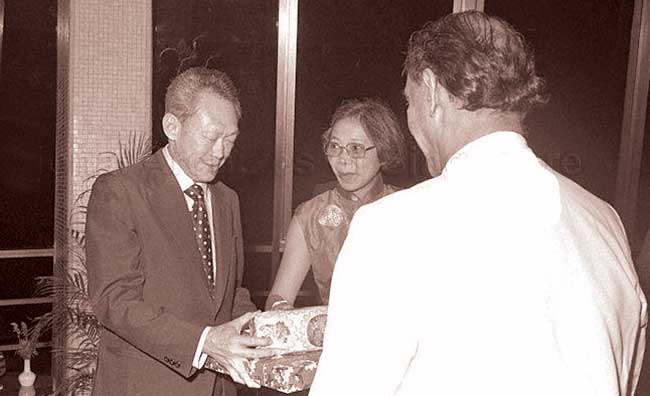
By Hasala Perera
It is often said that Lee Kuan Yew (LKY) once considered Sri Lanka as a development model, but no one has questioned the veracity of this claim, and it will be interesting to see what he has said about Sri Lanka.
LKY’s views about Sri Lanka have been published in three books, one is his memoirs, ‘From Third World to First’, second in a compilation of his speeches titled ‘LKY -The man and his ideas’ and ‘Giants of Asia – Conversations with LKY’, which contains interviews American journalist Tom Plate had with LKY.
In his book, ‘From Third World to First’, LKY has dedicated an entire chapter to his views of India, Pakistan and Sri Lanka, and it titled ‘South Asia’s Legends and Leaders’ and seven out of these 22 pages are devoted to Sri Lanka.
For easy reference, ‘From Third World To First’ as [1], ‘LKY – Man and his ideas’ is mentioned as [2], and ‘Giants of Asia – Conversations with LKY’ as [3] with the corresponding page number where appropriate. It is important to note here that LKY refers to the country both as Ceylon and Sri Lanka.
LKY’s first Impression
LKY visited Sri Lanka on four occasions. His first visit was in 1956 and during each visit he had happened to meet a new leader in the country.
He states that ‘Ceylon was Britain’s model commonwealth country’ [1, p 461] and that ‘Ceylon had more resources and better infrastructure than Singapore’ [1, p 460], he attributes this to Lord Mountbatten’s presence in Kandy [ibid], which could be some proof that he had a positive outlook of Sri Lanka and wished if Singapore had the same infrastructure as Sri Lanka.
He was full of praise of the capital city Colombo when he states that ‘Colombo was a better city than Singapore’ [2, pg.14/22], and he was ‘impressed by the public buildings’ in the city [1, p 460].
His View of Sri Lankan Leaders
LKY gave his opinion on six Premiers of Sri Lanka namely S.W.R.D. Bandaranaike, Dudley Senanayake, Sirimavo Bandaranaike, J.R Jayewardene, Ranasinghe Premadasa and on Mahinda Rajapaksa just a. few years before his death
His first visit to Sri Lanka coincided with the victory of Bandaranaike’s newly created Sri Lanka Freedom Party, he calls him a dapper little man, well dressed, articulate and a ‘Pukka Sahib’ [1, p 460] a term invented by the British to call the inhabitants of their colonies who followed their ways.
LKY says that Bandaranaike was elated to have won the election mandate from a Sinhala majority and he had promised to make Sinhalese the official language and Buddhism the state religion and did not seem troubled by the disadvantage caused by the minorities as a result of it [1, p 460], during his conversations with him he felt that Bandaranaike spoke to him as if he had still been a member of the Oxford Union debating society [1, p461], despite all his effort to be a champion of the Sinhalese Language, he states that three years later he was not surprised to hear about his assassination by a Buddhist monk [ibid].
LKY’s second visit to Sri Lanka was in 1966, when Dudley Senanayake was the prime minister of the Country, who he refers as a gentle, resigned and a fatalistic elderly man [1, p 462], while playing golf together in Colombo he describes an incident where Dudley Senanayake apologised to him about the huts, goats and cows encroached by squatters at the fairway, as he was unable to justify people for keeping open spaces in the city, unlike our present leaders Senanayake quite casually sent LKY by train from Colombo to Nuwara Eliya, where he played a game of golf and witnessed the same problem with the squatters as in Colombo [ibid]. He felt that Senanayake was a weak leader and did not have control over the citizens of the country.
When he visited Sri Lanka for the third time in 1970, the prime minister of Sri Lanka was Sirimavo Bandaranaike, whom he believed had won due to a sympathy vote [1, p 461] but he describes her as a tougher, determined and less voluble leader than her husband S.W.R.D Bandaranaike [ibid]. He praises her policy on the non-aligned ideology, but he is not in favour of her policy-based decision on supporting the removal of US troops from several South East Asian Countries as he felt that Singapore could be at a disadvantage if they were removed as there was a possibility of communism taking over those countries which could have a negative impact on Singapore [ibid].
It was through one of her Cabinet Ministers Felix Dias Bandaranaike that he learnt Sri Lanka spent only 2.5% of its budget on defence [1, p 461], and the reason he gives is that Sri Lanka is “blessed” with peace and security as a result of its good fortune in geography and history. LKY calls him a bright but an ‘unprofound’ person, but despite its ‘blessings’ he ironically mentions that 10 years later Sri Lanka spends more than half of its budget on defence and arms to crush a rebellion that took place inside the Country [ibid], he is the only Sri Lankan minister ever mentioned by him.
LKY further states the futility of Mrs Bandaranaike’s decision to change the name of the country from ‘Ceylon’ to ‘Sri Lanka’ and making the country a republic as it did not improve the fortunes of the country, the best example he takes here is that Sri Lankan Tea was still been sold as Ceylon Tea [1, pg.463] as a matter of fact even to this day Sri Lankan Tea is known as Ceylon Tea. He further states that by changing names sometimes you could deceive gods, but you can’t deceive the people who live in it [2, pg.15/22]
His meeting with President J R Jayewardene took place outside Sri Lanka, which was at the CHOGRM Conference held in Sydney. He says that during this meeting Jayewardene wanted Sri Lanka to move away from socialist policies which had bankrupted the country and wanted Singapore to get involved in the development of Sri Lanka; he says that he was impressed by his practical approach which made him visit Sri Lanka for the fourth time in 1978 [1, pp 463,464].
Despite the positive outlook LKY had on President Jayewardene, as time went by he started seeing his drawbacks, the former thought that the latter’s decision to start a national airline as a symbol of progress and employ a pilot as a chairman of the newly built airline as a weakness [1, p 464]. He finally states Jayewardene retired as a tired man who had run out of solutions [1, p 465], which indicates that his opinion of Jayewardene had changed.
He calls Ranasingha Premadasa, who succeeded him a ‘Sinhala Chauvinist’ [1, p 465] and considers the latter’s decision to remove Indian Soldiers brought down during the Jayawardena government to fight the civil war as insensible [ibid]. He did not have a positive attitude towards Ranasinghe Premadasa.
A few years before his death in an interview he had given to the American journalist Tom Plate he gives his views on the former President and the incumbent Prime Minister Mahinda Rajapaksa as follows: “He thinks he has finished the war, I have read his speeches, I knew he was a Sinhalese extremist and I cannot change his mind” [3], he felt that Rajapaksa was an obstinate leader and extremist.
His View on Sri Lanka’s Economy and Management
LKY was aware that Sri Lanka was a country with wealth. ‘Sri Lanka had large Sterling Reserves’ [2, p 14/22], yet he knew that the country lacked management principles and sound policies that could one day challenge the ability to retain that wealth.
One of his first experiences was when the Prime Minister Dudley Senanayake sent LKY from Colombo to Nuwara Elya by train in a special carriage, the food given on that train was ‘poisonous’, and the crab meal that was served to him was stinking and badly contaminated [1, pg.462], which showed carelessness and irresponsible management by the railway department. He went into the toilet and spewed it all [ibid].
LKY realised that Sri Lankan leaders were not intelligent in identifying priorities. When Jayewardene wanted to start an airline as he thought that it was a symbol of progress, LKY advised him that it should not be his priority because to start an airline one needed many talented and good administrators, in addition to that an airline is a glamour project and is not of great value for developing Sri Lanka [1, p 464] instead he advised the Sri Lankan President that priority should be given to other projects in the country such as irrigation, agriculture, industrial development and housing [ibid].
LKY observed the lack of meritocracy in Sri Lankan administration when Jayewardene decided to employ a pilot as a Chairman of the newly formed Airline, his simple question to him was this: ‘How can an airline pilot run an airline?’ [1, pg.464], he firmly believed that it should be done by a capable administrator. However Jayewardene insisted on it so LKY helped him to launch it in six months with the help of the staff of Singapore Airlines. This was the beginning of Air Lanka (now Sri Lankan Airlines), but it lacked a proper top management and when the newly elected chairman decided to buy certain aircraft against their advice, the Singaporean government decided to withdraw its support.
LKY foresaw that Air Lanka was doomed to fail, and he gave five reasons for it, and they were excessive capacity expansion, negative cash flow, lack of trained staff, unreliable services and insufficient passengers. [1, p 464].
LKY noticed the absence of meritocracy when he saw the condition of the tea estates here; he was very disappointed of the way tea estates were managed and criticised the locals who managed it when he states that ‘the locals who had been promoted were not good supervisors as their British predecessors’ [1, p 463], and as a result there was no strict discipline, plucking was not done appropriately and the tea plantations were in a deplorable condition’[ibid]; if responsibilities are not given based on meritocracy the industries wouldcollapse and as a result the economy of the country is doomed to fail.
LKY’s on the Education System of Sri Lanka and his visit to the Peradeniya University
LKY had a very positive view of the education system introduced by the British in Sri Lanka. He says, ‘It (Sri Lanka) had a relatively good standard of education’ [1, p 462]. He says Sri Lanka had some universities of high quality in Colombo and Kandy (Peradeniya) that was teaching in English [ibid] and before the war they had thick layer of educated talent [2, pg. 14/22], but he was disappointed at its change of medium to local languages and the standards of the education after his visit to the Peradeniya University.
LKY mentions his visit to the Peradeniya University, which he calls the University of Kandy, when he learnt from the Vice Chancellor that the medium of instruction in the university Sinhala for Sinhalese students, Tamil for students from Jaffna and English for Burgher students. [1, pg.463]
LKY asks the Vice Chancellor, ‘How can three engineers educated in three different languages build one bridge?’ And the VC replied: ‘That, Sir is a political question for the ministers to answer’ [1, p 463]. This statement showed how qualified educationists in Sri Lanka became helpless because of the decisions made by politicians.
The Vice Chancellor further mentions that all the basic textbooks which were printed in English had to be translated to Sinhala and Tamil and by the time they were translated and printed, they were three to four editions old; LKY calls this translation a slow and unwieldy process [1, p 463].
Although LKY does not mention the name of the Vice Chancellor, he describes him as a Burgher gentleman who wore a Cambridge University tie, and this description matches Professor E. O. E Periera, who held the position of the Vice Chancellor of Peradeniya University from 1969 to 1971.
Even though LKY was full of praise of the Sri Lankan education system, which was initially conducted in English, after his visit to the Peradeniya University his views changed as he witnessed the switch over from English to local languages and the helplessness of the academics.
What Sri Lanka did was the opposite of what LKY did to Universities in Singapore; he changed the medium of instruction at the Nanyang University in Singapore from Chinese to English, when he realised that it could not be done as the lecturers lacked the proper skills he merged it with the University of Singapore and thus was the beginning of the National University of Singapore [2, p 3/4], several years later reflecting about his decision he says Nanyang University no longer taught in Chinese and its graduates could easily find employment. [1, pg702].
LKY’s view on ethnic problem of Sri Lanka
LKY was very sympathetic towards the Tamils of Sri Lanka. He states that ‘they were active and intelligent fellows who worked hard and got themselves penalised as a result of the domination of the Sinhala majority’ [2, p 14/22]: ‘Sinhalese who are less capable are putting down Tamils who are more capable [3].
He was critical of Sri Lanka’s election. He mentions that ‘one-man-one-vote system did not solve a basic problem’ [1, p 462]. He believed that that the voting system did not give a fair representation. He states, ‘The majority Sinhalese could outvote the Tamils’ [Ibid] and ‘Sri Lanka is a democracy based on one citizen one vote’ [3] and he is not against democracies when they work, but he was against defending countries because of democracy [ibid].
J R Jayewardene told LKY that he was willing to give autonomy control to the Tamil people in Jaffna but later realised that he could not giveaway to the supremacy of Sinhalese to the Tamil, which led to the civil war [1, pg.464].
LKY firmly believed that a political solution was the only way to sort out the ethnic problem of Sri Lanka. During his meetings with President Premadasa he tried to convince him that the conflict could not be solved by force of arms and the political solution was the only way [1, p 465].
LKY believed that the civil war that took place in Sri Lanka destroyed the hope of a prosperous Sri Lanka for many years if not many generations [1, p 464], which is true as every successive government in Sri Lanka from the 1980s had to deal with it and despite ending the war, we are yet overcome the scars and horrors of it.
His view on reasons for Sri Lanka’s failure
LKY thought that S.W.R. D Bandaranaike’s decision to make Sinhala the national language and Buddhism the national religion as the start of the ‘unravelling’ of Ceylon [1, p 460]; he further states that the minority Tamils felt disadvantaged and disposed as a result of it [1, p 462].
He wanted English to be made the primary language of use in Singapore. ‘We inherited the English Language from the British and adopted it as our common working language’ [1, p 78] and when Singapore got independence from the British, the Chinese Chamber of Commerce wanted him to make Chinese the official language of Singapore. Although the Chinese were the majority community in Singapore and LKY was himself a Chinese, his answer to them was ‘You must be mad’. [2, pg.2/4].
LKY was against the concept of welfare. ‘Welfare undermines Self Reliance’ [1, p 126] as he believed everyone had to work. ‘The world does not owe us a living; we cannot live by the begging bowl’ [1, p 70] but successive Sri Lankan governments depended on loans and aid while the people of Sri Lanka depended on welfare and concessions.
In 1994, during a debate in the Singapore Parliament LKY asked, ‘Can you have a good government without having good men in charge?’ [2, pg13/22], his simple view was that you can’t have a good Country without good administrators and referring to Sri Lanka he states, ‘During my visits over the years I watched the promising country go to waste [1, pg.462] and it failed because they had wrong or weak leaders like the Philippines [2, p 15/22].
Conclusion
Was LKY aware that Sri Lanka was looking at Singapore as a model? He did, and what was his opinion about it? He says, ‘It was ‘flattering’ for Sri Lanka to model its Country from Singapore’ [1, pg464]. He knew that Sri Lanka can never be a Singapore.
LKY never wanted any prestige and honour. ‘I had no desire to rewrite the past and perpetuate ourselves by renaming streets or buildings or putting our faces on postage stamps or currency notes’. However, in Sri Lanka majority of the road names in Colombo were changed and many Prime Ministers and Presidents had their faces in postage stamps, coins and banks notes.
LKY ends the chapter on Sri Lanka in his memoir thus: “It’s sad that the country whose ancient name Serendip [sic] has given the English Language the word ‘serendipity’ is now the epitome of conflict, pain, sorrow and hopelessness’ [1, pg.466]. According to the Oxford Dictionary the word serendipity means ‘Something interesting or pleasant happening by chance’.
In another speech, LKY states that Sri Lanka can never be put together again and somebody should have told Sri Lankans to change the system, loosen up or break off [2, pg.14/22]. Today, Sri Lankans have come on to the streets protesting the rulers to leave and change the system, something LKY expected Sri Lanka to do, or the Country would break.
A few years before his death, LKY mentioned that despite the end of the civil war ‘It (Sri Lanka) is not a happy, united country’ [3], so will Sri Lanka groom itself to be a united and a happy Country, this will be possible only if its citizens are confident in achieving it, as Lee Kwan states ‘If I have to choose one word to explain why Singapore succeeded, it is CONFIDENCE’ [1, p 87]. Hopefully, if Sri Lankans move forward with confidence, the country will be able to achieve its goal.


Children are the future of every nation, and the values they learn during childhood shape the society they will eventually lead. In Sri Lanka, where family traditions, respect for elders, and social responsibility have long been important cultural values, the way children are raised remains a topic of great interest. In recent years, many parents and educators have moved away from traditional forms of punishment and embraced more child-friendly approaches to discipline. While protecting children from physical and emotional harm is essential, an important question arises: can a child who grows up without any form of punishment or consequences become a threat to Sri Lankan society?
To answer this question, it is necessary to understand the difference between punishment and discipline. Punishment is often associated with penalties imposed for wrongdoing, while discipline refers to teaching children self-control, responsibility, and respect for rules. Modern child psychology generally discourages harsh physical punishment because it can cause fear, anxiety, and resentment. However, completely removing consequences for inappropriate behavior may create a different set of problems.
Sri Lankan society has traditionally emphasized discipline within the family. Parents, grandparents, and teachers have often played active roles in guiding children’s behavior. Respect for elders, obedience, and good manners have been considered important virtues. While some traditional disciplinary methods may no longer be acceptable, the underlying principle of teaching accountability remains relevant.
A child who never faces consequences for wrongdoing may struggle to understand the boundaries that exist in society. For example, if a child is allowed to insult others, damage property, or ignore rules without correction, they may develop the belief that their actions have no consequences. Such attitudes can become problematic when the child enters school, the workplace, or the wider community.
Sri Lankan schools already face challenges related to student discipline. Teachers often report difficulties in managing classrooms where some students refuse to follow instructions or respect school regulations. When children are not taught accountability at home, educational institutions may find it harder to maintain a productive learning environment. This can affect not only the individual student but also classmates whose education is disrupted.
Another concern is the development of entitlement. A child who is never told “no” may come to believe that personal desires should always be fulfilled. In a society where cooperation and mutual respect are essential, such attitudes can lead to conflicts with peers, teachers, employers, and even family members. Sri Lanka’s social fabric depends heavily on community relationships, and individuals who fail to respect others can weaken these bonds.
The influence of social media and modern technology has added another dimension to this issue. Today’s children have access to information and entertainment on an unprecedented scale. Without proper guidance and consequences, some may misuse technology, engage in cyberbullying, spread misinformation, or develop unhealthy habits. Parents who avoid setting limits may unintentionally expose children to risks that affect both personal development and social well-being.
The workplace offers another example of why accountability is important. Sri Lanka’s economic development depends on a workforce that is disciplined, responsible, and capable of working with others. Employers value punctuality, respect, and professionalism. Individuals who grow up without learning responsibility may find it difficult to meet these expectations, affecting both their personal success and the productivity of organizations.
However, it is equally important not to interpret this argument as support for harsh punishment. Research has shown that excessive physical or emotional punishment can have serious negative effects on children. Fear-based parenting may produce obedience in the short term but can damage confidence, trust, and mental health in the long term. Therefore, the solution is not stricter punishment but more effective discipline.
Positive discipline provides a balanced alternative. It involves setting clear rules, explaining expectations, and applying fair consequences when those rules are broken. For instance, if a child neglects schoolwork, they may lose certain privileges until responsibilities are fulfilled. If they damage property, they can be required to help repair or replace it. Such consequences teach accountability while preserving the child’s dignity.
Sri Lankan parents, teachers, and community leaders all have a role to play in nurturing responsible citizens. Families should create environments where children feel loved and supported but also understand that actions have consequences. Schools should encourage character development alongside academic achievement. Religious and community organizations can reinforce values such as honesty, compassion, and respect for others.
A balanced approach is especially important in a rapidly changing society. As Sri Lanka continues to modernize and integrate with the global community, young people must learn not only their rights but also their responsibilities. Freedom without responsibility can lead to selfishness, while discipline without compassion can lead to fear. The challenge is to find the middle ground.
A punishment-free child can become a concern for Sri Lankan society if the absence of punishment also means the absence of discipline and accountability. Children who never learn consequences may struggle to respect rules, authority, and the rights of others. However, harsh punishment is not the answer. The most effective approach combines love, guidance, clear boundaries, and fair consequences. By raising children who understand both freedom and responsibility, Sri Lanka can build a future generation that strengthens society rather than threatens it.
Saumya Aloysius
(An essayist, children’s writer and freelance writer who holds a Master’s Degree in Sociology from the University of Kelaniya)

On Friday 12 June, 2026, a SriLankan Airlines Airbus 330 was en route from Colombo to Sydney, Australia was about 45 minutes into its flight when a loud bang was heard, accompanied by a blinding flash. In what was assumed to be a lightning strike, the airplane’s left (No. 1) engine was damaged, forcing the aircraft to return to BIA-Katunayake, where it landed safely.
Lightning travels from cloud to cloud or cloud to ground. Because the aircraft is not electrically ‘grounded’, or ‘earthed’, it must have been in the path of the thunder bolt purely by chance. There is also a phenomenon whereby the aircraft may travel through an electrically charged atmosphere (for example a cloud) where an electrical charge could build up and strike, or be emitted, as lightning. In such an instance, pilots hear electrical static in their headsets before the strike. Usually, when lightning strikes an aircraft in flight, the electrical charges remain on the outside, as on a ‘Faraday’s Cage’ apparatus, and the passengers and crew are perfectly safe.
To help the efficient and safe discharge of static electricity from the airplane’s structure, static wicks, or static dischargers, are fitted at the trailing (rearmost) edges of the wings and tail surfaces. When an airplane has landed after a lightning strike, ground engineers count the number of wicks that may have been burnt out to ensure that a minimum (recommended) number is available for a subsequent flight. Sometimes, there is minor damage, like pitting of the paintwork at the points where the charges left the aircraft.
The last instance in the USA of an airplane believed to have been lost due to a lightning strike was on December 8, 1963, when a Pan Am Boeing 707-121, en route from Baltimore, Maryland to Philadelphia, Pennsylvania, suffered a fuel tank explosion, later determined to have been the result of a lightning strike. Since then, aircraft have been rendered immune from lightning damage thanks to extensive research conducted by manufacturers using high-voltage currents.
Interestingly, modern airliners have electronic instrument displays which don’t even flicker when the aircraft is struck by lightning. By a process of connecting all the metallic parts, known as ‘bonding’, the entire fuselage effectively becomes a protective cocoon, so electrical charges caused by lightning will always reside on the outside of the aircraft.
What is unusual in the recent SriLankan Airlines incident is the extent of damage to the left engine. Did it encounter hail or ingest something?
Only a thorough, independent inquiry by aviation safety investigators will reveal the cause.
GUWAN SEEYA


“Vision without execution is hallucination.” – Thomas Edison
Introduction: Stabilisation Is Not Transformation
Sri Lanka has come a long way since the economic collapse of 2022. Inflation has been brought under control. Foreign reserves have improved. Debt restructuring has advanced. Government revenue has increased significantly through taxation reforms. The exchange rate has stabilised, and confidence has gradually returned to financial markets.
These achievements deserve recognition.
However, stabilisation should not be confused with economic transformation. A patient discharged from intensive care is not necessarily healthy. Likewise, an economy that has escaped collapse has not necessarily achieved sustainable prosperity.
The central economic question facing Sri Lanka today is no longer how to avoid another crisis. Rather, it is how to achieve sustained economic growth of at least 7% per annum by 2029.
Unfortunately, much of the current policy debate remains trapped in economic diagnosis. Policymakers, economists, and commentators repeatedly identify familiar problems: (i) low productivity, (ii) weak exports, i(iii) Inadequate innovation, (iv) poor competitiveness, and (v) insufficient investment. While these diagnoses are correct, they are not new.
Sri Lanka now needs economic engineering.
The country requires a clear, measurable, and actionable National Growth Strategy for 2026-2029 that identifies (i) where growth will come from,(ii) what investments are required,(iii) which institutions will lead implementation, and (iv) how success will be measured.
The difference between diagnosis and engineering is the difference between describing a problem and solving it.
The Missing National Growth Target
One of the most striking weaknesses in Sri Lanka’s economic discourse is the absence of a publicly articulated growth target supported by a detailed implementation framework.
Successful economies establish measurable objectives.
Sri Lanka should adopt the following growth trajectory:
2026 – 4%
2027 – 5%
2028 – 6%
2029 – 7%
Such targets would provide direction to investors, public institutions, universities, exporters, and development partners. Without a destination, even the best policies risk becoming disconnected initiatives.
Today, many policy interventions appear fragmented—valuable in isolation but lacking integration into a broader national growth framework.
Growth Will Not Come From Consumption
For decades Sri Lanka relied heavily on consumption, imports, remittances, tourism, and external borrowing.
That model has reached its limits.
No country has achieved sustained prosperity through consumption-led growth alone.
The countries that transformed themselves—Singapore, South Korea, Ireland, Vietnam, and China—generated growth through productive investment, exports, industrialisation, and integration into global markets.
Sri Lanka’s future growth must therefore be driven by investment and exports rather than domestic consumption.
The challenge is not increasing spending but increasing productive capacity.
Export-Led Growth: The First Pillar of Transformation
Every successful Asian growth story has one characteristic in common: exports.
Exports generate foreign exchange, create jobs, attract investment, encourage innovation, and improve productivity.
Sri Lanka should establish an ambitious target of doubling export earnings within the next decade.
This requires moving beyond traditional exports and expanding into:
High-value agriculture
Food processing
Information technology services
Logistics services
Advanced manufacturing
Professional services
Export growth must become a national mission comparable to post-war reconstruction efforts seen elsewhere in Asia.
Without a major expansion of exports, sustained 7% growth will remain elusive.
Manufacturing: The Forgotten Growth Engine
Manufacturing remains the single most important source of rapid economic transformation worldwide. Vietnam provides perhaps the best recent example.
Through (i) industrial zones, (ii) trade agreements, (iii) infrastructure development, and (iv) targeted investment attraction, Vietnam became deeply integrated into Asian production networks.
Sri Lanka possesses strategic advantages:
A prime Indian Ocean location
Strong port infrastructure
Educated labour force
Proximity to India
The country should establish specialised manufacturing clusters focusing on:
Electronics assembly
Medical devices
Processed food products
Boat building
Rubber-based products
Engineering components
Rather than attempting to compete with every country, Sri Lanka should specialise in selected niches where competitive advantages can be developed.
RCEP: The Strategic Door to Asia
Sri Lanka’s future lies increasingly in Asia.
The Regional Comprehensive Economic Partnership (RCEP) represents the largest trading bloc in the world and includes many of the fastest-growing economies.
Membership or closer integration with RCEP supply chains could provide Sri Lankan exporters with access to markets, investment, technology, and production networks that are currently beyond reach.
Unfortunately, discussion on RCEP remains limited compared with its strategic significance.
A dedicated national roadmap for RCEP engagement should become a top economic priority.
The question is not whether Sri Lanka can afford to integrate more deeply into Asia.
The question is whether Sri Lanka can afford not to.
Knowledge Economy: Turning Universities Into Growth Institutions
Sri Lanka’s universities produce thousands of graduates annually, yet their contribution to commercial innovation remains limited.
Globally, universities have become engines of economic development.
Research institutions should not merely produce graduates; they should produce patents, technologies, startups, and commercial solutions.
A national innovation framework should:
Link universities with industry
Encourage commercialisation of research
Support technology transfer
Expand startup financing
Reward innovation and entrepreneurship
Knowledge must become an economic asset rather than an academic exercise.
Dairy, Agriculture, And Import Substitution
Export growth alone is insufficient.
Sri Lanka must also reduce unnecessary import dependence.
The dairy sector offers a compelling example.
For decades, billions of rupees have left the country through dairy imports despite favourable climatic conditions and substantial agricultural potential.
A comprehensive dairy development strategy should focus on:
Improved genetics
Feed production
Commercial farming
Processing investment
Farmer productivity
The objective should be import substitution combined with rural income growth.
The same principle can be applied selectively to other sectors where domestic production is economically viable.
Creating A National Investment Targeting Agency
Sri Lanka does not need another bureaucracy.
It needs a professional institution dedicated exclusively to investment targeting.
Instead of passively waiting for investors, this agency would actively identify and attract strategic investments aligned with national priorities.
Its mandate would include:
Identifying priority sectors
Marketing opportunities globally
Coordinating approvals
Monitoring outcomes
Facilitating technology transfer
Singapore’s Economic Development Board and Ireland’s Industrial Development Agency demonstrate how targeted investment institutions can transform national economies.
Sri Lanka requires a similar mechanism adapted to local realities.
From Economic Diagnosis To Economic Engineering
The next stage of Sri Lanka’s recovery requires a fundamental shift in thinking.
The policy debate must move beyond identifying problems. The country already knows its problems.The challenge is implementation.Every policy proposal should be evaluated against a simple question:
Will this contribute to achieving 7% growth by 2029?
If the answer is no, resources should be redirected.
Economic engineering requires focus, prioritisation, accountability, and measurable outcomes. The era of fragmented initiatives must give way to a coherent national growth strategy.
Summary
Sri Lanka has achieved significant macroeconomic stabilisation, but stabilisation is only the first step toward sustainable prosperity.
To move from recovery to transformation, Sri Lanka should adopt a National Growth Strategy for 2026-2029 built around five pillars:
Export-led growth
Investment-led growth
Manufacturing expansion
Knowledge-economy development
Regional integration through RCEP and Asian supply chains
Supporting sectors such as dairy, tourism, logistics, and information technology should be strategically developed within this framework.
Most importantly, investment must be targeted rather than scattered, supported by specialised institutions and measurable performance indicators.
Conclusion
History demonstrates that no nation has become prosperous by accident. Economic success is rarely the product of isolated policies or short-term political initiatives. It is the outcome of a deliberate strategy pursued consistently over many years.
Sri Lanka stands at a crossroads.
One path leads to modest growth, periodic crises, recurring debt challenges, and continued vulnerability. The other leads to transformation through investment, exports, innovation, manufacturing, and regional integration.
The choice is ultimately strategic.
The time has come for Sri Lanka to move from economic diagnosis to economic engineering.
The future will not be determined by how successfully the country stabilised after the crisis. It will be determined by how effectively it builds the foundations for sustained growth thereafter. If Sri Lanka can articulate and execute a coherent investment-led growth strategy today, achieving 7% growth by 2029 need not be an aspiration.
It can become a national objective—and a national achievement, economic Engineering
The writer, among many, served as the Special Advisor to the Office of the President of Namibia from 2006 to 2012 and was a Senior Consultant with the UNDP for 20 years. He was a Senior Economist with the Central Bank of Sri Lanka (1972-1993). He can be reached via asoka.seneviratne@gmail.com

Creditor receives USD 2.5 mn as Lankan public bears loss from theft of Treasury funds

Former Minister Nalin raises defence of double jeopardy

UNP asks whether govt. obtained findings of FBI probe into 2019 Easter Sunday carnage

Opposition urges IMF to act on Lanka’s governance failures

Former private secretary to President GR arrested for drawing two salaries

Hakim wants Sallay to surrender passwords

‘Dates have the highest sugar content to fight Coronavirus’

Sunday Island 27 December – Headlines

#SundayIsland 17th December – Headlines

Sunday Island – 28th March

Sunday Island Headlines – 21 March

Sunday Island – 21st February – Headlines
-

 News4 days ago
Release of 2025 O/L results likely to be delayed
-

 Sports4 days ago
Tharanga set for high-profile javelin clash in Ostrava
-

 Features5 days ago
Politics of protected species
-

 News3 days ago
Beijing Capital Airlines to resume flights to Colombo signalling boost to tourism
-

 News4 days ago
Theft of USD 2.5 mn from Treasury: CoPF accused of complicity in NPP cover-up
-

 News6 days ago
Commonwealth lawyers urge Lanka to uphold rule of law
-

 Opinion4 days ago
Decoding Trump’s 12.5% “Forced Labor Tariff” on Sri Lanka
-

 Opinion4 days ago
Palm leaf manuscripts of Sri Lanka – Part V