
News
LSSP urges govt. to hand over power to interim administration

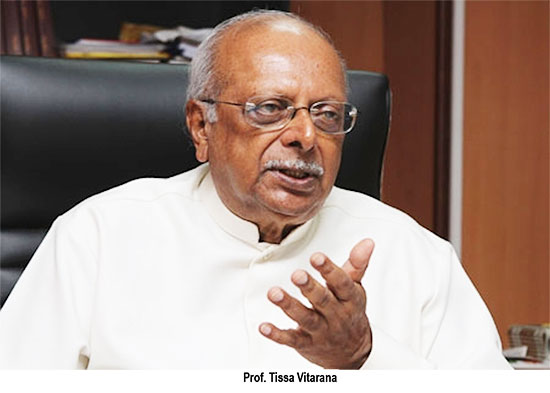
LSSP leader Prof Tissa Vitarana, in Parliament, on Friday, said that if the present government handed power over to a suitable interim government of good people, chosen from Parliament, and the administrative service, at the helm, and properly execute the above policies, and some others, it would be possible to find a solution to the present major crisis confronting the country.
Text of Prof Vitarana’s speech in Parliament:
“The people of Sri Lanka are suffering due to the high prices and the shortages of essential items which leads to queues lasting several days. The shortages of Imported items, like fuel, gas, milk powder and other food items, and medicines, is causing great suffering and a threat to life. For instance, the Sri Lanka Medical Association (SLMA) and Government hospital staff are publicly protesting about the suffering of patients due to this. The lack of electricity is another major problem. The Government has allowed traders to sell goods at any price without any controls. A system should be developed to ensure that the benefits of any concession given by the Government only goes to the ordinary people, especially the poor, and not to the rich. The consumers have to go hungry and more than 60% of the population, who are below the poverty line, have to manage with one meal a day.
“The Government has promised to supply some or all of these items in the near future, but no precise dates are being given. I call upon the government to inform the people when these essentials will be made available at a reasonable price. The government must stick to these dates and times, and not fool the people any longer with false promises.
“The government must address the causes of the people’s suffering and lead by setting an example. All ostentatious lifestyles of political administrative leaders of the country should be done away with so that the people will regain some confidence in the government’s promises. For instance, the tax system should be revised, as I always said. It is absurd, at a time of crisis, to have the upper limit of personal tax at 14% and the upper limit of company tax at 18%, to help the super-rich.
The tax system should be drastically revised as indicated in Table 1.
Table 1– Income tax System
Income bracket Percentages
< 100,000 No Tax
100,000-200,000 20
200,000-400,000 30
400,000-1,000,000 50
Over 1000,000 75
It was absurd for the government to increase VAT by 2% in the recent past, which was an indirect tax which affects every person, however poor he may be. There should be no increase in indirect taxes, like VAT. The large amount of money which, will be obtained from the super rich in this way, can then be used to give a parcel of dry rations to the hungry people on a weekly basis.
The above situation has arisen due to the lack of dollars with the government and with the private sector in the country. Our Foreign Exchange Reserve (FOREX) which normally average between USD 7 to 8 billion has now dropped to less than USD 1 billion (probably around USD 500 million). The government is deeply in debt to foreign creditors, and has to pay more than USD 6 billion this year. A part of this has been already paid and a payment of more than 3 billion dollars is due in May this year. This must not be done.
I recommend that the government should not go out of its way to repay these amounts on time, but ask for a moratorium on our debt for about five years. This means that for the next five years, Sri Lanka does not repay any of the debt which it has accumulated over several decades, which amounts to about USD 30 billion. During the next five years this money could be used to provide what the people are now lacking and suffering. Some development of the economy can also occur.
The Government must actively intervene to control prices. The Cooperative Movement, both producer and consumer, must be revived and function properly by direct purchase between the two. The major cause of the price increases is the huge profit made by the traders, which can be eliminated. This will ensure that both the producer and the consumer get a reasonable deal. All loss-making institutions, both government and private, should be run under the Solidarity principle. As an example, the privately run plantations which claim that they are running at a loss and therefore are not paying the promised Rs.1000/ daily wage, could be made into highly profitable institutions. The basic principle is that the ownership of the plantation is given to employees, who in addition to their regular salary get an equal share of the profits. This is no pipe dream. This has succeeded marvelously in many countries like Kerala, India, where the 66,000 hectares of tea–plantations are now running at a huge profit. Thus if the present Government hands power over to a suitable Interim Government, of good people, chosen from Parliament, and the Administrative service at the helm, and properly execute the above policies, and some others, it would be possible to find a solution to the present major crisis confronting our country and its people.


Noritake Company Limited of Japan has donated Rs. 20 million to the Government’s disaster relief programme.
The cheque was presented to Prime Minister Dr. Harini Amarasuriya by the Managing Director of Noritake Lanka Porcelain (Pvt) Ltd, Mr. Kenji Obara, at the Parliament Complex on 18 December.
Minister of Public Administration, Provincial Councils and Local Government Chandana Abeyratne, Director and General Manager of Noritake Lanka Porcelain (Pvt) Ltd, Ms. Sujatha Egodagedara, and Assistant General Manager Captain M. M. Athula Rohan Senarath also participated in the event.
[Prime Minister’s Media Division].
Latest News
GovPay Concludes 2025 with Rs. 2 Billion in digital transactions, marking a major milestone in Sri Lanka’s digital transformation


GovPay, Sri Lanka’s Government Digital Payment Platform concluded the year 2025 by surpassing Rs. 2 billion in total digital transaction value, marking a major milestone in the country’s digital transformation journey. Notably, GovPay doubled its collections from Rs. 1 billion to Rs. 2 billion in just 45 days, reflecting rapid adoption, growing public trust, and strong institutional uptake across the public sector.
Since its official launch on 07 February 2025, GovPay has processed over 69,000 digital transactions, enabling payments for 3,372 government services across 215 government institutions. This accelerated growth underscores the increasing reliance on secure, convenient, and transparent digital payment mechanisms by both citizens and government institutions.
Implemented under the strategic leadership of the Ministry of Digital Economy, the Information Communication Technology Agency of Sri Lanka (ICTA) in collaboration with LankaPay, GovPay has emerged as a key pillar of Sri Lanka’s national digital public infrastructure. The platform plays a critical role in advancing financial inclusion, improving service efficiency, and strengthening transparency in public service delivery.
A key milestone in 2025 was the launch of the Online Traffic Fine Payment System through GovPay on 10 April 2025. Since its introduction, the system has facilitated over 50,000 digital traffic fine payments, generating more than Rs. 66 million in revenue. The service is currently operational across the Western, Southern, Northern, North Western, and North Central Provinces, including the Southern, Katunayake, and Central Expressways. While the island wide rollout planned for December 2025 was postponed due to adverse weather conditions and disaster-related challenges, ICTA, in coordination with the Sri Lanka Police and with the support of LankaPay, has agreed to complete the nationwide rollout in January 2026, with a landmark launch in the Central Province.
GovPay has continued to expand its reach across local authorities, including Divisional Secretariats, Municipal Councils, Urban Councils, and Pradeshiya Sabhas, significantly enhancing access to government services in citizens’ day-to-day activities. The platform has enabled digital transactions for all local authorities in the Northern Province and all Divisional Secretariats in the Southern Province, with a national target to digitize all local authorities by 2026.
Institutions such as Kotelawala Defence University, Sri Lanka Police, the Department of Technical Education and Training, the University of Moratuwa, and the Sri Lanka Atomic Energy Board emerged as some of the highest contributors to GovPay in 2025. Strong adoption by the education sector in particular highlights the readiness of younger generations to embrace digital transformation and demonstrates the platform’s scalability and reliability.
Beyond routine government services, GovPay also supported national disaster response efforts. Since 30 November 2025, the platform facilitated digital donations to the Rebuild Sri Lanka Disaster Relief Fund, collecting almost Rs. 14 million across 909 transactions, including contributions from Sri Lankans living abroad, ensuring transparency and ease of contribution during a national emergency.
As GovPay continues to grow, ICTA is working on revamping www.govpay.lk with enhanced features to support institutional onboarding, service management, and reporting capabilities. With Rs. 2 billion in digital collections achieved within its first year of operation and the last Rs. 1 billion reached in just 45 days, GovPay stands as a strong testament to the impact of coordinated digital transformation, reinforcing Sri Lanka’s vision of achieving a USD 15 billion digital economy by 2030.

A discussion on the restoration of religious, cultural and archaeological sites affected by Cyclone Ditwah was held on Thursday (18) afternoon at the Presidential Secretariat under the patronage of the Minister of Buddhasasana, Religious and Cultural Affairs, Dr. Hiniduma Sunil Senevi, with the participation of the Most Venerable Mahanayaka Theras of the three Chapters and other religious leaders.
Addressing the meeting, the Minister stated that more than one thousand religious, cultural and archaeological sites across the country had sustained damage due to the disaster. He assured that prompt measures would be taken to commence restoration work and reinstate these sites to their original condition without delay.
The Minister further stated that all restoration work is expected to be carried out while preserving the historical and cultural authenticity of the sites, under the guidance of the Most Venerable Maha Sangha and other religious leaders, with the active participation of all relevant stakeholders.
The Secretary to the Ministry of Buddhasasana, Religious and Cultural Affairs, Prince Senadheera, noted that arrangements are currently underway to mobilize the required human resources and financial assistance for the restoration process. He also stated that steps have been initiated to recruit the necessary technical officers on a contractual basis to conduct technical assessments of the affected sites. In addition, plans are in place to involve officials of the Ministry as well as officers of its affiliated institutions in carrying out these restoration activities.
The Secretary to the Ministry further stated that generous financial contributions from donors are currently being received to the fund established under the Ministry of Buddhasasana, Religious and Cultural Affairs for the reconstruction of damaged religious places of worship.
The meeting also considered continuing the gathering as an interfaith committee to oversee the restoration activities. Accordingly, it was agreed that the progress of construction work would be regularly reported to the committee and that the committee would be entrusted with mobilizing support for the fund in a transparent manner, including assistance from foreign donors, international organizations, Buddhist organizations and other religious institutions.
It was noted that the Central Cultural Fund has identified eight sites that were severely damaged by the disaster and are difficult to restore through conventional construction methods, requiring the specialized expertise of archaeologists, mural conservation specialists, and architects. The cost of restoring these sites has been estimated at over Rs. 500 million.
It was further decided that the committee would meet once a month to review and discuss the progress of these restoration activities.
Religious leaders commended the Government’s intervention in providing relief to those affected by the disaster and in restoring livelihoods, expressing appreciation for the effective management of the response. They also praised the Government’s prompt action in initiating restoration work at damaged religious sites.
The event was attended by several eminent religious leaders, including the Registrar of the Asgiri Maha Viharaya, Venerable Dr. Medagama Dhammananda Nayaka Thero; the Registrar General of the Amarapura Siri Saddhammawansa Maha Nikaya, Venerable Balapitiye Siri Seevali Nayaka Thero; the General Secretary of the Sri Lanka Ramanna Maha Nikaya, Venerable Attangane Sasanarathana Nayaka Thero; the Chief Secretary of the All-Ceylon Shasanarakshaka Board, Venerable Professor Mugunuwela Anuruddha Nayaka Thero; and the Tri-Nikaya Maha Sangha, led by the Chairman of the National Bhikkhu Front, Venerable Wakamulle Uditha Thero.
Also in attendance were Hindu religious leaders, including Venerable Swami Aksharatmananda, representatives of the Catholic Church and the National Christian Council, including Father Alec Roy Samantha Fernando, All-Ceylon Muslim religious leaders, including the General Secretary of the Jamiatul Ulama Organization, Ash-Sheikh Arkam Nooramith, Deputy Minister of Religious and Cultural Affairs, Mohamed Muneer , as well as senior officials of the Ministry of Buddhasasana, Religious and Cultural Affairs and relevant line institutions.

US to host Qatari, Turkish and Egyptian officials for Gaza ceasefire talks

Noritake Company Limited donates Rs. 20 million to the Government’s disaster relief programme

Subhan, Minhas star as Pakistan set up U-19 final with India

Malhotra, George fifties set up India vs Pakistan final

Sri Lanka replace Asalanka with Shanaka as captain ahead of T20 World Cup

GovPay Concludes 2025 with Rs. 2 Billion in digital transactions, marking a major milestone in Sri Lanka’s digital transformation

‘Dates have the highest sugar content to fight Coronavirus’

Sunday Island 27 December – Headlines

#SundayIsland 17th December – Headlines

Sunday Island – 28th March

Sunday Island Headlines – 21 March

Sunday Island – 21st February – Headlines
-

 Midweek Review3 days ago
How massive Akuregoda defence complex was built with proceeds from sale of Galle Face land to Shangri-La
-

 Features6 days ago
Why Sri Lanka Still Has No Doppler Radar – and Who Should Be Held Accountable
-

 News2 days ago
Pakistan hands over 200 tonnes of humanitarian aid to Lanka
-
 News2 days ago
Pope fires broadside: ‘The Holy See won’t be a silent bystander to the grave disparities, injustices, and fundamental human rights violations’
-

 Latest News6 days ago
Landslide early warnings in force in the Districts of Badulla, Kandy, Kegalle, Kurunegala, Matale, Nuwara Eliya and Ratnapura
-
 News3 days ago
Burnt elephant dies after delayed rescue; activists demand arrests
-

 News7 days ago
Govt. okays postgraduate medical training for Maldivian medical officers and dental surgeons
-
 Features6 days ago
Srima Dissanayake runs for president and I get sidelined in the UNP