
News
Interim government to meet crises needs correct policies

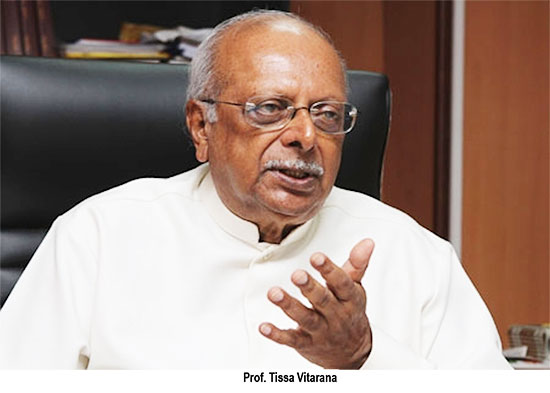
by PROF.TISSA VITARANA
The decision taken by the leaders of the Eleven Party Alliance to request that the President to forms and Interim Government is an essential first step towards solving the present crisis facing Sri Lanka. This interim Government needs to have correct policies to meet a crisis of this enormous magnitude. The interim government should not follow the policies that have aggravated the global economic crisis to such a scale in Sri Lanka. The immediate problems facing the suffering people such as the high price of food and food shortages, the shortages of essential medicines, fuel, gas and electricity have to be given priority. As mentioned by me last week the shortage of dollars is the principle factor. I like to stress once again that we should delay the settlement of loans and interest due for the next five years through a Moratorium. As we had to pay US dollars 6 billion last year to settle our loans, such a course will probably save about 30 billion dollars. This would enable us to immediately obtain the above mentioned essentials that are the main cause of the suffering of the people. I stressed that this has been done by several countries faced with similar economic crises in the past and even the present. The main policy of the SLPP Government not to do this but to somehow other pay back the loans on time will not provide the dollars that we badly need. The required change of attitude will not discredit us to the extent that the SLPP Government fears because, as mentioned earlier, this has been done in the past and even the present.
The above course of action will relieve the suffering of the people and bring back the confidence in the President and the interim government. The alternative that is proposed by the SLPP Government, UNP and Samagi Jana Balawegaya (SJB) of turning to the International Monetary Fund (IMF) will only aggravate the problem. This is because the neoliberal policies that those parties favor were the main cause of the massive defeat of the Yahalapanaya Government. The IMF insists on the door being opened for the import of any goods and article from abroad, whether they be cheaper or more expensive than what we can produce. It was the massive importation of luxury and non-essential goods over a long period of time by several Governments, most of all the Yahapalanaya Government, that led to our Foreign Reserves dropping from the usual safe level of 7 to 8 billion US dollars to the present level of less than one billion US dollars that has aggravated the crisis to this massive level. The loss of our ability to purchase essential items like oil, gas, milk powder and flour will be overcome as soon as we turn to the Moratorium policy of settlement of loans for five years as mentioned above. Once the people’s needs are provided and the crisis overcome in this way there will be no need to tie up with the IMF. The latter course would mean that we have to get more loans and get further into debt. The problem of debt and interest repayment will continue to plague us. The correct policy of developing a national economy where we become self-supporting with regard to food and also develop value added industries (both small, medium and large) that was decided on by the SLPP Government, but not implemented, could also be done. Therefore it is essential that those in the Interim Government should not insist on the tie-up with the IMF and the resultant commitment to implement their policies.
Another very important step is that the Interim Government should properly revive the Cooperative Movement, both consumer and multipurpose. By ruining this the present major problem of high prices of food leading to hunger, starvation and malnutrition could be solve by eliminating the price rises which are due to the large number of middleman who profiteer at the expense of both the farmer and the consumer. This can be quickened by reviving the Marketing Department which can also directly purchase from the farmer and provide the consumer with food at a reasonable price, by only covering their expenses, without any profiteering as is done by private traders.
The next essential step that must also be taken is establishing value added industries (both SMEs and Large scale). The necessary science and technology funding should be provided, to do the required research. With a stable economy and a stable government it would be possible to attract foreign investment. In addition the Lanka Sama Samaja Party (LSSP) proposal of introducing the principle of a Solidarity Economy should be put into effect. This principle has been adopted by several countries in Europe and in the third world, as well as the USA. A classic outcome is that it has helped both public and private loss making institution to become profitable ones. A good example is what happened in Kerala, India. There when TATA’s refused to give a salary increase to the workers on the premise that they were running at a loss, like the private plantations in Sri Lanka, the Left-wing Government took back the land from TATA’s and gave the ownership for a period of 30 years to the employees. The outcome is that the plantations are now running at a big profit to the benefit of both the employees and the Kerala Government.
During the SLFP/LSSP/CP Coalition Government (1970-1975) when faced with an equally severe crisis Dr.N.M.Perera, the LSSP leader, who was the Minister of Finance, was able to increase the Forex Reserves from 1.5 billion US dollars to 3.2 billion dollars, thereby ensuring adequate dollars to meet the cost of essential imports. Further he balanced the budget and took away the burden from the poor people, by reducing indirect taxes, and making up for this by increasing the taxation of the rich. He raised the highest tax slab for the super-rich to 75%. It is a crime to raise the VAT tax as the SLPP Government has done now by 2%, while maintaining the upper limit of tax for the super-rich at 14%. NM encouraged investment in the manufacturing industry by maintaining a very low tax level and any rich person could also get that benefit by investing there.
The LSSP, as a member of the Eleven Party Alliance supports the above policies if we are not only to have an Interim Government that puts the country back on the correct track, but also describes the policies that should be pursued if we are to get out of this severe crises and rescue our country and our people from poverty and its consequences. We shall give the President our fullest support in the setting up and functioning of this Interim Government. We hope that once there is some degree of stability General Elections will be held and a new Government formed that will get us out of the crisis, build national unity, and lead to the development of our country.

Latest News
Flood warning issued to the Divisional Secretariat Divisions of Ganga Ihala Korale, Udapalatha, Doluwa, Udunuwara, Yatinuwara, Gangawata Korale, Harispattuwa, and Pathadumbara


Due to heavy rainfall received in the upper catchment areas of the Mahaweli River over the past few hours, there is a risk of minor flooding in the low-lying areas surrounding the Mahaweli River within the Divisional Secretariat Divisions of Ganga Ihala Korale, Udapalatha, Doluwa, Udunuwara, Yatinuwara, Gangawata Korale, Harispattuwa, and Pathadumbara.Residents living in the above mentioned areas and motorists using roads passing through these areas are urged to exercise extreme caution and remain highly vigilant regarding the prevailing situation.
Furthermore, residents living in close proximity to the Mahaweli River in these areas are advised to remain highly alert to the situation and take all necessary precautions to protect themselves from any potential flooding.The relevant disaster management authorities are requested to take all necessary measures in response to this situation.
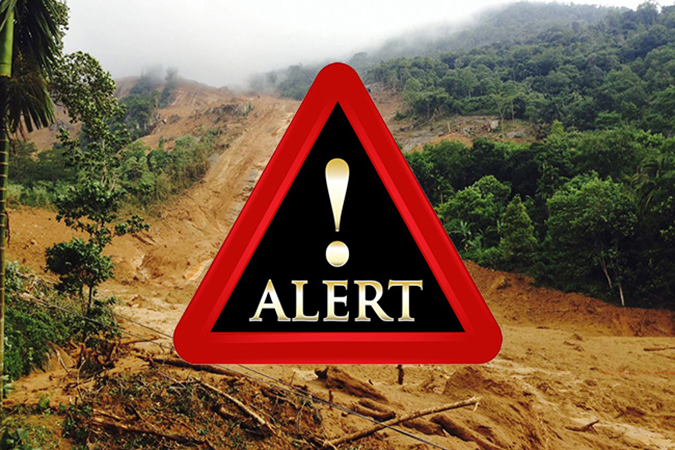
The National Building Research Organisation [NBRO] has issued landslide Red Alerts to the districts of Kandy, Kegalle and Nuwara Eliya effective from 14:00 hrs on 20.09.2026 To 14:00 hrs on 21.09.2026
Accordingly,
LEVEL III [RED] Land Slide early warnings have been issued to the Divisional Secretaries Divisions and surrounding areas of Pasbage Korale in the Kandy district, Dehiowita, Aranayake, Deraniyagala, Mawanella and Yatiyanthota in the Kegalle district and Kothmale West, Kotmale East, Ambagamuwa and Norwood in the Nuwara Eliya district
LEVEL II [AMBER] Land Slide early warnings have been issued to the Divisional Secretaries Divisions and surrounding areas of Padukka in the Colombo district, Nagoda, Thawalama and Neluwa in the Galle district, Bulathsinhala, Palindanuwara, Walallawita and Agalawatta in the Kalutara district, Ganga Ihala Korale in the Kandy district, Bulathkohupitiya and Kegalle in the Kegalle district, Akuressa and Pitabeddara in the Matara district, Thalawakele in the Nuwara Eliya district and Pelmadulla, Ratnapura, Ayagama, Kuruwita and Ratnapura in the Ratnapura district.
LEVEL I [YELLOW] Land Slide early warnings have been issued to the Divisional Secretaries Divisions and surrounding areas of Seethawaka in the Colombo district, Niyagama and Baddegama in the Galle district, Mirigama in the Gampaha district, Ingiriya in the Kalutara district, Udapalatha and Yatinuwara in the Kandy district, Galigamuwa, Warakapola and Ruwanwella in the Kegalle district, Kotapola, Pasgoda and Athuraliya in the Matara district, and Eheliyagoda, Kalawana and Elapatha in the Ratnapura district.
News
Development projects can deliver results to the people more quickly when the political authority and the public service work together towards a common goal – PM
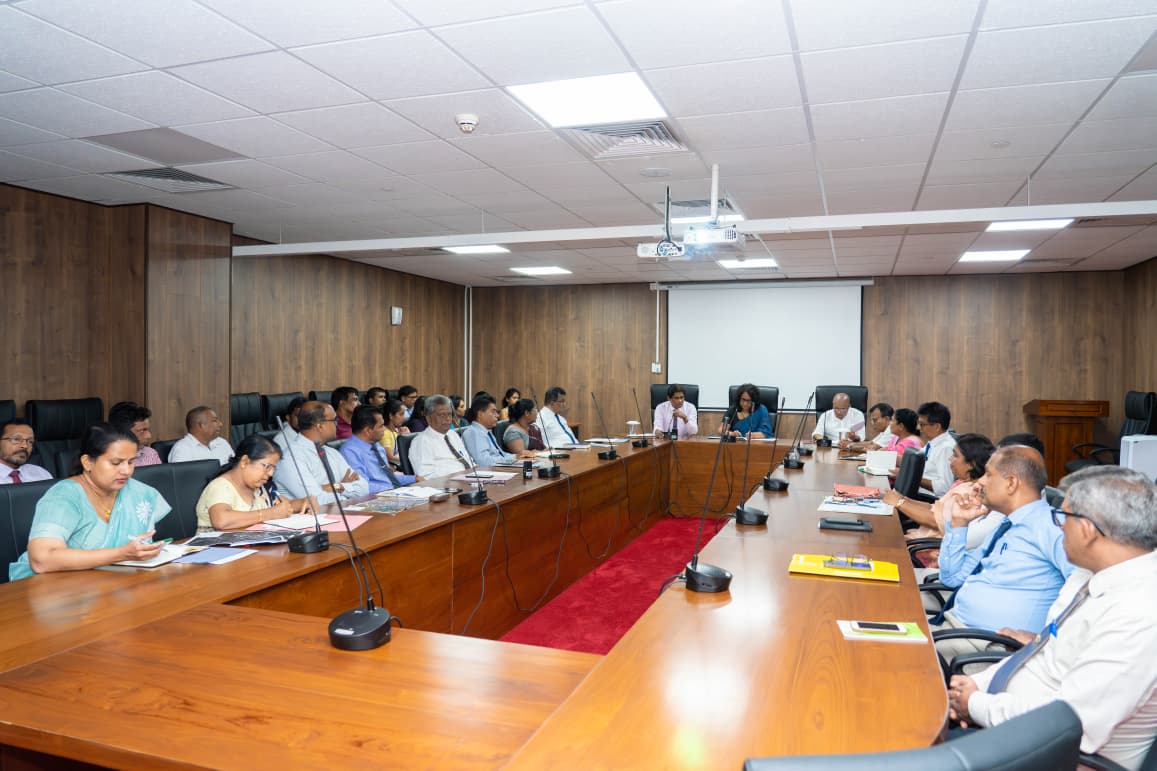
Prime Minister Dr. Harini Amarasuriya stated that development projects can deliver results to the people more quickly when the political authority and the public service work together towards a common, people-oriented objective.
The Prime Minister made these remarks while participating in a discussion held on Friday [September 18] at the Western Province Council Auditorium to review the progress of the development project to rehabilitate Rathmalana Kandawala Road and the drainage system on either side of the road, within the Dehiwala–Mount Lavinia Municipal Council limits in the Colombo District.
The project, which commenced on September 10, 2026, is scheduled to be completed before June 30, 2027. Implemented by the Provincial Road Development Authority (PRDA), the project includes the construction of a bridge at a cost of Rs. 64 million, the rehabilitation of the drainage system at a cost of Rs. 930 million, and the rehabilitation of the road at a cost of Rs. 115 million.
The Prime Minister also paid special attention to the progress of the responsibilities assigned to the Western Province Council, the Irrigation Department and the Ratmalana Divisional Secretariat in accordance with decisions taken at the previous committee meeting. Attention was also given to the current status of the plans being carried out by the Sri Lanka Land Development Corporation (SLLRDC), as well as the construction and maintenance activities being undertaken by the Provincial Road Development Authority (PRDA).
Commending the expedite and commendable progress of the project, the Prime Minister particularly appreciated the commitment demonstrated by officials of the relevant government institutions to work in close coordination with one another and in collaboration with the political authority.
The Prime Minister also emphasised the importance of taking measures well in advance to control flooding and minimise its impact on Colombo and several other districts in view of the rainy weather that may affect the Western Province during the latter part of this year.
The meeting was attended by the Chairman of the Colombo District Coordinating Committee and Member of Parliament Lakshman Nipuna Arachchi, Chairperson of the Ratmalana Divisional Coordinating Committee and Member of Parliament Samanmalee Gunasinghe, Chairman of the Roads Sub-Committee of the Colombo District Coordinating Committee Dewananda Suraweera, Mayor of the Dehiwala–Mount Lavinia Municipal Council Parakum Shantha, Chief Secretary of the Western Province K.G. Pradeep Pushpakumara, along with a number of government officials.
[Prime Minister’s Media Division]

Flood warning issued to the Divisional Secretariat Divisions of Ganga Ihala Korale, Udapalatha, Doluwa, Udunuwara, Yatinuwara, Gangawata Korale, Harispattuwa, and Pathadumbara

Landslide Red Alerts issued to the districts of Kandy, Kegalle and Nuwara Eliya

Shafali dazzles with 49-ball unbeaten 100 and India march into Asian Games final

Development projects can deliver results to the people more quickly when the political authority and the public service work together towards a common goal – PM

Landslide Early Warnings issued to the Districts of Colombo, Galle, Kalutara, Kandy, Kegalle, Matara, Nuwara Eliya and Ratnapura

Chamari Athapaththu’s unbeaten 83 leads Sri Lanka into final

‘Dates have the highest sugar content to fight Coronavirus’

Sunday Island 27 December – Headlines

#SundayIsland 17th December – Headlines

Sunday Island – 28th March

Sunday Island Headlines – 21 March

Sunday Island – 21st February – Headlines
-

 Opinion7 days ago
From Galkissa (Mount Lavinia) to Tambuttegama
-

 News4 days ago
US embassy won’t comment on IGP’s probe into joint drug raid
-

 Features6 days ago
The emptying university: why are academics leaving?
-

 Features7 days ago
Sri Lanka’s university crisis: Brain drain and union action demand urgent reform
-

 News3 days ago
Bid for Basil’s extradition nears final stage: Police
-

 Opinion7 days ago
Ashraff: From the SLMC towards the National Unity Alliance
-

 Business4 days ago
All-new Bolero MaXX unveiled in Sri Lanka
-

 Editorial7 days ago
Muscle flexing, astroturfing and dog-and-pony shows