
News
Lanka faces looming threat to its environment from haphazard disposal of non-biodegradable face masks

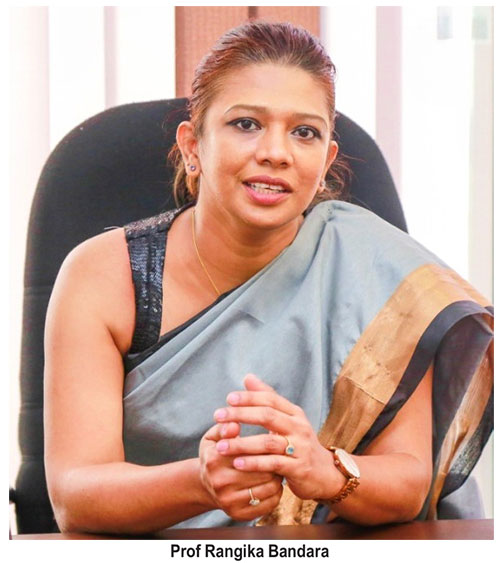
Sri Lanka’s environment is facing a looming threat owing to the haphazard disposal of millions of used face masks and personal protective equipment, reveals a recent study by the University of Kelaniya.
“Mostly, face masks are made of petroleum-based non-renewable polymers that are non-biodegradable, hazardous to the environment and create health issues. It is reported that Sri Lanka generates around 14 to 70 million of face mask waste a week,” said Prof Rangika Bandara, Director of the Centre for Sustainability Solutions of the university’s Department of Zoology and Environmental Management.
She said: “We should understand that disposable face masks which are commonly known as surgical face masks or K-95 masks contain polypropylene which is a popular kind of plastics. According to study findings, a K-95 mask contains about 9 grams of polypropylene and this value is around 4.5 gram in a surgical face mask. By looking at these numbers, it is estimated that as a country Sri Lanka emits 47-185 tons of polypropylene per week to the environment through face masks only.”
“Plastic is considered as a non-biodegradable material as it takes over 500 years to get rid of it from the environment. Disposing facemasks inappropriately on different land surfaces will gradually end up in rivers, lakes, ponds, forests and other vegetation, agricultural fields and finally in oceans by washing them off with runoff and surface flooding and also by wind,” she said.
Prof Bandara said that disposal of used face masks along with other disposable personal protective equipment posed serious risks to valuable global eco-systems creating threats to public health.
According to the health experimental results, wearing a face mask will reduce the risk of transmitting coronavirus by 47% by acting as a particle filter and by minimising the number of times an individual touches the face/mouth/nose with unwashed hands. Therefore, WHO has recommended wearing a suitable face mask appropriately at public places and when interacting with COVID infected or suspected cases. Also, according to the WHO estimates nearly 89 million face masks are needed worldwide to control COVID-19 each month. We should understand that disposable face masks which are commonly known as surgical face masks or K-95 masks contain polypropylene which is a popular kind of plastics. According to study findings, a K-95 mask contains about 9 grams of polypropylene and this value is around 4.5 gram in a surgical face mask.
Prof. Bandara said: “While the soil is contaminated with plastics, soil texture and structure will be altered and become unsuitable for plant growth hence with time, we will not be able to harvest expected yields from agricultural fields. On that day the damage will become irreversible. Not only the soil but also clogging drainage and irrigation channels by waste face masks can be expected. Currently, most of the irrigation and drainage channels in the country, especially in urban areas are already clogged by invasive aquatic weeds such as Eichornia (japan jabara) and Salvinia creating a huge social and environmental problem. Inappropriate disposal of face masks will trigger the problem as they associate with water weeds creating a mesh thereby further blocking water passages. If that is the case, flash floods in cities even in light rains would be unavoidable which is a significant economic loss and greater impact on livelihood specially those who have settled along the water canals.
“Studies carried out in the Mediterranean Sea and ocean bottoms near Hong Kong have shown lining of ocean bottom by layers of face masks which inhibit transfer of oxygen between water and soil in the bottom. With time ocean bottom will create an anaerobic condition which will badly affect the survival of benthic organisms like sea anemones, sponges, corals, sea stars, sea urchins, worms, bivalves, crabs, When the ocean is polluted by facemasks those in settle ocean bottom as well as among aquatic weeds and corals which disturb and disturbed the normal behavioural patterns of aquatic living organisms. Macroorganisms like fishes, jellyfish, and turtles will indigest face masks. This will destroy the eco- system balance and ocean productivity will go down posing a risk to the fisheries industry.
“Plastics will be broken into tiny particles less than 5 micrometres in size and form micro plastics in the form of fibres and/or particulate matter in the ocean, freshwater and marine environment. Different packaging plastic materials, bottling plastic materials and containers from the food processing industries are primary sources of micro plastics pollution. Polypropylene mixed face masks would be another source of micro plastic, especially in ocean and soil. Ultimately, Micro plastics will enter the human body through terrestrial and aquatic food chains causing numerous diseases including different types of cancers.
“As a nation, we have to develop a strategic plan to deal with the post-covid crises. One of the strategies should focus on proper disposal of PPE waste including waste face masks.
If we take examples from the world, countries like China, Canada, Hong Kong, Japan have already identified face masks as an emerging waste category and place bins with a new colour code in public places to separate waste face masks from other type of waste at the point of generation. Incineration of waste face masks is a viable option. Incinerating means burning face masks at high temperatures greater than 1000-1200 centigrade in an incinerator or dumping them in a sanitary landfill after boiling or subjecting to a heat treatment. By practicing this kind of a waste management strategy, we can stop sending waste face masks into different eco-systems. As a nation, we should recognise the importance of waste face masks management by understanding waste face masks and other disposable PPEs as an emerging waste category and should make a waste management plan immediately without further delays. Making this effort a priority by allocating required resources is an investment. Otherwise, we will be desperately looking for solutions to reclaim degraded ecosystems as we drop our agricultural production, fisheries production, increment of vector-borne diseases and other non-communicable diseases, unknown ideologies, losing corals and biological diversity.



Right-arm wristspinner Arab Gul, took 4 for 8 on T20I debut and left-arm spinner Nangeyalia Kharote picked up 3 for 19 as Afghanistan successfully defended a modest 129 against Japan to open their Asian Games men’s competition campaign with two points in Group A.
Two days after nearly beating India in a rain-shortened game in Sano, hosts Japan made a steady start to the chase and reached 53 for 2 in the eighth over before losing their way.
Gul did much of the damage, taking two wickets apiece in the 12th and 14th overs as Japan slid from 60 for 4 to 63 for 8. Abdollah Ahmadzai and Kharote then finished off the lower order, with Japan bowled out for 81 in 19.3 overs.
Asked to bat first, Afghanistan had posted 129 for 6, with Mohammad Akram making 34, captain Darwish Rasooli 29 and Karim Janat 21.
But it was Mohammad Ishaq’s unbeaten 25 off 17 balls from No. 6 that provided the late impetus after Japan had kept Afghanistan to under six an over for the first 15 overs. Right-arm seamer Shoma Sugaya-Slater and offspinner Ibrahim Takahashi took two wickets apiece for Japan.
The two sides have games against Nepal lined up in Group A. The top two teams from the group will proceed to the quarter-finals.
Scores:
Afghanistan 129 for 6 in 20 overs (Mohhamad Akram 34, Karim Janat 21, Darwish Rasooli 29, Mohammad Ishaq 25*; Reo Sakurano Thomas 1-05, Shoma Sugaya-Slater 2-18, Ibrahim Takanashi 2-19) beat Japan 81 in 19.3 overs (Reo Sakurano- Thomas 23, Kendel Kadowwaki Fleming 14, Benjamin Ito Davis 17; Arab Gul 4-8, Abdullah Ahmadzai 2-13, Nangeyalia Khan 3-19, Najibullah Zadran 1-07 ) by 48 runs
(Cricinfo)

The Bar Association of Sri Lanka (BASL) yesterday called on all political parties, represented in Parliament, to allow their members to vote on the proposed 22nd Amendment to the Constitution according to their conscience, stressing that the responsibility for deciding whether the Bill should be enacted now rests with Parliament.
In a statement issued after the Supreme Court’s determination on the 22nd Amendment Bill, BASL President Rajeev Amarasuriya and General Secretary Nalin de Silva have said the SC’s determination should not be interpreted as an endorsement of the proposed constitutional amendment as a matter of policy.
The BASL has said the SC’s jurisdiction, under Articles 120, 121 and 123 of the Constitution, was to determine the constitutional requirements for the enactment of the Bill, including whether the Bill, or any of its provisions, required approval at a referendum under Article 83.
“The determination is therefore not a determination as to whether the proposed amendment is good or bad policy, desirable or undesirable, wise or unwise, or whether Parliament ought to enact it,” the BASL said.
Full text of the BASL statement: The Supreme Court has now delivered its Determination on the Twenty-Second Amendment to the Constitution Bill and determined that the Bill does not require the approval of the People at a Referendum.
In terms of Articles 120, 121 and 123 of the Constitution, the jurisdiction of the Supreme Court in relation to the Bill is to determine the constitutional requirements for its enactment, including importantly whether the Bill, or any provision thereof, requires the approval of the People at a Referendum by virtue of Article 83.
The Determination is therefore not a determination as to whether the proposed Amendment is good or bad policy, desirable or undesirable, wise or unwise, or whether Parliament ought to enact it.
This distinction is also evident from Sri Lanka’s previous constitutional amendments. During the 48 year history of the second republican Constitution there have been many amendments which passed constitutional muster but nevertheless had a negative effect on democracy, constitutionalism, the independence of the judiciary and the rule of law.
The question that now arises is whether Parliament ought to enact the proposed Amendment. That responsibility rests with Parliament and with each individual Member of Parliament when they vote on the Bill.
In making that decision, Members of Parliament should be mindful of the possible and probable consequences the 22nd Amendment will have on our nation. They should also consider the lack of transparency and a proper consultative process in the introduction of the 22nd Amendment. As representatives of the people they should also consider the concerns that have been expressed in relation to the proposed Amendment by a broad cross-section of society including the Maha Nayakes of the Three Nikayas, the Catholic Bishops’ Conference in Sri Lanka, the Church of Ceylon, the Bar Association of Sri Lanka, the Judicial Service Association, the Commonwealth Lawyers Association, LAWASIA, the International Association of Judges, the United Nations Special Rapporteur on the Independence of Judges and Lawyers, the French National Bar Council, and more than 40 Professional Associations and Unions, including the Government Medical Officers’ Association and other leading professional bodies.
Accordingly, the Bar Association of Sri Lanka calls upon all the political parties in Parliament to allow the Members of Parliament to speak and vote on the 22nd Amendment according to their conscience.
The responsibility now lies with Members of Parliament, when called upon to vote, to take a principled position according to their conscience giving due consideration to their constitutional responsibility, their representative capacity and most importantly their duty to the sovereign People of Sri Lanka.

SL to regain access to international financial and capital markets next year in line with IMF projections
Sri Lanka is on course to regain access to international financial and capital markets around 2027, in line with the International Monetary Fund’s (IMF) current economic projections, IMF Mission Chief Evan Papageorgiou said yesterday.
Papageorgiou said the IMF’s core assumptions under Sri Lanka’s economic programme continued to envisage the country returning to international capital markets in 2027.
“Our previous assumption that Sri Lanka will go back to capital markets still stands. We still have a good trajectory to achieving this in 2027 or thereabouts, and that should be the goal,” he said.
Papageorgiou stressed that Sri Lanka could not rely solely on domestic sources of financing to build long-term economic resilience and would need a diversified funding strategy.
“Every country needs to have a good ability to access funds both in domestic markets, as it already has, as well as international markets for eurobonds and other modes,” he said.
He said a return to international capital markets would have significant implications for Sri Lanka’s external debt composition, while strengthening foreign exchange reserves would remain essential as the country prepares to meet future debt-servicing obligations.
The IMF’s assessment comes amid improving international investor sentiment towards Sri Lanka and positive developments in the country’s sovereign credit ratings.
Papageorgiou cited Fitch’s recent upgrade of Sri Lanka’s credit rating as a positive development, saying global investors were increasingly viewing the country from a more constructive perspective.
Sri Lanka remains under the IMF’s Extended Fund Facility (EFF) programme, which is scheduled to continue until March 20, 2027. Regaining access to international capital markets remains a key milestone under the country’s broader economic recovery.
The IMF has stressed the importance of rebuilding Sri Lanka’s foreign exchange buffers and maintaining stability in domestic financial markets as the country approaches substantial external debt repayments.
A sustained improvement in these areas would help strengthen the country’s capacity to return to international markets while safeguarding macroeconomic stability, the IMF has indicated.

Muhammad Shahzad smashes fastest first-class hundred by a Pakistani batter

Gul, Kharote spin Afghanistan to victory over Japan in Asian Games opener

Showerss above 100 mm are likely at some places in the Western, Sabaragamuwa, Central and North-western provinces and in Galle and Matara Districts

Mirabai Chanu wins Asian Games silver as Ri breaks weightlifting record

Trump greets China’s Xi Jinping on arrival for three-day US

BASL calls for conscience vote on 22nd Amendment

‘Dates have the highest sugar content to fight Coronavirus’

Sunday Island 27 December – Headlines

#SundayIsland 17th December – Headlines

Sunday Island – 28th March

Sunday Island Headlines – 21 March

Sunday Island – 21st February – Headlines
-

 News6 days ago
Shanakiyan urges urgent action over reported death sentence for Lankan in Saudi Arabia
-

 News7 days ago
Bid for Basil’s extradition nears final stage: Police
-

 News5 days ago
Namal Rajapaksa Buddhist gambit fails, bail denied
-

 Features5 days ago
Why the spelling Sri Lankan names in English vary
-

 Features5 days ago
Three bands, a new identity: Sri Lankan wolf snake recognised as distinct species
-

 Business5 days ago
SLIIT holds largest-ever convocation
-

 News5 days ago
Govt monitors reported Saudi death sentence – Foreign Ministry
-

 News5 days ago
Vehicle prices drop by up to Rs. 1 mn, says importers’ body