
News
IFC reaffirms commitment to Sri Lanka amid plans to increase investments

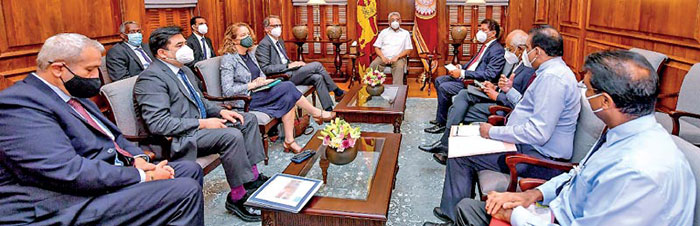
International Finance Corporation Regional Vice President for Asia and the Pacific Alfonso Garcia Mora has said that IFC aims to boost its investments in Sri Lanka, with a focus on supporting private sector job creation, paving the way for robust investments to help spur the country’s recovery and future growth, it said.
The comments by IFC Regional Vice President for Asia and the Pacific Alfonso Garcia Mora, came at the end of a three-day visit to Sri Lanka, which included a meeting with the President Gotabaya Rajapaksa, Finance Minister Basil Rajapaksa, government officials, including Central Bank Governor Ajith Nivard Cabraal, private sector representatives, entrepreneurs, and development partners.
Garcia Mora was accompanied by IFC’s Vice President for Risk Mohamed Gouled, Regional Director for South Asia Hector Gomez Ang and the new Country Manager for Sri Lanka and the Maldives Lisa Kaestner, as well as the World Bank Country Director for Sri Lanka, Maldives and Nepal Faris Hadad-Zervos.
“In my meeting with the President, we discussed the need to have a sound macro fiscal stability to attract foreign capital and provide medium- and long-term certainty,” Garcia Mora said. “The talks also focused on ways to maximise the potential of the country’s private sector to help address Sri Lanka’s challenges and achieve the inclusive growth the country needs.”
“We are committed to Sri Lanka,” Garcia Mora said. “This is demonstrated by our investment commitments in the past six months which have targeted export-oriented industries. Since the onset of the pandemic, IFC has also played a strong counter cyclical role in its financing and will continue to build on that program going forward.”
During his meetings, Garcia Mora highlighted IFC’s investment of $ 450 million during the first 18 months of the pandemic in Sri Lanka as a sign of IFC’s steadfast commitment to the country.
“We are working with the private sector in the country to create a robust investment pipeline and this can be accelerated with additional reforms in the infrastructure sector, allowing the private sector to play a bigger role,” Garcia Mora said. “IFC intends to invest a further $ 150 million during the current fiscal year ending in June 2022. Over the next five years, IFC is looking at an investment pipeline of more than $ 800 million, specifically in supporting growth-enabling sustainable infrastructure.”
IFC’s efforts will focus around three strategic pillars in Sri Lanka: supporting innovation for growth, including export diversification, start-ups, niche market agriculture and value additions for export, high tech manufacturing; growth-enabling sustainable infrastructure, including low-cost clean energy, sustainable transport and logistics systems; and deepening social and financial inclusion, including digitisation, economic participation of underserved people, especially women.
While in Colombo, Garcia Mora also signed a cooperation agreement with John Keells Holdings (JKH) to develop a commercially viable and sustainable street market in Colombo 2, which will also promote women’s participation in hospitality and tourism. The officials also had the opportunity to meet clients and partners of the Women in Work program – IFC’s largest, standalone country-based gender program designed to close gender gaps in Sri Lanka’s private sector.
Since the beginning of the pandemic, IFC has invested $ 450 million in Sri Lanka, including $ 175 million in JKH to boost retail and tourism – IFC’s largest investment in Sri Lanka over its 50-year operations. As part of the overall pandemic response, IFC injected $ 50 million in Commercial Bank of Ceylon and $ 25 million in Nations Trust Bank to help small businesses stay afloat during the height of the pandemic.
IFC’s strategy also focused on expanding export diversification, promoting sustainability and inclusive growth. Last year, IFC piloted a new digital health program – DigiHealth – to boost access to affordable and quality health-care services in Sri Lanka and beyond.
In October, IFC also issued its first-ever rupee-denominated bond in the country – the ‘Serendib Bond’ – to ensure that the private-sector has access to long-term offshore financing in local currency.

Latest News
“Let’s move forward together in unity to build a country where all labour is valued, rights are protected, and equality prevails” -PM

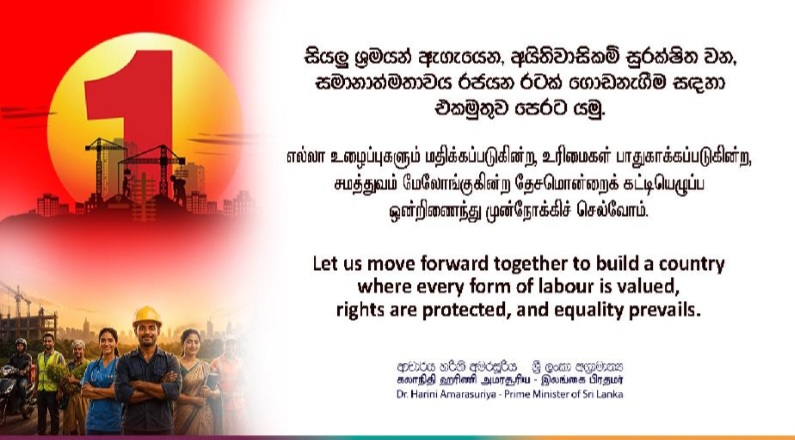
Prime Minister Dr Harini Amarasuriya in her May Day message called upon the working people in Sri Lanka to move forward together in unity to build a country where all labour is valued, rights are protected, and equality prevails.
The full text of the PM’s message:
The history of the Sri Lankan labour movement is a remarkable journey, shaped over decades by the blood, sweat, and sacrifices made in the pursuit of rights, justice, and dignity.
Beginning with the printers’ strike of 1893, the working people of this country emerged as an organised force. Through the trade union movement led by A. E. Goonesinha and the emergence of the Lanka Sama Samaja Party, the voice of labour gained political strength. The Railway Workers’ Strike of 1923 and the public service strike of 1947 reaffirmed that the true ’driving force’ behind the country’s economic and social transformation was its working people. I respectfully acknowledge the invaluable contributions of workers in the plantation sector, ports, railways, and across both the public and private sectors, whose dedication laid the foundation for many of the labour rights we benefit from today.
As we commemorate International Workers’ Day with dignity once again, we pay tribute to all working people across the world, including the heroic workers who sacrificed their lives in the struggle for an eight-hour workday in Chicago in 1886. This year’s May Day holds special significance as it is being celebrated under a government built through the power of the people, in honour of the entire working community of Sri Lanka.
Granting due respect to labour and safeguarding the rights of all working people are core policy commitments of our government. Accordingly, we remain dedicated to creating a fair and safe working environment by expanding existing services and implementing new programmes aimed at improving the living standards of working people.
Ensuring fair and equal access for all citizens is a fundamental objective of the government. Following that, it is our responsibility to create an environment in which everyone can lead a dignified professional life. Establishing a national social protection system that recognises unpaid labour and guarantees social security for unpaid labours is among the foremost priorities of our government.
On this May Day, we must reaffirm the importance of moving forward together in unity to build a country where all labour is valued, rights are protected, and equality prevails. With the strength and dedication of all working people, may we soon achieve the vision we all share: “A Thriving Nation – A Beautiful Life
Latest News
Heat Index at Caution Level at some places in the Northern, North-central, Eastern, Sabaragamuwa and North-western provinces and in Monaragala district during the day time
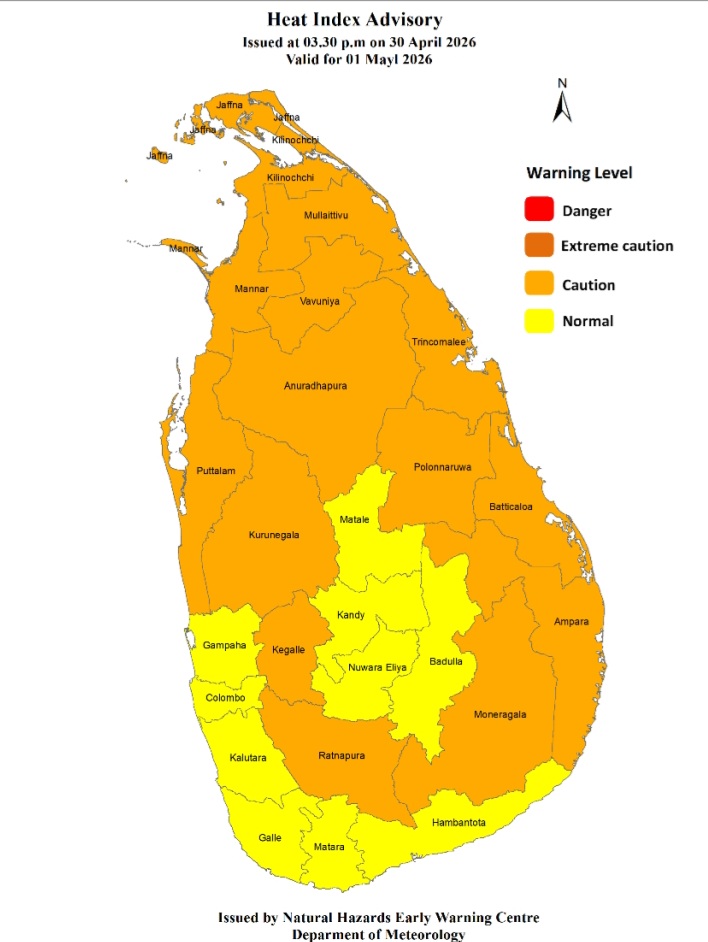
Warm Weather Advisory
Issued by the Natural Hazards Early Warning Centre
Issued at 3.30 p.m. on 30 April 2026, valid for 01 May 2026.
The Heat index, the temperature felt on human body is likely to increase up to ‘Caution level’ at some places in the Northern, North-central, Eastern, Sabaragamuwa, and North-western provinces and in Monaragala district during the day time.
The Heat Index Forecast is calculated by using relative humidity and maximum temperature and this is the condition that is felt on your body. This is not the forecast of maximum temperature. It is generated by the Department of Meteorology for the next day period and prepared by using global numerical weather prediction model data.

Effect of the heat index on human body is mentioned in the above table and it is prepared on the advice of the Ministry of Health and Indigenous Medical Services.
ACTION REQUIRED
Job sites: Stay hydrated and takes breaks in the shade as often as possible.
Indoors: Check up on the elderly and the sick.
Vehicles: Never leave children unattended.
Outdoors: Limit strenuous outdoor activities, find shade and stay hydrated.
Dress: Wear lightweight and white or light-colored clothing.
Note:
In addition, please refer to advisories issued by the Disaster Preparedness & Response Division, Ministry of Health in this regard as well. For further clarifications please contact 011-7446491.


An Assistant Director of the External Resources Department (ERD) of the Ministry of Finance, interdicted pending an investigation into the diversion of US$2.5 million in Treasury funds to a rogue account was found dead at his residence in Kuliyapitiya.
The deceased has been identified as Ranga Nishantha, 50.
Police said the officer had been found in the garden of his house and they believed that the officila had committed suicide. However, investigators have not ruled out other possibilities, and inquiries are continuing.
The official was interdicted along with three other senior Finance Ministry officials over a cyber-enabled financial fraud.
Those interdicted include a Director and an Assistant Director from the ERD, as well as a Director and an Additional Director General from the Public Debt Management Office (PDMO).
Police sources said that the CID had on two occasions asked Nishantha to make a statement in connection with the ongoing investigation, but he had failed to comply.
Police said the CID probe into the alleged cyber fraud is continuing, with investigators examining the circumstances surrounding the diversion of funds through compromised communication channels.Kuliyapitiya Police said further investigations were underway to establish the exact cause of death.

The cost of 76 years of US wars, from Korea to Iran

Myanmar ex-leader Aung San Suu Kyi moved to house arrest, military says

“Let’s move forward together in unity to build a country where all labour is valued, rights are protected, and equality prevails” -PM

Violence in Australian town after arrest of man over girl’s murder

Holder, Rashid and Arshad give Gujarat Titans NRR-boosting win

Showers or thundershowers will occur in most parts of the island after 1.00 pm.

‘Dates have the highest sugar content to fight Coronavirus’

Sunday Island 27 December – Headlines

#SundayIsland 17th December – Headlines

Sunday Island – 28th March

Sunday Island Headlines – 21 March

Sunday Island – 21st February – Headlines
-
 News3 days ago
Treasury chief’s citizenship details sought from Australia
-

 News5 days ago
BIA drug bust: 25 monks including three masterminds arrested
-

 Business6 days ago
Nestlé Lanka Announces Change in Leadership
-
 News6 days ago
Hackers steal $3.2 Mn from Finance Ministry
-

 News5 days ago
Banks alert customers to phishing attacks
-

 News2 days ago
Rooftop Solar at Crossroads as Sri Lanka Shifts to Distributed Energy Future
-
 News4 days ago
Govt. assures UN of readiness to introduce ‘vetting process’ for troops on overseas missions
-
 Business4 days ago
ADB-backed grid upgrade tender signals next phase of Sri Lanka’s energy transition