
News
SL stresses just balance between human rights and national security

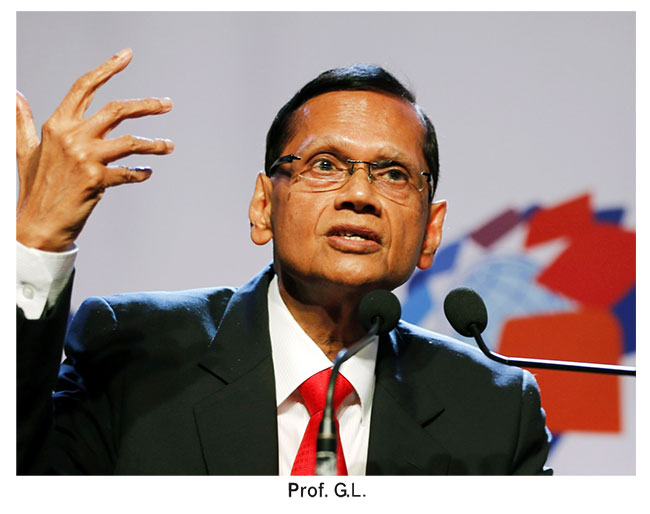
49th Geneva session:
…reiterates opposition to evidence gathering mechanism
Foreign Minister Prof. G.L. Peiris has said that as elsewhere in the world, Sri Lanka endeavoured to strike a just balance between human rights and national security when dealing with terrorism.
The Minister said so at the 49th session of the Geneva-based United Nations Human Rights Council yesterday (01)
In his presentation, the academic reiterated Sri Lanka’s strong opposition to the so-called evidence-gathering mechanism, a measure that was strongly opposed by a number of countries. Such initiatives create disharmony both in the domestic and international arenas. It creates obstacles to reconciliation efforts, breeds hatred by reopening past wounds, and polarises society
The following is the text of FM’s statement: ” Sri Lanka is an active participant in the multilateral framework to realise the promotion and protection of human rights.
Fundamental rights are embodied in our Constitution, progressively advanced through our democratically elected organs of government and enforced through our independent judiciary. Despite multiple challenges we have faced from terrorism, we have restored peace, security and the rule of law throughout the country. Our democratic traditions and independent institutions ensure free and fair elections at regular intervals through universal adult franchise. We will further advance the considerable progress we have made in post-conflict recovery and healing. For this, we have put in place domestic institutions for reconciliation, accountability and social justice.
Through this Council, we have completed three mutually beneficial Universal Periodic Reviews, engaged in constructive dialogue with the Treaty Bodies, welcomed Special Procedures Mandate Holders, and held frank and open discussions with domestic and international interlocutors. We have benefitted from the considerable expertise available with the UN on human rights including through its technical cooperation and capacity building programmes. Through the UN country team, we value the ongoing support to our domestic processes on reconciliation and achievement of SDGs.
Through this cooperative interaction, and in line with our domestic framework and international obligations, we continue to ensure the promotion and protection of human rights and social justice for all our citizens, irrespective of ethnic and religious identity and political affiliation.
Despite the economic setbacks due to the Covid 19 pandemic, we continue to ensure our people’s right to development. Sri Lanka has improved its global rank by 7 positions according to the latest SDG Report. We appreciate the contribution made by our civil society partners, through their extensive grass-roots level outreach and expertise.
As a developing Member State of the international community, we brace ourselves to face the further adverse economic consequences of crises, such as the pandemic and the unravelling conflict in Europe, which will impact on our efforts to achieve the SDGs.
We are today in a period of review of the work of the Council. We reflect on whether the Council has been successful in overcoming the credibility gap that led to the downfall of its predecessor Commission.
The multilateral architecture for the implementation of human rights was progressively developed in the last decades. Consensus was forged on key principles which we consider sacrosanct, such as that the promotion and
protection of human rights should be guided by the principles of impartiality, objectivity and non-selectivity, based on the sovereign equality of Member States. UNGA resolution 60/251 and HRC resolutions 5/1 and 5/2 also decided that the working methods of the Council shall be transparent, fair and impartial, and shall enable genuine dialogue.
In March 2021, the Council voted on Resolution 46/1 which was tabled without the consent of Sri Lanka as the country concerned. The consideration of this matter polarized and politicized this forum. In a startling departure from the mandate which the UN General Assembly originally conferred on this Council, operative paragraph 6 of this resolution refers to a so-called evidence-gathering mechanism, a measure that was strongly opposed by a number of countries. Such initiatives create disharmony both in the domestic and international arenas. It creates obstacles to reconciliation efforts, breeds hatred by reopening past wounds, and polarizes society.
Member States have mandated this Council and its Secretariat with a truly extensive array of helpful working methods to assist Governments in the promotion and protection of human rights. Sri Lanka has participated actively and constructively in those aspects of the Council’s work that have been productive and beneficial, and which have helped to ensure that our people live safer, longer, and more dignified lives. We reject those that are punitive, politicized, divisive, unhelpful and initiated due to extraneous reasons.
As elsewhere in the world, we endeavor to strike a just balance between human rights and national security when dealing with terrorism. Sri Lanka is convinced that counter-terrorism legislation must secure and protect the rights of persons subject to investigation detention and trial, and must not restrict democratic freedoms such as the freedom of expression. With these objectives in view, I recently presented a Bill in the Parliament of Sri Lanka which is an initial step in amending the Prevention of Terrorism Act, 43 years after it was promulgated.
We take particular objection to the use of voluntary funding which has the necessary consequence of undermining objectivity and detachment. Against this background, Sri Lanka once again reiterates its view that the evidence gathering mechanism established under OP 6 of resolution 46/1 is unhelpful to the people of Sri Lanka, will polarize Sri Lankan society, and adversely affect economic development, peace and harmony at a challenging time. It is an unproductive drain on Member State resources, at a time of severe financial shortfalls across the entire multilateral system including the High Commissioner’s Office.
On the 4th of March the Council will meet in an interactive dialogue on Sri Lanka. I look forward to sharing with you some thoughts on the written update on Sri Lanka.”


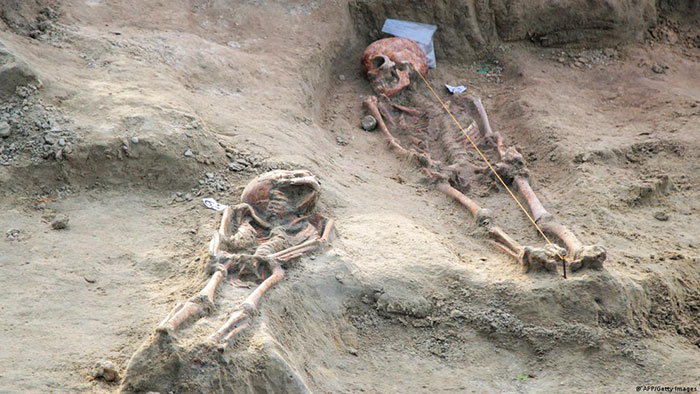
ECONOMYNEXT –International assistance for forensic analysis of the remains unearthed at the Chemmani mass grave will be sought when the need arises, Sri Lanka’s Minister of has Justice said after opposition legislators urged the government to seek help.
“We have spoken to embassies, we have made all the local finances necessary for excavation. But when it comes to DNA analysis, depending on the type and nature we will definitely have to go for internationally recognised places,” Harshana Nanayakkara said in response to a query in Parliament.
Nanayakkara said that request for international expertise is dependant on the direction the courts give on what needs to be done, after which they will decide which agency best suits the proceedings.
The minister also recognised that local expertise is lacking in the forensic department, and the need to train local staff with the help of international experts.
Opposition MPs argued that the present need is direct help in forensics from international entities, rather than the longer term need to train the staff on analysis.
Currently, the investigation is in the excavation and exhumation stage, conducted by archaeologist Raj Somadeva and his team.
The existence of the Chemmani mass grave was first brought to light in 1998, during the trial of the rape and murder of schoolgirl Krishanti Kumaraswamy.
In February 2025, construction workers found remains near the Sinthupathy Cemetery, and following investigations ordered by the Learned Magistrate, the mass grave was discovered.
412 bodies have been discovered, with 409 bodies recovered as of 23 June 2026. According to the Office on Missing Persons, this is the 17th recorded mass grave in Sri Lanka.

The Asian Development Bank (ADB) has approved a $57.4 million financing package to help Sri Lanka expand access to affordable clean energy and reduce greenhouse gas emissions through a large-scale rooftop solar aggregation and virtual net metering programme.
The financing comprises a $35 million concessional loan, $16.9 million in grants from the European Union and $5.5 million from the Japan Fund for the Joint Crediting Mechanism. With additional contributions from implementing agencies, the total estimated cost of the project is $80.5 million.
Under the Rooftop Solar Aggregation and Virtual Net Metering Project, two state-owned utilities — Electricity Distribution Lanka (Private) Limited and Lanka Electricity Company (Private) Limited — will introduce a scalable model to collect electricity generated from large rooftop solar installations and allocate the benefits virtually among eligible consumers.
The initiative will allow consumers to access solar power benefits without having to install individual rooftop solar systems.
ADB Country Director for Sri Lanka Shannon Cowlin said the project would broaden access to affordable renewable energy while strengthening the resilience and inclusiveness of the country’s power sector.
She said the initiative would also support grid modernisation and digital transformation, while creating employment opportunities and encouraging greater participation of women and youth in the clean energy sector.
The project is expected to benefit micro, small and medium enterprises and community organisations that face financial or space constraints in installing their own rooftop solar systems. Through a social compensation mechanism, eligible groups will receive reductions in electricity costs under the virtual net metering system.
The programme will support around 25 megawatt-peak of rooftop solar capacity while strengthening distribution networks, improving digital capabilities and preparing the national grid to accommodate higher levels of distributed renewable energy.
A dedicated training facility will also be established under the project to develop green skills, enhance women’s participation in the sector and build technical expertise in advanced low-carbon technologies.
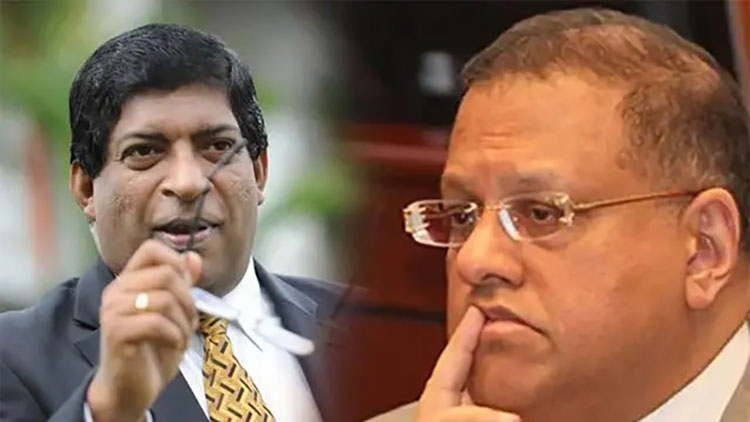
The Colombo High Court on Friday ordered that proceedings in the case filed against 11 defendants, including former Central Bank Governor Arjuna Mahendran and former Finance Minister Ravi Karunanayake, over alleged irregularities in the Central Bank bond auction be taken up again on July 22.
The case was called before Colombo High Court Judge Manjula Thilakaratne, who informed court that the Trial-at-Bar bench appointed to hear the matter had not been properly constituted.
Accordingly, the judge directed that the case be recalled on July 22 for further proceedings.
The Attorney General has filed indictments under the Public Property Act against 11 accused, including Mahendran, Karunanayake, Perpetual Treasuries Limited and its directors Arjun Aloysius and Geoffrey Aloysius.
The accused have been charged over alleged irregularities connected to a Treasury bond auction conducted by the Central Bank in March 2016.

Zafar, Feroza lead Pakistan to consolation win

Jangoo 233, Chase 194 put West Indies in commanding position

Showers will occur at times in the Western, Sabaragamuwa and North-western provinces and in Galle, Matara, Kandy and Nuwara-Eliya districts

Venezuelans dig for earthquake survivors as death toll rises to 1,430

Chemmani mass graves: Govt to seek international forensic help

ADB approves $57.4 million package to boost Lanka’s rooftop solar drive

‘Dates have the highest sugar content to fight Coronavirus’

Sunday Island 27 December – Headlines

#SundayIsland 17th December – Headlines

Sunday Island – 28th March

Sunday Island Headlines – 21 March

Sunday Island – 21st February – Headlines
-

 Features7 days ago
Sri Lanka developing independent hydrographic capabilities
-

 Opinion6 days ago
Ranasinghe Premadasa: The man who would not take ‘No’ for an answer
-
 News1 day ago
Another 1,132 Sri Lankan Personnel to be deployed for United Nations Peacekeeping Missions
-

 Latest News7 days ago
Sooryavanshi thumps fastest List A fifty as India A win tri-series
-

 Opinion5 days ago
Sri Lanka’s national security: Justice, reconciliation, and forward-looking vigilance
-

 News5 days ago
US Assistant Secretary of State for South and Central Asian Affairs meets President
-

 News3 days ago
Kelaniya emerges as highest ranked Lankan uni in Times Higher Education Sustainability Impact Ratings
-
 Opinion4 days ago
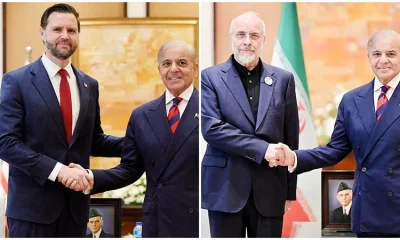
A triumph for Pakistan’s skilled diplomacy at Iran-US talks