
Features
Sudden withdrawal of Prohibition of Obscene Publications Bill


MINISTRY of JUSTICE LEGAL REFORMS:
By Kalyananda Tiranagama
(continued from yesterday)
In early 2005, Lawyers for Human Rights and Development (LHRD) made a comprehensive and country-wide study on the spread of obscene publications throughout the country and their pernicious social impact, heavily contributing to the increase of sexual abuse of women and children and disruption of family life; on the weakness and lacunae in the existing laws to deal with the problem; the problems and difficulties faced by the Police in the enforcement of the law; how the existing law can be enforced more effectively till required amendments are made in the law and possible amendments that can and need to be made to strengthen the law to effectively deal with the problem. The Study was published in Sinhala and English in May 2005 and launched at a public seminar held with the participation of high officials from the concerned public institutions, Ministry of Justice, Attorney General’s Department, Ministry of Women’s Affairs, National Child Protection Authority, Women and Children Bureau of the Police and Department of Probation and Child Care.
Following the launch, at the initiative of the Sri Lanka Foundation Institute, a public seminar was conducted for law enforcement officers to explain to them how the existing law can be enforced more effectively to curb the menace of obscene publications. Over 500 law enforcement officers participated in the seminar held in the SLFI Auditorium, chaired by Chandra Fernando, Inspector General of Police.
Limitations in the existing law
In our study we pointed out the following limitations in the existing law:
a. Lack of a clear definition of the term ‘obscene’
retarding Police from taking action against publications that are clearly obscene.
b. Existing penalties,
Rs. 1500 – 2000 fine or/and imprisonment for a term not exceeding six months, are hardly adequate for these offences and they cannot have a deterrent effect.
c. No provision to deal with exposure of children to pornographic material.
The 1995 Penal Code amendment does not cover such offences.
d. No provision for confiscation of equipment used for the production and distribution of pornographic publications.
Without confiscating such equipment, the computers used to make these publications, the printing presses used to print them or the vehicles used for their distribution, this menace can never be arrested.
e. This law was hardly applicable to other media except print media
. At present a greater threat is posed by electronic media, social media.
f. The Police had the discretion to decide under which provision of law an offender is to be charged, the Penal Code or the Obscene Publications Ordinance.
g. Though many of the acts promoted through the stories and material published through various media are crimes punishable under the law, there is no specific provision to punish such incitement or promotion of criminal conduct.
h. More than the persons who sell these publications, it is the persons who print, produce and distribute these publications who are mainly responsible for this menace. Law needs to be further strengthened to enable the Police to arrest and prosecute persons who print, produce and distribute them rather than the sellers of obscene materials.
i. Producing and distribution of pornography is a big business with high profits, in which many people are involved. Existing law cannot deal with the partners in this business or the huge profits they make at a heavy social cost.
j. Though equally or more harmful material are shown by various T.V. Channels during peak hours when children are watching them, there are no provisions to prevent that or deal with the persons who are responsible for these shows either in the Public Performances Ordinance or in any other law.
Steps taken by the Government to Amend the Law in 2007
Following the launch of the Study in May 2005, in August 2005 the Ministry of Cultural Affairs and National Heritage obtained 100 copies of the Study for distribution among the members of the Cabinet of Ministers.
As shown by a letter of the Secretary to the Ministry of Cultural Affairs and National Heritage, the Cabinet of Ministers has approved a Cabinet Memorandum presented by the Minister of Cultural Affairs and National Heritage for the Amendment of the Obscene Publications Ordinance and it has been sent to the Legal Draftsman for drafting the Bill.
The Draft Bill prepared by the Legal Draftsman has been presented to the Cabinet of Ministers by the Minister of Cultural Affairs and National Heritage, Mahinda Yapa Abeywardhana (now the Speaker of Parliament) and the Minister of Justice and Legal Reforms, Amarasiri Dodangoda with a Cabinet Memorandum dated 28 March, 2008.
LHRD received a copy of the Draft Bill from the Secretary to the Ministry of Cultural Affairs with his letter dated 31 October, 2007 and LHRD sent its observations to the Secretary.
Provisions in the 2007 Draft Bill
This Obscene Publications Amendment Draft Bill has taken steps to rectify several weaknesses in the existing law:
a. Lack of a clear definition of the term ‘obscene’ –
S. 12 of the Bill defines the term ‘obscene’: Any matter, object or thing is obscene if such matter, object or thing tends to deprave and corrupt persons who are likely, having regard to all relevant circumstances, to read, see or hear such matter, object or thing.
b. Existing penalties – Rs. 1500 – 2000 fine or/and imprisonment for a term not exceeding six months – are hardly adequate for these offences and they cannot have a deterrent effect.
Draft Bill has proposed to impose heavy penalties which will have a deterrent effect:
– S. 3 of the Bill: For publishing obscene material – imprisonment up to 10 years or a fine not less than 25,000 rupees or both; second or subsequent conviction – imprisonment for a term which may extend up to twenty years or a fine not less than 100,000 rupees or both.
LHRD made the following observation on the penalties proposed in the Draft Bill
*** The Jurisdiction to try these offences has been given to the High Court. For practical reasons it is better to leave this jurisdiction with the Magistrate’s Court. Otherwise, these cases will pile up in the High Courts for decades.
*** These proposed sentences also appear too excessive. Mandatory jail sentence of two years coupled with a fine of Rs. 100,000 and confiscation of equipment will be more than enough to have a deterrent effect.
c. No provision to deal with exposure of children to pornographic material. The 1995 Penal Code amendment does not cover such offences.
–
S. 4 of the Bill: Exposure of children to obscene material: imprisonment for a term not less than two years and not exceeding ten years or a fine not less than 200,000 rupees or both; second or subsequent conviction – imprisonment for a term not less than two years and not exceeding twenty years and a fine not less than 500,000 rupees;
d. No provision for confiscation of equipment used for the production and distribution of pornographic publications. Without confiscating such equipment, the computers used to make these publications, the printing presses used to print them or the vehicles used for their distribution, this menace can never be arrested.
–
S. 16 (2) of the Bill makes provision for the confiscation of any movable property used in the commission of the offence.
e. This law was hardly applicable to other media except print media. At present a greater threat is posed by electronic media, social media.
– S. 3 (a) of the Bill makes it applicable to all media: Any person who (a) publishes, publicly exhibits or lets on hire or knowingly sells or distributes or in any manner introduces into circulation through any medium of communication, any matter, object or thing which is obscene – commits the offence.
f. The Police had the discretion to decide under which provision of law an offender is to be charged, the Penal Code or the Obscene Publications Ordinance.
– S. 4 of the Obscene Publications Ordinance is not in the Bill and they have to ignore Penal Code provisions and act under the new law.
Though this Bill was drafted by the Legal Draftsman to give effect to a Cabinet approved Memorandum, though the Draft Bill was presented to the Cabinet by two Ministers, the Minister of Cultural Affairs and National Heritage and the Minister of Justice and Legal Reforms as early as March 2008, for some unknown and undisclosed reason the Bill was never presented to Parliament.
In the study conducted in 2004 – 2005, LHRD had come across 29 different obscene publications published and distributed throughout the country by different publishers. Most of them were weekly or fortnightly publications with multi-colour photographs. Publishing of obscene material is a lucrative business. There can be no doubt that during election times many of our politicians and political parties get the support of these press owners to have their posters and other propaganda material printed. Otherwise, there is no valid reason for this important Bill not to be presented to Parliament even 12 years after the Bill was presented for Cabinet approval. That was the response we got from the Police as well when we questioned them as to why they raided only the paper stalls where these publications were available for sale and why they did not raid the printing presses where these publications were printed.
The ‘Prohibition of Obscene Publications Bill’ brought by the Ministry of Justice under its Legal Reforms Project was published in the Gazette on Friday, December 24, 2021. The weekend being Christmas Holidays, the public had hardly any time to go through the Gazette and see what it is. However, within two days of its publication the Bill was withdrawn by the Minister of Justice. A statement issued by the Secretary to the Ministry of Justice M.M.P.K. Mayadunne on December 29, has stated that the decision to withdraw the Bill was taken due to concerns raised by civil society activists and other stakeholders, objecting to the bill on several grounds, including copyrights.
Several questions arise from the statement of the Ministry Secretary. Other than the definition of the term ‘obscene’ in the Bill, the contents of the Bill were not published in any print media. What are the provisions in the Bill that led to objections that aroused concerns of the civil society activists? When and how did they raise these concerns? Print or electronic media did not publish any news about the concerns of civil society activists.
Usually when people have objections to or concerns about any matter, they issue a statement or conduct a press conference expressing their views. But nothing of that sort has happened in this instance. Moreover, there was hardly any time for anybody to raise their concerns. If there was anything contrary to fundamental rights or inconsistent with the Constitution in the Bill they can go to the Supreme Court and challenge it.
Who are these civil society activists and other stakeholders who are so powerful as to compel a powerful Cabinet Minister as the Minister of Justice to withdraw a Bill published in the Gazette within 48 hours of its publication? Who are these stakeholders who may be adversely affected by the prohibition of publication of obscene material? What copyright they can have in the production of indecent and obscene material?
Definition of the word ‘obscene’
The word ‘obscene’ has been defined in the Bill as “any matter, object or thing, which by itself or where it comprises more than one distinct component taken by itself, is sufficient to deprave and corrupt the mind of a reasonable person, but does not include any matter, object or thing containing anything done in the interest of science, literature, art, education or learning.”
If it is this definition of the word ‘obscene’ in the Bill that has led to these concerns of civil society activists and other stakeholders, it must be pointed out that it is a definition found in the law of England and India and upheld by our Supreme Court in a number of cases.
The definition in the 2007 Draft Bill
: “Any matter, object or thing is obscene if such matter, object or thing tends to deprave and corrupt persons who are likely, having regard to all relevant circumstances, to read, see or hear such matter, object or thing.’’
Webster’s New Collegiate Dictionary
definition: disgusting to the senses; repulsive; abhorrent to morality or virtue; designed to incite lust or depravity.
Oxford Dictionary
definition: “Offensive to modesty; expressing or suggesting unchaste or lustful ideas; impure, indecent, lewd.”
The definition
given in the English Case of Regina vs. Hicklin: “I think the test of obscenity is this, whether the tendency of the matter charged as obscenity is to deprave and corrupt those whose minds are open to such immoral influences, and into whose hands a publication of this sort may fall.”- Cockburn C. J., Regina v. Hicklin, 1L. R. 3 Q. B. 360, Quoted in Archibold, 27th ed., 1321
In the case of Sub-Inspector of Police, Tangalle v. Dharmabandu, 33 NLR 14, our Supreme Court adopted the definition of ‘obscenity’ given in the English Case of Regina vs. Hicklin. The Court held: “An Article is obscene where the tendency of its contents would be to deprave and corrupt the minds of those into whose hands it may fall.”
In two other cases – De Bruin v. Dharmabandu, 32 NLR 88; and Perera v. Agalawatte, 39 NLR 22, the Supreme Court adopted the definition given above. In these cases, the Supreme Court has clearly laid down certain criteria for deciding whether a publication is obscene or not. These criteria can be enumerated as follows:
a. Are there persons whose minds are open to immoral influences of (obscene) publications?
b. Is the publication likely to fall into the hands of those persons?
c. Do the photographs, pictures, stories and articles contained in a publication have a tendency to deprave and corrupt the minds of those into whose hands it may fall?
In respect of any publication, if the answers to these three questions are yes, then it is an obscene publication. In determining whether a publication could have had a harmful effect, the overall impact of the publication is taken into account. The intention of the editor/publisher/printer is irrelevant.
S. 292 and S. 293 of the Indian Penal Code dealing with obscene publications, enacted in 1969, has adopted the definition of obscenity given in Regina vs. Hicklin Case.
S. 292(1)
A book, pamphlet, paper, writing, drawing, painting, representation, figure or any other object, shall be deemed to be obscene if it is lascivious or appeals to the prurient interest or if its effect, or (where it comprises two or more distinct items) the effect of any one of its items, is if taken as a whole, such as to tend to deprave and corrupt persons who are likely, having regard to all relevant circumstance, to read, see or hear the matter contained or embodied in it;
Certain things or items are clearly exempted from the application of this provision:
Exception – this section does not extend to –
(a) any book, pamphlet, paper, writing, drawing, painting, representation, or figure-
(i) the publication of which is proved to be justified as being for the public good on the ground that such book, pamphlet, paper, writing, drawing, painting, representation, or figure is in the interest of science, literature, art or learning or other objects of general concern, or
(ii) which is kept or used bona fide for religious purposes;
(b) any representation sculptured, engraved, painted or otherwise represented on or in –
(i) any ancient monument within the meaning of the Ancient Monuments and Archaeological Sites and Remains Act, 1958 (24 of 1958), or
(ii) any temple or on any car used for the conveyance of idols, or kept or used for any religious purpose.
The definition of the word ‘obscene’ given in the withdrawn Bill is more or less the same as the above mentioned definitions found in the English Law, Indian Penal Code and the definitions adopted by our Supreme Court. There is nothing objectionable or inconsistent with freedom of expression in it. There is no apparent valid reason or justification for the Ministry to withdraw this Bill immediately after its publication in the Gazette.
The Ministry Statement has stated that an amended Bill would be presented to the Cabinet for approval, once discussions are held with interested parties, including the BASL.
Who are these interested parties who are so powerful as to compel the Minister to immediately withdraw a Bill that was published in the Gazette?
Are they the same parties that prevented, all this time since 2008, the Cabinet approved Obscene Publications Amendment Bill, drafted by the Legal Draftsman in 2007, from being enacted?
Certainly, it cannot be the BASL.
(The writer is the Executive Director of Lawyers for Human Rights and Development)

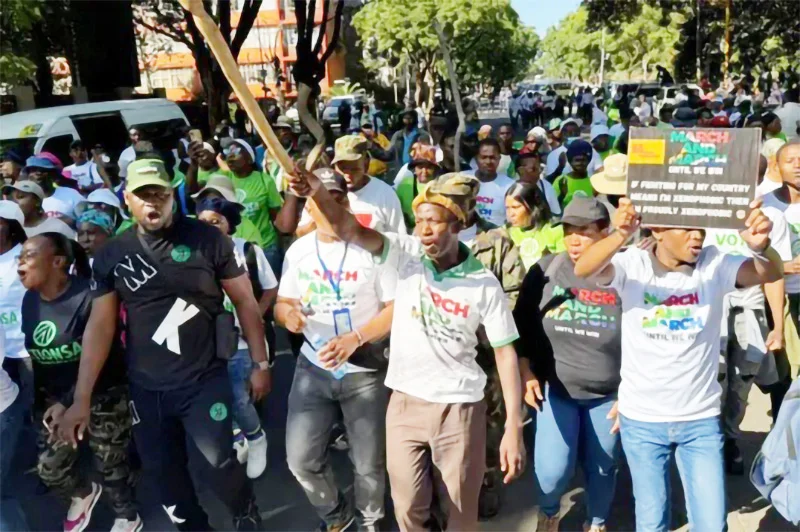
 The current outbreak of anti-immigrant protests in Durban, South Africa is bound to have taken many a subscriber to value-based politics or political idealism quite by surprise. After all, this is evidence that despite the historic accomplishments of nation-builders of the stature of the late President Nelson Mandela it cannot be taken for granted that identity politics, including racism in its worst forms, is no more in South Africa.
At the time of this writing details are scarce on the substantive root causes of the protests but it could very well be that economic grievances, particularly on the part of the majority community in South Africa, are contributing considerably to the disaffection. Shrinking employment and material prospects are likely to figure majorly among the factors igniting the unrest.
Fortunately, the local authorities in Durban are losing no time in calling for peaceful co-existence among the relevant communities and are pointing to the vital importance of stepping-up national integration processes. Apparently, immigrants in sizable numbers from neighbouring countries are present in Durban. However, international TV footage of the protests quoted some local authorities as saying that the majority of the immigrants in some centres that housed them were not illegal migrants and had the documents that entitle them to be in Durban.
In the Durban protests the world has fresh proof of the socially divisive consequences of the gathering globe-wide economic disaffection, touched off particularly by the continuing crisis in West Asia. Going ahead, the world would need to brace for increasing identity-based unrest of the kind it is just witnessing in South Africa.
Considering that the material lot of ordinary people everywhere could only aggravate progressively, with the US and Iran showing no signs of negotiating an end to their confrontation any time soon, it will be left to the more democratic and progressive sections of the world community to initiate positive measures collectively to bring a measure of relief to the discontented.
The swiftness with which such relief will be provided would depend crucially on the importance those sections taking up these undertakings attach to value-based politics as opposed to Realpolitik of power politics.
Going by these yardsticks, Italy could be considered to be moving in the right direction. Recently Italy came to the fore in initiating the collective named, ‘Rome Coalition for Food Security and Access to Fertilizer’, which has as one of its aims the swift provision of fertilizer to economically weak African countries.
In a recent statement Italian Minister of Foreign Affairs and International Cooperation, Antonio Tajani, said that a principal aim of the project was to ensure that the farmers of Africa gained easy access to fertilizer, considering that food security is a growing concern among some of Africa’s economically vulnerable countries.
The statement went on to mention that some 30 countries hailing from the Mediterranean region, the Middle East, the Balkans as well as the FAO had been invited to join the coalition. The venture is far-seeing in that food security is main among the reasons for social discontent which in turn could degenerate into endemic political turmoil and bloodshed. Separatist violence and geographical fragmentation of countries wouldn’t be too far behind these developments, as Africa itself has often proved.
It is hoped that more G7 countries would take the cue from Italy and do what they could to ease the hardships of economically distressed countries, particularly of the global South. In these efforts they would need to break rank with the US, which is today brutally indifferent to the consequences of its policy of making ‘America First’, come what may.
Going by current developments, the Trump administration seems to be blithely oblivious to the wider, deleterious effects of its policy course in West Asia. Besides rendering Iran militarily and otherwise impotent nothing else seems to matter to Washington, as regards West Asia. This is policy short-sightedness of an extreme kind. After all, right now West Asia could be said to be sitting on the proverbial powder keg.
On the other hand, Iran is not giving the world the impression that it is doing anything constructive to get out of the policy straitjacket that it wove for itself decades ago. Rather than enter into a policy of ‘live and let live’ in relation to Israel in particular and initiate a process of reconciliation with the latter, it has chosen to operate within policy parameters that continue to damn Israel. This has put Israel always on the ‘defensive’ so to speak and prevented the opening up of space for meaningful dialogue.
That said, Israel is obliged to explore the possibilities of entering into a negotiatory process with the Arab-Islamic world that could lead to a de-escalation of tensions and bloodshed. It cannot continue to look at its neighbours through lenses that distort them as archetypal enemies who should be ‘wiped off completely from the face of the earth.’
In other words, the need is urgent for Realpolitik to give way to value-based politicks. Italy is beginning to prove that the latter approach could be pursued with some success. May be the EU and the UK could throw their weight behind these initiatives as well and establish that international politics could be refashioned on the basis of humane, civilized norms. The UN would need to be fully supportive of these moves and prove an organizational nucleus of the operations that follow.
In fact the time is ripe for people of conscience to collectively stand up on the side of peace and say ‘No’ to war and violence. Organizations such as the ICRC, the WHO and Medicines Sans Frontiers have already taken up this call. Referring to the widespread destruction of health facilities and their dehumanizing results these organizations have said, among other things, that ‘This is not a failure of the law. It is a failure of political will.’
True, ‘failure of political will’ among those powers that matter accounts for the runaway, uncontrollable nature of war and destruction in contemporary times, but more fundamentally it is a failure of the human conscience. It could very well be that the phenomenal levels to which violence and war have been unleashed today have had the effect of deadening consciences. This is a matter for urgent study and wide discussion.

 I would describe Indunil Kaushalya Dissanayaka as innovative and creative, and she operates under the name of Cuteefly.
Indunil always comes up with something novel to celebrate special occasions, and she does it with candles … and that’s her profession.
She was in the spotlight when she created a happening scene, with candles, for Christmas, Sinhala and Tamil New Year, and Valentine’s Day.
As lanterns light up Sri Lanka for Vesak, the Colombo-based candle maker is quietly turning wax and wick into little pieces of the festival.
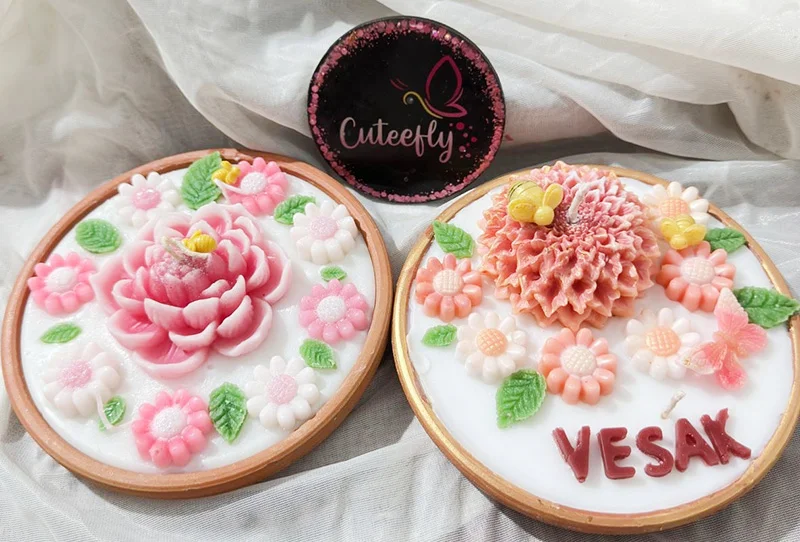
Candles reflecting Vesak themes
Her candles reflect Vesak themes – light, peace, remembrance, giving, etc., to enable you to fill your Vesak celebration with devotion and beauty.
Among her Vesak creations is a lotus-shaped soy candle, scented with sandalwood, lavender, etc., meant to burn during this Vesak Poya Day.

Indunil Kaushalya Dissanayaka: Customers
praise her for her creativity
These handcrafted Vesak candles are perfect for offering at the temple, she says.
What makes her creations so novel is that they come in different shapes, scents, themes, and all are handmade.
What’s more, her customers have heaped praise on her for her creativity.
According to Indunil, her creations are perfect as a thoughtful gift … to bring beauty, unity, and light into every moment.
Says Indunil: “Our beautifully handcrafted Unity candles are designed with premium detail and love, making them perfect for celebrations, gifts, and meaningful occasions.”
Cuteefly, says Indunil, is available online.
Readers could contact Indunil on 0778506066 for more details.
He Facebook Page is: Cuteefly.

Handmade with love

 Yes, dark spots do crop up on the skin, especially with sun exposure and, of course, as the skin ages.
However, these tips should be of immense benefit to those who are faced with dark spots.
* Lemon and Honey Glow Mask:
You will need 01 teaspoon lemon juice and 01 teaspoon honey.
Mix the lemon juice and honey well and then apply this mixture, only on the dark spots.
Leave for 10–15 minutes and then rinse with cool water.
Benefits:
Lemon helps brighten pigmentation.
Honey moisturises and heals skin.
Gives a natural glow.
* Aloe Vera Gel Treatment:
All you need is fresh aloe vera gel.
Apply the gel apply on dark spots, before going to bed.
Leave overnight and wash in the morning.
Benefits:
Reduces acne marks and pigmentation.
Soothes irritated skin.
Helps skin repair naturally.
* Turmeric and Yoghurt Paste:
You will need 01 teaspoon yoghurt and a pinch of turmeric
Mix the yoghurt and turmeric into a smooth paste and apply on affected areas.
Leave for 15 minutes and then wash gently with lukewarm water.
Benefits:
Turmeric brightens skin naturally.
Yoghurt removes dead skin cells.
Helps fade dark spots gradually.
Use these packs 02-03 times a week as results are generally seen over time.
You can also try this out: Mix a ripe papaya into a smooth paste and apply to the face, or directly on to the dark spots. Leave for 15-20 minutes and then wash with lukewarm water.

Farmers Affected by the Nilwala Salinity Barrier paid Rs. 1.2 Billion in Compensation

State Vesak Festival held with the participation of the President

Let us all build a society valued with peace and harmony, guided by unity and solidarity beyond all differences – PM

Showers will occur at times in the Western, Sabaragamuwa and North-western provinces and in Galle, Matara, Kandy and Nuwara-Eliya districts

Rajitha calls for combined lists, denounces those unwilling to join as traitors

20 lawmakers, four officials visiting China

‘Dates have the highest sugar content to fight Coronavirus’

Sunday Island 27 December – Headlines

#SundayIsland 17th December – Headlines

Sunday Island – 28th March

Sunday Island Headlines – 21 March

Sunday Island – 21st February – Headlines
-

 Business6 days ago
Historic launch of CCWE Fashion Week & International Summit 2026
-

 News4 days ago
All-New GRAVITE launches at LKR 6.99 Mn
-
 Features4 days ago
The NPP’s pivot to the past
-
 News3 days ago
Police probe underway to ascertain links between criminals deported from UAE and local politicians
-
 News2 days ago
Easter Sunday carnage: Court told Maulana’s statement cannot be accepted without cross-examination
-

 Opinion6 days ago
The need to reform Buddhist ecclesiastical order
-
 Features4 days ago
End of Peacekeeping
-
 Opinion2 days ago
Undermining the democratic political framework