
Life style
Upali Wijewardene: He reached for the stars

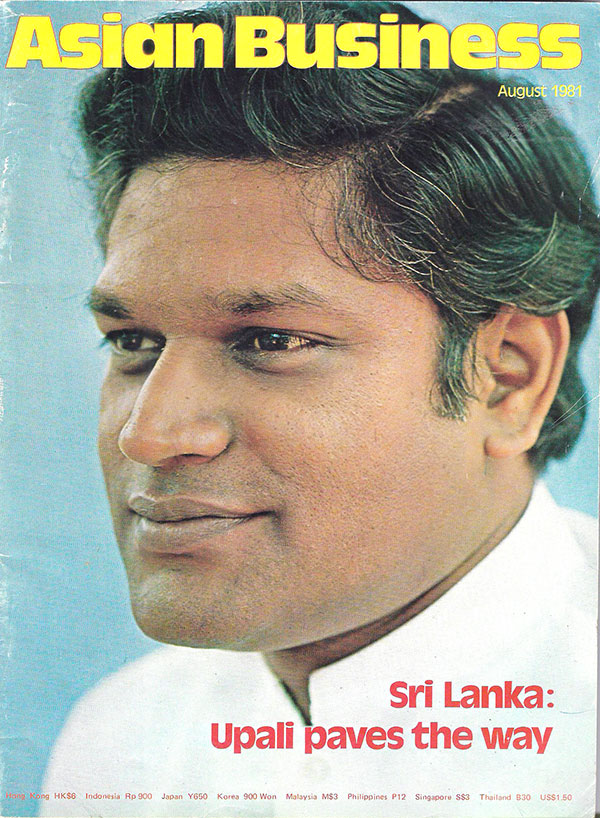
On a day like this 39 years ago on February 13, 1983, Sri Lanka’s much loved business leader, Upali Wijewardene, who captured the imagination of an entire nation vanished without trace in his Lear jet with five others on board. They were returning to Colombo from Malaysia where his Kandos chocolates had hit dizzy heights.
His disappearance engulfed the the region with shock and disbelief. US Orion surveillance aircraft, Soviet and Australian warships, Indonesian minesweepers, Indian airplanes, Malaysian patrol boats and Sri Lankan fishermen were all mobilized in search operations to no avail. ‘What if Upali lived? What really happened to Upali?’ continue to be yet unanswered questions.
If Upali Wijewardene was a sensation in life, he was elevated to a legend after he went missing just four days short of his 45th birthday.
Wild theories about his disappearance were floated around and Colombo’s children of the 80s were said to have devised a game called ‘Finding Upali’s Plane.’ A larger than life figure and a maverick who embraced life with such gusto had disappeared; but he continues to live in the heart of a nation.
The Sunday Island recaps the saga of its founder who was once dubbed ‘the ‘Quintessential Entrepreneur of Asia’ and ‘the man who would be President’
By Randima Attygalle
“My philosophy is to do what you know how to do well and from this I mean you must have the knowledge right all the way through…” reflected Philip Upali Wijewardene, or ‘PUW” as he was fondly called, in an interview with the Malaysian Business in December, 1981. In a technologically austere time, long before the digital revolution when a direct international call had to be ‘booked.’ Wijewardene plunged into chocolate-making, assembly of cars, newspaper publishing, aviation, plantations and much more. As was once documented, ‘the success story of Upali, is the story of how small Asian companies can grow into multinational corporations. It was a precursor of the coming of age of the ‘entrepreneurial Asian.’
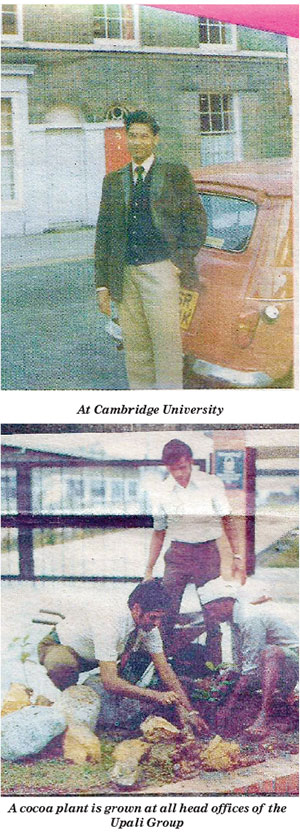
 Philip Upali Wijewardene was born on February 17, 1938 to Don Walter Wijewardene (from Sedawatta walauwa ) and Anula Kalyanawathi Wijesinghe (from Miriswatta Walauwa) at his famous paternal grandmother Helena Wijewardene’s mansion, Sri Ramya, in Colombo (where the present American Centre stands). Upali grew up amidst the affection of his two older sisters, Anoja and Kalyani and a bevy of cousins. He received his kindergarten education at Ladies’ College and later at Royal College, Colombo. When he turned 15, Upali was sent off to St. John’s School Leatherhead in England. Having read Economics at the University of Cambridge, the 21-year-old debonair Wijewardene returned home in 1959 and was recruited by Lever Brothers as a Management Trainee. The corporate rigours and an eternally irate boss left the young recruit drained in two years.
Having quit Levers in 1961, the blue-blooded Wijewardene did not fall back on his family wealth but sought his own fortune first with a friend’s ailing confectionery plant which he re-baptized as Delta and a few years later with Kandos – the brand promoted by Ceylon Chocolates Ltd. In 1970, with the demise of its founder Chairman, Senator Sarath Wijesinghe, his nephew Upali Wijewardene who was expanding his business empire took over the reins of that company.
True to Wijewardene’s philosophy: ‘plunge in and get on with it’, the expanding fully-fledged cocoa processing plants and factories in Malaysia, Singapore and Thailand enabled Kandos to be internationally present and rub shoulders with Nabisco, Mars, Cadbury and Hershey’s. At the time of his disappearance, Wijewardene claimed to be the only fully-integrated cocoa processor in Asia, with businesses ranging from growing cocoa to manufacturing cocoa-based consumer products. The cocoa tree which still adorns the Upali Group’s head office in Colombo and the taller tree which once stood at the door to his luxurious home in Pantai Hills in Kuala Lumpur, which he aptly named ‘Cocoa Hill’, says it all.
Following his uncle D.R. Wijewardene, the press baron, he went on to launch The Island and Divaina snubbing feasibility studies of foreign experts who warned him that the national newspaper market was already saturated. The exercise, as he alluded to the Insight magazine in May, 1981 five months ahead of its launch, was one of his ‘fun-projects’ but analysts say that political ambitions down the road were part of the story.
Just two months following the success of the newspaper, in an interview with a Malaysian business journal, Wijewardene gleefully remarked: “it must be a world record of some sort.” He went onto note that the newspaper’s popularity probably has more to do with editorial policy and style, adding tongue-in-cheek: “they said there was no market, but people must have got tired of reading gazettes!” As the founder editor of the Island, Vijitha Yapa once recalled, Wijewardene was “an editor’s ideal publisher who never interfered with the independence of the newspaper.”
 The present Managing Director and CEO of the Upali Group of Companies, Nimal Welgama recollects: “Upali was a man with tremendous energy which he employed in everything he did. He was mischievous, had a sense of fun and in the last lap of his life, not only gave of himself to his many private enterprises but also contributed his time and skill for public purposes; hence his period as Chairman and Director General of the Greater Colombo Economic Commission (GCEC), the predecessor of the Board of Investment (BOI).”
Having worked for the Upali Group as a young man, Welgama recounts his one-time boss ‘making waves in his own inimitable style.’ “He was ever conscious that his father died young and he did not expect to attain a venerable old age. At the time his life was so tragically snuffed out, he used to say that the accent is on enjoying”.
The emblem of the business group he set up – the blazing copper sun with a ‘U’ in the middle was a motif of Wijewardene’s own personality says the Upali Group’s CEO. “The warmth of his personality, like that of the sun, was felt by the many people he befriended. He was good to his employees, people who served him at various levels, and in return had not only their loyalty but their affection.”
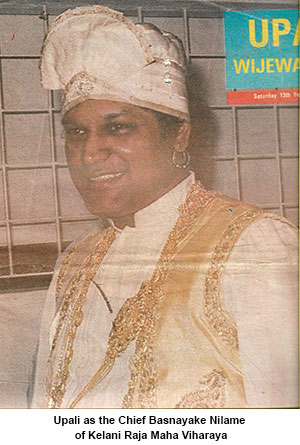
From steering a multinational to being the Chief Basnayake Nilame of the Kelani Raja Maha Vihara, Wijewardene donned many hats. His string of thoroughbreds and Labradors stole a large part of his heart. His beloved ‘Charlie’ is said to have kept a long vigil for months after he disappeared, waiting for his master who never returned.
“My late uncle Upali’s signature facet was his love for speed. This he applied in expanding his business empire. He bought a Lear jet and obtained a Red Passport as the Chairman of GCEC because he was a man for speed and a fast decision-maker. Even his other indulgences including his love for horse and car racing reflected this,” recollects nephew, Dhammika Attygalle who was 18 at the time of his uncle’s disappearance and is now a Director of the Upali Group of Companies.
Sporting his ‘Red and Gold Cross Slash’, Wijewardene’s Rasa Penang, Varron, Kandos-Man, General Atty, King of Zulu and Cornwall Garden shone at Royal Ascot, Singapore Derby and Perak Derby, ridden by none other than Lester Piggot. “One time Chairman of the Board of Stewards of the Sri Lanka Turf Club, he would even do a tarmac transfer to his helicopter and would make it to Nuwara Eliya, sometimes just minutes before races were to start.
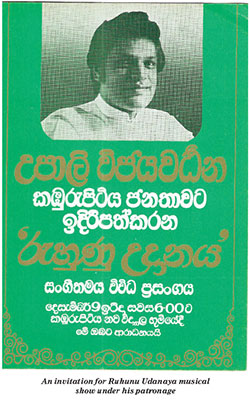
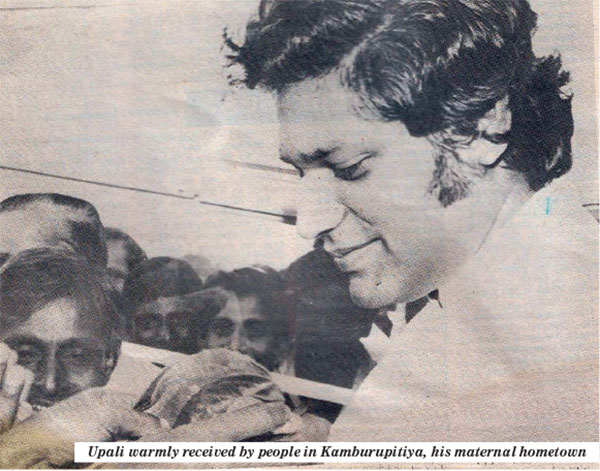
The luxury S-Class Mercedes Benz 116 which he imported from Malaysia was the first of its kind in Sri Lanka. Upali mama used to travel to Nuwara Eliya or Kamburupitiya (his maternal home town) after dinner to save time and to reach the destination fast,” recollects Attygalle who goes on to note that his late uncle initiated Ruhunu Udanaya Movement to develop his maternal home town Kamburupitiya from where he had ambitions of being elected to Parliament..
A fan of Victor Ratnayake, C.T.Fernando and Milton Perera, Wijewardene would also enjoy the country-western timbre of Jim Reeves, who as he had once conceded, ‘puts him in a pensive mood for thinking up new business schemes.’
Having built a global corporation which spanned several countries including Malaysia, Singapore and the USA in the 1970s and the early 80s in an era of snail mail, telegrams and pre-booked international calls when communicating with people abroad took weeks and travel overseas was expensive and a luxury, her late uncle’s confidence and ‘can do’ attitude inspired her, says niece Lakmini Wijesundera, Co-founder and CEO of IronOne Technologies and BoardPAC. “Today, we have instant communication access and the speed of business is fast-tracked. Asia and the South East Asian regions have comparably good infrastructure to perform. Therefore, the great strides and speed at which he operated despite the obstacles in a technologically-Spartan era is outstanding and stands out among the rest even by today’s standards,” says Wijesundera, a successful entrepreneur herself.
She further remarks that her uncle had his sights up high and was not discouraged by past benchmarks. Therefore, he was able to carve new paths and futures and created an impact in the minds and hearts of Lankans whom he inspired to ‘dream big.’ He hammered home the message that we didn’t necessarily have to be conservative in what we wished to attain.
“His focus on branding was unmatched,” reflects Wijesundera who points out that the Free Trade Zones and concepts of similar nature were supported and led by him to create a fresh economic future for Sri Lanka – models which were innovative then and sucessfully adopted by several other countries in the region.
Watching her Upali mama’s helicopter landing on the flat roof of his Thurstan Road residence was an unforgettable memory for young Lakmini and her siblings. “We were so excited to be part of this rare experience at that time,” she smiles adding that she recalls him to be full of life with a great sense of humour and always with a smile. Thirteen years old at the time her uncle vanished, Wijesundera who relished her mother’s stories about her brother ‘starting from scratch with great determination at a young age.’ She believes that her Upali mama personified the belief that anything is possible with the correct mindset- a mantra that she believes in today.
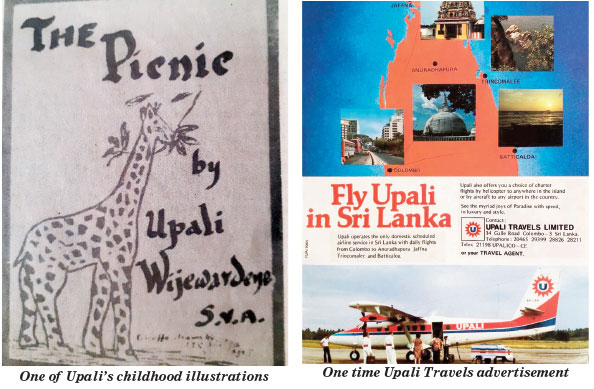
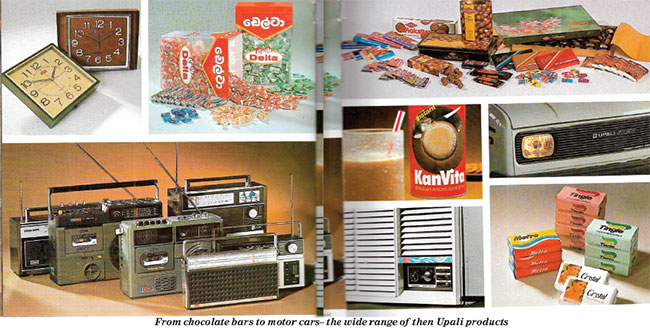
A man who would think big, Wijewardene would advance from Upali Fiat and UMC Mazda to ‘Upali Aviation’. – the only domestic flight which would bridge the North and the South. The halting of the operations of the Upali Airline was a double whammy to fellow Jaffna countrymen who not only saw the flight as a vehicle of better communication between Jaffna and Colombo but also its founder as a harbinger of hope who would have possibly bridged the economic disparity between North and South.
Describing Wijewardene as ‘Sri Lanka’s most colourful businessman who has made a fortune both at home and abroad’, Matt Miller in his article under the banner ‘The man who would be President’ documents in May, 1981, ‘now he is turning his abundant energies and resources to a new arena; politics.’ Noting that ‘Upali’s current passion for politics is matched only by his passion for racehorses,’ Miller goes onto write: “And now the 43-year-old commodities wizard has started what could be called Upali’s Third 20-Year-Plan: ‘The first 20 years were education,” he says, “the second business and the third politics.” He would “be willing”, he says with uncharacteristic restraint to become president of Sri Lanka someday.”
With his suave personality and witty repartee, Wijewardene was a darling of the press. Adorning cover pages of coveted international business journals, he still remains the only home-grown Sri Lankan entrepreneur owning a multi-national to have been featured in the prestigious Fortune magazine.
The present Editor of the Sunday Times, Sinha Ratnatunga, then a young journalist who was one of the close acquaintances of Wijewardene privy to the last moments of the tycoon recollects: “When Upali left for the airport around 6.30 p.m. that day, I left at the same time for Ana Seneviratne’s residence. He was then the High Commissioner for Sri Lanka in Kuala Lumpur. I was to stay there until I flew to join my father who was in Jakarta.
The High Commissioner was getting calls well past midnight and it was only in the morning I heard that Upali’s plane hadn’t arrived in Colombo. I was not particularly taken aback or overly concerned straightaway thinking it was typical of him to go off the beaten track as Upali could be so unconventional even in his planes. It was only by midday while at Genting Highlands watching the cable cars going about that I got that eerie feeling that the plane must be missing.”
As veteran journalist Ajith Samaranayake once commented, “politicians Sri Lanka had known before (included) poets, pundits, scholars, sportsmen, film stars and singers alike. Philip Upali Wijewardene, however, did not belong to any of these moulds. He was not moulded out of the common clay. He broke the mould and reshaped it closer to his heart’s desire.” In Wijewardene’s own words his image in the villages is of “an international businessman of whom they are proud… The villager identifies only with success and for the youth I am probably the culmination of their aspirations.”
On a personal note, although I was merely a child at the time of Mr. Wijewardene’s untimely demise, I was fortunate to have become a part of the legacy he left behind for Sri Lankan journalism. While Kandos chocolates, Delta toffees, his landmark home in Colombo and the resplendent Nuwara Eliya bungalow and its garden- (which often clinched the ‘Best Garden’ award during the April season) and his Lear jet were motifs I often associated with him as a young child, becoming part of his newspaper allowed me a vantage point to this towering personality.
One of my favourite research subjects, I often hear anecdotes about this trendsetter by my senior colleagues. My editor Manik de Silva who was Mr. Wijewardene’s first choice to edit The Island (which he has recounted under the title The job I didn’t take) has many stories I have savoured – particularly the one about the young Upali knowing he had got the Lever Brothers management trainee job when the sudda boss took him and his rival to the Galle Face Hotel to lunch to check out their table manners. “When my rival titled his soup bowl towards himself and not the other way, I knew I had the job,” Upali had said,
My other colleagues Zanita Careem and Anneston Weerasinghe who were recruited by Mr. Wijewardene more than 40 years ago remember him as a man of infectious charisma who would turn heads not just once but twice.
I’m only humbled to have clinched the award given in his name (Upali Wijewardene Feature Writer of the Year) multiple times – twice from a newspaper he founded. I’m indeed fortunate to have become part of the publication he founded 40 years ago as a platform for liberal expression without fear or favour.
Each time I hear the rustle of the wind blowing through the cocoa tree he planted in the Upali compound, and look at the splendid dome of St. Lucia’s Cathedral nearby towering overhead, I remember Elton John’s Candle in the wind he sang for Marylin Monroe.:
‘And I would have liked to have known you
But I was just a kid
Your candle burned out long before
Your legend ever did….’



Representation matters:
By Ifham Nizam
“There are no books written about pirates with prosthetic limbs, sporting blades, or racing wheelchairs—that is, until now,” says award-winning international children’s author Jann Weeratunga, whose Polly’s Piralympics series is challenging conventional ideas about who gets to be the hero in children’s literature.
For Weeratunga, representation is not simply about placing a disabled character somewhere in a story. It is about putting that character at the centre—leading, competing, winning, making friends, overcoming challenges and, most importantly, having adventures on their own terms.
Her books are designed not merely to be read, but to be experienced. Through interactive pages, children can colour, draw, write and respond to the stories, leaving something of themselves behind as they explore themes, ranging from disability and bullying to friendship, resilience and family.
At the heart of her growing literary brand is Polly’s Piralympics, a series in which disability is not presented as a limitation, but as part of a character’s identity and adventure.
The inspiration came from an unexpected moment during the closing speech of the 2012 London Paralympic Games by Sir Philip Craven. He recalled a young boy looking at an illustration of a pirate with an eye patch, a hook, a parrot and a wooden leg.
When his mother asked who the figure was, the boy replied that because the man had only one leg, “he must be an Olympian.”
The story moved Weeratunga deeply.
That moment of innocent perception—where disability was associated with sporting achievement rather than limitation—sparked the idea of Polly and her extraordinary Piralympic world.
In the series, Polly, a bird-napped African parrot, finds herself bullied in a Scottish pet shop before being rescued by Captain Hake. Their shared one-eyed view of the world becomes the beginning of an unusual friendship. Captain Hake teaches Polly the ways of a pirate, while Polly creates the Fellowship of Pirates and the Pirates Paralympics.
Soon, pirates from around the world are competing in events ranging from three-legged races and climb-the-rigging gymnastics to walk-the-plank diving and even a MasterChef competition.
It is an imaginative world, but behind the humour and adventure lies a serious message about inclusion and leadership.
Weeratunga recalls one school visit that brought home to her exactly why the books mattered.
A student with a prosthetic leg embraced her and said: “Thank you for writing these books for me, Auntie.”
The words left her overwhelmed.
“That was why I had written these books,” Weeratunga reflects.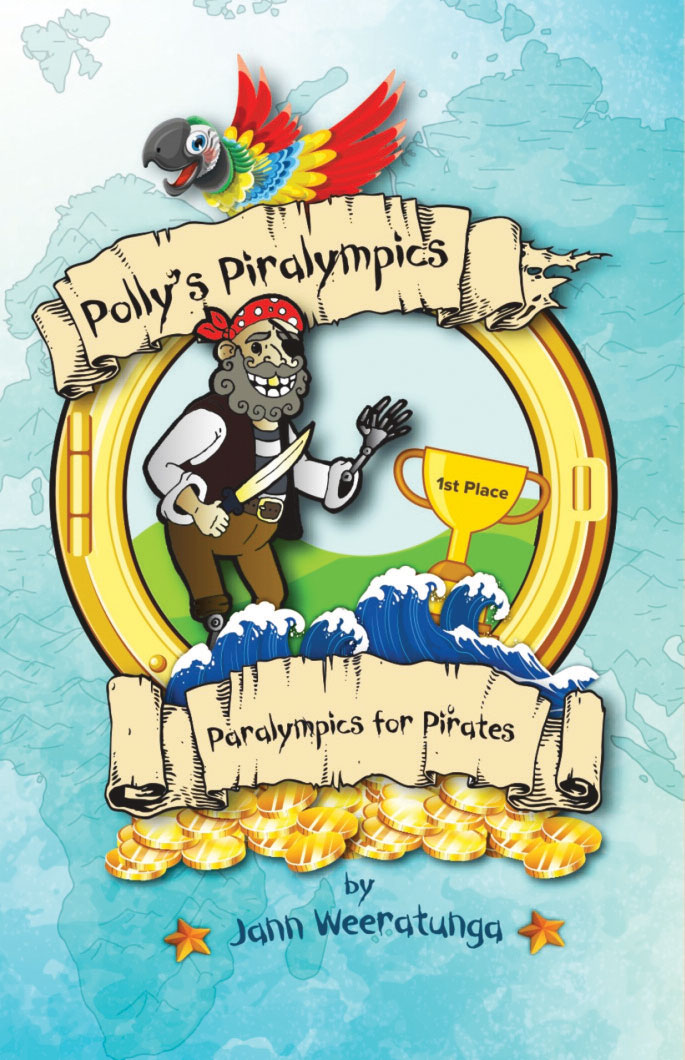
Her journey towards becoming an author, however, began long before Polly sailed into the world of children’s fiction.
Earlier in her life, Weeratunga was a Scout Leader in the UK, where volunteering became a way of life. She subsequently spent a decade in Sri Lanka, falling in love not only with a Sri Lankan, but with the country itself.
After her husband died just four years into their marriage, she joined five other women to establish a small school in Senarathwela to teach English to those who wanted to learn. Many of her pupils, subsequently, found employment at the newly opened Victoria Golf Course.
When she returned to Sri Lanka in 2025 and revisited the village and golf course, she found a landscape transformed by new roads, homes, shops and businesses. But the people she had taught remained.
“The village is unrecognisable, with new roads, homes, shops and businesses, but my dear pupils were still there as Caddies, Caddy Master and Golf Pro. I was so proud of them,” she says.
Her connection with Sri Lanka deepened further during one of the country’s darkest moments.
On Boxing Day 2005, while holidaying in the UK with her recently widowed mother, Weeratunga was woken by the words: “Something terrible has happened in Sri Lanka.”
She rushed to the television and witnessed the devastating aftermath of the Indian Ocean tsunami.
That very day, she established a non-profit organisation to raise funds and take relief to Sri Lanka. With support from local McDonald’s franchises, schools in Ferndown, the Mayor of Ferndown, freight companies and her friend Mr Wijekoon, a local Grama Niladhari, she helped rebuild lives in Arugam Bay.
The experience was hands-on and deeply personal. A family’s home had been swept away, and days were spent persuading surfers to help construct a future for her adopted family.
A Montessori was established on the hill, within the Buddhist temple grounds, while evenings were spent crafting, building and working with a small but effective generator.
Meals of rice and curry, prepared by the family’s sisters, using provisions donated from Senarathwela, brought the long days to a close.
When Weeratunga returned to the family, in 2025, she was able to see how far they had come.

Jann Weeratunga
Today, living in South Africa, she continues to draw inspiration from the landscape around her.
“Travelling—it leaves you speechless and then turns you into a storyteller,” she says, echoing the famous words attributed to Ibn Battuta.
And storytelling has become her way of opening conversations with a new generation.
While Polly’s Piralympics remains the flagship of her children’s publishing brand, Weeratunga’s wider collection explores a range of issues that matter to children and parents.
Terry and the Bully gives children practical and empowering ways to stand up for themselves, transforming a difficult subject into a story through which young readers can explore courage and self-confidence.
In Evie Visiting Grandma, children encounter the sensitive experience of visiting a loved one who now lives in a residential home. Rather than avoiding a potentially difficult subject, the story gently opens the door to conversations about ageing, family and change.
Terry the Toucane explores another universal childhood experience—the challenge and beauty of being different. Its central message is simple: being different should never prevent us from developing deep and lasting friendships.
Then there is Captain Bluebird, a resilient and entertaining adventure exploring what happens when Captain Bluebird receives a brand-new ship.
Across the collection, Weeratunga combines entertainment with meaningful life lessons, while her interactive approach gives children an opportunity to become participants rather than passive readers.
They can colour illustrations, draw pictures and respond to pages, making each reading experience personal.
That approach also gives the books an added value for parents and educators. They can become conversation starters—helping adults discuss subjects that children may find difficult to raise directly.
For Weeratunga, this is part of the larger purpose of her work.
Her books seek to fill a gap in children’s literature where diverse characters are not simply included for the sake of inclusion, but are given agency, personality and leadership.
In Polly’s Piralympics, disabled characters are not watching from the sidelines. They are the stars.
They lead.
They compete.
They win.
They champion their own adventures.
And that, ultimately, is the brand Weeratunga is building: children’s stories in which every child can find a place, a voice and perhaps even a little courage to become the hero of their own story.
Representation matters.
For young readers in Sri Lanka, Weeratunga’s books are now available through Sarasavi Bookshop, Vijitha Yapa Bookshop, M. D. Gunasena and Expo Graphics, Battaramulla.

By Zanita Careem
Music, laughter and a generous spirit filled Raflfles Hotel Colombo as Heart to Heart sing along brought together a vibrant gathering for an evening of melody, friendship and giving. The elegant ballroom reverberated with familiar lyrics as guests joined in, sang along and simply let their hair down. Adding to the infections atmosphere was the talented Rajiv and Clan, whose lively performance kept the energy soaring and had the gathering singing to some much loved favourites.
Keeping the evening moving with plenty of wit and warmth was the compere Mirzab Sherifdeen who ensured there was never a dull moment between the music, laughter and spontaneous sing-along moments, Guests were also treated to prizes galore adding an extra element of excitement to an already festive evening. There was cheers as winners stepped forward to collect their prizes, while friends and families aplauded and celebrated every winning moment.
Yet beneath all the sparkle was the meaningful purpose of Heart to Heart Trust Fund, founded by Dr. Rajitha Y de Silva and Dr. Ruwan Ekanayake, bringing people together in support of a cause built on compassion and care.
The dedications and the volunteering was evident throughout the evening with their commitment adding a special warmth to this special event.
Adding to the evening’s indulgence was a sumptous spread of cuisine by the Raffles, Hotel with an enticing selectiom that kept guests happily returning for more. From savoury favourites to tempting desserts, the food complemented the festive mood perfectly.
As the final song faded and the evening drew to a close, there was a quiet sense of gratitude. Behind the music, laughter, prizs and beautiful memories was a cause built as compassion, a cause that has continued to touch lives through the dedication of Dr. Rajitha de Silva and everyone who has stood beside him in the journey of Heart to Heart.
And as guests left Raffles Hotel with the last melodies still lingering in the air the most beautiful note of the evening remained – the sound of hearts earning for hearts. At the very heart of Hearts to Heart is Dr. Rajitha whose compassion has become the soul of the initiative. Dr. Rajitha’s work reminds us that medicine is not only about repairing what is broken. It is about giving people the courage to believe in tomorrow. And perhaps that is the greatest gift he offers. This spirit was beautifully reflected throughout the evening.It was a beautiful evening of music, friendship and generosity, with every contribution going towards a worthy cause- keeping alive a legacy built one one simple but powerful belief that every heart deserves a chance to beat on.
-
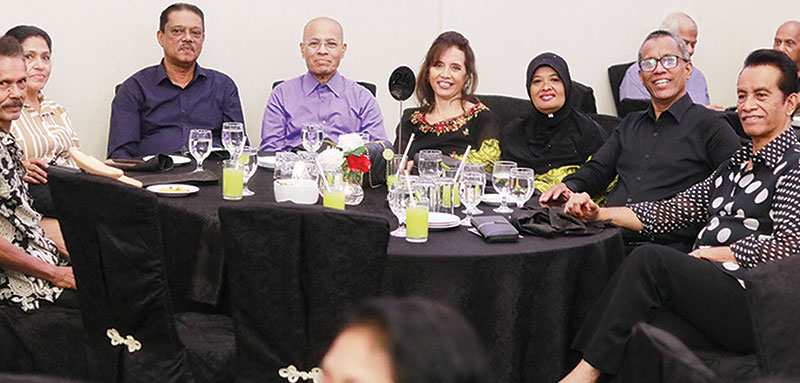
- Ramzi Rahaman with friends and family enjoying an evening of music
-

- Sarath Wimalaratne, Chandra and Bunny Bohoron
-

- Brigadier Bohoron
-

- Shanti Fernando shares a warm and happy moment with volunteers, adding to the camaraderie and cheerful spirit
-
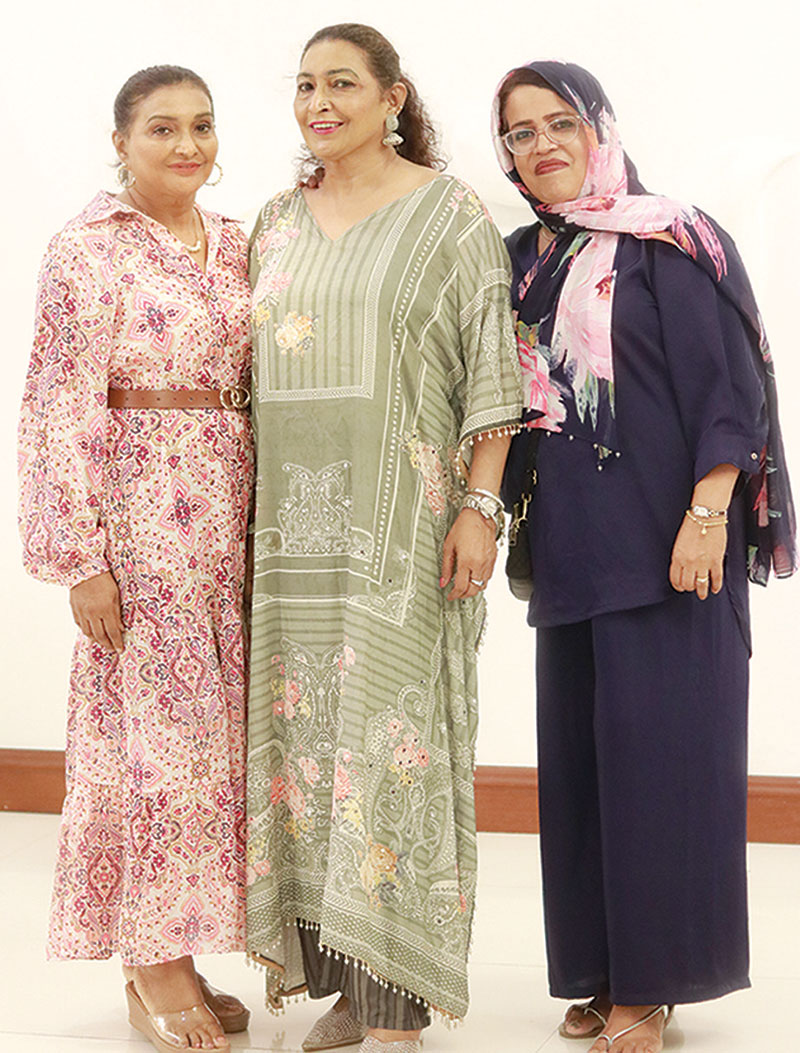
- Shahana, Sherin and Shahareen
-

- Lakshmie with her graceful moves
-

- Onitha Gurugalle with Arujana Ranasinghe
-

- Cardiologist and Senior Consultant Dr. Ruwan Ekanayake
-

- Dr. Rajitha Y de Silva and Dr. Arunie
-
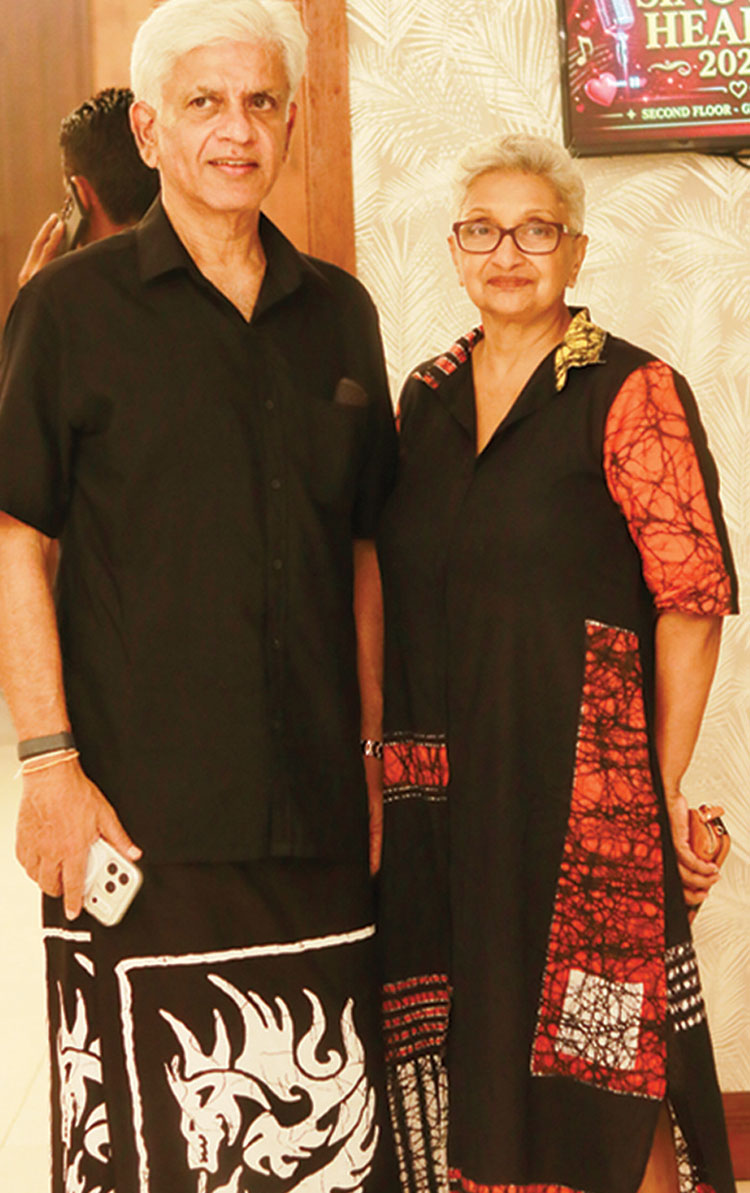
- Former Cricketer with spouse
-

- A guest takes centre stage

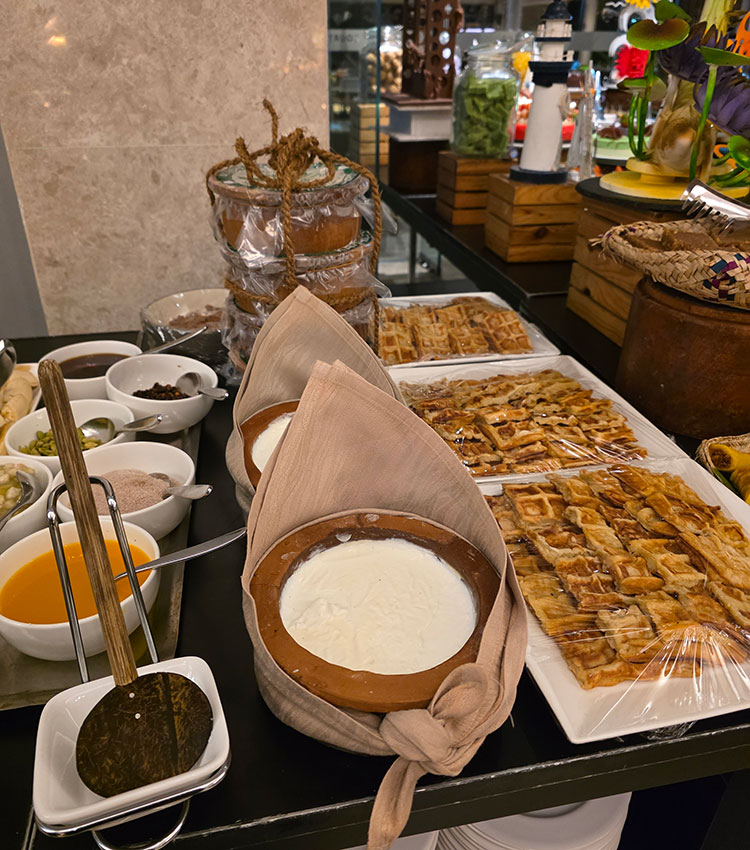
Taste of Ceylon opened its doors at Beira Kitchen, Courtyard by Marriott Colombo, on September 3rd; a festival of Southern, Central, Uva and Northern regional food, brought together on one table.
Four Regions, One Unforgettable Table
Each night, guests moved between four distinct culinary worlds. From the South came the deep, coconut-rich flavours of malu abulthiyal and Negombo pork curry with pineapple, alongside a lively fish polla roti action station. The Central province brought Kandalama lake fish, black octopus curry and carrot kalupol; dishes rooted in the region’s lakes and forests. Uva’s table leaned rustic and warming, with village chicken stew, prawn curry with murunga, and a coconut pittu drawing steady queues. And from the North came bold, unmistakable flavours of Jaffna crab curry, Jaffna mutton curry, and a dosai action station that quickly became one of the evening’s most talked-about corners.
Layered around the four regional stations was a spread that told its own story of Sri Lankan hospitality, from belimal herbal welcome drinks and a bread corner stretching from curry leaves rolls to kurakkan viyana rolls, to a dessert corner where watalappan, wood-apple coconut wandu and king coconut jelly sat alongside a full spread of traditional Sri Lankan sweets like kokis, athirasa and aluwa.
What the guests had to say
The feedback on opening night carried a common thread: guests were struck by just how different each region’s food tasted, side by side, on the same table. What could easily have blurred into “just Sri Lankan food” instead came through as four distinct culinary identities; the fire of the North, the coastal warmth of the South, the earthiness of the Central hills, and the rustic comfort of Uva, each unmistakably its own.
A Word from the team
Reflecting on the festival, the team at Courtyard by Marriott Colombo shared that Taste of Ceylon was designed from the start to be more than a menu. It was meant to be an experience guests could travel through, one region at a time, without leaving Beira Kitchen. Judging by the response over the four nights, that’s exactly how it landed.
There were many rave reviews and as the Taste of Ceylon experience at Beira Lake drew to a close, the flavours, aromas and vibrant spirit of Sri Lanka lingered on.

If we are to live fulfilling and happy lives, we need unity, mutual understanding, harmony, as well as art – PM

Dr. Roshanie Dissanayake appointed Secretary to the Ministry of Science and Technology

Death toll from Philippines ferry fire rises to 76, with more still missing

Anthropic boss Dario Amodei calls for AI development to slow down

It’s spin vs spin as India and Sri Lanka battle for Asia Cup title

Atmospheric conditions are favorable for afternoon thundershowers in most parts of the Island today [13]

‘Dates have the highest sugar content to fight Coronavirus’

Sunday Island 27 December – Headlines

#SundayIsland 17th December – Headlines

Sunday Island – 28th March

Sunday Island Headlines – 21 March

Sunday Island – 21st February – Headlines
-

 Sports3 days ago
DDS set to lose Test captaincy
-

 Features7 days ago
After the parade: What a traffic OIC’s walk-out tells us
-

 Editorial7 days ago
Arrests as theatre
-
 News6 days ago
Thailand shuts door on undesirables from Sri Lanka
-

 Latest News7 days ago
Harshitha’s composed knock seals Sri Lanka’s semi-final berth
-

 News3 days ago
Sri Lanka faces new grid challenge as rooftop solar surges: former CEB GM
-
 Business6 days ago
CEB successor company breaks into top three in competitive BESS tender
-

 News7 days ago
‘Choka Malli’ slips out of country before travel ban