
News
Long lines of vehicles on congested roads worry Johnson


‘People sent me pictures of traffic jams at entry and exit points on highways’
Chief Government Whip and Highways Minister Johnston Fernando yesterday vowed to make radical changes in his Ministry and the Road Development Authority to streamline their services to the general public.
Speaking at a ceremony held at his Ministry to commence operations for the New Year, the Minister said: “Today, I witnessed perhaps the longest lines of vehicles on our roads. Many have sent me pictures of traffic congestion this morning at expressways. Many towns have become chock-a-block. People suffering in traffic jams blame none but the government. There is no point in us being here if we cannot alleviate the sufferings of people. I have made a decision not to hesitate to make radical changes so that our Ministry and RDA could provide the services expected from them by people to their satisfaction.”
The Minister said that he would effect changes where necessary to increase efficiency and effectiveness of the services rendered to the public by the Ministry. “What I want is an expedited progress in our work this year. I want all my officials to cooperate with me for that goal. I am thankful to those who had dedicated themselves to serve continuously during lockdowns to prevent the spread of the pandemic. We all must strive to realise the goals set before us by the Vistas of Prosperity and Splendour programme of President Gotabaya Rajapaksa,” the Minister said.
Responding to questions by journalists at the end of the ceremony, the Minister said that President Rajapaksa could effect any changes to the Cabinet whenever he wanted. “It is his prerogative and he has the power to do so. People have given the powers to appoint the ministers and secretaries to the ministries. He will decide when to use those powers and to effect changes. He could do so at the beginning of the year or middle of the year or at midnight today,” the Minister said.
Asked whether a Cabinet reshuffle could bring about solutions for crises caused by the shortages of gas and dollars, the minister said: “Gas shortage is a crisis caused by officials including the Chairman of Litro gas. It is because of their inefficiency and dereliction of duties, a shortage of gas was created during the festive season. The officials should do their job, if not they should resign without letting the people and the government to be in difficulty.”
Asked whether the government would go to the IMF seeking a loan to find solutions for the forex reserve crisis, the minister said: “I am not the one who is to go to the IMF. That decision should be made by the Minister of Finance. If he thinks it is a necessity, then he will go there. It is not my place to comment on that issue.”
Responding to a journalist who said that Opposition leader Sajith Premadasa had equaled the government to a Maranadara Samithiya (death donation society) in Siyambalanduwa, the Minister said that Sajith Premadasa was the ideal Opposition leader for a government that expected no pressure from the Opposition. “He will go all around the country uttering whatever that comes to his mouth. He goes to Hambantota and Siyambalanduwa and laments about the plight of people in those areas and then comes home to drink wine and spends millions of rupees to host balls with his wife to his friends in Colombo. The one who weeps buckets in the morning for the cause of people suffering drinks and dances in the evening. It is good that we have an Opposition leader like him,” the minister said.
Asked for his comments on the possibility of joining of the SLFP teaming up with the JVP, the Minister said that the SLFP could do so. “Currently, the SLFP is with us. They can leave us anytime they want. They can even join Sajith Premadasa. Yet I still believe that the senior and capable lot in the SLFP are with us and won’t leave us.”
Among those present were Rural Roads and Other Infrastructure State Minister Nimal Lanza, Secretary to the Ministry of Highways R.W.R. Pemasiri, Secretary to the State Ministry of Rural Roads and Other Infrastructure, Prof Ranjith Dissanayake, Chairman of RDA Chaminda Athaluwage and RDA Director General Sardha Weerakoon.

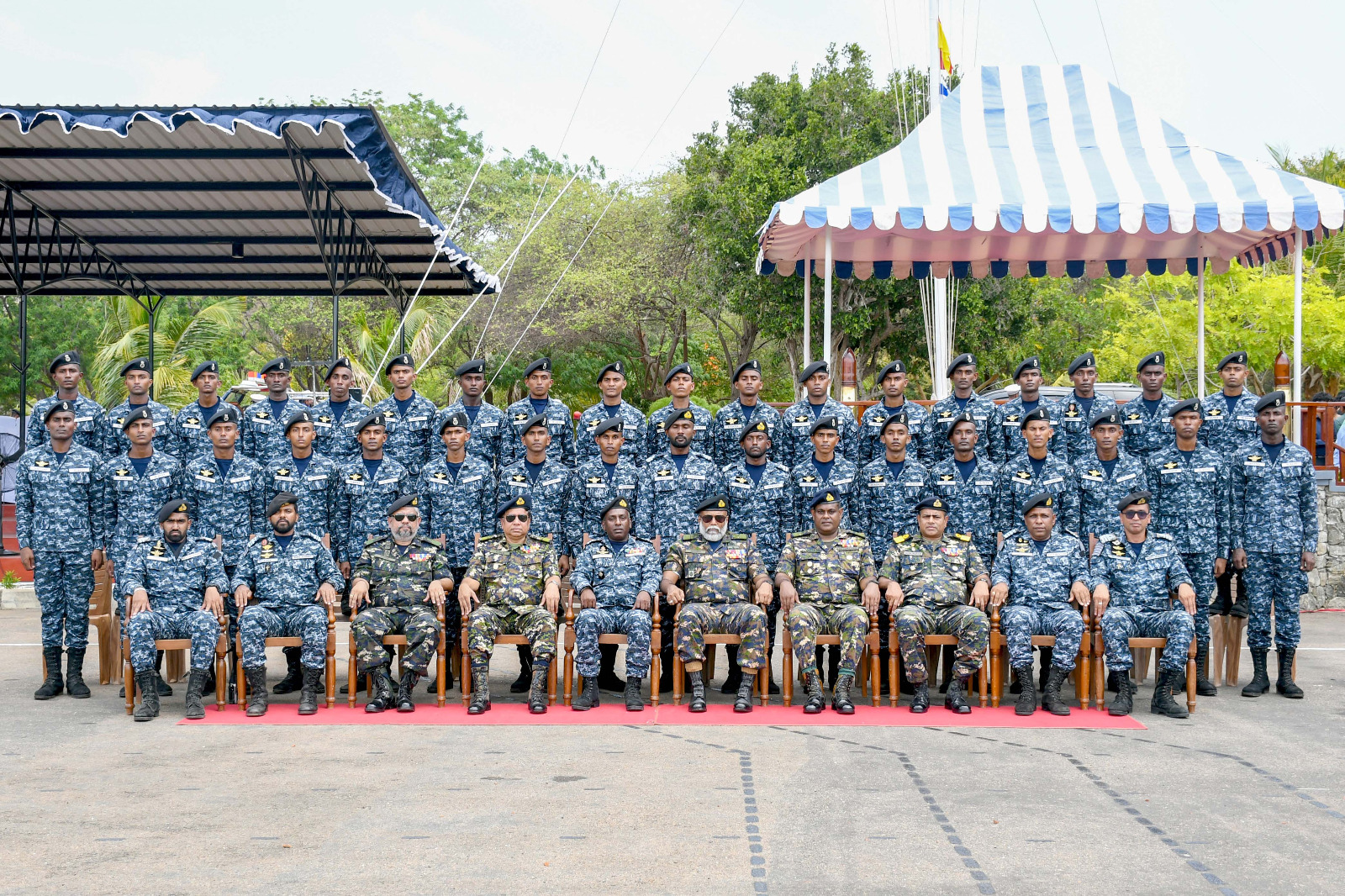
Thirty-six (36) naval personnel completed an eight-month Basic Marine Qualification Course and received their Marine insignia at the main parade ground of SLNS Vidura in Sampur, Trincomalee today, (29 August 2026).
At the invitation of Commandant SLNS Vidura, Captain Ravindu Harischandra, the ceremony was graced by Rear Admiral Buddhika Liyanagamage, Deputy Chief of Staff of the Navy and Commander Eastern Naval Area.
The group, comprising 3 officers and 33 sailors, completed the 10th intake of the Basic Marine Qualification Course, after volunteering for the demanding training programme.
In recognition of exceptional performance during the training, trophies were presented to outstanding personnel. Lieutenant (S) VPA Sasanka was awarded trophies for Best Marine of the Course, Highest Aggregate in Overall Subjects, and Best Marksman.
Physical Training Instructor WMGDP Bandara received the trophy for Best Physical Fitness. Addressing the newly qualified personnel,
Rear Admiral Liyanagamage congratulated them on successfully completing the course. He urged them to use the skills and experience gained through their training to contribute to safeguarding the country’s sovereignty and territorial integrity.
He also called on them to apply the courage and determination developed during the course both in their professional and personal lives, and to remain prepared to meet any challenge faced by the country.
He stressed the importance of keeping their knowledge and training up to date and maintaining constant vigilance while carrying out their duties.
Rear Admiral Liyanagamage also expressed his appreciation to
the Commanding Officer of SLNS Vidura and the directing staff for their contribution to the successful completion of the course.
The insignia ceremony also included a demonstration showcasing the capabilities and skills of the Sri Lanka Navy Marine.
Rear Admiral Achala Silva, Director General Logistics; Rear Admiral Kusal Dissanayake, Commandant Naval Infantry; Commodore Sanjeewa Kodikara, Director Marine; officers
from Navy Headquarters and the Eastern Naval Area; senior officers from the Army, Air Force and Police; and parents of the newly passed out marine personnel attended the ceremony.
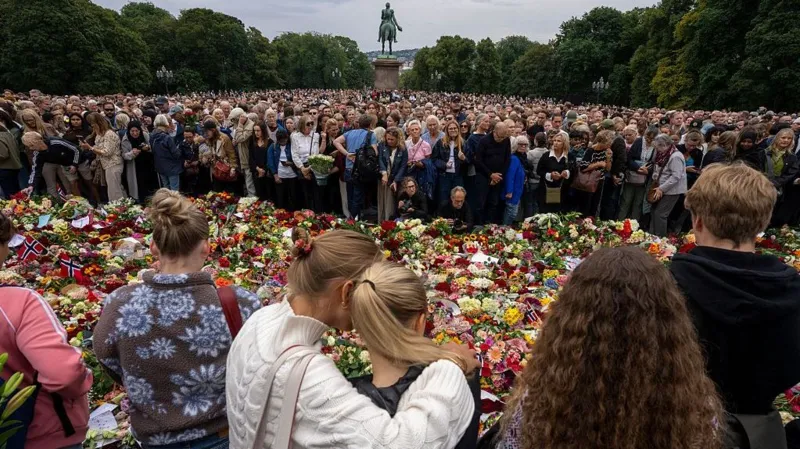
Norwegians are grieving the death of the beloved King Harald V, as a period of national mourning begins and his son Haakon VIII assumes the throne.
After Harald’s death was announced early on Friday, crowds amassed at the royal palace in Oslo, laying flowers and flags, some mourners visibly in tears.
The 53-year-old new king held an extraordinary council of state meeting with government ministers, saying he was taking on the royal family’s motto “All for Norway”.
Harald – who was on the throne for 35 years – died in hospital at 06:35 local time (04:35 GMT) aged 89, after being treated there for a rare blood condition. His coffin was later taken to the palace in a public procession.
Memorials outside the palace included a candle with the word “thanks” written on it (BBC)
An estimated 10,000 people lined the streets in the capital to see the late king go past, Norway’s public broadcaster reported.
The late monarch has been described as an inclusive, transparent and empathetic “people’s king” who modernised the Norwegian monarchy.
European royals, including King Charles III – whose mother Queen Elizabeth II was Harald’s second cousin – as well as political leaders and ordinary citizens, paid tribute to his service and the stability he brought to the country.
Norway’s Prime Minister Jonas Gahr Støre, who laid flowers outside the palace and signed a book of condolences after greeting the new king, said the country was “united in grief and gratitude”.
In a televised memorial address – one of multiple eulogies by ministers – he said the late king’s “legacy lives on” and offered condolences to the royal family and Queen Sonja, who would have celebrated her 58th wedding anniversary with Harald on Saturday. Støre was joined by ministers and a crowd of citizens grieving outside the palace (BBC)
Norway’s superstar footballer Erling Haaland thanked Harald for “everything you meant to Norway” in a post on Instagram, adding that it had been an honour to meet him earlier in the summer at the palace following the Fifa World Cup.
In the country’s capital, Norwegians shared their grief and affection for the late king.
“I personally will say he was everything for us, especially being an immigrant,” Biteya Terfassa, an Oslo resident who was born in Ethiopia, told news agency Reuters outside the palace.
“He made us feel at home and he made us feel loved. So he was like a grandfather that I never had.”
At noon, the Norwegian Armed Forces honoured Harald with a funeral salute of 21 shots from Akershus Fortress in central Oslo.
Later on Friday, a procession left the chapel at Rikshospitalet, where Harald died, taking his coffin in a hearse to the royal palace.
The date of Harald’s funeral is yet to be officially announced. Until then, he will be lying in state in the palace chapel so the public can pay their last respects.
During the national mourning period, flags will be flown at half-mast across the Nordic country, while Harald’s portrait will be displayed, candles lit and moments of silence held at professional events.
All non work-related social events will be cancelled or postponed. Oslo Mayor Anne Lindboe, who was due to get married on Friday, even postponed her wedding,
King Haakon, who is Harald’s younger child, is now the monarch and his wife Mette-Marit queen.
He is due to take an oath before the Norwegian parliament on Tuesday and will later participate in a consecration service – a stripped-down version of a coronation, which Norway no longer has.
His daughter, the 22-year-old Ingrid Alexandra, who joined her father to meet ministers at the palace on Friday, is next in line to the throne as crown princess after the rules of succession changed in 1990 to allow firstborn women to inherit the crown. Crown Princess Ingrid Alexandra, second from right, stood by her father’s side (BBC)
Haakon assumes his new role at a difficult time, as the royal family has faced health challenges and scandals this year.
Now-Queen Mette-Marit came under scrutiny earlier this year when it was revealed that she had a three-year friendship with the late convicted sex offender Jeffrey Epstein, for which she has publicly apologised.
Later in the year, she received a lung transplant, after suffering from pulmonary fibrosis since 2018. Doctors will not declare her stable until next year, meaning her husband must balance his new official duties with her care.
Meanwhile, Mette-Marit’s son from a previous relationship, Marius Borg Høiby, was convicted in June of rape and other offences and sentenced to four years in prison. He is appealing.
Høiby is not a member of the royal family, but was raised with them since he was four years old, when now-King Haakon married his mother.

Although Harald remained popular until his death, a poll for newspaper Aftenposten earlier this year found that support for the monarchy had dropped from 72% in 2024 to 54%.
However, Norwegian royal experts told the BBC that the new king, while facing questions about the turbulence surrounding his family, was respected, hard-working and, they believed, able to move forward despite the challenges.
(BBC)
Latest News
Sun directly overhead Pallawarayankaddu, Akkarayankulam, Ariviyal Nagar, Puthukkudiyiruppu, Ananthapuram at about 12.11 noon today (29)


The sun is going to be directly over the latitudes of Sri Lanka from 28th of August to 07th of September due to its apparent southward relative motion.
The nearest places of Sri Lanka over which the sun is overhead today (29) are Pallawarayankaddu, Akkarayankulam, Ariviyal Nagar, Puthukkudiyiruppu, Ananthapuram about 12.11 noon.

Thirty-six naval personnel pass out on successful completion of Marine training

Ex-White House teleprompter operator ordered to pay $172,000 for Trump speech bets

Rescuers on high alert for signs of secondary landslides

More than 600 killed in Nepal flood as search for survivors enters fourth day

Norway mourns King Harald as Haakon VIII ascends throne

Trump announces ‘biggest oil deal in world history’ with Venezuela

‘Dates have the highest sugar content to fight Coronavirus’

Sunday Island 27 December – Headlines

#SundayIsland 17th December – Headlines

Sunday Island – 28th March

Sunday Island Headlines – 21 March

Sunday Island – 21st February – Headlines
-
 Features7 days ago
My secondary schooling after Royal Primary
-
 Features7 days ago
From the First to the 22nd: A short history of Amendment Politics and Reform Frustrations
-

 News5 days ago
Missing doctor’s body found in Mahiyanganaya
-
 Features7 days ago
How Shelton Kodikara became first Professor of International Relations
-
 Features7 days ago
How St. John’s College Shaped Panadura for 150 Years
-
 News5 days ago
Australia declines to release Finance Secy Suriyapperuma’s citizenship details
-
 News7 days ago
Ex- Atamasthanadhipathi uses Magistrate’s gate to enter court
-
 News5 days ago
22A: BASL suggests CJ recuse himself from hearing petitions