
Features
Sri Lanka’s state-owned enterprises:

A major crisis in the making
By Migara Rodrigo
Sri Lanka has a whopping 527 state-owned enterprises1 (SOEs). The 55 SOEs classified as “strategically important” alone employ 10% of the public sector workforce2, or about 1.9% of all workers. Such a large number of SOEs are not the norm globally3; many other countries (such as India) have been reducing their stakes in SOEs and, in some cases (e.g. Air India), have been privatizing them entirely. SOEs – particularly many in Sri Lanka – tend to be grossly inefficient, loss making, and a burden on the taxpayer. The time is ripe for major SOE reforms.
What is an SOE?
A SOE is traditionally defined as a commercial entity that has majority ownership/control by a nation’s government – in Sri Lanka, this can include statutory bodies, regulatory agencies, promotional institutions, educational institutions, public and limited companies. While Sri Lankan SOEs have traditionally been incorporated by an Act of Parliament, in recent years these entities have also been incorporated under the Companies Act instead. Sri Lankan SOEs can be divided into three categories: 55 Strategic SOEs, 287 SOEs with commercial interests, and 185 SOEs with non-commercial interests. Unlike nations such as India which mandate internal audits of their SOE’s business activities and publish an annual overview with a balance sheet of each individual business, the majority of Sri Lankan SOEs do not reveal this pertinent information to the public; financial information is available for just 10.4% of SOEs.
Fundamental Problems with Sri Lankan SOEs
Contrary to what some believe, low quality of talent is not the most significant issue with SOEs; many employees are eminently qualified and capable. Unfortunately, these organizations fall victim to government mismanagement and corruption. In addition to excessive employment to fulfill their political ambitions, there have been allegations that some SOEs have been formed purely to facilitate corruption – for example, the Lanka Coal Company engaged in fraudulent deals to purchase coal causing a loss of over Rs. 4 billion (allegedly with the knowledge of the minister in charge)4. SOE financials are late and few obtain ‘clean’ audit reports. Investigations have revealed repeated instances of fraud, mismanagement, corruption and negligence. Furthermore, the internal control, monitoring and governance frameworks seem inadequate to deal with these problems – of over 500 SOEs, regular information is only available for 55. Even obtaining a complete list of entities proved to be a challenge. Public access to information is limited – the PED has not released an annual report since 2018, and right-to-information requests often go unanswered.
Moreover, SOEs have few budget constraints and shareholder (public) accountability, and therefore have limited incentive to control costs. Unlike with private sector enterprises, which have a need to make a profit, many SOEs (particularly in Sri Lanka) can simply borrow from other state organizations/banks or the government when they require additional funds, which undermines the threat of bankruptcy as a source of discipline5. Some recently established SOEs have found a new way of bypassing budgets and oversight: by incorporating as companies rather than through an act of Parliament, they are excluded from Parliamentary accountability and allowed to rack up unsustainable debts and surpass budgets more easily. This has led to SOEs burning through taxpayer rupees: the cumulative losses of the 55 strategic SOEs from 2006-20 amounts to Rs. 1.2 trillion.
Finally, while some SOEs do manage to make a profit this is, more often than not, due to the advantage that these companies have in an uneven playing field. In addition to lax budgetary requirements and ability to rack up unsustainable debts, these companies are supported by the government through direct subsidies and state-backed guarantees; by regulators through exemptions from antitrust policies and preferential treatment; and by the justice system through an ability to sidestep parliament. This has led to private sector organizations being crowded out of the industries that SOEs operate in. Instead of having private firms in the market-place with efficient and high-quality services, the Sri Lankan taxpayer is beset with SOEs with total liabilities of 4-5% of GDP6.
Potential Reforms
Given that the nation has reached an economic tipping point, with serious questions about debt sustainability and government solvency, it is clear that immediate action must be taken. Advocata proposes a short term policy solution consisting of privatization, restructuring and disinvestment, and listing on the Colombo Stock Exchange. None of these solutions are particularly radical in the global or local context. According to Anarkali Moonesinghe, CEO of CIMB Sri Lanka, the two main policies of both Western and Eastern governments when reforming SOEs are to reduce subsidies and increase efficiency, forcing SOEs to compete more equitably with private enterprises. Alternatively, full or partial privatization is a possible solution: SLTMobitel’s service has markedly improved following its 1997 privatization and the entrance of competitors such as Dialog Axiata, all held accountable by the broadly competent Telecommunications Regulatory Commission. Listing on the CSE would allow these firms to have broad-based direct ownership, while also improving the growth of the CSE and capital markets. Importantly, these firms would have to be ‘corporatized’ before listing, an opportunity to improve productivity and eliminate bloat. There are, unfortunately, firms that will essentially have to be given away due to their huge debts and poor reputations. A prime example of this is SriLankan Airlines, which has racked up Rs. 316 billion in losses7 since control was taken from Emirates in 2008. While some will regard this as a blow to our national pride, Sri Lanka would not be alone in taking such a pragmatic step to improve government finances and customer experience; Air India, the Indian national carrier, is currently in the process of being sold to the Tata Group for the relatively small sum of INR 18,000 crore. This would also inspire confidence in Sri Lanka amongst foriegn investors as it would show the country’s commitment to meeting its upcoming debt servicing obligations.
Furthermore, long term solutions include strengthening governance/limiting corruption & influence, improving efficiency, enacting cost-reflective pricing, and finally unbundling key sectors. This applies particularly to firms like the Ceylon Electricity Board which, as a natural monopoly, cannot be broken up and privatized without losing efficiency. A 2006 study by the Japan International Cooperation Agency recommended breaking up CEB into three parts: “making the generation, transmission, and distribution divisions…independent”8. Despite the 15 years and multiple nationwide blackouts that have occurred since, GoSL continues to drag their feet on the issue, as it is politically unpopular. Cost-reflective pricing (also prevented due to political unpopularity) is another essential reform. The existing system of having electricity tariffs priced below cost is a public subsidy whose cost will be borne by future generations. It is also inequitable, as the government could provide low cost services to those who need it by giving them direct cash transfers, instead of subsidizing the wealthy who can afford to pay. A similar situation is evident with the Ceylon Petroleum Corporation, which currently makes a loss of Rs 23-38 per litre of fuel9; again, a public subsidy to those who can often afford to pay the market price. Finally, greater accountability, by means of annual internal audits and the availability of SOEs’ financial information to the public, is also important to ensure these firms stick to the targets they are given.
A successful and thriving market, in most industries, will only occur with the presence of three crucial factors: competition, a good framework, and competent regulation. By reforming Sri Lanka’s SOEs to meet these criteria, we will ensure a good customer experience, a reduction in the government deficit, and general prosperity for all key stakeholders.
Migara Rodrigo is a Researcher at the Advocata Institute. He can be contacted at migara.advocata@gmail.com. The Advocata Institute is an Independent Public Policy Think Tank. Learn more about Advocata’s work at www.advocata.org. The opinions expressed are the author’s own views. They may not necessarily reflect the views of the Advocata Institute.

How Criminal Networks Launder Billions Across the World
Illegal foreign exchange, Undiyal, Hawala and money laundering: A four-part investigative series
The invisible financial empire – II
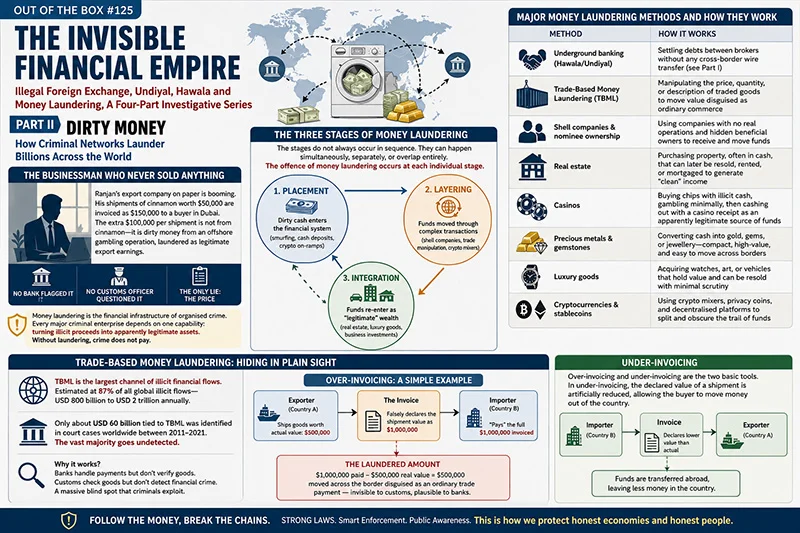
The Businessman Who Never Sold Anything
 Ranjan owns a small export company in Colombo. On paper, business has never been better. His shipments of cinnamon and coconut-based products to a trading partner in Dubai have tripled in declared value over eighteen months. His bank statements show steady, healthy growth. His tax filings are immaculate. His accountant calls him a model client.
There is only one problem. Ranjan’s actual cinnamon exports have not tripled. They have barely changed at all.
What has changed is the invoice. Each shipment of cinnamon worth roughly $50,000 is now declared on customs paperwork as being worth $150,000. The Dubai buyer, who is not really a buyer in any ordinary sense, pays the full invoiced amount without complaint. The extra $100,000 that flows back to Ranjan’s company with each shipment did not come from selling cinnamon. It came from somewhere else entirely: the proceeds of an offshore gambling operation that needed a way to bring money into Sri Lanka looking like ordinary export earnings.
No bank flagged it. No customs officer questioned it. The cinnamon was real. The shipment was real. Only the price was a lie, and that lie was enough to turn dirty money into the cleanest thing in the world: a profitable Sri Lankan export business.
This is money laundering. And it is far more sophisticated, far more pervasive, and far more damaging to ordinary economies than most people realise.
Why Laundering Matters More Than the Crime Itself
Money laundering is not merely about hiding cash under a mattress. It is the financial infrastructure of organised crime. Every major criminal enterprise, from narcotics trafficking and cyber fraud to corruption, tax evasion, illegal mining, human trafficking, and terrorism financing, ultimately depends on one single capability: the ability to convert illicit proceeds into apparently legitimate assets.
Without laundering, crime does not pay, not in any usable sense. A drug trafficker sitting on millions in cash cannot buy a house, send a child to university abroad, or invest in a business without first explaining where the money came from. Laundering is the bridge between criminal proceeds and a normal life. Remove the bridge, and the profit motive for organised crime collapses.
This is why the international community treats money laundering as a standalone crime, separate from and in addition to the original offence. According to the United Nations Office on Drugs and Crime, global money laundering is estimated at between 2% and 5% of world GDP, somewhere between USD 800 billion and USD 2 trillion every single year.
The Three Stages: Placement, Layering, Integration
Despite enormous variation in method, almost every laundering scheme, from a street-level drug operation to a sophisticated transnational network, follows the same underlying three-stage structure first formally identified by international regulators and now codified by the Financial Action Task Force (FATF) and adopted by Sri Lanka’s own Financial Intelligence Unit. (See Graph 1)
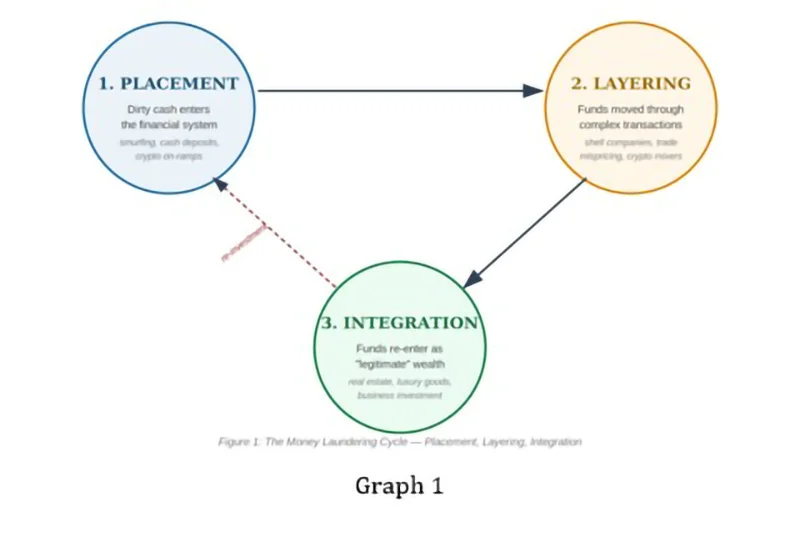
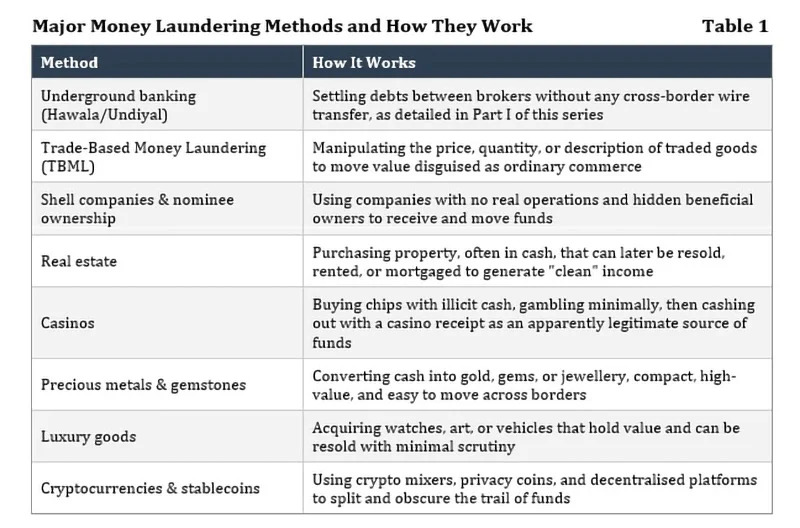
Crucially, as Sri Lanka’s FIU and the FATF both note, these three stages do not always occur neatly in sequence. They can happen simultaneously, separately, or overlap entirely, and critically, the offence of money laundering occurs at each individual stage, not merely at the end of the process. (See Table 1)
Trade-Based Money Laundering: Hiding in Plain Sight
Of all these methods, trade-based money laundering deserves special attention, because it is, by most expert estimates, the largest channel of all. According to FTI Consulting’s anti-financial-crime specialists, TBML accounts for an estimated 87% of all global illicit financial flows, which could translate to USD 800 billion to USD 2 trillion annually. Despite this staggering scale, court cases worldwide identified only about USD 60 billion tied to TBML between 2011 and 2021, meaning the overwhelming majority of trade-based laundering is never detected, let alone prosecuted.
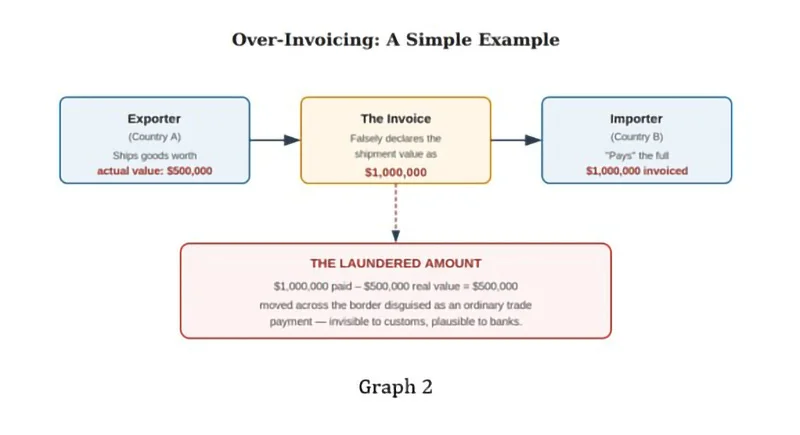
The reason is structural. Banks process the payments behind a trade transaction, but they rarely verify the physical goods being shipped. Customs authorities inspect the goods but focus on tariffs and contraband, not financial crime. Between these two gaps sits an enormous blind spot that traders like Ranjan, real or hypothetical, can exploit with remarkable ease. (See Graph 2)
Under Invoicing
Over-invoicing and under-invoicing are the two basic tools. In over-invoicing, the declared value of a shipment is inflated, allowing the buyer to transfer excess funds to the seller, disguised as a trade payment. Under-invoicing works the opposite way, understating the value to move money in the reverse direction, or to evade customs duties on the true value of the goods.
More sophisticated variants include multiple invoicing of the same shipment, misrepresenting the quantity or quality of goods, and outright phantom shipments where no goods move at all.
Money laundering does not exist in isolation. It is the connective tissue linking together a genuinely global criminal ecosystem, and the methods described above are used across an enormous range of predicate crimes.
The Cost to Nations
The damage caused by money laundering is rarely visible in the way a robbery or a bombing is visible. It is slower, quieter, and in some ways more corrosive, because it operates by corrupting the very institutions meant to prevent it. (Table 2)
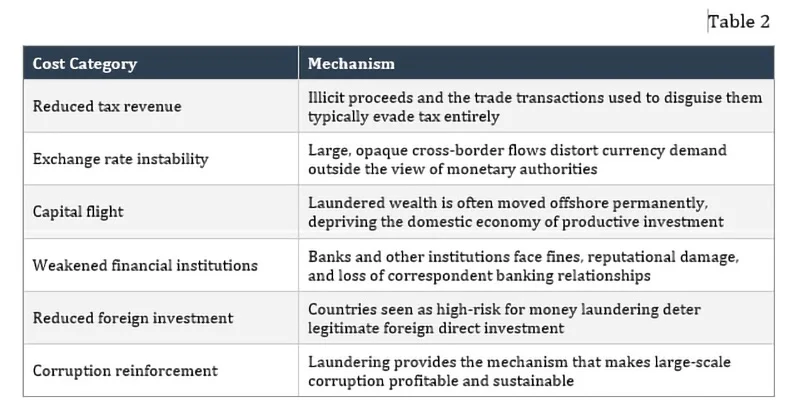
These costs are not abstract for institutions caught facilitating them, even unknowingly. Canada’s TD Bank was fined USD 3 billion in 2024 for failing to prevent criminals from transferring hundreds of millions of dollars in illegal funds through its systems. The UK’s Barclays Bank was fined a combined £42 million (approximately USD 56 million) in 2025 across two separate AML failings. Globally, the first half of 2025 alone saw USD 1.23 billion in AML fines, a 417% increase over the prior year, reflecting both the scale of the problem and intensifying regulatory pressure.
Sri Lanka’s Challenges: Preparing for a High-Stakes Test
Sri Lanka’s own experience with money laundering and its enforcement architecture offers an instructive case study, one with significant stakes attached in the immediate future.
Sri Lanka’s Financial Intelligence Unit, established under the Financial Transactions Reporting Act No. 6 of 2006 and operating within the Central Bank, is unusual among its global peers: although administrative in type, it has direct powers to freeze accounts, suspend transactions, and impose penalties for noncompliance, powers many FIUs around the world lack. The Prevention of Money Laundering Act No. 5 of 2006 backs this with serious criminal penalties: imprisonment of between five and twenty years, and fines of up to three times the value of laundered property, with the burden of proof placed on defendants to justify the legality of their assets.
Yet deficiencies remain. The absence of explicit conspiracy clauses limits prosecutors’ ability to charge coordinated networks rather than individuals. Predicate crimes such as drug trafficking, corruption, and trade-based manipulation generate significant illicit proceeds, but tracing those funds and linking them conclusively to offenders remains genuinely difficult, a challenge shared with every FIU in the world, not a uniquely Sri Lankan failing.
The stakes for getting this right have rarely been higher. Sri Lanka was grey-listed by the FATF in 2017 following “strategic deficiencies” identified in its AML/CFT regime, and was subsequently blacklisted by the European Union, a designation only lifted after extensive remedial work by the FIU and Central Bank. Sri Lanka now faces its third FATF mutual evaluation, scheduled for 2026, under a revised methodology that prioritises measurable enforcement outcomes, convictions, confiscations, and inter-agency coordination, over the mere existence of laws on paper.
“The bottom line, simply, is that we cannot afford to be grey-listed again,” FIU Director Dr. Subhani Keerthiratne has said. “We must somehow avoid it, because we are still recovering from the 2019 Easter Sunday attacks, the Covid pandemic, and recent economic crisis.” Grey-listing carries real economic consequences: it increases transaction costs, subjects correspondent banking relationships to stricter oversight, and reduces foreign investment, costs the Central Bank itself has acknowledged Sri Lanka cannot currently absorb.
In preparation, Sri Lanka has taken concrete steps: a High-Level Task Force on AML/CFT was appointed in February 2025; the Proceeds of Crime Act, passed in 2024, gave regulators new powers to freeze and manage confiscated assets; the FIU signed information-sharing agreements with bodies including the Commission to Investigate Allegations of Bribery or Corruption (CIABOC) and counterpart FIUs in Oman, Mongolia, Russia, Saudi Arabia, and the United States; and the UK’s HM Treasury has provided direct technical assistance ahead of the 2026 evaluation.
What Comes Next
But the landscape of illicit finance is changing faster than most regulators can track. In Part III of this series, “The Digital Underground: Forex Platforms, Cryptocurrency, AI and the New Financial Battlefield”, we turn to the technology reshaping this entire ecosystem: legitimate and fraudulent online forex platforms, the explosive growth of crypto-enabled laundering, and the artificial intelligence tools now being deployed on both sides of this contest.
(The writer, a senior Chartered Accountant and professional banker, is Professor at SLIIT, Malabe. Views expressed in this article are personal.)
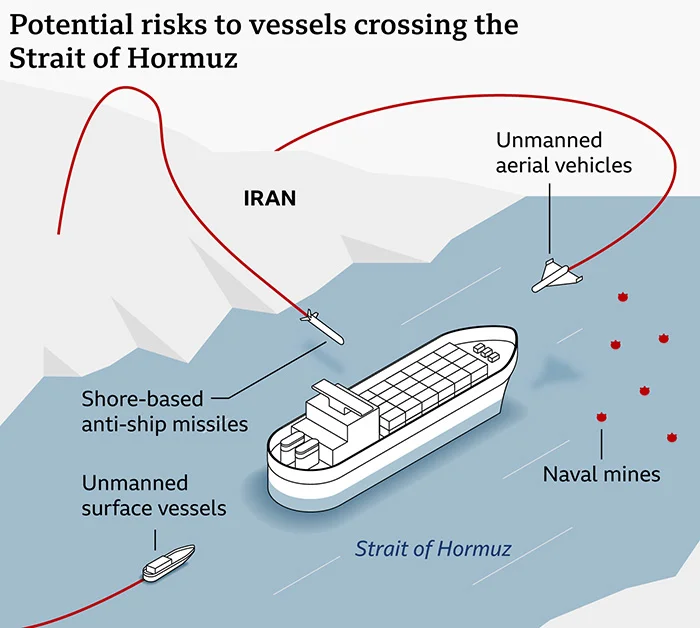
The long drawn out imbroglio in the straits of Hormuz and the blockades to navigation of ships through these straits by the warring parties to the US and Israel war against Iran was causing immeasurable economic disruption and suffering to people in the region and around the world. The signing of the Memorandum of Understanding and the ceasefire was received with cautious optimism and it is to be hoped that the fragile ceasefire endures. The seas are the paths of navigation and to the flow of goods and trade around the world. This is why freedom of navigation in the seas has always been the most important principle of the international law relating to the seas. Hence the right of innocent passage of ships even in territorial waters of coastal states and in international straits, has been retained despite claims of territorial sovereignty by coastal states.
The ongoing negotiations and the possibilities of a final settlement and permanent opening of the straits of Hormuz requires us to look at the international law of the sea and the question of passage of ships through territorial waters and international straits as also the rights of the different parties I.e the right of the coastal state or states, and the rights of third states in these waters which is what this article seeks to set out.
The law of the Seas has not been static. It has been dynamic and evolving in response to economic and political factors and new dimensions in science and technology. In Roman law the sea was regarded as ‘Res communes’ open to all. Subsequently there was the, closed sea doctrine and around the 16th century doctrine of the open seas ‘Mare Liberum’ espoused by the Dutch Jurist Grotius, which served the interests of the maritime and colonial powers like Holland and England. However in the 20th Century with new states in Asia, South America and Africa coming into being, there was a curtailment of this freedom as these states wished to control the resources of the seas adjoining their coasts, and hence the coastal states began to have greater areas of the sea under their sovereignty, as in the territorial sea, the exclusive economic zones, and under the sea, in the continental shelf of the seabed. These new zones were recognised under the 1982 Law of the Sea Convention. However, in order to protect the right of navigation in the seas the customary international law right of innocent passage of ships in the High seas was extended into the Territorial waters and Exclusive economic zones of coastal states and to international straits. This right has been codified and incorporated into the United Nations Law of the Sea treaty 1982, (UNCLOS), to which a large number of states are party.
Territorial seas
– It must be pointed out that in the territorial sea i.e. the seas adjoining the territory of States with maritime boundaries, it has always been recognised that the State exercises a sovereign right which extends not only over the Sea but also over the Air space. In the Sea up to a certain limit, which was earlier recognised as extending to 3 miles which was then the canon shot limit of coastal defenses. Today under UNCLOS it extends to 12 miles of territorial sea. Under the traditional law of the sea as set out by ‘Colombos’ a classical authority on “the International law of the Sea”, the Coastal State exercised well defined rights of control over foreign ships of war and merchant vessels in respect of police, customs and revenue functions, which implies right to collect tolls, fishing rights, maritime ceremonial and right to establish defense zones. In so far as the State exercises all these powers there is little to distinguish between territorial waters and internal waters. But there is one important point of difference and that is the Right of innocent passage, which is also provided for in United Nations Convention on the Law off the Sea (UNCLOS). As it is also a customary right of international law, it binds even non-parties to the Law of the Sea Convention such as the United States of America.
Innocent passage is defined under the convention as navigation through the territorial sea for the purpose of traversing the sea without entering internal waters or of making for internal waters, or for making for the high seas from internal waters i.e. Ports. The earlier 1958 Convention, defines it as “one that is not prejudicial to the peace, good order or security of the coastal state.” The 1982 Convention sets out what activities would be prejudicial and this includes any threat of force against the sovereignty, territorial integrity or political independence of any State or in any other manner in violations of the principles of international law in the Charter of the United Nations”. A new feature is the addition of any acts of willful and serious pollution contrary to the Convention. The Coastal State is also empowered to make laws and regulations relating to innocent passage as well as designated traffic separation schemes. Foreign ships exercising this right must comply with the laws and regulations of the coastal state. The question of the right of innocent passage of war ships is not specifically provided for in the Convention, however state practice indicates that they may require prior authorisation as in the case of India, Sri Lanka and other states such as Soviet Union, France, Norway etc.
The Coastal State may take the necessary steps to prevent passage which is not innocent. Furthermore it is the Coastal State that has the right to characterise the Passage. If the Coastal State deems the passage to be ‘Not Innocent’ it may refuse such passage. Hence although foreign ships have such right the Coastal State exercises a considerable degree of Control. As regards the Strait of Hormuz this falls within the territorial waters of Iran and Oman, and these states exercise this jurisdiction. Under UNCLOS all Coastal states have a territorial sea of up to 12 nautical miles and a contiguous zone of 12 nautical miles. In the case of States with opposite or adjacent coasts as in the case of Iran and Oman, the territorial waters are divided between them by agreement or by a median or lateral line.
The Strait of Hormuz is regarded as an international strait. International straits are narrow natural waterways connecting two parts of the high seas or Exclusive Economic zones with a High sea. UNCLOS provides for transit passage for ships in such Straits. Transit passage unlike innocent passage allows for continuous and expeditious transit for ships, submarines and Aircraft. However the Straits of Hormuz does not connect two parts of the High seas as for example the Straits of Malacca connects the Indian Ocean to the Pacific Ocean, or the Straits of Gibraltar connects the Atlantic Ocean to Mediterranean Sea. The Straits of Hormuz actually connects two parts of the same water body i.e. the ‘Persian Gulf’, and the Gulf of Oman which is not a separate ocean or sea. The Persian Gulf and Gulf of Oman are both parts of what is in the nature of an inland sea as for example the Baltic Sea. However as it has been regarded as an international straits over a long period of time it may not be possible to change its designation.
In any event even if there is some doubt as to whether these are international straits and hence there is no transit passage in these straits, there is nevertheless the right of innocent Passage. In the case of transit passage, it ensures freedom of Navigation and over flight solely for continuous and expeditious transit. The ships or Aircraft must proceed without delay, refrain from threat of force and comply with safety and environmental regulations. So we can see that freedom of navigation is assured and while Iran as the coastal state can claim that their action to close the strait was an act to protect their sovereignty, the blockade by the United States was illegal as it is contrary to the Treaty and customary international law of the Sea.
Way forward – Under the Charter of the United Nations it is the Security Council which has the primary responsibility for maintaining the peace and security of the world. Unfortunately this has not been the case in respect of the war in the region and threats to freedom of Navigation. Furthermore States whose interests were affected who should have made a collective effort to resolve the issue amicably keeping in mind the Sovereignty and territorial integrity of the States through whose territorial waters the straits are situated, namely Iran and Oman failed to intervene. It must also be kept in mind that the Coastal State in this instance Iran, has presented its action of Closure of these Straits as a defensive measure against an unprovoked armed attack and use of force by third states namely US and Israel. An attack which was not carried out under the mandate of the United Nations Security Council which alone has the right to initiate collective military action to restore international peace.
A fragile ceasefire under constant pressure remains in doubt and the recent signing of a Memorandum of Understanding between Iran and USA through the mediation of Pakistan, Oman and Qatar is still in place while negotiations continue. Once Peace is restored with guarantees for non-renewal of attacks, Iran can be called upon to fully open the straits, which were open before the commencement of the attacks. The Freedom of Navigation which is the underlying principle of the law of the Sea can then be restored and the right of passage in the straits of Hormuz restored.
The writer LL.B (Cey), LL.M (Cantab), Ph.D.(Col), Attorney–at–Law.
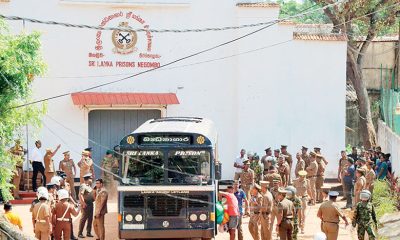
The prison violence in Negombo has become the first major crisis to confront the government since it came to power. The government may or may not be responsible for creating the conditions that have accumulated over decades and made the prison system a powder keg. The fact is the government’s Ratama Ekata anti-drug crackdown boosted the countrywide prison population from 28,000, in late 2024, to 41,000, in 2026. The conditions of imprisonment include chronic overcrowding, poor infrastructure, inadequate staffing, the penetration of organised crime and drug networks into prisons, and the long neglect of prison reform by successive governments. The Negombo Prison was housing approximately 2,600 inmates at the time of the clashes although it was built for only about 650. By the time order was restored, 29 people, including seven prison officers, had lost their lives and more than 100 others had been injured.
Justice Minister Harshana Nanayakkara accepted responsibility before Parliament, visited the Prison and announced immediate measures, including legislative changes to facilitate bail and alternatives to remanding prisoners. The NPP government needs to accept responsibility for its failure to anticipate the danger, to respond with sufficient speed and competence once the problem had erupted. A dangerous situation can be observed countrywide with more than 42,000 prisoners being held in prisons designed to accommodate about 10,000 inmates. The magnitude of the Negombo Prison tragedy needs to be understood not merely as an isolated incident but as a warning that the government cannot postpone structural reforms indefinitely. A government elected on the promise of changing the system cannot justify repeating the failures of its predecessors on the basis that it is sincere and uncorrupt unlike them.
The failure to move beyond promises has become evident in several other sectors as well. Farmers continue to agitate over unresolved problems. Plantation workers continue to seek meaningful integration into national life. Many of them, who were victims of Cyclone Ditwah, continue to live in miserable conditions due to the government’s slowness in dealing with their problems of their lack of ownership of lands and homes. The Mylathamadu cattle farmers of Batticaloa have issues once again even after two presidents, President Ranil Wickremesinghe and now President Anura Kumara Dissanayake ordered evacuation of intruders in terms of court orders. But the local police and the Mahaweli Authority officials seem slow to take any actions, even to the extent of not complying with judicial decisions. Victims of past human rights violations and thousands of families of missing persons are still waiting for justice. The promised repeal of the Prevention of Terrorism Act has yet to materialise. Prison reform has now joined this growing list of deferred commitments.
NPP Pledges
The National People’s Power election manifesto promised not merely honest government but systemic transformation. Under the section dealing with prisons, it pledged to restructure the prison system, reduce overcrowding, expand open prison facilities, strengthen rehabilitation through education, vocational training and psychological support, establish a formal parole system and transform prisons from places of punishment into centres of rehabilitation and reintegration. Those promises reflected international best practice and recognised that a humane prison system is essential to a democratic society. Yet nearly two years into its term little visible progress has been made in implementing these reforms.
Sri Lanka has witnessed different types of prison violence. Some have erupted spontaneously because of intolerable prison conditions, overcrowding and frustration. Others have occurred under circumstances that raised alarming questions about state complicity. The massacre of 53 Tamil political prisoners inside Welikada Prison during the anti-Tamil violence of July 1983 remains one of the darkest chapters in the country’s history. Those prisoners were not protected despite being under state custody. The Mahara Prison violence of November 2020, in which 11 inmates were killed after protests over Covid conditions, similarly generated serious allegations regarding the targeted use of weapons and led to widespread calls for an independent investigation.
Following the deadly violence at Mahara Prison during the Covid pandemic, then Opposition party leader Anura Kumara Dissanayake declared in Parliament that “those who are remanded and imprisoned are under the custody of the state. Therefore, the primary responsibility for the safety of the lives of the prisoners and detainees who are in state custody lies with the government.” He further said that “it is entirely unacceptable in a democratic nation that upholds human rights for prisoners, who are under the protection of the state, to be gunned down while in government custody.” But in the Negombo tragedy once again the state, with President Dissanayake at the helm, was unable to protect the inmates though there is no evidence that the government orchestrated the violence. Being in power for two years there is a rightful expectation that it could have taken better preventive action.
Urgency Needed
There are two special conditions, however, that make the Negombo Prison tragedy a possible turning point rather than merely another episode in Sri Lanka’s long history of prison violence. The first is that until these events the country had enjoyed an extended period without major organised political or communal violence. This improvement was recognised internationally when Sri Lanka rose 30 places in the 2025 Global Peace Index to rank 67 among 163 countries. The Index measures countries on three broad indicators, namely the level of societal safety and security, the extent of ongoing domestic and international conflict, and the degree of militarisation. The improvement reflects the country’s recovery from the years of political upheaval and economic collapse and suggests that Sri Lanka is moving towards a more peaceful future.
The second distinguishing feature is that the present government has no known links to organised crime or the underworld that has so often been associated with sections of the political establishment in the past. This is one of its greatest strengths. President Anura Kumara Dissanayake has spoken publicly about the nexus between organised crime, drug trafficking, money laundering and politics, and has challenged political parties to take action against members who maintain links with criminal networks. That willingness to confront organised crime gives the government a credibility that previous governments lacked. But integrity by itself is not enough. Honest intentions must be matched by administrative competence and political will. A government that seeks to change the system must demonstrate that it can reform and manage the institutions of the state more effectively than those who came before it. The Negombo tragedy suggests that this remains a major challenge.
The government’s greatest asset remains the trust that the public has placed in its sincerity. Unlike many previous governments, it is not burdened by allegations of protecting organised crime or profiting from corruption. That gives it a unique opportunity to undertake reforms that others could not credibly pursue. But it must not rest on its laurels in the belief it is superior to the rest. The Negombo Prison tragedy should become the catalyst for implementing the wider programme of reform promised in the election manifesto. Prison reform cannot be viewed in isolation. It is part of the broader commitment to change the system, strengthen public institutions and ensure that the state serves the people with competence as well as integrity. The reforms promised to rice farmers, cattle herders, plantation communities, victims of past human rights violations and all those who looked to the government for a new beginning deserve the same sense of urgency. Other priorities cannot justify postponing the structural changes that the NPP promised and the country has waited for decades.
by Jehan Perera

A few showers may occur in the Western, Sabaragamuwa and North-western provinces and in Kandy, Nuwara-Eliya, Galle and Matara districts

Negombo Prison riot: No convicts among 21 inmates killed

2026: 128 elephants killed in first four-and-a-half months

Sigiriya Jungles marks 10 years with community medical camp

Protests continue in Valikamam North demanding military-held land

Dirty Money

‘Dates have the highest sugar content to fight Coronavirus’

Sunday Island 27 December – Headlines

#SundayIsland 17th December – Headlines

Sunday Island – 28th March

Sunday Island Headlines – 21 March

Sunday Island – 21st February – Headlines
-
 News5 days ago
Herath warns prospective migrant workers not to get fleeced by racketeers
-
 Features3 days ago
Prison riots and politics: NPP’s biggest challenge and Sri Lanka’s biggest opportunity
-

 Editorial4 days ago
What’s the world coming to?
-
 Foreign News5 days ago
Tensions erupt in Indian state after 11-year-old raped and murdered
-

 Features5 days ago
Devanesan Annan – in Memoriam
-

 News6 days ago
Negombo Prison riot: Ensuring protection of prisoners fundamental responsibility of the state – UN
-
Editorial5 days ago
Punishment in hellholes
-

 News6 days ago
Representatives of the Organization of Professional Associations (OPA) of Sri Lanka meet the Prime Minister