
Business
BOC chair optimistic about notable economic growth in 2022

by Sanath Nanayakkare
Bank of Ceylon Chairman Kanchana Ratwatte expects that growth will rebound in 2022 with three primary elements as drivers of the economy, moving forward.
According to his predictions, Sri Lanka should see notable rebound in earnings from tourism, SME sector businesses and foreign remittances.
Speaking at an event held at its Head Office In Colombo yesterday with a multi-religious ceremony to invoke blessings on the staff of the bank, all its customers and all Sri Lankans in general, Ratwatte said, “I see a rainbow on the horizon. Sri Lanka should see a significant rebound in the tourism sector, small and medium enterprises (SME) sector and the country’s foreign remittances base in the first half of the year. The Bank of Ceylon stood as a tower of strength during the Covid-19 pandemic for nearly two years supporting to hold the national economy in place, and will unwaveringly continue to do so until the country gets back to normalcy,” he said.
The following are some excerpts from his speech.
“Today signifies a momentous day in my life. Two years ago, I assumed duties as chairman of this giant organisation which comprises a family strongly bonded with one another. I regard being able to serve for BOC as a great fortune in my life.”
“In the past two years despite challenges caused by the Covid-19 pandemic, BOC was able to give promotions to its employees in compliance with the due process. Also, we absorbed the trainees who had successfully concluded their training into our permanent carder. We were able to give promotions from junior executive ranks up to the echelon of general manager amid the pandemic chaos as a recognition for their dedication and loyalty towards the bank.”
“Most notably, we were able to successfully complete the official process in signing the collective agreement with the trade unions of the bank providing the basis for sound relations between the management and employees.”
“With that said, our happy workforce is not solely because of those motivations but also because of the positive work environment which encourages collaboration and communication; which is a unique feature of the BOC family.”
“BOC’s improved strategies to counter the pandemic saw significant resilience in its foreign remittances base. In 2019, remittances stood at USD 2.5 billion for BOC. In 2020, we managed to reach USD 2.8 billion. Despite the ongoing external challenges, this year we have crossed the USD 3.5 billion benchmark of remittances.”
“We thought the pandemic’s vulnerable conditions would be an opportune moment to launch and implement the BOC Export Circle to support the SME sector to revive the battered businesses and help take the surviving ones to the next level. Last year, BOC placed special emphasis on the revival of businesses through Export Circle.. Thus a revival unit was established to rekindle the businesses hit by the pandemic. I am proud to say that many of these companies have stayed afloat and the BOC has been able to turn around almost Rs. 35 billion worth of assets through this exercise. I see a few smiling faces here who have been served by the Revival Unit of the BOC.”
“BOC managed to overcome most of the issues the pandemic introduced to us out of the blue by ensuring seamless online banking services for our customers. However, most employees reported to work upon ensuring minimised impact of the pandemic on them.”
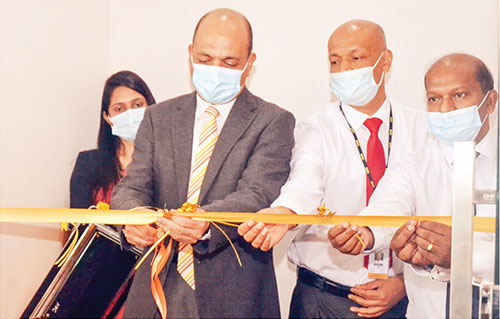 BOC Chairman Kanchana Ratwatte, General Manager/CEO K.E.D Sumanasiri and CFO Russel Fonseka inaugurate the BOC SME Circle at the BOC Head Office in Colombo yesterday.
Talking about external sector challenges, he said,””A 20-foot container of a particular item that came from Shanghai via Singapore for USD 900 in 2019, costs USD 8000 today. The prices of wheat and petroleum have surged among other commodities. Today a litre of petroleum in India is 104 Indian rupees. It is about LKR 270. The State is still subsidising petroleum products. Has the consumption gone down at current prices? No, it hasn’t. Despite the lockdowns, usage of petroleum increased. Letters of Credit (LCs) opened by the BOC for petroleum imports grew by 20% despite Coronavirus lockdowns. These should be factored into the current situation.”
Talking about revenue from Tourism, he said,” Up to 2019 prior to Easter Sunday attacks, Tourism generated a minimum of USD 4.5 billion. As a result of the pandemic, Tourism sector had to be looked after by other sectors. It was a double whammy on the economy. In contrast, now I see a bright side emerging as more than 200,000 tourists arrived in the country last year.”
“The livelihoods of Sri Lankan migrant workers came to a complete standstill for two years due to travel restrictions imposed globally. Now we see the encouraging trend of them going back to their overseas jobs as well as students going abroad for higher education. On a daily basis, the BOC gets requests from customers to remit amounts ranging from USD 2500 – 20,000 for their children’s higher education requirements. We oblige with that segment of customers regardless of which bank they initially banked with.”
“BOC reached rupees one trillion in its asset base in 2012 – the equivalent of a USD 5 billion worth company when converting the currency at LKR 200 per US dollar. In 2018, it reached two trillion making it a USD 10 billion worth company. In March 2021, we reached the 3 trillion mark which made it a USD 15 billion company. I am proud to say that every year we will be adding USD 5 billion to the asset base of BOC. By next year, we should be a USD 20 billion company. This is the strength on which we continue to serve our customers and the nation at large. Dear customers, let me tell you that BOC is resilient and strong enough to hold the economy until the country gets back to normalcy,” he said.
Emphasising the importance of encouraging Sri Lankan SME and Micro entrepreneurs, the Bank also launched BOC SME Circle yesterday.
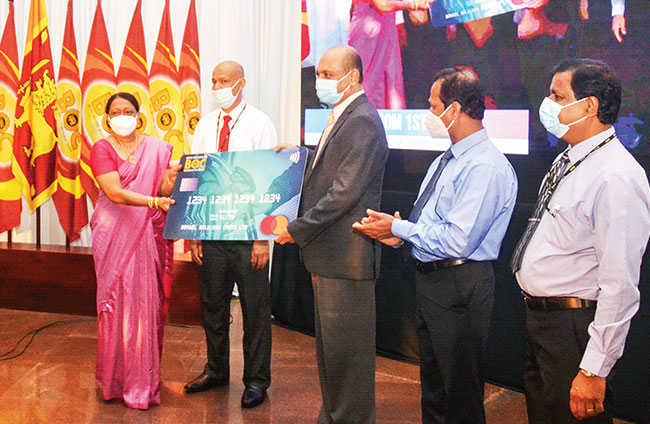
In addition to that the Bank launched the BOC Fuel Card. The BOC fuel top-up card is designed to be beneficial to customers who face the hassle in managing their fuel expenses. The card is offered to corporate entities, fleet operators and individuals to add convenience to their daily operations.






by SK Samaranayake
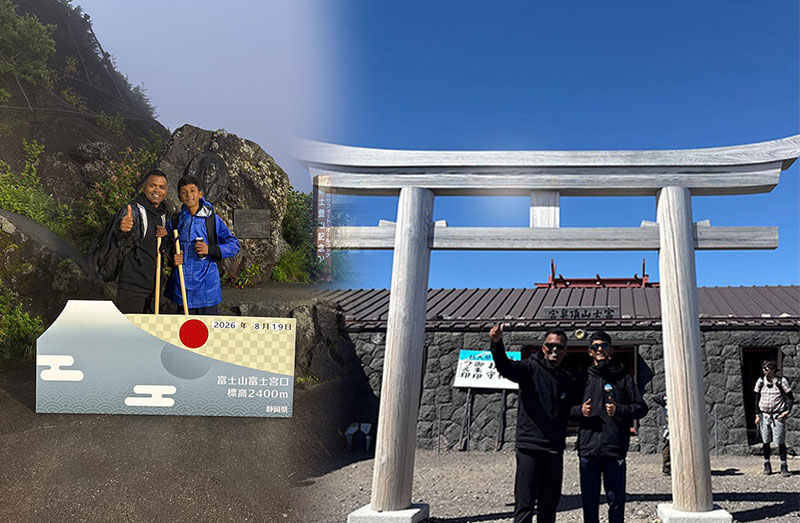
For Daham Gunasena, reaching the summit of Mt. Fuji with his 12-year-old son was not the end of the journey but the beginning of a different kind of lesson.
Gunasena, Director – Commercial at SPAR Sri Lanka and a senior business leader, academic and Chartered Accountant, spent nearly 12 hours on August 19 climbing Japan’s highest mountain with his son, Methum. After eight hours of climbing, the pair reached the 3,776-metre summit before beginning a demanding four-hour descent to Fujinomiya 5th Station.
“The summit was only halfway,” Gunasena reflected, describing the experience as a lesson in preparation, perseverance and responsibility.
Their journey began two days earlier with a trial excursion to the 6th Station and the volcanic landscape around Mt. Hoei. The experience allowed Gunasena to assess the altitude, terrain, weather and equipment before deciding whether his son was ready for the summit attempt.
The climb itself reinforced the value of taking one step at a time. Rather than focusing on the distant summit, father and son concentrated on the next marker, the next few steps and short periods of rest.
Reaching the summit brought another lesson. After taking photographs and celebrating, they still had four hours of descent ahead of them over loose volcanic terrain.
“Reaching the top was an achievement. Returning safely was success,” Gunasena said.
The experience also prompted him to reflect on how Japan manages Mt. Fuji, including visitor education, digital information, sanitation, transport, safety and environmental protection.
Having climbed Sri Pada 12 times last year and five times so far this year, Gunasena sees opportunities to apply some of these principles in Sri Lanka without compromising the mountain’s unique pilgrimage traditions.
He suggested a comprehensive digital platform for Sri Pada providing information on weather, congestion, transport, sanitation, first aid and emergencies, while educating foreign visitors about its religious significance.
For Gunasena, however, the most enduring lesson was personal: a mountain can teach what lectures cannot—through preparation, perseverance, respect for nature and the shared experience of taking each step together.

Sri Lankan industries are being encouraged to adopt advanced condition monitoring technologies to detect equipment problems before they develop into costly failures, as global technology company FLIR and its local partner Marlbo Trading Company strengthen their collaboration.
The companies brought together industry professionals at a technical seminar held on August 20 at Taj Samudra, Colombo, focusing on the use of thermography and acoustic imaging to reduce unplanned downtime, improve energy efficiency and lower maintenance costs.
Organised by Marlbo under the theme “Condition Monitoring Using Thermography and Acoustic Imaging for Measurable ROI,” the seminar highlighted the growing importance of proactive and predictive maintenance in improving equipment reliability and operational efficiency.
FLIR Sales Director – Instrumentation, India, Bhaskar Lala, and APAC Condition Monitoring Specialist David Gambarte shared their expertise on the latest diagnostic technologies and their practical industrial applications.
Thermal imaging can identify abnormal heat patterns linked to electrical and mechanical faults, while acoustic imaging can detect problems that may go unnoticed during routine inspections.
The technology is particularly useful in identifying compressed-air leaks, which can cause significant energy losses and increase operating costs.
Shevon Liyanage, Engineer – Measuring Instruments at Marlbo, also shared insights into applying condition monitoring technologies in the Sri Lankan industrial environment.
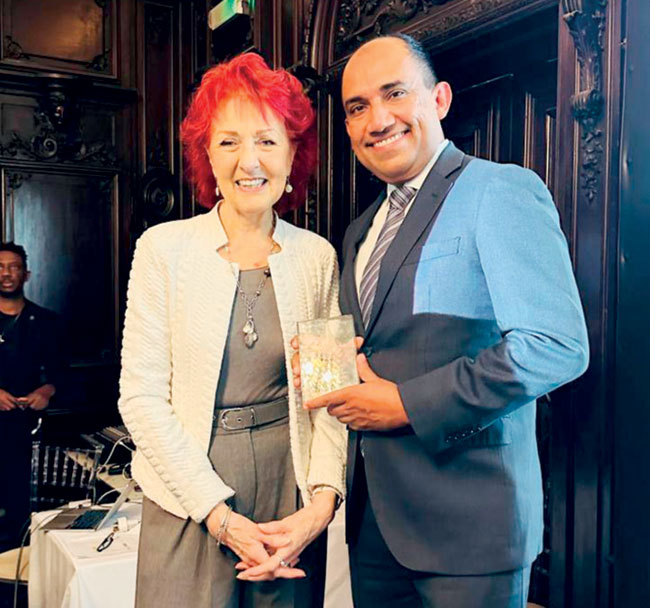
Lumbini Tea Valley Ceylon won an award for its Singharaja Wirytips at The Leafies: International Tea Awards held in London in 2024, marking another international recognition for the Sri Lankan tea producer.
The award comes as the company marks two decades of direct exports, with its premium and organic Ceylon teas now reaching 35 countries across six continents.
Established in 1984, Lumbini Tea Valley began its direct export drive after Chaminda Jayawardana joined the family business in 2000 alongside his father, Dayapala Jayawardana. The initiative materialised in 2006 with the company’s first direct shipment—a 15-kilogram consignment of Flowery Broken Orange Pekoe (FBOP) tea to the United States.
Since then, the company has expanded its direct-export operations, which now account for around 20% of its total manufacturing output. Following its transition to organic production, approximately half of its organic tea output is exported directly by the company.
Its key export markets include Japan, the United States, France, the Netherlands, Switzerland and Australia, with direct shipments now reaching 35 countries.
The company said its direct-export model would continue to expand amid growing international demand for traceable, single-origin Ceylon tea, with premium and organic grades at the centre of its export strategy.

Voting closes in Iceland’s knife-edge EU referendum

Showers in the Sabaragamuwa, Western and North-western provinces and in Galle, Matara, Kandy and Nuwara-Eliya districts

Sun directly overhead Mannar, Periyamadu, Puliyankulam, Welioya and Pulmoddai about 12.11 noon today (30)

Lanka tracks 11 US-sanctioned Iranian tankers off coast

House to debate abolition of Chief of Defence Staff post

Mass graves tragic evidence of failed states – Rathnayake

‘Dates have the highest sugar content to fight Coronavirus’

Sunday Island 27 December – Headlines

#SundayIsland 17th December – Headlines

Sunday Island – 28th March

Sunday Island Headlines – 21 March

Sunday Island – 21st February – Headlines
-

 News5 days ago
Missing doctor’s body found in Mahiyanganaya
-

 News5 days ago
Australia declines to release Finance Secy Suriyapperuma’s citizenship details
-
 News5 days ago
22A: BASL suggests CJ recuse himself from hearing petitions
-

 News2 days ago
Eight politicians in drug kingpin probe
-

 Editorial6 days ago
Govts. drag feet as undergrads age
-
 Features4 days ago
Insights from Chieftains of Uva: Genealogy of two Kandyan Families – Part II
-

 Features4 days ago
Export diversification: Missing the wood for the trees – Part I
-

 Business2 days ago
Sri Lanka opens up: A new season of direct connectivity