
Business
Bottle-to-bottle recycling can boost Sri Lanka in the transition to circularity in plastics

By Amila Abeynayaka
Dr. Abeynayaka is a Policy Researcher currently attached to the IGES Centre Collaborating with UNEP on Environmental Technologies (CCET), Institute for Global Environmental Strategies (IGES), Japan.
Pollution caused by the irresponsible disposal of plastics is a significant issue, particularly in developing countries like Sri Lanka.
 According to Great Britain’s Royal Statistical Society, it is estimated that only 9% of all plastics ever produced globally has been recycled. This is particularly concerning since according to the United Nations Environment Programme (UNEP), all nations collectively produce about 300 million metric tonnes of plastic every year – nearly equivalent in weight to that of the entire global human population.
However, not all plastics are equal in this equation. Polyethene terephthalate (PET) plastics, in particular, stand out, given that they are 100% recyclable. PET is considered the most promising food-packaging plastic for recycling and is used extensively for this purpose, particularly for the production of bottles containing drinks, hand sanitisers, dishwashing liquid etc. In addition, PET is more suitable for the recycling process, given its ability to minimise the possibility of contamination following consumption.
Hence, in sharp contrast with the overall recycling rate of plastics, PET bottle recycling rates in some countries exceed 80%. Sri Lanka also aspires to increase its PET bottle collection and recycling rate from 27% to 100% by 2025 to ‘ensure safe, high-quality and durable products,’ as per the National Action Plan on Plastic Waste Management in Sri Lanka (NAPPWM).
The changes required
Technology is not a constraint and is already available within the country. However, achieving this target requires crosscutting enabling conditions, including legal arrangements and policy changes, stakeholder engagement and dialogue, public participation, financing, and capacity development.
Legal and policy changes are necessary for a crucial shift towards bottle-to-bottle recycling. This relates to recycling an entire PET bottle to produce a new PET bottle, a concept that has been successfully implemented in many developed regions.
After being used by consumers, the three common scenarios for PET bottles are; bottle-to-bottle recycling, incineration and landfill disposal.
It is clear that bottle-to-bottle recycling is by far the preferred option among these options. It reduces pollution and carries a host of other benefits, including reducing carbon emissions by decreasing the need for new plastics.
However, Sri Lanka doesn’t legally allow recycled products in food-grade manufacture. The Extraordinary Gazette Notification No. 1160/30 of 29th June 2010 prohibits the use of ‘any food in any package, appliance, container or vessel that has been made from recycled plastic.’ This reality needs to change and conducive regulations/policies should be introduced.
Implementing the changes
In terms of implementation, bottle-to-bottle recycling can be done through two methods; mechanical and chemical recycling. The first refers to using mechanical processes (which typically involve cleaning, grinding, re-melting, and re-granulating). It is considered that through this method, bottle-to-bottle recycling is possible up to 4 to 6 times for PET plastics.
Chemical recycling, in contrast, uses a chemical process to achieve this objective, to break down the material to its original form for processing and, after that, for the production of new items. This system allows potentially infinite cycles of recycling. Still, it has implications for the comparatively larger generation of carbon emissions associated with transboundary PET waste movements.
Besides the method of recycling that should be employed, another critical consideration is whether bottle-to-bottle recycling carries risks since the plastics could potentially get contaminated, especially in food-grade packaging. For instance, contact between plastics and other waste, such as electronic waste, increases the risk of the presence of toxic metals in recycled plastics.
However, such concerns can be addressed by putting the necessary safeguards in place by adopting models similar to those of developed countries. For instance, in the European Union (EU), recycled plastics used in food contact materials should only be obtained from recycling processes that have been assessed for safety by the European Food Safety Authority and authorised by the European Commission.
Transition to a ‘circular’ model
Such certification ensures the separation of different types of waste, domestic waste collection systems with storage and transportation that avoid contaminations and sound tech-driven recycling. Another alternative exists, too, including chemical recycling to regenerate material similar to virgin material.
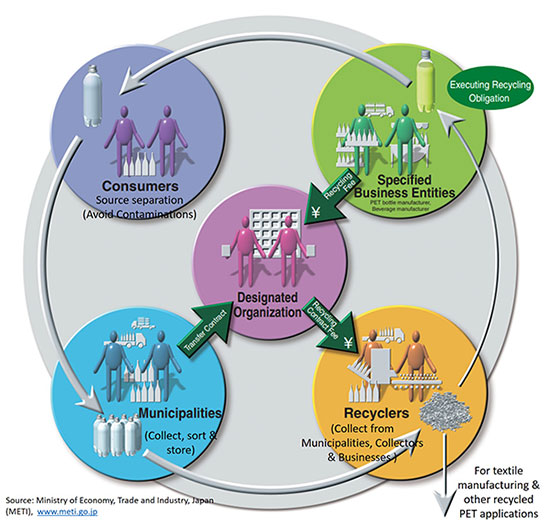
However, such efforts require collaboration between and high levels of awareness among all stakeholders. This includes manufacturers and recyclers in the private sector, consumers and the Government. The model used in Japan provides an excellent case study. In this model, consumers ensure proper segregation of used plastic containers and packages, which facilitates the collection of the segregated waste by the Municipal Government. Manufacturers recycle this waste and, after that, use it in products. Hence, all stakeholders play an equally-critical role, which ensures the smooth functioning of the system.
Sri Lanka too can transition to a similar model, with high ‘circularity,’ which involves a ‘closed loop’. In this, the value of plastics is retained through reuse and recycling, not allowing leakage into the environment. This is unlike the present ‘linear’ model in which plastics are used and disposed of, creating significant damage.
Such a model will be beneficial economically – for instance, by reducing foreign exchange lost through imports of plastics each year and socially and environmentally – by reducing pollution and its harmful effects – which includes the likes of the increased spread of diseases such as dengue.
Hence, Sri Lanka should begin the transition towards bottle-to-bottle recycling of PET plastics. However, as indicated, this requires the support of all stakeholders.
The author would appreciate your feedback on the article. You can start a conversation with Dr. Abeynayaka directly on Twitter on @litterlifecycle.
Web: www.iges.or.jp/en | www.ccet.jp
Transforming “waste” into “resources” once again (a Japanese example)


By Ifham Nizam
National Transmission Network Service Provider (Pvt) Ltd. (NTNSP), has secured third place in Sri Lanka’s fiercely contested 160 MW/640 MWh Battery Energy Storage System (BESS) tender, beating a number of established private-sector energy players in a major competitive procurement exercise just six months after the restructuring of the Ceylon Electricity Board (CEB).
The result marks a significant early indication that a newly restructured CEB successor company can compete on a commercial footing with established players in the rapidly expanding energy market, Senior Engineer Pubudhu Niroshan told The Island Financial Review.
More significantly, Niroshan said NTNSP’s entry into the tender helped intensify competition and contributed to a roughly 10% reduction in the lowest bid compared with the previous 160 MW/640 MWh BESS procurement, potentially delivering a more favourable outcome for electricity consumers.
“Entering such a highly competitive bidding process within just six months of restructuring and emerging third is by no means an easy task, Niroshan said.
He said the achievement had to be viewed in the context of the calibre and number of competitors involved in the process, adding that NTNSP had demonstrated that a successor company emerging from the CEB restructuring could step into a competitive commercial environment and hold its own against established businesses.
The significance of NTNSP’s participation, however, extended beyond its third-place ranking.
According to Niroshan, the company’s decision to enter the BESS procurement created an additional layer of competition, forcing other bidders to sharpen their commercial offers.
‘The first and second-ranked bidders had NTNSP as another competitor. That itself created additional competitive pressure, he said.
The BESS procurement involved a total capacity of 160 MW/640 MWh, with the programme divided into individual projects.
The procurement was designed to bring private and other eligible project proponents into the development and operation of battery storage facilities, providing an important mechanism for integrating renewable energy and strengthening the electricity system.
The outcome, he said, was particularly important for electricity consumers because greater competition in procurement could ultimately translate into lower costs for the power system.
‘Once you have several serious players competing, offering a fair and competitive price becomes essential. That is ultimately good for the consumer, he said.
Niroshan also referred to concerns previously raised by NTNSP before the Public Utilities Commission of Sri Lanka (PUCSL) regarding prices submitted for BESS projects under the Feed-in Tariff (FiT) mechanism.
He said subsequent market developments had provided support for the view that some of the prices submitted under the FiT mechanism were comparatively high.
For Niroshan, the experience also demonstrated why competition must remain at the heart of the restructuring of the electricity sector.

Serendib Flour Mills continued its longstanding commitment to rural communities through the fifth edition of Serendib Uththama Dalada, more than 100 elderly mothers and fathers from remote farming communities to experience the sacred Sri Dalada Perahera in Kandy.
Held on 26 August 2026, the initiative brought together elderly parents from Mahalakotuwa, Elahera and Attanakadawala, many of whom have spent a lifetime engaged in agriculture and contributing towards sustaining communities across the country. For these elders, the initiative offered an opportunity to undertake a deeply meaningful spiritual journey and witness one of Sri Lanka’s most revered religious and cultural traditions.
Conducted under the campaign thought, “Nourishing the hearts of elderly parents with spiritual merits, who once nourished a generation,” Serendib Uththama Dalada recognises the lifelong contribution and sacrifices of farming mothers and fathers while creating an experience that may otherwise remain beyond their reach.
Serendib Flour Mills facilitated the entire journey, providing safe and comfortable return transportation to Kandy aboard three dedicated buses. Special arrangements were also made to enable the participants to worship at the Sri Dalada Maligawa, followed by reserved seating at a specially erected VIP stand, allowing them to comfortably witness the grandeur of the Dalada Perahera.

Siyapatha Finance PLC, the largest fully-owned finance company of the Sampath Bank Group, delivered an exceptional financial performance for the six months ended 30 June 2026, reflecting the Company’s continued strategic growth initiatives, resilient asset quality, and unwavering commitment to sustainable value creation.
The Company recorded a profit after tax (PAT) of Rs. 1,007 million, a robust 43 percent increase from Rs. 706 million in the corresponding period of 2025, while profit before taxes (PBT) grew 38 percent to Rs. 2,334 million from Rs. 1,689 million, demonstrating sustained market and customer confidence in the Company’s core operations.
“Our performance in the first half of 2026 is a clear reflection of Siyapatha Finance’s strategic foresight and our unwavering commitment to sustainable growth,” said Siyapatha Finance Chief Executive Officer Mathisha Hewawitharana. “Surpassing the Rs. 104 billion mark in total assets while significantly improving our asset quality underscores the strength of our core operations and the deep trust our customers place in us. As we navigate the evolving macroeconomic landscape, we remain focused on prudent risk management and delivering enhanced value to our stakeholders.”
The Company’s core business operations continued to yield strong returns, with total interest income growing to Rs. 7,719 million from Rs. 5,272 million a year earlier, driving net interest income up to Rs. 3,487 million from Rs. 2,629 million, signifying the Company’s efficient management of assets and liabilities. Other income strengthened to Rs. 1,054 million from Rs. 826 million, reinforcing the effectiveness of the Company’s revenue diversification strategy. The cost-to-income ratio improved to 49 percent from 54 percent, a testament to the Company’s continued focus on operational efficiency and process optimization.
Asset quality strengthened markedly during the period, underscoring the success of Siyapatha Finance’s prudent credit risk management and proactive recovery initiatives. The gross stage 3 loans ratio improved to 4 percent from 8 percent a year earlier, while the net stage 3 loans ratio declined to 2 percent from 3 percent.

UN Delegation Meets Chief of Staff to the President

Afghanistan to host Zimbabwe, Bangladesh in ODI tri-series

Sandhu’s 6 for 7 seals Pakistan’s semi-final spot

INS Udaygiri makes port call in Colombo

Showers in the Uva, Central and Eastern provinces and in Polonnaruwa district

22A: Exclusion of 8 petitions questioned, action filed against SC Registrar, others

‘Dates have the highest sugar content to fight Coronavirus’

Sunday Island 27 December – Headlines

#SundayIsland 17th December – Headlines

Sunday Island – 28th March

Sunday Island Headlines – 21 March

Sunday Island – 21st February – Headlines
-

 News6 days ago
Denied of promotion to SC despite vacancies, justice Gurusinghe retires
-

 Latest News6 days ago
Grade 5 scholarship exam results released
-

 News6 days ago
22A: SC urged to suspend hearing, appoint full bench
-

 Midweek Review7 days ago
The local and global dynamics of Sri Lanka’s 22nd Amendment
-

 News4 days ago
Namal remanded until Sept. 18 over Airbus deal investigation
-

 Latest News3 days ago
Tharanga creates history with Diamond League crown in Brussels
-
 News6 days ago
Govt. seeks NATO assistance
-

 News7 days ago
40 professional organisations and TU oppose proposed 22A