
Midweek Review
From meeting Pottu, Balraj and Soosai to being Sri Lanka’s top envoy in Canada

By Shamindra Ferdinando
Who could have imagined that the incumbent government would name wartime President Mahinda Rajapaksa’s one-time emissary for talks with the top LTTE leadership, as Sri Lanka’s High Commissioner in Ottawa?
Prominent civil society activist Harsha Kumara Navaratne, on Dec 07, 2021 presented his credentials as Sri Lanka’s High Commissioner to the Governor General of Canada Mary May Simon, at a ceremony held at the Rideau Hall in Ottawa. Having rejected the nomination of retired Air Force Commander Air Marshal Sumangala Dias, Ottawa swiftly accepted the appointment of Navaratne. Founding chairperson of the Sevalanka Foundation, Navaratne succeeded career diplomat Asoka Girigagama, who was unceremoniously recalled in the wake of Gotabaya Rajapaksa’s triumph at the Nov 2019 presidential election.
Canada, a member of Sri Lanka Co-Chairs at the Geneva-based United Nations Human Rights Council (UNHRC), ignored AM Dias receiving unanimous approval of the Parliamentary High Posts Committee, Chaired by Speaker Mahinda Yapa Abeywardena, On Nov 09, 2020. Following the Nov 2019 presidential election, Navaratne received appointment as a member of the Human Rights Council of Sri Lanka (HRCSL). The HRCSL comprised former lawmaker Dr. Jagath Balasuriya, (Chairperson),– Dr. M.H. Nimal Karunasiri, Dr. Vijitha Nanayakkara, Ms. Anusuya Shanmuganathan and H.K. Navaratne Weraduwa. Under President Gotabaya Rajapaksa, the new Board of HRCSL was constituted on Dec 10, 2020. Balasuriya’s appointment drew flak from various quarters, especially from the NGO front. The former lawmaker quit on Oct 31, 2021. He was replaced by retired Supreme Court Judge Rohini Marasinghe. In place of Harsha Kumara Navaratne, the government brought in Ven. Kalupahana Piyarathana, a member of the civil society grouping, Sri Lanka Collective for Consensus (SLCC) engaged in a high profile dialogue with the Rajapaksa government.
However, the SLCC has failed to receive the much required support from other mainly Western-funded prominent civil society groups. The writer dealt with the simmering disputes among the civil society over the government-SLCC relationship in Midweek piece titled ‘Govt-civil society imbroglio’ published on the Dec 15 edition of The Island.
The decision to bring in Navaratne, in place of AM Dias, underscores the readiness on the part of the government to please the Western powers, despite the obvious snub, based on unverified allegations against the victorious Lankan security forces over “the most ruthless terrorist outfit in the world” amidst all odds arrayed against them. Canada is behaving in this arrogant and crass manner at the behest of the US-led West, despite a wealth of fresh evidence against her over committing genocide against its native population. There are instances of, for example, members of its so-called famed Royal Canadian Mounted Police being used by oil and gas companies as a private militia to harass natives and their supporters standing in their way in what is left of their own traditional lands to this day. But bleeding heart prominent liberal outfits funded by the West see nothing of it even though they are ever ready to scream bloody murder in places like Sri Lanka, at the slightest digression.
During his short tenure as a member of the HRCSL, the writer had an opportunity to discuss the accountability issues with Navaratne. By then, t Parliament had confirmed his appointment as Sri Lanka’s top envoy to Ottawa, one of the countries vigorously pursuing accountability agenda against us. Navaratne’s appointment should be examined against the backdrop of the passage of Bill 104 in the Legislative Assembly of Ontario in May 2021. The Bill designated May 18 each year as ‘Tamil Genocide Education Week.’ Sri Lanka couldn’t have sent a better person than Navaratne to convince the Canadians. The civil society activist is one of those who had been in touch with the Colombo-based diplomatic community and the Liberation Tigers of Tamil Eelam (LTTE). Navaratne had access to the LTTE leaders as senior as the much-feared LTTE Intelligence Chief Shanmugalingam Sivashankar aka ‘Pottu Amman, Balasegaram Kandiah alias Balraj and Sea Tiger leader Thillaiyampalam Sivanesan aka Soosai. Asked whether he had met Velupillai Prabhakaran, Navaratne said: “No I haven’t talked to him though I saw him at well-attended media conferences in Kilinochchi in the wake of the Feb 2002 Ceasefire Agreement (CFA).
Clandestine meet with Pottu and Balraj
The LTTE triggered a major crisis by stopping the free flow of water from the Mavil-aru anicut. The Mavil-aru crisis gripped the country in the wake of an abortive bid to assassinate the then Army Chief, Lt. Gen. Sarath Fonseka, on April 25, 2006. The country was rapidly hurtling towards Eelam War IV. In between the Mavil-aru crisis (July-August 2006) and the attempt on the life of the Army Chief (late April 2006), the LTTE mounted claymore mine attacks.
In spite of taking a bold public stand, the then President Mahinda Rajapaksa made a desperate bid to prevent the resumption of fighting. The LTTE believed it had the wherewithal to bring large scale offensive operations, both in the Northern and Eastern Provinces,to a successful conclusion, simultaneously. On the other hand, the then political leadership felt the military lacked the sufficient firepower to meet the LTTE threat.
On the instructions of President Rajapaksa, Harsha Kumara Navaratne had accompanied the then Secretary to the President Lalith Weeratunga to meet Pottu Amman and Balraj in KIlinochchi. Navaratne, at that time, appeared to have enjoyed the confidence of the LTTE as his social service organisation Sevalanka was doing a great deal of work in that violent environment both in the North and the South, and received a prompt response despite the LTTE launching a spate of claymore mine attacks in the Jaffna peninsula and Mannar as well. Navaratne told the writer how they tried to convince the LTTE to ease pressure on the military in the North. President Mahinda Rajapaksa had summoned Navaratne for a meeting at his official residence and instructed him to arrange for an urgent meeting with the LTTE. However, they had to return empty handed as Pottu and Balraj ruled out giving up their renewed violent strategy.
However, C.A. Chandraprema, in his widely led ‘Gota’s war: The Crushing of Tamil Tiger Terrorism in Sri Lanka’ published in 2012, asserted that Weeratunga met an LTTE representative named Poovannam at Arippu, Mannar. Chandraprema, one time Sunday Island political correspondent now our Permanent Representative in Geneva, Chandraprema referred to Weeratunga reaching the destination in a Sevalanka vehicle though no reference was made to Navaratne. Now both Chandrapema and Navaratne hold key diplomatic appointments in Geneva and Ottawa, respectively. They cannot absolve themselves of their responsibility to set the record straight. But that depends on the incumbent government’s strategy.
Then Defence Secretary Gotabaya Rajapaksa sought Navaratne’s help once again when the LTTE triggered the Mavil-aru crisis in the East. On the instructions of President Rajapaksa, Navaratne had taken the then Minister Jeyaraj Fernandopulle for a clandestine meeting with the LTTE leadership. Soosai had represented the LTTE and the meeting had taken place in an extremely hostile environment in KIlinochchi. Navaratne told the writer that Jeyaraj couldn’t convince Soosai to de-escalate Mavil-aru. Obviously, the LTTE believed, at that time it had the wherewithal to overwhelm the military and force a stalemate, regardless of the consequences.
However, the then Defence Secretary Gotabaya Rajapaksa thought otherwise. ‘Evaluation of Norwegian peace efforts in Sri Lanka 1997-2009’ launched in Nov 2011 revealed the then Defence Secretary’s response. Let me reproduce the relevant section verbatim. “On April 06, 2006, Hanssen-Bauer and Brattskar had a tense meeting with Defene Secretary Gotabaya Rajapaksa. In response to a question about whether the ethnic and political problems in Sri Lanka could be solved by military means Gotabaya answers ‘yes’”.
In the second week of August 2006, the LTTE mounted simultaneous offensives in the North and the East. Navaratne said that former editor of Ravaya, Victor Ivan, in a brief article following the assassination of Minister Fernandopulle quite appropriately dealt with the meetings in Kilinochchi, arranged by him on President Mahinda Rajapaksa’s request. The LTTE assassinated Fernandopulle on the morning of April 06, 2008 at Weliweriya. Victor Ivan’s article appeared in a book titled ‘Jeyaraj’ published by Cyril Ederamulla in 2011. Ivan made the revelation as regards secret talks sought by President Mahinda Rajapaksa on the thebasis of a discussion TNA leader R. Sampanthan, then lawmakers, Mavai Senathiraja and Suresh Premachandran, Harsha Kumara Navaratne and himself had at the residence of Dr. Kumar Rupesinghe several months after Fernandopulle’s assassination.
Navaratne had revealed determined efforts made by President Rajapaksa to prevent war when one of the TNA lawmakers therein accused the President of not making an attempt to solve the conflict through negotiations. Ivan conveniently refrained from naming the TNA MP but obviously the accuser had been one among Sampanthan, Mavai Senathiraja or Suresh Premachandran.
Based on what Navaratne had told the gathering, Ivan asserted that Fernandopulle’s equally aggressive response to Soosai at the Kilinochchi meet had influenced the decision to assassinate the Minister. But by the time, the LTTE carried out the Weliweriya assassination, the LTTE was retreating on the Vanni front after having lost the battles in the Eastern Province. The military brought the war to a successful conclusion in May 2009, less than one and half years after Fernandopulle’s assassination.
It would be pertinent to mention that the LTTE operative, known as Morris, who played a significant role in Fernandopulle assassination, also planned the suicide attack on Lt. Gen. Fonseka. Fonseka recently declared in Parliament that Morris should be released along with others held under the Prevention of Terrorism Act (PTA).
According to Ivan, in his presence at the Finance Ministry, Fernandopulle, in 1994 requested the then Prime Minister Chandrika Bandaranaike Kumaratunga to include him in the government delegation for talks with the LTTE. This was immediately after Kumaratunga took oaths as the Prime Minister following parliamentary polls in August 1994. In spite of Fernandopulle asserting himself a place in the delegation due to his ability to converse in three languages, in addition to his knowledge of the national issue, Kumaratunga rejected the proposal. Ivan said that Kumaratunga expressed the view that inclusion of Ministers weren’t suitable. Interestingly, Ivan revealed that following the 1995 peace negotiations and the resumption of war, Kumaratunga sent him to Jaffna to meet the LTTE, unofficially. This should be examined against the backdrop of Ivan’s claim that though he had been invited by Kumaratunga to be a member of her delegation for talks with the LTTE, he was not included.
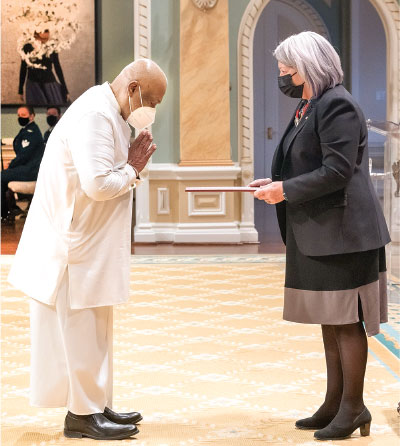 Harsha Kumara Navaratne pictured with the Governor General of Canada, Mary May Simon at a ceremony held at the Rideau Hall in Ottawa on Dec 07, 2021, after the new HC, presented his credentials as Sri Lanka’s High Commissioner(pic courtesy Foreign Ministry)
New HC’s responsibilities
There is no harm in the government seeking a consensus with the civil society as regards the post-war reconciliation process. However, the government cannot turn a blind eye to sharp differences among civil society members over the SLCC dialogue with the incumbent dispensation. In addition, the government should pay attention to the high profile joint Global Tamil Forum (GTF) and the Tamil National Alliance campaign meant to pressure Sri Lanka on the human rights front. For some strange reason, the government continues to refrain from setting the record straight in Geneva. There is absolutely no point in only educating the public by way of presentations, articles and statements. The newly set up Strategic Communication Unit (SCU) of the Lakshman Kadirgamar Institute of International Relations and Strategic Studies has so far dealt with some issues at hand. Waruni Kumarasinghe and Dinithi Dharmapala countered lies in a well compiled article headlined ‘AI report on Sri Lanka: Far from the truth.’ Subsequently, attorney-at-law Dharshan Weerasekera, an SCU consultant, in an article titled ‘Ontario’s Bill 104: Tamil Genocide Education or Mis-education Week?’ discussed the absurdity in the Canadian action. But, would that be enough to overcome the challenge faced by Sri Lanka. Due to utterly irresponsible, sluggish and treacherous response on the part of the Foreign Ministry of Sri Lanka, the Western powers had no difficulty in including the war-winning country on the Geneva agenda ON THE BASIS OF UNSUBSTANTIATED ALLEGATIONS.
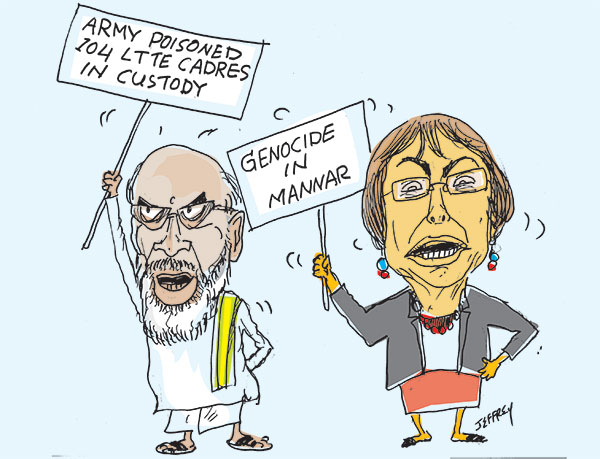
The following are the issues that needed government attention without further delay. (1) Dismissal of war crimes accusations by war time US Defence Attaché Lt. Col. Lawrence Smith in Colombo. Smith did so at the May-June 2011 first post-war defence seminar in Colombo. The State Department disputed the official’s right to represent the US at the forum though it refrained from challenging the statement. (2) Examine the US statement along with Lord Naseby’s Oct 2017 disclosure based on the then British Defence advisor here Lt. Colonel Anthony Gash’s cables to London during the war. (3) Wikileaks revelations that dealt with the Sri Lanka war. A high profile Norwegian study on its role in the Sri Lanka conflict examined some of these cables. However, the Norwegian process never strengthened Sri Lanka’s defence. Instead, Norway merely sought to disown its culpability in the events leading to the annihilation of the LTTE. One of the most important Wikileaks revelations disputed the oft-repeated narrative against Sri Lanka of deliberately targeting civilians. The cable proved that ground forces took heavy losses by taking the civilian factor into consideration. (4) Wide discrepancies in loss of civilian lives claimed by the UN and various other interested parties. The UN estimated the figure at 40,000 (March 2011) whereas Amnesty International (Sept 2011) placed the number at 10,000 and a member of the UK Parliament (Sept 2011) estimated the death toll at 100,000. (5) Disgraceful attempt made by Geneva to exploit so called Mannar mass graves during the Yahapalana administration. The Foreign Ministry remained silent as was often the case on the Mannar graves, while Western diplomats played politics only to be proved utterly wrong. Acting at the interest of those hell-bent on blaming Sri Lanka, Geneva too faulted Sri Lanka before the conclusion of the investigation. The then Northern Province Governor C.V. Wigneswaran rejected scientific findings of Beta Analytic Institute of Florida, USA, in respect of samples of skeletal remains sent from the Mannar mass grave site. Human Rights Commissioner Michelle Bachelet went to the extent of commenting on the Mannar mass grave in her report that dealt with the period from Oct 2015 to January 2019. We come to wonder whether she was actually a victim of Gen. Pinochet or a mere manufactured victim. (Now, Wigneswaran as the leader of a Northern Province political party representing the current Parliament continues to propagate war crimes accusations. Other political parties never properly challenged Wigneswaran’s lies. They should be ashamed and take remedial measures at least now.) Had the US lab issued a report to suit their strategy, would they have accepted fresh tests in case the government of Sri Lanka requested? The following is the relevant section bearing No 23 from Bachelet’s report: “On May 29, 2018, human skeletal remains were discovered at a construction site in Mannar (Northern Province), Excavations conducted in support of the Office on Missing Persons, revealed a mass grave from which more than 300 skeletons were discovered. It was the second mass grave found in Mannar following the discovery of a site in 2014. Given that other mass graves might be expected to be found in the future, systematic access to grave sites by the Office as an observer is crucial for it to fully discharge its mandate, particularly with regard to the investigation and identification of remains, it is imperative that the proposed reforms on the law relating to inquests, and relevant protocols to operationalise the law be adopted. The capacity of the forensic sector must also be strengthened, including in areas of forensic anthropology, forensic archaeology and genetics, and its coordination with the Office of Missing Persons must be ensured.”
(6) Wigneswaran, in his capacity as the then Northern Province Chief Minister in August 2016 accused the Army of killing over 100 LTTE cadres held in rehabilitation facilities. Wigneswaran claimed the detainees had been given poisonous injections resulting in deaths of 104 persons. The unprecedented accusation made by the retired Supreme Court judge had been timed to attract international attention. Wignewaran is on record as having said a US medical team visiting Jaffna at that time would examine the former rehabilitated LTTE cadres, who he alleged had fallen sick because they were injected with poisonous substances at government detention or rehabilitation centres.
Sri Lanka paid a very heavy price for its pathetic failure to counter a web of lies fashioned by interested parties, both local and foreign and well-funded by the West to coerce the country to adopt a new Constitution to the liking of its long time agenda here. The previous government played a key part in this strategy. Their strategy remained simple. A new Constitution meant to do away with Sri Lanka’s unitary status to address STILL unsubstantiated war crimes allegations. The previous government reached agreement with Geneva regarding a new Constitution as part of the overall deal that could have been executed successfully if not for the UNP causing a massive crisis by way of Feb 27, 2015 Treasury bond scam at the onset of the yahapalana administration.
Over two years after the last presidential election, the government is yet to take tangible measures to counter specific lies. That should be a key part of overall strategy to convince the world and the Tamil speaking people here that eradication of the LTTE was certainly not a war waged against them though the group, almost 100 percent comprised Tamils.

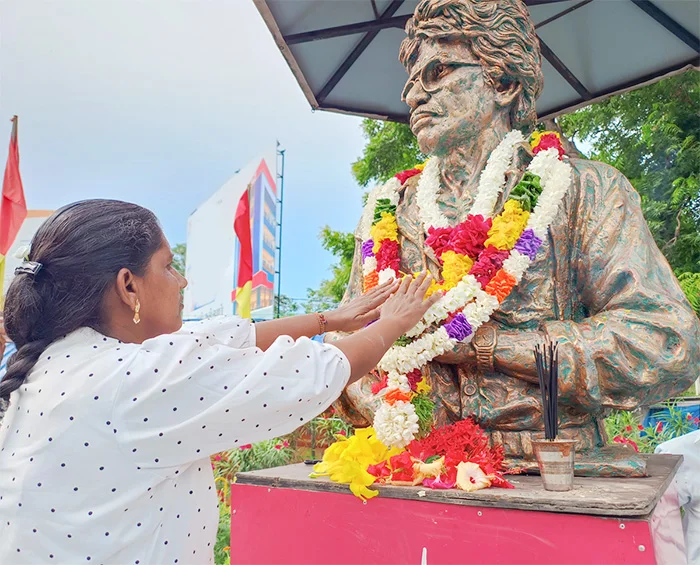
Tamil political parties and politicians are seeking political advantage over the death of Thileepan. Last year, organisers of Thileepan commemoration prevented Fisheries, Aquatic and Ocean Resources Minister Ramalingham Chandrasekaran from entering the Thileepan memorial in Nallur. In spite of being a Minister, Chandrasekaran couldn’t enter the premises. The NPP National List lawmaker made the abortive bid on 17 Sept., 2025, the third day of the 12-day commemoration.
Would he risk being snubbed for a second consecutive year? At the time the Thilipeen commemoration started, on 15 Sept., Chandrasekeran had been away in China and he returned to the country over the weekend.
By Shamindra Ferdinando
Commemorative events held at the newly installed bronze statue of the late Rasiah Parthipan, alias ‘Lt. Colonel’ Thileepan at Nallur, Jaffna, caused controversy. A section of the Opposition accused the NPP government of encouraging separatist movement by turning a blind eye to the growing hero worship of an LTTEer.
The unveiling of the statue took place on 15 Sept., the day the Tiger launched his fast unto death, in 1987, to become a hero in the eyes of his equally misled community. At the time of his death, at the Nallur Hindu Temple, on 26 Sept.,1987, Thileepan was 23-years-old.
The controversial commemoration will continue till 26 September, 2026. The SLPP led the attack against the backdrop of accusations that the former ruling party promoted the LTTE ideology, by accommodating maverick Jaffna District Independent lawmaker Dr. Ramanathan Archchuna, a truly qualified medical doctor on its political platform. Dr. Archchuna also never shies away from calling a spade a spade, irrespective of any consequences.
Almost four decades after his death, controversy still surrounds the circumstances leading to the former Jaffna Hindu College student, and Jaffna University undergraduate, launching the fast unto death.
Jaffna Monitor, in a story headlined ‘Jaffna Begins 39th Commemoration of Thileepan’s Fast,’ posted this month, dealt with Thileepan’s fast. Let me reproduce the relevant section: “His fast followed the Indo-Lanka Accord of July 1987, under which Indian troops were deployed to the north as a peacekeeping force. On Sept. 13, 1987, the LTTE handed the Indian High Commission a letter setting out five demands: the release of Tamils held under the Prevention of Terrorism Act and emergency regulations; an end to Sinhalese settlement in Tamil areas carried out in the name of rehabilitation; a halt to all such rehabilitation work until an interim administrative council is established; an end to the construction of police stations in the Northern and Eastern Provinces; and the disarming of government-armed home guards, together with the withdrawal of the army and police from schools. The demands were addressed to New Delhi on the reasoning that India alone could compel Colombo to act. No reply came.” https://www.jaffnamonitor.com/featured/jaffna-begins-39th-commemoration-of-thileepans-fast/
But, ex-LTTE combatant Niromi de Soyza (not her real name) in her internationally acclaimed ‘Tamil Tigress’ disclosed what transpired at a meeting (p 142) chaired by Thileepan himself at a place called Freedom Birds’ head office where he declared the LTTE’s determination to force the Indian Army to leave Sri Lanka. Declaring that those who served the group’s political wing didn’t get an opportunity to show their commitment to the organisation, he had vowed to go ahead with fast unto deaths, regardless of the consequences. Soyza, who had been assigned to the group responsible for crowd control at the fast unto death site, quoted Thileepan as having said at the previously mentioned meeting: “This is my chance. I’m optimistic it will achieve something, whether I live or die. We must force the Indians out of our land.”
The author of “Tamil Tigress’ who had been among those who received her first assault rifle and cyanide capsule from Thileepan questioned the (Chapter 9: There’s still time to change your mind) as to why Velupillai Prabhakaran chose physically fragile Thileepan to undertake the fast unto death.
According to Soyza’s narrative, the fast unto death had been directed at the Indian Army. Referring to the Nallur hunger strike 39 years ago, Soyza said that lyrics of all songs played therein expressed the same sentiments. In her own words, Thilpeepan’s dying wish was to see the foreign army, the IPKF (Indian Peace Keeping Force) defeated.
Sri Lanka never really examined at least key events that shaped the war in the North-East. Successive governments lacked political will to meticulously scrutinise events thereby setting the record straight. Over the years various interested parties have been successful in promoting false narratives, pertaining to key events. Thileepan’s fast unto death is a case in point.
A memorial for IPKF
IPKF memorial
Thileepan’s fast unto death, or slow suicide, created the background for the LTTE-IPKF war. The war erupted just two weeks after Thileepan’s death. Those propagating false narratives have conveniently forgotten that the crux of the matter is the fact that the LTTE didn’t hand over its weapons as envisaged in the Peace Accord signed on 29 July 1987. All Tamil terrorist groups were to be disarmed within 72 hours after the signing of the accord. India failed in one of its primary responsibilities.
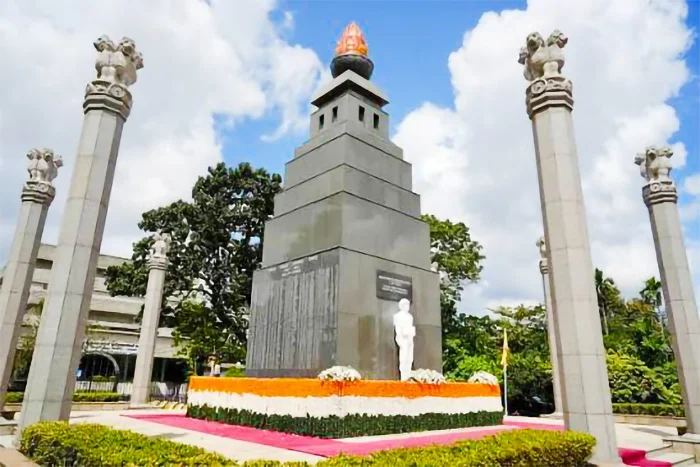
The much publicised weapons handover that took place in Jaffna was a farce. Perhaps, the top IPKF command knew of the LTTE strategy but chose to turn a blind eye. The consequences were devastating. The memorial put up by Sri Lanka, in 2008, for the IPKF, at Battaramulla, is a stark reminder of the war caused by the LTTE. Had it accepted the Indo-Lanka Peace Accord, as previously agreed, there wouldn’t have been the fast unto death undertaken by Thileepan and a bronze statue or a memorial for the IPKF.
The LTTE had been hell-bent on eradicating other Indian-sponsored former Tamil terrorist groups, as well as taking on the Indian Army. Prabhakaran had been so over confident of his group’s military prowess, he created an extremely hostile environment conducive for war. Having deceived the governments of India and Sri Lanka regarding the surrendering of armaments in line with the peace accord, Prabhakaran, apparently engineered Thileepan’s slow suicide. ‘Tamil Tigress’ author who personally knew Prabhakaran and Thileepan emphasised that point quite clearly. The bottom line is that Thileepan’s demise had been a tool in Prabhakaran’s hands who brazenly manipulated the Jaffna community. Prabhakaran used Thileepan’s needless agonising death to maximise the overall LTTE strategy. The LTTE wanted an excuse to resume hostilities. Obviously, he was quite successful in creating an environment conducive for war. Don’t forget that Thileepan launched his fast unto death six weeks after the deployment of the Indian Army in Northern and Eastern Sri Lanka.
The surrender of arms, arranged at Suthumalai sportsground on 4 August, 1987, with the presence of the media, was meant to underscore the end of the conflict. But the ‘Tamil Tigress’ author, who had been present at the arms surrender, revealed in her memoirs how Prabhakaran expressed suspicion of the peace accord. According to her, on the night of 4 August, 1987, she was among those addressed by Prabhakaran, his first interaction with LTTE cadres following his Suthumalai sham weapons surrender to fool the fools. Soyza quoted Prabhakaran as having told them: “All our good ammunition was stashed prior to the surrender. We’ll continue to hand over the rest.” She also quoted Prabhakaran as having declared: “War will resume in a month or two.”
Close on the heels of a group of LTTE cadres taking their lives after being apprehended by the Navy in the first week of Oct., 1987, the author of ‘Tamil Tigress’ quoted Prabhakaran as having alleged India engineered the peace process as a plot to gradually eliminate them. The LTTE leader had obviously forgotten if not for India they wouldn’t have achieved powerful military status. India not only armed the Tamil terrorists, but also granted them freedom to conduct operations across the Palk Strait. The Indian Navy looked the other way when terrorists, wounded in combat with the Sri Lankan military, were moved across the short passage to receive treatment in Tamil Nadu hospitals.
The suicide of LTTE cadres, including the then Jaffna commander ‘Lt. Col.’ Kumarappa, and Trincomalee commander ‘Lt. Col’ Pulendran, boosted Prabhakaran’s strategy. Those propagating false narratives tend to forget that Prabhakaran smuggled in cyanide capsules into Palaly air base where the 17 personnel were held. In a way, the slow death of Thileepan, and mass suicide of LTTE cadres, all were engineered by Prabhakaran himself. Those demanding accountability on the part of Sri Lanka never bothered to examine Prabhakaran’s murderous plots.
Sri Lanka’s dilemma
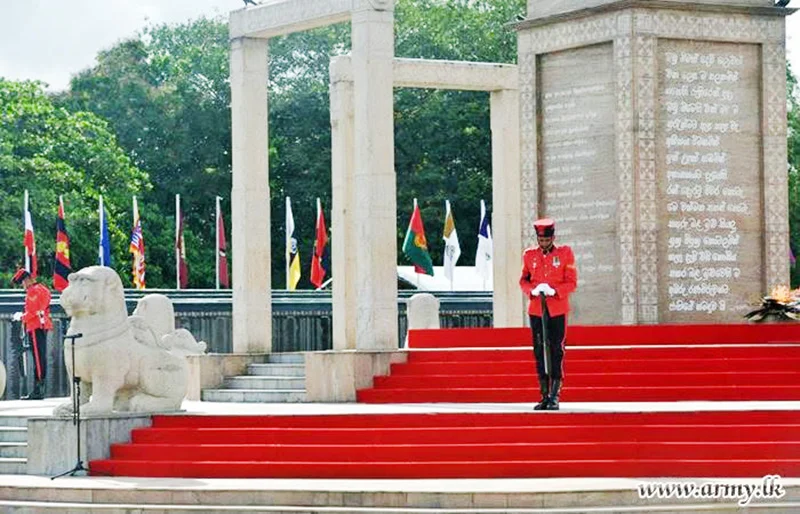
Sri Lanka memorial
Indian Defence Minister Rajnath Singh, during his recent visit here, paid a floral tribute to the IPKF memorial, at Pelawatte, Battaramulla. It would be pertinent to mention that the construction of the memorial was completed in 2008. The late General Lionel Balagalle, in his capacity as the Commander of the Army and Chief of Defence Staff, proposed a memorial for IPKF, following a visit to New Delhi in Dec., 2003. What made Balagalle propose a memorial for the IPKF, knowing very well India destabilised Sri Lanka and the introduction of the foreign Army by way of arm twisting the then government, headed by JRJ, was not appreciated, under any circumstances. He, like many of us, however realised we had to make peace with our giant overbearing neighbour, irrespective of whether we liked it or not, in order to co-exist.
The destabilisation of a friendly country had been in line with their overall strategy to deploy its Army to ensure the installation of an administration loyal to New Delhi. India went to the extent of forming a force called Tamil National Army (TNA) during the period leading to the withdrawal of the IPKF in March 1990. Having joined The Island editorial as a novice, in June 1987, the writer had the opportunity to cover the last Indian troop carrying vessel leaving Trincomalee port on the afternoon of 24 March, 1990 (The IPKF is off, The Sunday Island, 25 March, 1990). India violated Sri Lanka airspace on 4 June to air drop 25 tonnes of food and medicine over Jaffna peninsula without anyone’s permission here, which came to be sarcastically termed the ‘parippu drop’, just three days after I joined The Island.
While honouring the IPK with a memorial in which 1069 names of its officers and men killed in the Lankan misadventure inscribed, since the end of the war, in May 2009, Sri Lanka played politics with the defeated LTTE. The Thileepan’s statue is a case in point. The installation of a new bronze statue of Thileepan, who died in a fast unto death against India demanding the withdrawal of the IPKF, soon after the Indian Defence Minister paid floral tribute to the IPKF memorial, highlighted Sri Lanka’s continuing dilemma.
The ruling NPP under any circumstances cannot risk antagonising the Tamil electorate, or the Tamils living overseas, by clamping down on events, such as the Thileepan commemoration. Having won all electoral districts in the predominantly Tamil speaking Northern and Eastern Provinces at the presidential and parliamentary polls, in 2024, and done well at the Local Government polls of May 2025, in the same regions, the NPP may have bent backwards to avoid confronting organisers of such events.
The intervention made by police at Nallur, on 18 Sept., 2026 .should be considered as a measure to counter accusations that the government promoted separatist sentiments. Police disrupted the public address system claiming that the organisers didn’t obtain permission to use speakers. But, the commemorations continued not only in Nallur but in Batticaloa as well.
The undeniable truth is all political parties, represented in Parliament, played ball with the LTTE, during the conflict and after, hence the song and dance will continue. The reality is Prabhakaran staged Thileepan’s slow death and engineered mass suicide at the Palaly air base in Sept. and Oct. 1987 to plunge the country back into war. Therefore, the country should be wary of those propagating and promoting false narratives in support of their despicable political agendas. The issue is whether Thileepan willingly sacrificed his life to help Prabhakaran implement his strategy or was used as a tool. If Soyza’s narrative is accurate Thileepan had been chosen from among a large group of volunteers who accepted the challenge. There is no doubt fast unto death must have been Prabhakaran’s brainchild as much as the Palaly mass suicide was. What made Prabhakaran believe that he could overwhelm the Indian Army, at that time numbering over 1.1 mn and was considered the fourth largest with the Soviet Union, China and the US maintaining far bigger land forces?
During the Indian Army deployment that began in July/August, 1987, the strength was around 10,000 officers and men. Their mission was to ensure implementation of the ceasefire and disarming of terrorist groups. But, when Prabhakaran executed a group of Sri Lankan soldiers in their custody following the mass suicide at Palaly airbase on Oct. 5, 1987, and fighting erupted a week later, India had no option but to bring in additional forces. At the peak of their deployment here the total strength including the Navy and Air Force units, reached 100,000.
Thileepan insulted
It is a paradox that a section of the Tamil community commemorated Thileepan after having voted for warwinning Army Commander General (retd.) Sarath Fonseka at the 2010 presidential election. In spite of Fonseka suffering a humiliating defeat, he won all predominantly Tamil speaking districts. Tamils, including recipients of foreign citizenship, annually commemorate various LTTE events. ‘Black Tiger Day’ on 5 July, the day Vallipuram Vasanthan, known by the nom de guerre Captain Miller, mounted a suicide attack on troops of ‘Operation Liberation,’ based at the Nelliady Central College, is one such event. That was the time between the infamous Indian airdrop and the signing of the so-called Indo-Lanka peace accord that was done under the threat of direct Indian military intervention.
What made the community that still considered Thileepan as a hero to vote for Fonseka who mercilessly brought the war to an end? What made lawmaker Archchuna, who still venerated Prabhakaran, to join Mahinda Rajapaksa on the SLPP platform? Thileepan would have turned in his grave if he saw how the community behaved. Nothing could have offended him or Prabhakaran than the Illankai Thamil Arasu Kadchi (ITAK)-led Tamil National Alliance (TNA) joining hands with the UNP and the JVP to field Fonseka as the common candidate at the 2010 presidential election.
The TNA consisted of former Indian funded terrorist groups TELO, PLOTE and EPRLF, in addition to the ITAK, had no qualms in promoting Fonseka’s candidature after having accused his Army of gross human rights violations. The Tamil electorate had no qualms in choosing Fonseka over Mahinda Rajapaksa, who sought political consensus with the LTTE as a last bid to end bloodshed before unleashing the armed forces on an all-out assault, within our limited means, to defeat uncompromising Tiger terrorists.
Sri Lanka pathetically failed to set the record straight. The worst offender is President Rajapaksa himself. His administration could have done much more to explain the developments leading to all-out war. Instead, the first post-war Rajapaksa government squandered that opportunity. Its pathetic failure helped those who couldn’t stomach the LTTE’s defeat to propagate war crimes accusations with the help of the conniving West, which, unfortunately, included the United Nations organs like the UNHRC, controlled by them.
While the top Sri Lankan military and political leaderships were held accountable for unsubstantiated war crimes allegations, with the US, the UK and Canada declaring targeted sanctions against former Presidents Mahinda Rajapaksa and Gotabaya Rajapaksa as well as Admiral of the Fleet Wasantha Karannagoda, General Shavendra Silva et al. Australia found fault with strategist Maj. Gen. Chagie Gallage for taking command, post-war command, of 59 Division that played a significant role in eradicating the LTTE. Gallage was denied a visa during the Yahapalana administration. When this writer raised the relentless Western attacks on wartime Sri Lankan leadership at a media briefing called by the Foreign Ministry in Sept., 2022, the then Foreign Minister Ali Sabry, PC, said that entire divisions deployed on the northern front had been blacklisted.
While Indian dignitaries paying their respects at the IPKF memorial seemed to have received public acceptance, last year the NPP government created unprecedented controversy ahead of the May 2025 commemoration when the Defence Ministry announced President Anura Kumara Dissanayake wouldn’t attend the 16th ‘War Heroes’ commemoration ceremony. The declaration triggered a massive political backlash. President Dissanayake was compelled to reverse his decision. The JVP and NPP leader, who also holds the Defence portfolio and the post of Commander-in-Chief of the armed forces, attended the event. This year there was no controversy. Whatever the JVP/NPP political stand, the President cannot, under any circumstances, shun the annual war heroes’ commemoration.
The armed forces eradicated JVP terrorism twice in 1971 and 1986/87 to 1990. They defeated the conventional military and terrorist challenge posed by the LTTE. Whatever the ungrateful opportunists and Western-funded NGO hacks write, the armed forces triumph over the LTTE is the single most important post-independence achievement. The eradication of the JVP challenge that almost overwhelmed the UNP government in the late 80s, too, is equally important and had the armed forces failed at the time, the country could have ended up in far worse chaos. The bottom line is that the eradication of the LTTE couldn’t have been achieved if the UNP didn’t triumph over the second JVP-inspired terror campaign. That is the undeniable truth. It would be unfair by the JVP if we didn’t mention that the UNP too drove the JVP to take up arms in the 80s by proscribing the party over the 1983 anti-Tamil violence, though it was not responsible for the breakdown of law and order, countrywide, when UNP goons went on the rampage against innocent Tamils, especially in Colombo. The postponement of scheduled parliamentary elections by six years to 1989, after holding a sham referendum by the JRJ government, too, contributed to the war in the North, and terrorism in the South.

By Chandre Dharmawardana
chandre.dharma@yahoo.ca)
(Continued from 22 Sept. 2026)
Other well-recognised fault lines
In discussing Sri Lanka’s political trajectory since 1948, many writers relish a narrative where its current impasse and its ethnic conflict are traced back to the “curse of partisan politics” (e.g., This curse of partisan politics in Sri Lanka, Island 2026/09/4, by Brig. Ranjan de Silva [10]). A more sophisticated narrative is based on the negative impact of Sinhala Only nationalist policies introduced by SWRD Bandaranaike after defeating the pro-business UNP in 1956. In fact, many social scientists (e.g., H. L. Seneviratne [11]) have analysed Sri Lanka’s post-Independence trajectory in dystopian terms within this paradigm equated to the negative impact of a majoritarian “Sinhala-Buddhist-dominance” politics.
H. L. Seneviratne explicitly positions the 1956 election of S. W. R. D. Bandaranaike and the subsequent “Sinhala Only” Act as the foundational missteps that set Sri Lanka on a tragic path. He argues that this political turn institutionalised majoritarian chauvinism to secure electoral victories. Seneviratne analyses the post-1956 era in stark, structural terms. He argues that by allowing Buddhist monks (the Sangha) to morph from spiritual renunciates into a highly politicised, corporate pressure group, the state birthed a toxic political culture. In his evaluation, this “New Buddhism” fostered ethnic polarisation, institutionalised corruption, and ultimately laid the structural groundwork for the devastating Sri Lankan Civil War.
These authors have claimed that the increasingly jingoistic policies of many politicians of the majority community, as well as the ultra-nationalist politics of the Ilankai Thamil Arasu Kadchi (ITAK) established in 1949 dictated an irrevocable path to armed conflict that sapped Sri Lanka for over three decades. Majoritarian “Sinhala-Buddhist domination” is frequently cited by Tamil opinion writers as a major cause hindering Sri Lanka. In contrast, Sinhalese opinion writers point to the “excessive” set of demands of the 12% Tamil minority that began with their rejection of the Donoughmore constitution and the Eelamist demands for an exclusive Tamil homeland that grew out of the political platform of the ITAK.
The 1972 republican constitution of the SLFP-LSSP government became a pivotal juncture when the Tamil youth, inflamed by the violent propaganda, e.g., the poetry of Kasi Anathan, firmly embraced militant separatism. This was finally ratified by the Vaddukkodai resolution of 1976 crafted by the Tamil United liberation Front (TULF). Kasi Anandan had called for physical elimination of “thurogi” (traitors) who sought federalism or any form of power sharing with the majority. By then, several of the moderate Tamil leaders who had been named by Kasi Anandan had been assassinated. The TULF leaders were themselves assassinated and Tamil politics was hijacked by violent youth groups. The LTTE emerged out of the blood bath within the Tamil community to confront the Sri Lankan state militarily until the LTTE’s demise in 2009.
Historians, like K. M. de Silva, have characterised the Tamils as a minority who behave like a majority, while the Sinhalese are a majority who have behaved like a minority always fearful that the Tamil minority and Tamil-Nadu Tamils would act together and prevail against them.
However, both inter-Ethnic violence as well as intra-ethnic violence are fueled by the availability of discontented youth populations. Currently, Sri Lanka’s youth population has probably fallen below threshold for driving social upheavals, as Sri Lanka is now in demographic contraction. However, given the widening rich-poor gap, the residual youth populations still have the potential to spawn urban terrorist cells that can have an impact far beyond their numerical strengths.
Malaysia provides a strong counterexample to the type of social analysis presented by H. L. Seneviratne and others who argue that demotion of English and majoritarian jingoist politics were the key factors that have weighed in on Sri Lanka’s post-independence performance.
Malaysia emerged from British Malaya and by 1970 adopted Malay as the only official language. It demoted English completely, and made no room for the use of Chinese, the language of the 30% minority. Furthermore, Malaysia openly and unabashedly adopted a policy of discriminating in favour of Malay ethnics (60% of the population) who were named “Bhumiputra” (sons of the soil) with special rights and privileges in an Islamic hegemonic society. Unlike in Sri Lanka (where the leaders at least affirmed equality for all, or the wish to create just societies), Malaysia adopted an unapologetically chauvinist political programme.
In strong contrast to the political programme launched by elite leaders of the Tamils in Sri Lanka, the Chinese minority, basing on its previous experience of violence faced by them, followed a non-violent approach, ostensibly cooperating with the Malays, but concentrating on achieving hegemony in the mercantile and professional sectors.
Another factor that worked in favour of Malaysia was the absence of a significant Marxist political movement that could have deterred foreign investment or spawned nationalisation of successful private assets. Massive tax breaks and guarantees of labour stability enabled Malaysia to attract industrial giants such as Mitsubishi, Intel, HP, Texas Instruments etc., into its free-trade zones in the 1970s. At that time Sri Lanka was busy nationalising its tea plantations, driving out experienced managers to other countries such as South Africa and looking at foreign investors with a Marxist lens. Meanwhile, in Malaysia, majority and minority ethnic groups worked together in spite of political and linguistic discrimination, and today the average income of a Malaysian citizen is approximately five times that of a citizen of Sri Lanka.
A fragile facade
The Central Bank’s upbeat figures and the upgrade to middle-income status provide a vital psychological boost, but they reflect a temporary stabilisation rather than permanent structural health. A country cannot genuinely move into “safe waters” when its corporate elite is exporting capital, its professional class is fleeing overseas, and its remaining domestic population is rapidly aging.
Without aggressive structural reforms aimed at curbing trade mis-invoicing, incentivising talent retention, and preparing the economy for an aging workforce, the current economic growth will remain a fragile facade. If these three dystopian factors are left unaddressed, they will inevitably intersect, trigger a collapse in productivity, and rapidly destabilise Sri Lanka’s hard-won recovery. The leaders of the country, as well as the populace, irrespective of their political hue, have not appreciated the overarching importance of the three fault lines that we have described. They are enjoying the theatre of political arrests, jingoist exchanges and conspiracy theories even while their very firmament is trembling. The two ethnic groups that have fought each other will find that their communities face extinction because their TFR has dropped way below the 2.1 children per female that is needed to sustain their populations.
References & citations
[1] Central Bank of Sri Lanka (CBSL). (2026). Macroeconomic Developments and Estimates for First/Second Quarters 2026. Colombo: CBSL; and Central Bank of Sri Lanka (CBSL). (2026). Special Probes Report on Telegraphic Transfers and Fictitious Capital Outflows. Colombo: Financial Intelligence Unit.
[2] Global Financial Integrity (GFI). (2024). Trade Misinvoicing and Illicit Financial Flows in Developing Nations: A Focus on South Asia. Washington, D.C.: GFI; Global Financial Integrity (GFI). (2026). Trade-Related Illicit Financial Flows in Developing Asia (2013–2022). Washington, D.C.: GFI.
[3] National Chamber of Exporters of Sri Lanka (NCE). (2025). Annual Review on Export Sector Diversification and Off-Shoring Capacity. Colombo: NCE.
[4] Sri Lanka Bureau of Foreign Employment (SLBFE). (2025). Statistical Handbook on Migration Trends and Professional Brain Drain. Colombo: SLBFE.
[5] Hasini Lecamwasam, “The emptying university: why are academics leaving? (Island, 15th September 2026)
[6] Prof. Amarasiri de Silva, Sri Lanka’s university crisis: Brain drain and union action demand urgent reform (Island, 14th September 2026)
[7] World Bank. (2025). Sri Lanka Development Update: Navigating the Demographic Transition and Economic Recovery. Washington, D.C.: World Bank.
[8] De Silva, R., The Demography of Transition in South Asia: Emerging Trends (Colombo University Press, Colombo, 2025).
[9] Haldane, J. B. S., Daedalus; Science and the Future (Kegan Paul, Trench, Trubner & Co., London, 1924).
[10] Brig. Ranjan de Silva, This curse of partisan politics in Sri Lanka, Island 2026/09/4
[11] H. L. Seneviratne, The Work of Kings: The New Buddhism in Sri Lanka, University of Chicago Press (1999/2000).
 by Sasanka Perera
(The writer is on X as @sasmester)
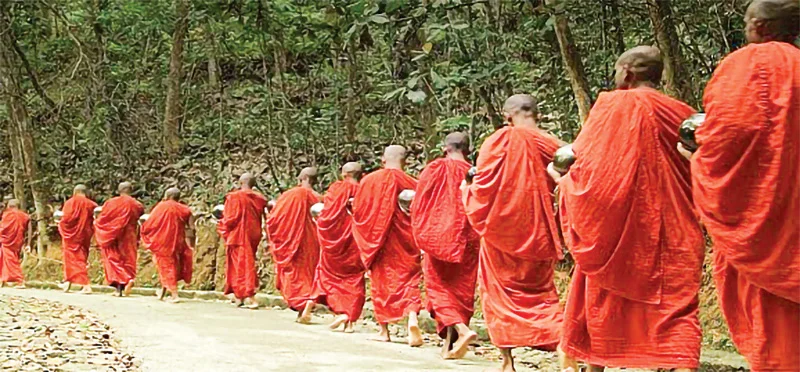
The ongoing controversy surrounding the internal disciplinary proceedings against Reverend Kekirawe Sudassana conducted by senior monks of the ecclesiastical order he belongs to–Sri Lanka Ramanna Nikaya–offers an opportunity to reflect upon dissent and discourse within Sri Lankan Buddhism. The inquiry is the result of a series of complaints made against Reverend Sudassana focused on his public discourses which have been widely shared in social media and other online portals.
As usual, this case too has polarised Buddhists in the public domain. Those in support of Reverend Sudassana see absolutely nothing wrong in what he has done and said. Similarly, those against him in the public domain, see nothing but wrong in all his public utterances and want him taken to task. Between these two extremes, the core meaning of the Buddha’s notion of ehipassiko, which literally means ‘come and see for yourself’, is completely lost.
I have followed some of the public statements and discourses of Reverend Sudassana for a while as part of my interest in popular religion. Much of what he has to say goes against long held beliefs and traditions in Sri Lankan Buddhism. I find his ideas shift between rationalism and noisy rhetoric, both not unusual in different manifestations of Sri Lankan Buddhism. For instance, the much-respected Anagarika Dharmapala was essentially a rationalist who wanted to focus on the dhamma and not on Buddhism’s rituals or even on gods. But this does not mean that Reverend Sudassana can be judged in the same way as Anagarika Dharmapala given the vast variation in historical epochs the two operated in and their different approaches to public discourse.
Reverend Sudassana has often critiqued what he sees as mythology and ritualism in Buddhism. For him, many long-held rituals and beliefs embedded in popular Sri Lankan Buddhist practices are irrational and therefore not acceptable. While to any rational thinking being, there is no contention here, one must concede that it is mythology and rituals that hold any core set of philosophical ideas such as the dhamma together as a religion. It is through these practices that religion as a matter of faith emerges from abstract ideas. This is common to any religion. It is through these practices that Buddhism, Christianity, Hinduism or Islam become religion as opposed to other philosophical ideas such as Plato’s and Socrates’ discourses or more recent trends in post-modern thinking, which do not constitute religion.
So, when Reverend Sudassana critiques and dismisses something so central to religion as belief and ritual as irrational, he needs to offer an alternative that would hold religion’s core ideas together. That, in my view, cannot be done by philosophy, the dhamma in the abstract sense or rationality as it is commonly understood today.
But when Reverend Sudassana argues against the over-commercialised merit-making practices, such as elaborate and very expensive pujas and certain customs that divert lay people from the Buddha’s pragmatic, core philosophical teachings, then, we have to pay serious attention to what he has to say. It is this kind of merit-making that I wrote about in 1995 with the use of the concept ‘grandiose religiosity’ that I coined to refer to expensive rituals and offering of alms.
Reverend Sudassana also stepped into the social minefield when he questioned the ordination of children at a very young age, inviting society to reflect on whether a child is mature enough to make a lifelong commitment to monasticism. He is not the first one to ask this question. Earlier critics include Gananath Obeyesekere and many others. This is an extremely important area that deserves the serious attention of citizens. Related to the same issue, Reverend Sudassana has also openly spoken out against child abuse within monastic environments, a topic that has traditionally been treated with strict institutional silence even through this has gained more traction as a public topic recently, at least in social media
Reverend Sudassana, through online commentaries has frequently targeted contemporary preaching styles of many Buddhist monks, explicitly calling out senior and popular monks who in his opinion perform ‘entertainment-driven’ or emotionally manipulative sermons (such as weeping while preaching) rather than focusing on true dhamma. Given the advent of what we may call ‘tele-monk’s or ‘online monks’, Reverend Sudassana’s criticism cannot be faulted if the comparison is only with the traditional preaching style of Buddhist monks. However, if this is the point of departure, then, Reverend Sudassana’s often combative style of discourse can also be critiqued in the same way. The issue in public discourse should be based on what preachers actually say and to what extent they take listeners closer to the dhamma or not. But often, such a reflective examination of dhamma content does not take place.
In certain ways, Reverend Sudassana has attempted to introduce a more rational interpretation of the Buddha as a historical figure and subsequent Buddhist history. From a historiographical point of view, this makes sense. The problem is, there is a vast variation between history as a formal academic discourse and belief in the past in terms of both perceived history and the past lives of well-known people. In the latter, there is not much space for rational reflection. That is why it is part of faith and not historiography. However, by trying to do this and attempting to separate what he views as historical fact from ‘literary or cultural interpretation’, Reverend Sudassana has drawn fierce opposition from orthodox factions of institutional Buddhism as well as many ordinary people who view his arguments as an attack on sacred text and tradition. What does all this mean? It is in answering this question that we need to reflect on the ancient Pali term, ehipassiko –‘come and see for yourself.’ In discursive terms, it is thought to be an open invitation by the Buddha himself to explore what he has preached rather than a demand for blind faith. The idea represented by ehipassiko is one of the six core qualities of dhamma in so far as the Theravada practice is concerned. the other five qualities include, svākkhāto (well-expounded by the Buddha), sandiṭṭhiko (directly visible or apparent right now), akāliko (timeless conditions, the results of which will be apparent when one practices), opaneyyiko (leading onwards to be applied within oneself) and paccattaṃ veditabbo viññūhī (to be personally known and realised by the wise).
Of these, ehipassiko is the most open invitation for reflection, which in my opinion goes very well with the Kalama Sutra or the Buddha’s charter of free inquiry. If Reverend Sudassana was motivated by ehipassiko and Kalama Sutra in his public discourses, he may have come closer to Buddhist ideals when it comes to Buddhism’s sympathies with freedom of inquiry. But at the same time, he has also moved considerably away from common sense dictating what is possible and what is not possible within the context in which he operates. First, complete rationalisation of Buddhist practice within an idiom of post-Enlightenment sense of rationalism is both not possible and dangerous. This applies to all religions. If this is done, then, faith will have to become mere philosophical reflection, thereby undermining what religion over time everywhere has done for humanity.
Second, what is actually possible to critique within the structures he is operating from (including his nikaya affiliations) needs to be clearly understood. What I can say as a scholar based on my research and reflection, are things a monk cannot say beyond a point as long as he is a monk. This common sense needs to be clearly understood if one is interested in reforming institutionalised Buddhism. It is in this area that many of the formal complaints against Reverend Sudassana have been made in the ongoing inquiry. There are numerous seriously problematic areas in his commentaries. These include claiming that the idea of karma is a myth and that rebirth is false. These are such core beliefs in Buddhism. One cannot critique them without disrupting the overall structure of the faith. But one can remain an unbeliever by virtue of personal choice but not make such opinions matters of public discourse. He has also claimed that specific powers such as the ability to read others’ minds, attributed to the Buddha are fictional. Again, beyond matters of rationality and within a discourse of faith, these things cannot be questioned in Buddhism in the same way they also cannot be in any other structure of belief. Reverend Sudassana has also been accused of providing problematic interpretations to long held positions espoused in the sutras and for claiming that that the Mahayana abhidhamma is superior to the Theravada version and so on. While the latter may be open to interpretation, Reverend Sudassana so far has not established that his grasp of the dhamma is adequate to offer such critical reinterpretations.
Third, endless combativeness is counterproductive if the aim is reform. It is much better to pick one’s battles on a rational basis rather than having a noisy opinion on everything under the sun. For instance, if Reverend Sudassana has issues with some of the less rational aspects of Buddhism like the Jataka stories, rebirth, specific rituals and so on, the better option is to underemphasise them in his sermons and public statements and replace them with life experiences of contemporary or historical times so that people understand the specifics of the dhamma being explained.
As for his more violent detractors on social media, my suggestion is to let the logic of ehipassiko come into play the way it was intended. Verbal violence, threats or ill-will have no space in Buddhism or in any decent society. If Reverend Sudassana’s discourses have negatively impacted disciplinary positions of his nikaya, I hope, they will be resolved through the kind of inquiry that is ongoing and even more importantly through broader reflection. But the senior monks in Sri Lanka Ramanna Nikaya must also reflect on why a discursive disagreement has generated this much internal reflection and interest leading to a formal inquiry at a time when very serious and continuous disciplinary and ethical violations by many monks, which are also now part of the public discourse, have not received the same attention.

‘Vision’ Programme Marks Two Years

Costa Rica minister fired for unapproved meeting with Trump in US

At least 41 die as boat capsizes in DRC’s Lake Tanganyika

Showers will occur at times in the Western, Sabaragamuwa, Southern, Central and North-western provinces

Sajith vows to scrap 22A under future govt.

Two retired female Navy officers remanded over disappearance of two women during war

‘Dates have the highest sugar content to fight Coronavirus’

Sunday Island 27 December – Headlines

#SundayIsland 17th December – Headlines

Sunday Island – 28th March

Sunday Island Headlines – 21 March

Sunday Island – 21st February – Headlines
-

 News6 days ago
Shanakiyan urges urgent action over reported death sentence for Lankan in Saudi Arabia
-

 News5 days ago
Namal Rajapaksa Buddhist gambit fails, bail denied
-

 Features5 days ago
Why the spelling Sri Lankan names in English vary
-

 Features5 days ago
Three bands, a new identity: Sri Lankan wolf snake recognised as distinct species
-
 Business5 days ago
SLIIT holds largest-ever convocation
-
 News5 days ago
Vehicle prices drop by up to Rs. 1 mn, says importers’ body
-
 News5 days ago
Govt monitors reported Saudi death sentence – Foreign Ministry
-

 Business5 days ago
All-new Bolero MaXX Pik-Up unveiled in Lanka