
Business
CEAT radials designated Original Equipment for locally–assembled Mahindra Bolero City Pik-ups

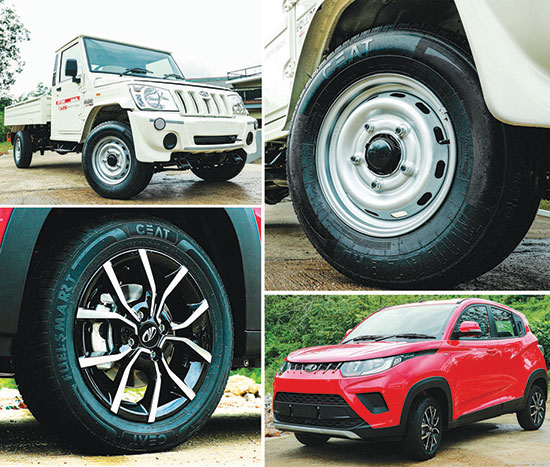
CEAT Kelani Holdings has reached another milestone in radial tyre manufacture in Sri Lanka with the Company’s appointment as an Original Equipment Manufacturer (OEM) for Bolero City Pik-up vehicles assembled in Sri Lanka by Mahindra & Mahindra (M&M) India in collaboration with Ideal Motors.
All Mahindra Bolero City Pik-ups rolling off the assembly line at the Mahindra Ideal Lanka Automotive Assembly Plant at Welipenna, Matugama are fitted with CEAT Milaze HD radial tyres in the size of 215/75 R15, manufactured at the CEAT Kelani plant in Kelaniya, under an OEM agreement between the two companies.
CEAT has already supplied 180 of these high performance radial tyres for 36 vehicles that will be assembled in November and December this year and has committed to supply up to 720 tyres per month from January 2022 onwards for a targeted maximum of 144 vehicles to be produced monthly by the Mahindra Ideal Lanka joint venture, the Company said.
Commenting on the agreement, CEAT Kelani Managing Director Ravi Dadlani said: “We are delighted to contribute to the local value addition component of the Mahindra and Ideal Motors venture, while doing what we do best – producing high quality tyres designed and engineered for local conditions and supporting the government’s efforts to conserve foreign exchange. Over the past two decades, CEAT has built the equity of the ‘Made in Sri Lanka’ proposition in the tyre industry, and we are proud and appreciative of the opportunity, as exclusive tyre supplier, to support the aspirations of Mahindra and Ideal Motors to progress to vehicles made in Sri Lanka.”
The Managing Director of Mahindra Ideal Lanka Pvt Ltd. Nalin Welgama noted that “This new initiative is a step in the right direction and supports the government policy framework for Sri Lanka’s migration from a market economy to a production-based economy.”
The CEAT Milaze tyres manufactured by CEAT Kelani for the Mahindra Bolero City Pik-up feature profiled shoulder lateral grooves that provide better heat dissipation and wide-angle circumferential grooves that resist cuts and chips. Angular transversal notches and sipes provide enhanced grip and uniform wear, while the angular notched 4-rib high land area design provides longer tyre life and durability.
No stranger to the OEM segment, CEAT Kelani Holdings has been the exclusive original equipment tyre supplier for Mahindra KUV100 compact SUVs assembled in Sri Lanka since 2019. All locally-assembled Mahindra KUV100 vehicles are fitted with CEAT FUELSMARRT 185/60 R 15 tyres.
CEAT Kelani Holdings is considered one of the most successful India – Sri Lanka joint ventures. The joint venture’s cumulative investment in Sri Lanka to date totals Rs 8 billion, inclusive of Rs 3 billion invested since January 2018 for expansion of volumes, technology upgrades and new product development. The company’s manufacturing operations in Sri Lanka encompass pneumatic tyres in the radial (passenger cars, vans and SUVs), commercial (nylon and radial), motorcycle, three-wheeler and agricultural vehicle segments.
The CEAT brand accounts for market shares in Sri Lanka of 48 per cent in the Radial segment, 80 per cent in the Truck category, 84 per cent Light Truck tyre category, 51 per cent in the Three-Wheeler tyre segment, 36 per cent in the Motorcycle tyre segment and 72 per cent in the Agricultural vehicle tyre category. CEAT Kelani exports about 20 per cent of its production to 16 countries in South Asia, the Middle East, Africa and the Far East.


By Sanath Nanayakkare
On the surface, the 41st Board Meeting of the India-Sri Lanka Foundation (ISLF) in New Delhi on August 28, 2026, was structured as a routine diplomatic engagement. Co-chaired by Indian High Commissioner Santosh Jha and Sri Lankan High Commissioner Mahishini Colonne, the session formally approved a standard slate of cultural and educational projects.
However, looking closer at the broader macroeconomic and geopolitical landscape, the meeting underscored a much deeper structural alignment between the two nations. Against a backdrop of ongoing economic recovery, bilateral discussions increasingly touch upon critical areas of regional integration, investment, and infrastructure.
Among the key areas attracting attention are post-civil war reconciliation efforts and administrative milestones in the Northern Province.
Discussions in diplomatic circles continue to focus on the progressive release of state-held lands back to civilian inhabitants, alongside the anticipated finalization of provincial council elections to support local governance frameworks.
In the economic sphere, commercial integration remains a central theme as Sri Lanka stabilizes its foreign exchange reserves.
Recent financial dialogues in Colombo were seen exploring mechanisms such as transacting in Indian Rupees (INR), aligning with wider regional efforts to facilitate bilateral trade settlements and mitigate foreign currency pressures. Financial institutions, including the State Bank of India, continue to support these bilateral trade facilitation mechanisms.
Cooperation in the energy sector is also progressing through key joint ventures aimed at harnessing renewable resources. Proposals such as the 200MW solar power project in Sampur, developed via a partnership between NTPC and the Ceylon Electricity Board, highlight ongoing efforts to diversify national power generation. Discussions concerning cross-border grid interconnections further reflect strategies to enhance regional energy security and optimize renewable capacity.
At the same time, ongoing reviews of project tariffs – such as those involving renewable initiatives by firms like Adani Green Energy – demonstrate the government’s focus on balancing capital investments with domestic economic interests.
As the ISLF marks decades of supporting bilateral cultural exchanges through hundreds of initiatives, the overarching partnership between New Delhi and Colombo continues to evolve. Navigating these complex frameworks of trade, energy, and development remains essential as Sri Lanka charts its economic future within the South Asian region.

Sysco LABS, the Global Innovation Center of Sysco, has been named one of Sri Lanka’s Most Outstanding Women-Friendly Workplaces at the Women-Friendly Workplace Awards 2026, marking its highest recognition at the awards to date.
The recognition represents an important milestone in Sysco LABS’ ongoing journey to build a workplace where women are supported not only to enter and participate in the technology industry, but to develop, progress and build meaningful long-term careers.
Held recently, the 2026 awards organized by Satynmag continued a six-year journey of recognizing and encouraging organizations to move beyond intention towards meaningful and measurable progress for women at work. This year’s awards placed particular emphasis on a defining question for women-friendly workplaces: beyond representation, how far are women able to go?
This win also reflects a progression in the company’s recognition journey at the Women Friendly Workplaces Awards. Following an “Honorable Mention” in the 2023 edition of the ceremony while winning a special award for “Best Women in STEM Project” in 2025, 2026 marks the first time Sysco LABS has been recognized as one of Sri Lanka’s Most Outstanding Women-Friendly Workplaces.
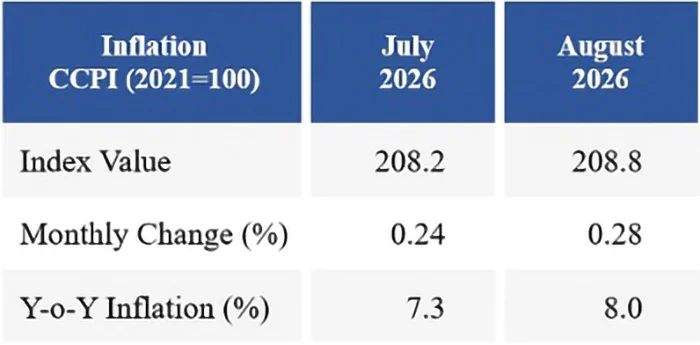
The Colombo Consumer Price Index (CCPI, 2021=100) based headline inflation (year-on-year, Y-o-Y) increased to 8.0% in August 2026 from 7.3% in July 2026, primarily due to the statistical base effect in food inflation. Meanwhile, food inflation (Y-o-Y) increased to 8.5% in August 2026 from 6.3% in July 2026, contributing mainly to the increase in headline inflation, while non-food inflation (Y-o-Y) decelerated to 7.7% in August 2026 from 7.8% in July 2026.
On a month-on-month basis, the CCPI increased by 0.28% in August 2026. This increase was mainly driven by the food category, which contributed 0.20 percentage point, largely owing to the increase in prices of Milk Powder, while the non-food category contributed a marginal 0.07 percentage point.
Meanwhile, core inflation (Y-o-Y) accelerated to 5.1% in August 2026 from 4.4% in July 2026.
According to the inflation projections made at the monetary policy round in July 2026, headline inflation is expected to remain above the target of 5% in the near term, before easing and stabilising around the target over the medium term, supported by appropriate policy measures. These projections are conditional, among other assumptions, on the expectation that the effects of the tensions in the Middle East and their spillovers will be temporary and gradually dissipate.

Malta businessman acquitted of plotting journalist Caruana Galizia murder

Nilakshika fifty, Athapaththu seven-for rescue Sri Lanka against Indonesia

Winners to receive medals at Western Province School Games after many years

MoU signed for technology to prevent wild elephant-train collisions

Grade 5 scholarship exam results released

Prime Minister participates in Global Conscious Food Systems Summit in Bhutan

‘Dates have the highest sugar content to fight Coronavirus’

Sunday Island 27 December – Headlines

#SundayIsland 17th December – Headlines

Sunday Island – 28th March

Sunday Island Headlines – 21 March

Sunday Island – 21st February – Headlines
-

 News6 days ago
Eight politicians in drug kingpin probe
-

 Features4 days ago
“Wrap Me Up in My Blazer”— A Gentlemanly Bradby Reminiscence
-

 Business6 days ago
Sri Lanka opens up: A new season of direct connectivity
-

 Features3 days ago
When Sri Lankan stories find their own voice
-

 Features6 days ago
Redefining ageing in Sri Lanka
-

 Latest News7 days ago
Nepal-Tibet floods: What happened, what caused them and who is missing?
-

 Editorial7 days ago
Unfolding El Niño and burning issues
-

 Editorial6 days ago
The toxic legacy of two lakes