
News
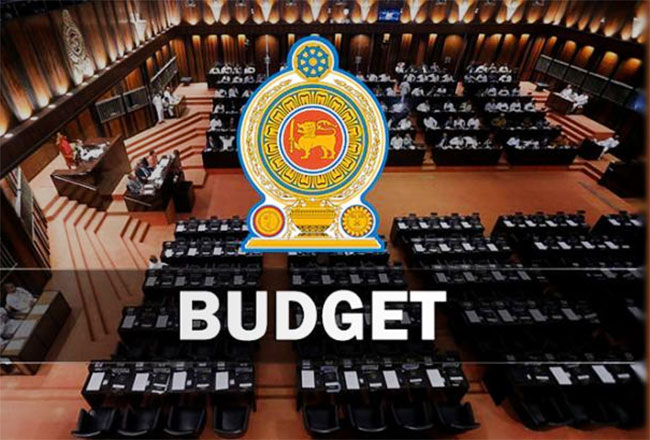
Rajapaksa presents ‘non-traditional’ Budget

* Rs. 30 bn for rectifying teachers’ salary anomalies
* PTL’s Rs. 8.5 bn to be transferred to Treasury
* VAT on banks, financial service providers up from 15% to 18%
* One-time tax surcharge of 25% on some companies, etc.
* Rs. 5 bn for agrotechnology development
* Rs. 1 bn to Batik and Handloom manufacturing sector
* Rs. 5 bn for basic infrastructure development
* Price of cigarette increased by Rs 5
* Retirement age of public sector increased to 65
* Period for MPs to qualify for pension up from five to 10 yrs
by Saman Indrajith
Finance Minister Basil Rajapaksa, presenting what he described as a non-traditional Budget, yesterday, said that it would help increase government revenue and keep expenditure in check to boost investor confidence.
Minister Rajapaksa said that the government was presenting the Budget at a time when the country and the entire world were facing a difficult period.
“We are presenting the Budget amidst global challenges. Many countries are focusing on internal problems, there are climate problems, inflation and Covid-19 have disrupted economic activities,” Minister Rajapaksa said, presenting the country’s 76th annual Budget.
He said the country had been locked down several times to protect the people against Covid-19. The national economy had suffered a loss of around Rs. 500 billion rupees in revenue, he said.
Now, the country had achieved its vaccination target and was working closely with multilateral lenders to revive the economy, he said, adding that Rs. 30 billion would be allocated to rectify the salary anomalies affecting teachers and principals.
A one-time tax surcharge of 25% has been imposed on persons or companies with taxable income over Rs. 2 billion for the year of assessment 2020/2021.
Rs.100 billion is expected to be earned through this tax.
VAT on banks and financial service providers under supply of financial services by specified institutions will be increased to 18 percent from 15 percent. This tax should be paid monthly from 01 January 2022 to 31 December 2022. Furthermore, this tax should not be passed on to the customer. Rs 14 billion is expected to be earned through this tax.
Minister Rajapaksa proposed to transfer Rs. 8.5 billion that Perpetual Treasuries Ltd. had earned in violation of the Code of Conduct, from the Central Bank of Sri Lanka, to the Treasury.
He said the economy had to be developed in a sustainable manner.
Sri Lanka was on track to post a budget deficit around 10 percent of gross domestic product with the deficit up to July being at 6.2 percent of gross domestic product.
The price of a cigarette would be increased by five rupees, Minister Rajapaksa said, adding that the decision had been taken as the prices of cigarettes had not been increased in three years. The government expects to rake in an additional Rs. 8 billion.
The Finance Minister proposed to increase excise tax with immediate effect, and additional revenue of Rs. 25 billion is expected through this tax increase, and the gazette regarding the relevant tax increase would be published within a day.
Minister Rajapaksa said that the budgetary allocations for the MP would be increased by Rs. 5 million each and Rs. 15 million would be allocated to each MP for development activities in their electorates. Relief would be provided to school van and school bus operators affected by Covid-19, Minister Rajapaksa said, adding that Rs 400 million would be allocated for that purpose.
Rs. 700 million would be allocated for the provision of relief to three-wheeler drivers and Rs. 1,500 million for the bus operators, who had lost their revenue due to the Covid-19 pandemic.
Finance Minister proposed the employment of methods such as Blockchain technology, and moving towards mobile banking through the digitalisation of banks.
“Our government is always dedicated to safeguard the interests of our farmers,” he said, adding that however a clear law had not been formulated for this purpose. He proposed the drafting of the ‘Green Agricultural Development Act’ for the benefit of the farming community.
The country would be developed as a hub for “Wellness Tourism” and focus its attention on avenues of tourism such as “Event Tourism”, “Destination Tourism” and providing tourists with “Home Stays”.
A regulatory authority would be established for three-wheelers, Minister Rajapaksa said, noting that telecommunications network covering the entire country would be established immediately and all 10,155 schools in the country provided with fibre optic internet connections. Telecommunications connectivity and Internet access shortcomings in the country had been noticed during the pandemic, the Minister said, adding that the construction of new office buildings for the state institutions would be suspended for two years.
Annual Warrant for state expenditure would be made a Quarterly Warrant in the future, he said.
The government is planning to extend the retirement age for state sector employees to 65 years as the average life expectancy had increased and Sri Lanka’s population was ageing. “As they are able to engage in active service for a longer period of time, it is essential to make use of their experiences and maturity,” the Finance Minister added, proposing to extend the age limit for public servants’ pensions to 65.
Fuel allowance for ministers and state officials would be reduced by five litres each a month.
The minimum period an MP has to serve to obtain the pension has been extended from five to ten years.
The Finance Minister said that proposals and opinions of several organisations and individuals were obtained before preparing the budget proposals.
Since independence, all the government had failed to act with a clear vision with regard to the country’s foreign reserves, Minister Rajapaksa said.
The “international drug mafia” was one of the biggest obstacles the country was facing, he said.
“We are a government that does what it says,” Minister Rajapaksa said, referring to the vaccination programme.
There was no more room for terrorism and extremism, said Minister Rajapaksa. “Today, Sri Lanka is one of the most peaceful countries in the world.”
Yesterday’s was the 76th budget of an independent Sri Lanka. It is also the second budget of the incumbent government, and the first presented by Finance Minister Basil Rajapaksa.
The 2022 Appropriation Bill was presented to Parliament by the Minister of Finance on 07 Oct.



Environmental groups have raised fresh concerns over increasing levels of coal ash generated at the Norochcholai Coal Power Plant, warning of serious environmental and public health risks if proper disposal mechanisms are not urgently implemented.
Environmental scientist and Centre for Environmental Justice (CEJ) Chairman Hemantha Withanage, in a strongly-worded comment yesterday, said the growing volume of ash was being treated as a “blessing” by authorities, while, in reality, it posed a major ecological threat.
He told The Island: “More coal and more ash are being celebrated as a blessing. People around Norochcholai should get ready to apply it on their foreheads — and this will affect everyone, regardless of political affiliation.”
Norochcholai, Sri Lanka’s largest coal-fired power station, produces thousands of tonnes of fly ash and bottom ash annually. Environmentalists say a significant portion of this waste is either inadequately stored or disposed of without proper environmental safeguards.
Withanage said coal ash contains toxic heavy metals, such as mercury, arsenic, cadmium and lead, which can contaminate soil, groundwater and nearby marine ecosystems.
“Coal ash is not ordinary waste. It is a hazardous industrial material. If it leaks into the environment, it can enter food chains and drinking water sources,” he said.
He warned that communities living around Norochcholai were already exposed to air pollution from ash particles, especially during windy conditions, leading to respiratory problems and long-term health risks.
CEJ has repeatedly called for a transparent national policy on coal ash management, including safe storage facilities, independent monitoring, and exploring environmentally responsible reuse options under strict regulation.
Withanage stressed that while some countries recycle coal ash in construction materials, Sri Lanka lacks the regulatory framework and technical safeguards to do so safely.
“Without proper standards, recycling can become another pathway for toxic exposure,” he cautioned.
Environmentalists are also urging the government to accelerate the transition away from coal towards renewable energy, arguing that continued dependence on coal will only multiply waste and health burdens in the coming years.
Norochcholai supplies nearly one-third of the country’s base-load electricity, but has remained controversial, since its commissioning, due to repeated technical failures, marine pollution concerns and its long-term environmental footprint.
“With climate change and public health risks, coal is a problem we should be reducing, not normalising,” Withanage said. “Otherwise, the ash will eventually come back to all of us.”
by Ifham Nizam

The police have arrested one of the two gunmen involved in the killing of Attorney-at-Law Buddhika Mallawarachchi and his wife, at Akuregoda, on 13 February. The suspect has been identified as a legally discharged soldier.
A team of the Homagama Divisional Crime Investigation Bureau personnel apprehended the ex-soldier at Delduwa, Ambalangoda, on Saturday, around 6.20 p.m. Sources said that the suspect, identified as drug addict, had admitted that he was the one who fired the T-56 assault rifle in the attack. The other attacker used a pistol. He is still at large.
Police identified the suspect in custody as a 46-year-old resident of Baddegama. He made use of a general amnesty offered to deserters, after the conclusion of the war, to secure legal discharge. He was with a friend at Delduwa, Ambalangoda, and worked on a nearby cinnamon estate.
The suspect has been detained under PTA and the police given the power to hold him for 90 days.
The police recovered his mobile phone.
The killers arrived at Akuregoda, in a car, and fled the area after killing the couple. The ex-soldier had got off the car, near Kottawa, and then took a bus to Dehiwala, from where he proceeded to Ambalangoda.
Under interrogation, the suspect has revealed that he carried out the hit on a contract given by Karandeniye Sudda, a notorious underworld figure, who paid him Rs 1 mn and provided a quantity of heroin.
The ex-soldier is among nine persons taken into custody in connection with the ongoing investigations into the Akuregoda double murder.
Among those taken into custody are two brothers from Athurugiriya who allegedly transported one of the firearms used in the killing and provided information about the lawyer’s vehicle. Another person, identified as “Polgasowita Dila,” believed to have coordinated the Akuregoda hit, was also taken into custody during preliminary investigations.
The Police Special Task Force’s Southern Province Special Operations Unit arrested six more suspects over the weekend at Ethkandura, Kahaduwa, for aiding and abetting the double murder
Investigations have further revealed that the individual, who moved the gunman to a hotel in Pannipitiya, had fled to Thailand, via the Bandaranaike International Airport (BIA).

Justice Minister Harshana Nanayakkara said in Parliament on Friday that some Opposition politicians who had not even dared to mention the name of Gotabaya Rajapaksa during the Rajapaksa era were now acting like heroes.
Minister Nanayakkara said so when SJB Kalutara District MP Ajith P. Perera asked whether the government would reopen cases against Gotabaya Rajapaksa, who no longer enjoyed presidential immunity. The former UNP Deputy Minister asked the Justice Minister whether the NPP, as promised during the polls campaign, had resumed hearings into 42 cases filed against the Rajapaksas and others.An irate Minister Nanayakkara said that those who had been under their beds those days were now acting as if they were heroes. He refused to answer MP Perera’s question. (SF)

Coal ash surge at N’cholai power plant raises fresh environmental concerns

Akuregoda double murder: Suspected gunman in custody a duly discharged ex-soldier

Those who hid under beds fearing Gotabaya, now talking big: Justice Minister

Demand for accommodating Thimphu principles in promised Constitution: ITAK says it was not party to that move

Tamil politicians tell the UK NPP govt. not fulfilling its promises

Protection of Occupants Bill: Good, Bad and Ugly

‘Dates have the highest sugar content to fight Coronavirus’

Sunday Island 27 December – Headlines

#SundayIsland 17th December – Headlines

Sunday Island – 28th March

Sunday Island Headlines – 21 March

Sunday Island – 21st February – Headlines
-

 Features1 day ago
Why does the state threaten Its people with yet another anti-terror law?
-

 Features1 day ago
Victor Melder turns 90: Railwayman and bibliophile extraordinary
-
 Features1 day ago
Reconciliation, Mood of the Nation and the NPP Government
-
 Features1 day ago
Victor, the Friend of the Foreign Press
-

 Latest News3 days ago
New Zealand meet familiar opponents Pakistan at spin-friendly Premadasa
-

 Latest News3 days ago
Tariffs ruling is major blow to Trump’s second-term agenda
-

 Latest News3 days ago
ECB push back at Pakistan ‘shadow-ban’ reports ahead of Hundred auction
-

 Features1 day ago
Barking up the wrong tree