
News
20A root of many evils: Lakshman Kiriella


by Saman Indrajith
The independence of the public service has deteriorated with the Executive Presidency becoming more powerful after the 20th Amendment to the Constitution, says Chief Opposition Whip Kandy District SJB MP Lakshman Kiriella.
In an interview with the Sunday Island, Kiriella said that the 17th Amendment was introduced to set up several independent commissions. “This was reversed by the 18th Amendment but was subsequently restored by the 19th Amendment and the independent commissions began to function again giving both the police and the public service the strength to execute their duties independently.
“Soon after that it was noticed by all that the judiciary, police and public service were gradually finding their independence. However all that has been reversed by the 20th Amendment, which consolidated all powers with the Executive Presidency. This is the main problem in our society today. We have capable judges, police officers and public officials, but their independence has been taken away. This was the reason we have witnessed many officials resigning from their posts,” Kiriella said.
“The spree of resignations by top officials has been endless and worrying, but also encouraging because it is a sign that officials want to do what is right and not simply follow the ruler’s diktat,” he said.
Even the European Union delegation that visited the country recently to review the GSP Plus had observed that the incumbent government was turning back one by one the democratic achievements gained for the people by the 19th Amendment.
“We introduced 19A which brought about democratic values as well as further ensuring the rights of the people. Powers that had been concentrated around the presidency were delegated to the PM, parliament, cabinet and the constitutional council. The country was set on the path of democracy by the changes in 19A. Soon after this government came to power, they did away with it and consolidated all powers around the executive presidency once again. This is the mother of all ills and problems people are facing today.”
19A had ensured the protection of human rights and upheld principles of rule of law. “We as a nation are bound to ensure the protection of human rights outlined in the conventions and treaties that have been ratified and we have signed. That is an international obligation. After doing away with the 19A, a situation has been created depriving people of those rights. Before the 20th Amendment the appointments to the top posts had been done by the constitutional council. The council we have now has no powers to reject any nomination and proposes its own. This is a sad situation.”
Q: You were Leader of the House under Prime Minister Ranil Wickremesinghe. When Sajith Premadasa became the Opposition Leader he chose you as the Chief Opposition Whip. How could you win the trust of both leaders who have so many differences of opinion?
A:
I count 33 years in parliament politics. I am a lawyer too. I am conversant with Standing Orders of Parliament and parliamentary traditions. That might be the reason for their choice to select me to hold those top most posts in both sides of the well of the House.
Q: President Gotabaya Rajapaksa has admitted that he made mistakes in governance. Would you like to comment?
A:
This is again has its origin in the 20th Amendment. Why has this happened? Because he amassed all power in his hands. All the powers of the Prime Minister, the Cabinet, parliament and the Constitutional Council have been taken over by the President. There is no team spirit. Everything is decided by a single person and that could lead to failures and disasters.
When the 19th Amendment was brought to Parliament, I was the Leader of the House. We had only 45 MPs in the UNP. But we could persuade the opposition that we were trying to go in the right direction to obtain their support to get two thirds of the votes to pass the amendment. But when this government brought in the 20th Amendment they did not ask the opinion of the opposition. Even we did not know what it would be until we came to parliament. A country cannot be run in that manner.
Q: The President also spoke of a new Constitution. What is the opposition’s standpoint on this?
A:
We do not think that the most urgent problem in our society at this time is a new constitution. Look at the way the government is preparing the draft. Usually a new constitution is prepared by a council representing parties in parliament. That could have been done by a parliamentary select committee. Who is making the new constitution? A bunch of lawyers who appeared for the cases against President Gotabaya Rajapaksa have been given the task of preparing a new Constitution. It is as if a private contract. There is no single word or debate in parliament in this regard. When we brought the 19th Amendment we discussed its content with all parties in parliament. A group of lawyers have been tasked to make a new constitution for the country.
Q: There are statements by some ministers about elections. Most of them mean provincial council election. Are you ready for that?
A:
There is no governance in the country. There is no price control. People have lost the democratic powers and privileges they had before this government came to power. The government on the other hand has not fulfilled the promises it made to get the votes. In a democratic system, the usual practice is to have an election, either provincial, local government, presidential or general, at least every two years. That is how the constitutions of many countries operate. It is same in India. Now nearly two years have passed since this president came to power. We challenge the government to hold an election if possible to see the way people reject them. When I heard the President’s recent speech I did not think they would go for an election even next year.
Q: The President too has accepted that an election should be held but the Attorney General has opined that an election cannot be held for the provincial council under the previous system of elections.
A:
Elections could be held according to the previous system. There is only one clause against it. It could be brought to parliament in the form of an amendment to activate the previous system of holding elections. Such amendment could give powers to the representative election method known to people. If the government brings such an amendment we would support it. In that manner the government could hold elections without postponing them.
Q: The president says that there had been shortcomings because he lacked experience in politics. Yet you say that he has all the powers. How could one fail if he has all the powers?
A:
In politics you need experience. The President has a genuine desire to develop the country. We accept that. Yet in politics the desire or need alone would not bring about results. You need experience. One cannot run a country just because you have all the powers. You have to learn work with others with team spirit. Army officers were appointed to the top posts while leaving out many capable and qualified civil officials. This is country is used to a civil administration, not military.
Q: The president promises to eliminate corruption. Is that possible?
A:
He has not been able to prove that by action. How can one could expect him to eliminate corruption? Haven’t you seen the way they have released many who had been accused of frauds and corruption in the recent past? So many cases have been withdrawn by the prosecutors themselves. Those who had been accused of many corrupt deals were released one by one in an unprecedented manner.
Q: People complain of the prices increases of essentials. Do you think that the SJB would have been able to control such a situation if it were in power?
A:
In a market economy, the prices are decided by the market. That is the truth. A government however could manage the price controls by using various strategies. For example, during the times of our government we had a cost of living committee which met regularly. That committee kept an eye on the market. Whenever there was a shortage of any commodity in the market it permitted imports. Suppose there is a rice shortage and the rice millers and businessmen try to jack up the prices. We import rice so that there would not be any price increase. The government should actively engaged in that process. You cannot control prices in the market by appointing an army officer to do the job. Today businessmen and traders decide the prices. The government should involve itself in managing this situation.

Latest News
Sun directly overhead Madampe, Thorayaya, Thotagamuwa, Rattota and Kalavanchikudy about 12.09 noon today (03)


The sun is going to be directly over the latitudes of Sri Lanka from 28th of August to 07th of September due to its apparent southward relative motion.
The nearest places of Sri Lanka over which the sun is overhead today (03) are Madampe, Thorayaya, Thotagamuwa, Rattota and
Kalavanchikudy about 12.09 noon.
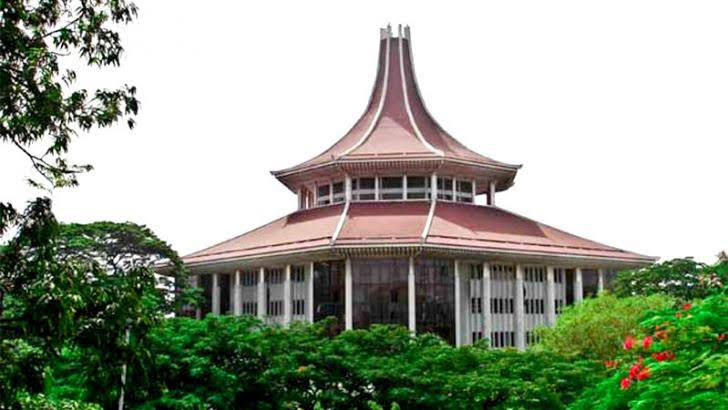
Attorney-at-Law Sugandhika Fernando, on behalf of the Vinivida Foundation, petitioned the Supreme Court yesterday (02), seeking a full bench, excluding Chief Justice Preethi Padman Surasena, to hear the petitions challenging the 22nd Amendment Bill. She also requested that the hearing be suspended immediately until the matter was fully heard and determined.
Among the respondents are Chief Justice Surasena, the first respondent, and Attorney General Parinda Ranasinghe. Justices Yasantha Kodagoda, Shiran Gooneratne, Achala Wengappuli and Priyantha Fernando have also been named as respondents.
The petitioner has sought to have quashed the decision of the first respondent to appoint a five-member bench, which she alleged was made in violation of the norms of public law. She also sought a bench comprising all Supreme Court judges, excluding those cited as respondents, to hear the special determination applications on the 22nd Amendment.
The petitioner further contended that Chief Justice Surasena, who is due to retire on December 1, 2026, would be the main beneficiary of the 22nd Amendment.
The hearing of the petitions continued for a second day yesterday (02) before a five-member Supreme Court bench comprising Chief Justice Preethi Padman Surasena and Justices Achala Wengappuli, Arjuna Obeyesekere, Sampath Abeykoon and Gihan Kulatunga.
The hearing, which commenced on Tuesday morning, continued for nearly 12 hours, until 10:30 p.m.
Solicitor General Viraj Dayaratne, appearing for the Attorney General, submitted yesterday that the Government had presented the 22nd Amendment Bill to the Constitution and the Judicature (Amendment) Bill with the objective of expanding and streamlining the country’s judicial system.
After the Solicitor General’s submissions concluded, counsel representing the petitioners requested an opportunity to respond to the Solicitor General and the intervening petitioners. However, the Chief Justice declined to allow the petitioners’ counsel to make further oral submissions, concluded the determination hearing and directed them to file written submissions instead.
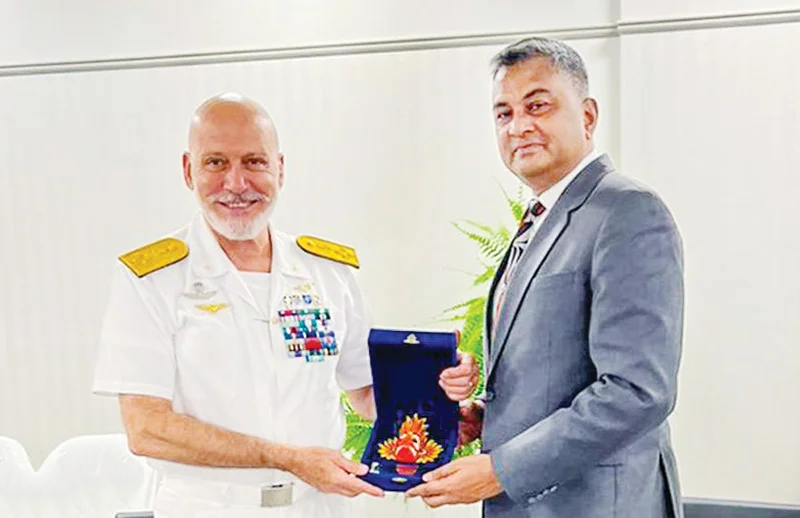
Sri Lanka has formally requested assistance from the North Atlantic Treaty Organisation (NATO).
According to a press release issued by the Defence Ministry, Defence Secretary Air Vice Marshal (retd) Sampath Thuyakontha has discussed defence cooperation with NATO, with discussions focusing on military modernisation, advanced technology, cyber capabilities and disaster response.
This was during talks between AVM Thuyakontha and NATO Military Committee Chairman Admiral Giuseppe Cavo Dragone on the sidelines of the Chiefs of Defence Conference in Victoria, Canada.
During the meeting, Secretary Thuyacontha outlined Sri Lanka’s defence requirements and areas of interest, including the modernisation of military hardware, acquisition of advanced technologies, and strengthening cyber capabilities and surveillance platforms, the Ministry of Defence said in a statement.
The two sides also discussed opportunities for greater technical cooperation, including the exchange of military personnel, expanded education and training programmes, and increased sharing of expertise and information.
Humanitarian Assistance and Disaster Relief (HADR) was also identified as an area for potential cooperation. The discussions included the exchange of expertise and the effective use of unmanned aerial vehicles (UAVs) in disaster response and related operations.
Defence Secretary Thuyacontha invited NATO to further strengthen its engagement with Sri Lanka, emphasising sustained dialogue, information sharing and practical cooperation in areas of mutual interest.

India to host inaugural Women’s Champions Trophy in February

Sun directly overhead Madampe, Thorayaya, Thotagamuwa, Rattota and Kalavanchikudy about 12.09 noon today (03)

Afternoon thundershowers in the Northern, North-central, Eastern and Uva provinces in next few days, starting from today (03).

22A: SC urged to suspend hearing, appoint full bench

Govt. seeks NATO assistance

Recent ‘Ice’ detection at the Colombo Port made on US intelligence – Embassy

‘Dates have the highest sugar content to fight Coronavirus’

Sunday Island 27 December – Headlines

#SundayIsland 17th December – Headlines

Sunday Island – 28th March

Sunday Island Headlines – 21 March

Sunday Island – 21st February – Headlines
-

 News7 days ago
Eight politicians in drug kingpin probe
-

 Features5 days ago
“Wrap Me Up in My Blazer”— A Gentlemanly Bradby Reminiscence
-
 Business7 days ago
Sri Lanka opens up: A new season of direct connectivity
-

 Features4 days ago
When Sri Lankan stories find their own voice
-
 Features7 days ago
Redefining ageing in Sri Lanka
-

 Editorial7 days ago
The toxic legacy of two lakes
-
 Business7 days ago
Jaffna Teaching Hospital secures lifeline water supply via ADB-funded Thalaiyadi sea water desalination plant
-
 Features5 days ago
JVP/NPP government as seen from outside by Lionel Bopage now domiciled in Australia