
Features
Taiwan’s and Sri Lanka’s Power Sectors


by Kumar David
(State Owned Utility like our CEB)
There is no reason, except cabinet and ministerial mismanagement, government meddling and political corruption, why the electricity supply sector is a mess in Mother Lanka but successful in, say Taiwan. But then the same is true of these two economies almost in every way. Lanka’s population is 22 million and Taiwan’s 26 million, our land area of 65 thousand sq. km is quite a bit larger than Taiwan’s 36 thousand and both countries lack significant deposits of oil, gas or mineral resources. Taipei, latitude 25 degrees north of the equator is more temperate than Colombo’s six degrees north. The economic indices however are as far apart as paradise is from purgatory; Taiwan’s nominal GDP and GDP per capita are US$ 760 billion and US$ 32,000, respectively, while the corresponding numbers in Mother Lanka before Covid were US$ 88 billion and US$ 3,700; though in the first decades after the Second World War we started with a notable handicap in our favour. People wistfully recall Lee Kuan Yew’s lament about similar early disadvantages that Singapore had to start from. Taiwan in those days after the civil-war in China was a bigger laggard.
These differences show up sharply in the electricity supply sector. The size of the sector in Taiwan with the corresponding number for Sri Lanka in parenthesis is; installed capacity 49 GW (4.1 GW) and electricity generated 270 TWh (20 TWh). A TWh (terra watt hour) is a thousand-million kWh and a kWh in common parlance is a unit. Taipower, Taiwan’s CEB owns the world’s largest gas-turbine power-station, the 4.4 GW Tatan and the world’s fourth largest coal-fired station, the 5.5 GW monster Taichung, nine times bigger than today’s Norochcholai. And, Taipower manages without provoking too big an uprising by irate environmentalists and without blanketing the nearby countryside with fly-ash to an unbearable extent. Taiwan’s breakdown of generation by energy source is 35% coal, 32% gas, 10% nuclear, 9% renewables and 8% oil. Allow me to remind you that in Sri Lanka the averages – hydro varies with rainfall and modifies all other annual percentages – is about 40% coal and 25% major hydro, other renewables including minor-hydro, wind, solar and biomass add to about 5%. The rest is oil-fired (private and CEB). Renewables will increase in the coming years in absolute terms but not much as a percentage because demand too will rise as the country’s economy (hopefully) improves.
 Taiwan as one of four Asian Tigers is credited with an astounding economic trajectory; but the other three are easier to understand. South Korea is the biggest and Korea has the longest modern history, it also sports a complex and chequered relationship with Japan. Singapore’s upswing is half a century and going; it is a meritocracy of singular distinction, a place where racial bigotry is officially despised and there is English. Hong Kong from the post-revolution Shanghai money pots and after that in Deng’s days it was a sophisticated hub of the world’s soon to be largest economy. But Taiwan is different. It was colonised and raped by Japan from 1895 to 1945, and in 1949, kicked out of China. Chiang Kai Chek established himself as dictator till he died in 1975. Forty two years of Martial Law on the island ended only in July 1987 and thereafter the territory gradually emerged as a thriving if cantankerous democracy.
In the next three to four decades Taiwan evolved into a thriving economic powerhouse. What is the answer to this enigma? Let me try to explain. First, Taiwan was in the frontline of America’s anti-China policy and a magnet for American investment and finance. Second, a treasure-trove of Chinese talent fled to the island with Chiang in the late 1940s and carried with it a mother-lode of historical and artistic treasure and money. Thirdly, Deng’s opening up of China benefited Taiwan as much as it did Hong Kong.
However there is another reason which is no less important for us in Sri Lankan. Religion, language and ethnicity count for nothing and Taiwan has no “national conflict” to speak of; it is pretty cohesive. Mandarin is the unofficial national language and after the removal of Japanese was made compulsory in schools. It is a more natural lingua franca in Taiwan than English or Hindi are in India. True, though related, in everyday life nearly 70% speak Hoklo (Hokkien) and 20% use Hakka; aboriginals have their own languages. The point however is that the government recognises and fosters many languages and dialects.
A second huge advantage that Taiwan has over Sri Lanka is that religion has no clout in public life and plays no official role. No Mahanayakes or Ganasaras rally their forces, no Cardinals gather their flock and there is hardly a ‘madarasa’ school in sight. Thankfully, 20% of Taiwan’s population is officially atheist. Among the majority about 35% each are Far Eastern Buddhists and Taoists and 4% Christians. Nearly 10% belong to a rainbow of faiths though unfortunately Animists (a better lot than the religious) have died out even among the remoter indigenous peoples. The lesson to me seems clear; though admittedly language, race, ethnicity and religion aid social cohesion, communication and culture, none can dominate the show and boss others in political-space. Now you fill in the blanks.
Let me get back to the electricity sector which I chose because it is topical in Lanka and representative of the point at which I am hammering away. There are reasons some different and some similar why renewable sourced electricity is nine percent in Taiwan and 25-30% in Sri Lanka. Taiwan is simply not blessed with big hydro power in the way we are. However, being a small island with an even higher population density than Lanka it simply cannot find the tens of thousands of acres of land needed to generate gigawatts of power and terra-watt hours of electricity using solar panels. Being intelligent the Taiwanese are not living in 70% cloud-cuckoo land.
A crucial matter on which learning from East Asia is vital for Sri Lanka is how to buy LNG on contract and in global spot-markets. Whatever happens to the New Fortress Energy game (I hope a competitive tender succeeds instead) we can be certain that LNG is the way to go. The hard part is that gas and LNG prices have been wildly volatile in 2021 thanks to supply chain disruptions and the unexpected post-Covid pick up of the global economy. And the future’s not ours to see. Therefore, Sri Lanka, meaning CEB and CPC, need to build LNG buying departments and teams and start training right now. East Asia is the place to send our people for training.
Let me give you a ball-park idea of scale. When the two stations (total 660 MW) now under consideration for LNG fuelling in the Negombo area are in full flow they will need about 35 million-million Btu of LNG a year. The secretive contract with New Frontier Energy makes mention of the following two pricing options for the Take-or-Pay deal that is being pushed: Henry-Hub+115%+$5 per million Btu or Japan-Korea Marker+$1.15 per million Btu. My column last week (Oct 3) carried graphs of Henry Hub and JK-Marker prices in recent months. No one can be sure where they will end up in about two years but these two composites computed on Jan 2021 prices work out at about $12 and $25 per million Btu, respectively. (The big difference may be due to liquefaction and transport costs but the variation underlines a point; we need purchasing people who are on the ball. Otherwise the country will be screwed).
Now as I said these are ball-park numbers to indicate to readers the magnitudes involved. Let me use $15 per million Btu for LNG for my purposes next. The LNG bill for the two aforementioned power stations will be about $525 million per annum – dear God! The CEB’s long term expansion plan to 2037 speaks of a gas-fired generating capacity of about 3,000 MW. If all this happens and if prices stay more or less the same as my assumption, the outlay on LNG fuel will be in the region of $2 billion to $2.5 billion per year. These numbers will be out of kilter within a decade but one thing is for sure, LNG is the way of the foreseeable future for electricity generation and it brings me back to what I am trying to say: Start inducting a group of blokes with expertise in gas purchasing and LNG spot markets. My two cents worth is that East Asia is an important location for this training. After core teams are built the skills will become self-perpetuating, but get down to training buyers now whatever happens to ongoing shenanigans.
There is one other matter we need to bear in mind going forward. China’s President Xi announced at the UN a few weeks ago that his country will not build any more coal-fired plants abroad. Sri Lanka’s only coal plant and the additional unit now being installed are Chinese made; and China helped in the financing. Now that road is closed. However, the CEB’s 2020-2039 expansion plan envisages the addition of 1,800 MW of coal-fired capacity distributed over five power plants in this period. Pretty surely some projects will go out of the window but the 600 MW plant at Foul Point said to be for 2026 will be re-timed but not easy to replace. Europe and America are not in the power plant construction game but are turbine, generator, transformer and control software providers. This leaves us with India, Japan and South Korea as potential sources for finance and equipment and construction agents as well. Taiwanese plant contractors with equipment sourced globally may also be an option. Is it too cheeky to expect Beijing to finance projects while the province of Taiwan builds them? Ah well, hope springs eternal in the human breast and paupers need to find ever more innovative ways to beg.

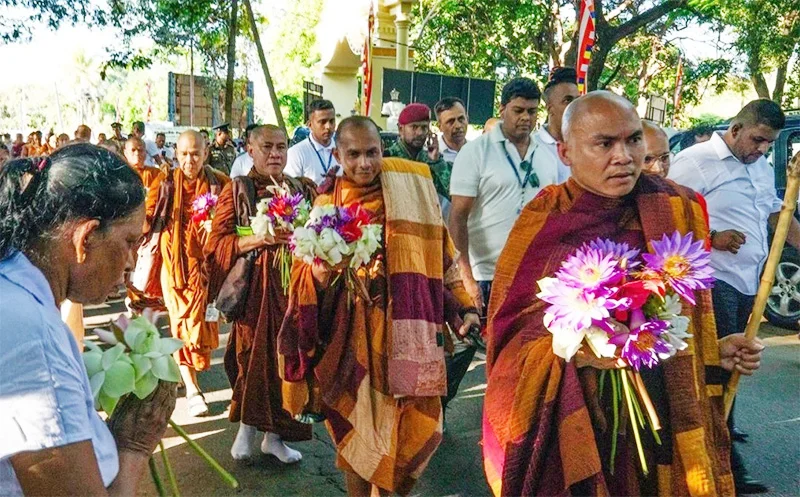
The ongoing peace march by a group of international Buddhist monks has captured the sentiment of Sri Lankans in a manner that few public events have done in recent times. It is led by the Vietnamese monk Venerable Thich Pannakara who is associated with a mindfulness movement that has roots in Vietnamese Buddhist practice and actively promoted among diaspora communities in the United States. The peace march by the monks, accompanied by their mascot, the dog Aloka, has generated affection and goodwill within the Buddhist and larger community. It follows earlier peace walks in the United States where monks carried a similar message of mindfulness and compassion across communities but without any government or even media patronage as in Sri Lanka.
This initiative has the potential to unfold into an effort to nurture a culture of peace in Sri Lanka. Such a culture is necessary if the country as the country prepares to move beyond its history of conflict towards a more longlasting reconciliation and a political solution to its ethnic and religious divisions. The government’s support for the peace march can be seen as part of a broader attempt to shape such a culture. The Clean Sri Lanka programme, promoted by the government as a civic responsibility campaign focused on environmental cleanliness, ethical conduct and social discipline, provides a useful framework within which such initiatives can be situated. Its emphasis on collective responsibility and shared public space makes it sit well with the values that peacebuilding requires.
government’s previous plan to promote a culture of peace was on the occasion of “Sri Lanka Day” celebrations which were scheduled to take place on December 12-14 last year but was disrupted by Cyclone Ditwah. The Sri Lanka Day celebrations were to include those talented individuals from each and every community at the district level who had excelled in some field or the other, such as science, business or arts and culture and selected by the District Secretariats in each of the 25 districts. They were to gather in Colombo to engage in cultural performances and community-focused exhibitions. The government’s intention was to build up a discourse around the ideas of unity in diversity as a precursor to addressing the more contentious topics of human rights violations during the war period, and issues of accountability and reparations for wrongs suffered during that dark period.
Positive Response
The invitation to the international monks appears to have emerged from within Buddhist religious networks in Sri Lanka that have long maintained links with the larger international Buddhist community. The strong support extended by leading temples and clergy within the country, including the Buddhists Mahanayakes indicates that this was not an isolated effort but one that resonated with the mainstream Buddhist establishment. Indeed, the involvement of senior Buddhist leaders has been particularly noteworthy. A Joint Declaration for Peace in the world, drawing on Sri Lanka’s own experience, and by the Mahanayakes of all Buddhist Chapters took place in the context of the ongoing peace march at the Gangaramaya Temple in Colombo, with participation from the diplomatic community. The declaration, calling for compassion, dialogue and sustainable peace, reflects an effort by religious leadership to assert a moral voice in favour of coexistence.
The popular response to the peace march has also been striking. Large numbers of people have been gathering along the route, offering flowers, water and support to the monks. Schoolchildren have been lining the roads, and communities from different religious backgrounds extend hospitality. On the way, the monks were hosted by both a Hindu temple and a mosque, where food and refreshments were provided. These acts, though simple, carry a message about the possibility of harmony among Sri Lanka’s diverse communities. It helps to counter the perception that the Buddhist community in Sri Lanka is inherently nationalist and resistant to minority concerns that was shaped during the decades of war and reinforced by political mobilisation that too often exploited ethnic identity.
By way of contrast, the peace march offers a different image. It shows a readiness among ordinary people to embrace values of compassion and coexistence that are deeply embedded in Buddhist teaching. The Metta Sutta, one of the most well-known discourses in Buddhism, calls for boundless goodwill towards all beings. It states that one should cultivate a mind that is “boundless towards all beings, free from hatred and ill will.” This emphasis on universal compassion provides a moral foundation for peace that extends beyond national or ethnic boundaries. The monks themselves emphasised this point repeatedly during the walk. Venerable Thich Pannakara reminded those who gathered that while acts of generosity are commendable, mindfulness in everyday life is even more important. He warned that as people become unmindful, they are more prone to react with anger and hatred, thereby contributing to conflict.
More Initiatives
The presence of political leaders at key moments of the march has emphasised the significance that the government attaches to the event. Prime Minister Harini Amarasuriya paid her respects to the peace march monks in Kandy, while President Anura Kumara Dissanayake is expected to do so at the conclusion of the march in Colombo. Such gestures signal an alignment between political authority and moral aspiration, even if the translation of that aspiration into policy remains a work in progress. At the same time, the peace march has not been without its shortcomings. The walk did not engage with the Northern and Eastern parts of the country, regions that were most affected by the war and where the need for reconciliation is most acute. A more inclusive geographic reach would have strengthened the symbolic impact of the initiative.
In addition, the positive impact of the peace march could have been increased if more effort had been taken to coordinate better with other civic and religious groups and include them in the event. Many civil society and religious harmony groups who would have liked to participate in the peace march found themselves unable to do so. There was no place in the programme for them to join. Even government institutions tasked with promoting social cohesion and reconciliation found themselves outside the loop. The Clean Sri Lanka Task Force that organised the peace march may have felt that involving other groups would have made it more complicated to organise the events which have proceeded without problems.
The hope is that the positive energy and goodwill generated by this peace march will not dissipate but will instead inspire further initiatives with the requisite coordination and leadership. The march has generated public discussion, drawn attention to the values of mindfulness and compassion, and created a space in which people can imagine a different future. It has been a special initiative among the many that are needed to build a culture of peace. A culture of peace cannot be imposed from above nor can it emerge overnight. It needs to be nurtured through multiple efforts across society, including education, religious engagement, civic initiatives and political reform. It is within such a culture that the more difficult questions of power sharing, justice and reconciliation can be addressed in a constructive manner.
by Jehan Perera
 The countryside and peripheral regions have been neglected in the national imagination for many decades. This has also been the case with regional universities which were seen as mere appendages to the university system, and sometimes created to appease political constituencies in the regions. The exclusion of the rural world and the institutions in those regions was not accidental nor inevitable, but the consequence of conscious policies promoted under an extractive and exploitative global order. Neoliberalism globalisation, initiated in the late 1970s with far-reaching policies of free trade and free flow of capital, or the “open economy,” as we call it in Sri Lanka, is now dying. The United States and the Western countries that promoted neoliberalism, as a class project of finance capital to address the falling profits during the long economic downturn in the 1970s, are themselves reversing their policies and are at loggerheads with each other. However, those economic processes will continue to have national consequences into the future.
At the heart of such policies is the neoliberal city, which has become the centre of the economy with expanding financial businesses and a real estate boom. Such financialised cities also had their impact on universities, in lower income countries, where commercialised education with high fees, rising student debt, research for businesses and transnational educational linkages with branch campuses of Western universities, have become a reality.
In the case of Sri Lanka, while neoliberal policies began with the IMF and World Bank Structural Adjustment Programmes, in the late 1970s, the long civil war forestalled the accelerated growth of the neoliberal city. I have argued, over the last decade and a half, that it is with the end of the civil war, in 2009, coinciding with the global financial crisis, that a second wave of neoliberalism in Sri Lanka led to global finance capital being absorbed in infrastructure and real estate in Colombo. The transformation of Colombo into a neoliberal city was overseen by Gotabaya Rajapaksa as Defence Secretary with even the Urban Development Authority brought under the security establishment. While Colombo was drastically changing with a skyline of new buildings and shiny luxury vehicles drawing on massive external debt, there were also moves to promote private higher education institutions. The Board of Investment (BOI) registered many hundred so-called higher education institutions; these were not regulated and many mushroomed like supermarkets and disappeared in no time when they incurred losses.
In contrast to these so-called private higher education institutions that proliferated in and around Colombo, Sri Lanka, drawing on its free education system, has, over the last many decades, also created a number of state universities in peripheral regions. However, these regional universities lack adequate funding and a clear vision and purpose. The current conjuncture with the neoliberal global order unravelling, and the immediate global crisis in energy and transport are grim reminders of the importance of local economies and self-sufficiency. In this column I consider the role of our regional universities and their relationship to the communities within which they are embedded.
Regional context
The necessity and the advantage of robust public services is their reach into peripheral regions and marginalised communities. This is true of public transport, as it is with public hospitals. Private buses will always avoid isolated rural routes as their margins only increase on the busy routes between cities and towns. And private hospitals and clinics flock to the cities to extract from desperate patients, including by unscrupulous doctors who divert patients in public hospitals to be served in the private health facilities they moonlight. Similarly, it is affluent cities and towns that are the attraction for private educational institutions.
Public institutions, including universities, can only ensure their public role if they are adequately funded. Over the last decade and a half, with falling allocations for education, our state universities have been pushed into initiating fee levying courses, both at the post-graduate level and also for undergraduate international students. These programmes are seen as avenues to decrease the dependence of universities on budgetary support. However, the reality is that it is only universities in Colombo that can draw in students capable of paying such high fees. Furthermore, such fee levying courses end up pushing academics into overwork including by offering additional income.
Therefore, allocations for underfunded regional universities need to be steadily increased. Housing facilities and other services for academics working in rural districts would ensure their continued presence and greater engagement with the local communities. Increased time away from teaching and research funding earmarked for community engagement will provide clear direction for academics. Indeed, such funding with a clear vision and role for regional universities can provide considerable social returns. In a time when repeated crises are affecting our society, agricultural production to bolster our food system as well as rural income streams and employment are major issues. Here, regional universities have an important role today in developing social and economic alternatives.
Reimagining development
In recent months, there have been interesting initiatives in the Northern Province, where the Universities of Jaffna and Vavuniya have been engaging state institutions on issues of development. In an initiative to bring different actors together, high level meetings have been convened between the staff of the Agriculture Faculty and officials of the Provincial Agriculture Ministry to figure out solutions for long pending agricultural problems. Similar meetings have also been organised between provincial authorities and the Faculties of Technology and Engineering in Kilinochchi. These initiatives have led to academics engaging communities and co-operatives on their development needs, particularly in formulating new development initiatives and activating idle projects and assets in the region. Such engagement provides opportunities for academics to share their knowledge and skills while learn from communities about challenges that lead to new problems for research.
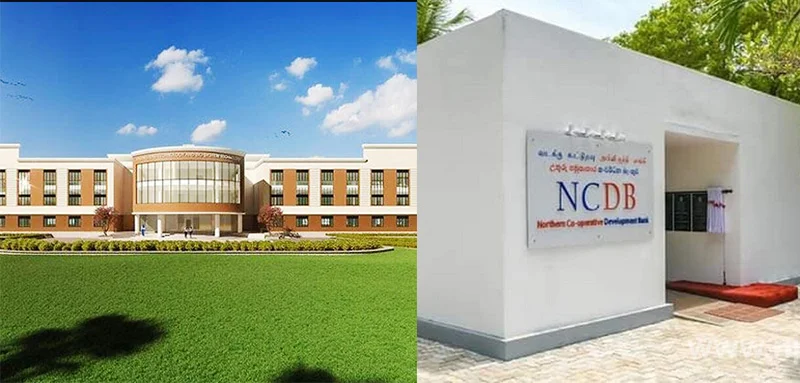
One of the most rewarding engagements I have been part of is an internship programme for the Technology Faculty of the University of Jaffna, where four batches of final year students, from food technology, green farming and automobile specialities, have been placed for six months within the co-operative movement through the Northern Co-operative Development Bank. This initiative has created a strong relationship between the Technology Faculty and the co-operative movement, with a number of former students now working fulltime in co-operative ventures. They are at the centre of developing solutions for rural co-operatives, including activating idle factories and ensuring quality and standards for their products.
I refer to these concrete initiatives because universities’ role in research and development in Sri Lanka, as in most other countries, are often narrowly conceived to be engagement with private businesses. However, for rural regions, the challenge, even with technological development, is the generation of appropriate technologies that can serve communities.
In Sri Lanka, we have for long emulated the major Western universities and in the process lost sight of the needs of our own youth and communities. Rethinking the development of our universities may have to begin with an understanding of the real challenges and context of our people. Our universities and their academics, if provided with a progressive vision and adequate resources and time to engage their communities, have the potential to address the many economic and social challenges that the next decade of global turmoil is bound to create.
Ahilan Kadirgamar is a political economist and Senior Lecturer, University of Jaffna.
(Kuppi is a politics and pedagogy happening on the margins of the lecture hall that parodies, subverts, and simultaneously reaffirms social hierarchies)
by Ahilan Kadirgamar
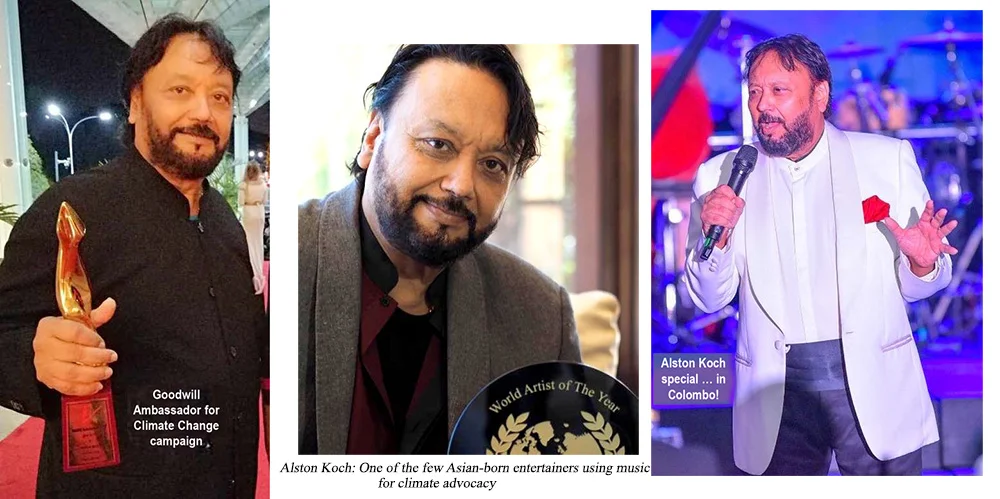
 The name Alston Koch is generally associated with the hit song ‘Disco Lady.’ Yes, he has had several other top-notch songs to his credit but how many music lovers are aware that Alston is one of the few Asian-born entertainers using music for climate advocacy, since 2008.
He is back in the ‘climate change’ scene, with SUNx Malta, to celebrate Earth Day 2026, with the release of ‘A Symphony for Change’ – a vibrant Dodo4Kids video by Alston.
The inspiring musical video highlights ocean conservation and empowers children as future climate champions, honouring Maurice Strong’s legacy through education, creativity, and global collaboration for a sustainable planet.
The four-minute animated musical, composed and performed by platinum award-winning artiste Alston Koch, brings to life a resurrected Dodo, guiding children on a mission to clean up marine environments.
With a catchy melody and an uplifting message, the video blends entertainment with education—making climate awareness accessible and engaging for the next generation.
SUNx Malta is a Climate Friendly Travel system, focused on transforming the global tourism sector that is low-carbon, SDG-linked, and nature-positive.
Professor Geoffrey Lipman, President of SUNx Malta, described the project as a joyful collaboration with purpose:
“It’s always a pleasure to produce music with Alston for the good of our planet. And this time, to incorporate our Dodo4Kids in the video urging the next generation of young climate champions to help save our seas.”
For Alston, now based in Australia, the collaboration continues a long-standing journey of climate-focused creativity:
Says Alston: “I have been working on climate songs since the first release, in 2009, of the video ‘Act Now.’ Since then, I’ve performed at major global events—from Bali to Glasgow. I wrote this song because the climate horizon is darkening, and our kids and grandkids are our best hope for a brighter future.”
Alston’s very first climate song is ‘Can We Take This Climate Change,’ released in 2008.
It was written by Alston for the World Trade Organisation presentation, in London, and presented at ‘Live the Deal Climate Change’ conference in Copenhagen.
The Sri Lankan-born singer was goodwill ambassador for the campaign, and the then UK Minister Barbara Follett called it a “gift in song to the world suffering due to climate change.”
Alston said he wrote it after noticing butterflies, birds, and fruit trees disappearing from his childhood days.
In 2017, his creation ‘Make a Change’ was released in connection with World Tourism Day 2017.
Alston Koch’s work on climate advocacy is pretty inspiring, especially as climate change is now creating horrifying problems worldwide, and in Sri Lanka, too.
Alston also indicated to us that he has plans to visit Sri Lanka, sometime this year, and, maybe, even plan out a date for an Alston Koch special … a concert, no doubt.
Can’t wait for it!

Plane crashes near South Sudan’s Juba, killing all 14 on board

Gunmen kidnap 23 children from Nigerian orphanage

US press gala shooting suspect charged with attempting to kill Trump

Showers above 75 mm are likely at some places in the Western, Sabaragamuwa, Central, North-western, North-central and Southern provinces and in Mannar district

Hazlewood and Bhuvneshwar lead rout of Delhi Capitals

Govt. assures UN of readiness to introduce ‘vetting process’ for troops on overseas missions

‘Dates have the highest sugar content to fight Coronavirus’

Sunday Island 27 December – Headlines

#SundayIsland 17th December – Headlines

Sunday Island – 28th March

Sunday Island Headlines – 21 March

Sunday Island – 21st February – Headlines
-

 News5 days ago
Lanka faces crisis of conscience over fate of animals: Call for compassion, law reform, and ethical responsibility
-
 News4 days ago
Whistleblowers ask Treasury Chief to resign over theft of USD 2.5 mn
-

 News4 days ago
No cyber hack: Fintech expert exposes shocking legacy flaws that led to $2.5 million theft
-

 News1 day ago
BIA drug bust: 25 monks including three masterminds arrested
-

 Business2 days ago
Nestlé Lanka Announces Change in Leadership
-

 News1 day ago
Banks alert customers to phishing attacks
-
 News5 days ago
USD 2 mn bribe: CID ordered to arrest Shasheendra R, warrant issued against ex-SriLankan CEO’s wife
-
 News2 days ago
Hackers steal $3.2 Mn from Finance Ministry