
Business
An overview of new Securities and Exchange Commission Act


By Viraj Dayaratne PC
Chairman Securities and
Exchange Commission of Sri Lanka
Continued from yesterday
Prosecutorial Discretion of the Commission
Criminal proceedings
Consequent to the completion of investigations by the Commission, if the Commission is of the view that sufficient evidence exists to establish the commission of an offence under Part V, steps will be taken to institute criminal proceedings. Since criminal proceedings are to be instituted in the High Court and charges are filed in the form of an ‘indictment’ which can be presented only by the Attorney General as stated in the Code of Criminal Procedure Act (with the exception indicated in the Bribery Act), the Commission will refer the matter to the Attorney General for the filing of indictment and the prosecution will be conducted by the Attorney General. Even when charges were to be filed in the Magistrate’s Court in respect of all offences under the previous Act, the preparation of the charges and the conduct of the prosecution was by the Attorney General.
The offences other than what is contained in Part V are triable in the Magistrate’s Court.
Civil Proceedings
A new feature that has been introduced by the Act is the discretion conferred on the Commission to institute civil proceedings in the High Court exercising civil jurisdiction which is commonly referred to as the Commercial High Court in order to recover damages and to seek the imposition of a civil penalty. The Act has specifically conferred this jurisdiction on the Commercial High Court. Such proceedings can be instituted against a person who has committed a contravention under Part V. The decision of the Commission to institute such proceedings will depend on the ‘nature and manner of the contravention, the impact it has on the market and the extent of the loss caused to any investor’. The amount recoverable by the Commission will be three times the gross amount of the pecuniary gain made or loss avoided and the penalty the court can impose will not be less than ten million and not more than one hundred million rupees depending on the severity or gravity of the contravention. How damages so recovered will be distributed has also been stated.
The Commission has also been vested with the discretion to enter in to an agreement with any person with or without the admission of liability to pay an amount equivalent to three times the gross amount of the pecuniary gain made or loss avoided in respect of contraventions under Part V. Offences other than those enumerated under Part V can be compunded for a sum not exceeding one half of the maximum fine that can be imposed for such offence.
Administrative Sanctions
Another important feature that has been introduced is the ability of the Commission to impose ‘Administrative Sanctions’ on wrongdoers. Previously, the Commission was not expressly empowered to impose penalties or other administrative sanctions although all contraventions were considered as offences.
However, depending on ‘the nature and manner of the contravention, non compliance or breach and its impact’ this new provision leaves the Commission with the discretion (except in respect of offences under Part V) of imposing a variety of administrative sanctions such as a reprimand, penalty, restitution, imposing a moratorium on or prohibiting trading etc.
Steps to protect assets of investors and right to seek certain orders from court
Some of the other new features are the ability of the Commission to take certain steps to protect assets of investors, issue directives during the course of conducting investigations or inquiry known as ‘freezing orders’ (which are valid only for a period of seven days and thereafter to be confirmed by the Commercial High Court), power to apply to the Commercial High Court in situations of violations or imminent violations seeking certain orders such as a declaration that a securities transaction is void, directing a person to dispose of any securities etc.
Development of the Capital market
There are several provisions in the Act that will contribute towards the development of the market. The use of state of the art infrastructure such as the much needed Central Counterparty (CCP) has been recognized which will greatly minimize central counterparty risk and also enable the introduction of new products. The new law spells out the requisites for investing in derivatives (such as futures and options irrespective of the nature of the underlying asset), stock borrowing and lending, regulated short selling etc. This will enhance the liquidity levels in the market and take away the one sided potential that is presently available and help create a vibrant market. Long term investors will benefit from these opportunities.
The trading of unlisted securities is facilitated through a platform operated by a recognized market operator thus providing an additional trading platform. The ability for ‘market makers’ to operate as a market intermediary will ensure continued and efficient exchange of securities between buyers and sellers. This will provide depth to the market and also encourage the setting up of funds such as exchange traded funds.
Furthermore, the new law has redefined ‘securities’ to include an array of securities in keeping with new developments across the world. Similarly, there is also provision for ‘Collective Investment Schemes’ which go beyond Unit Trusts. As to what would come under this umbrella has been defined. These will provide new investment opportunities.
In line with expanding the product range that is currently available in the market, a category of persons have been recognized as ‘accredited investors’. Not only will this result in the protection of non-sophisticated investors, but will facilitate the issue of high risk instruments to the market which could be utilized by those who are in a position to take higher risks.
Provisions for the protection of whistleblowers have been included with the expectation that it will facilitate the curbing of market malpractices. Whilst it is important to ensure that this protection is not abused by making frivolous claims, the benefits such a system can bring forth should not be discounted.
Checks and Balances on powers and discretion of the Commission
The Commission has been vested with wider powers and discretion under the Act in order to ensure that it can perform its functions as a regulator in a more meaningful and effective manner. However it must be borne in mind that the Commission does not enjoy immunity and like any other public authority that has been vested with power and discretion, has to exercise such power and discretion according to law and will have to in all instances follow the rules of natural justice. It is relevant to note that the power and discretion vested in the Commission is circumscribed by several checks and balances that will ensure that the Commission will be held accountable and will not under any circumstance exceed its authority.
They take the form of provisions which mandates the commission to hear a party before it takes a decision against such party, affords a party a right of appeal, requires the Commission to give reasons for certain decisions as well as those that require the Commission to obtain orders from court and where the court is expected to afford a hearing to the affected party before making an order.
Further, the common law remedy of being able to challenge a decision of the Commission by way of a writ application in the Court of Appeal has been re-iterated in the Act thus statutorily fortifying the rights of an aggrieved party.
Conclusion
It is expected that the progressive provisions of the Act will make sure that all market participants have the confidence and the necessary environment to engage in their activities which is the ultimate goal of a capital market. The Commission as the regulator of the market at all times will be aware of the perils of over regulation and therefore be committed to striking the right balance. At the same time it must be emphasized that if all market participants practice self-regulation and act within the confines of the law, there will be no necessity for most of the provisions contained in the law to be made use of.
Concluded

Business
Redefining Industry Standards: Home Lands Group Emerges as Sri Lanka’s Premier Force in Lifestyle and Developer Leadership


At a time when Sri Lanka’s property landscape is experiencing rapid transformation, one organisation continues to define the direction of the market through scale, innovation, and an unwavering commitment to quality. At the 2025 PropertyGuru Asia Property Awards (Sri Lanka), the Home Lands Group of Companies maintained its place at the peak of the industry, acquiring two of the most influential awards of the year: Best Developer for the Group and Best Lifestyle Developer for Home Lands Skyline (Private) Limited.
These distinctions signify more than just project-level success. They reflect the organisation’s leadership in shaping how Sri Lankans aspire to live, work, and invest.
The Home Lands Group has built a broad presence throughout Sri Lanka’s most active corridors, from the rapidly evolving suburbs of Colombo to the developing lifestyle hubs of Negombo, Malabe, and Kahathuduwa, guided by extensive market research. The Group has transformed its in-depth knowledge of the property market into a portfolio of assets embodying superior residential living experiences, supported by strategically located branches that deliver an integrated suite of real estate services for buyers nationwide.
Home Lands Skyline, the Group’s flagship development arm and the 2025 Best Lifestyle Developer, is responsible for this on-ground reach. The company was commended for shaping communities through visionary residential environments and for its ability to combine cutting-edge sustainability with expansive lifestyle amenities. With 19 completed projects, including the largest integrated golf community in Sri Lanka and nine sustainable developments, Home Lands Skyline keeps raising the bar for efficiency, design, and placemaking.
Both ambition and operational strength are evident in its recent accomplishments. The company completed a number of landmark projects such as Elixia 3C’s Apartments, Santorini Resort Apartments & Residencies, and the 1,200-unit Canterbury Golf Resort Apartments & Residencies, which has more than 50 resort amenities that meet international standards and the nation’s first day-and-night golf course. In addition, the Group’s remarkable 58% market share earned it the title of Sri Lanka’s Most Preferred Residential Real Estate Brand in the RIU Brand Health Survey.
This growth is supported by a sustainability-first philosophy. The company incorporates environmental responsibility into every stage of development, from modular construction, renewable energy integration, and ethical sourcing throughout its supply chain to passive design principles that improve natural light and ventilation. This dedication is demonstrated by its Platinum Award at the CIOB Green Awards 2024.
The Home Lands Group is at the forefront of creating new lifestyle expectations as demand for well-planned, resort-style communities rises. In addition to confirming past achievements, the Group’s 2025 victories at the PropertyGuru Asia Property Awards (Sri Lanka) indicate a trajectory of ongoing leadership, positioning it as a transformative force in the future of Sri Lankan real estate.

The opening weeks of 2026 are offering a glimmer of cautious hope for the business community weary from years of economic turbulence and steep financing costs. The Central Bank’s latest weekly economic indicators signal more than just macroeconomic stability. They point to early signs of a long-awaited trend; a measurable dip in borrowing costs.
“If sustained, this shift could transform steady growth into a robust, investment-led expansion,” a senior economist told The Island Financial Review.
The benchmark Average Weighted Prime Lending Rate (AWPR) declined by 21 basis points to 8.98% for the week ending 16 January, according to the Central Bank.
“For entrepreneurs and CEOs, this is not just another statistic. It could mean the difference between postponing an expansion and hiring new staff. Across boardrooms, the hope is that this marks the start of a sustained downward trend that holds through 2026,” he said.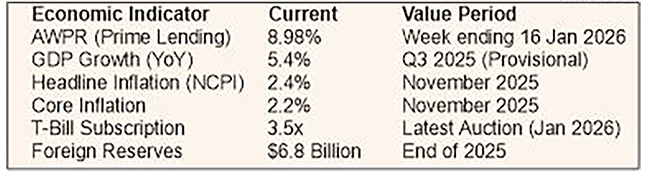
When asked about the instances where Treasury Bills are not fully subscribed by the investors, he replied,” Treasury Bill yields remained broadly stable, with only minimal movement across 91-day, 182-day, and 364-day tenors. Strong demand was clear, with the latest T-Bill auction oversubscribed by about 3.5 times. This sovereign-level stability creates room for the gradual easing of commercial lending rates, allowing the Central Bank to nurture a more growth-supportive monetary policy.”
Replying to a question on how he views the inflation numbers in this context, he said, “The year-on-year increase in the National Consumer Price Index stood at a manageable 2.4% in November, with core inflation at 2.2%. Such an environment should allow interest rates to fall without sparking a price spiral. For businesses, it means the real cost of borrowing adjusted for inflation, and it is becoming more favourable for them. While consumers still face weekly price shifts in vegetables and fish, the broader disinflation trend gives policymakers leeway to keep credit affordable.”
Referring to the growth trajectory, he mentioned, “With GDP growth provisionally at 5.4% in the third quarter of 2025 and Purchasing Managers’ Indices signalling expansion in both manufacturing and services, the economy is in a growth phase. However, to accelerate this momentum businesses need capital at lower cost to modernise machinery, boost export capacity, and spur innovation. Affordable credit is, therefore, not merely helpful, it is essential to shift growth into a higher gear.”
In conclusion , he said,” The coming months will be watched closely, because for Sri Lankan businesses, a sustained decline in borrowing costs isn’t just an indicator; it’s the foundation for growth. There’s hope that this easing in the cost of money will prevail through most of the year.”
By Sanath Nanayakkare ✍️

Mercantile Investments & Finance PLC has expanded its national footprint to 90 branches with a new opening in Tangalle, reinforcing its commitment to community accessibility. The trusted non-bank financial institution, with over 60 years of service, now supports diverse communities across Sri Lanka with leasing, deposits, gold loans, and tailored lending.
This physical expansion aligns with significant financial growth. The company recently surpassed an LKR 100 billion asset base, with its lending portfolio doubling to Rs. 75 billion and deposits growing to Rs. 51 billion, reflecting strong customer trust. It maintains a low NPL ratio of 4.65%.
Chief Operating Officer Laksanda Gunawardena stated the branch network is vital for building trust, complemented by ongoing digital investments. Managing Director Gerard Ondaatjie linked the growth to six decades of safeguarding depositor interests.
With strategic plans extending to 2027, Mercantile Investments aims to convert its scale into sustained competitive advantage, supporting both customers and Sri Lanka’s economic progress.

At least six killed in Pakistan as fire rips through Karachi shopping mall

Chile declares ‘state of catastrophe’ as deadly wildfires menace cities

At least 21 killed in Spain after crash involving high-speed trains

U – 19 World Cup: Mahboob, Sadat star for Afghanistan against West Indies

U – 19 World Cup: Rew, Mayes lead England to victory

Mitchell, Phillips centuries trump Kohli’s as New Zealand win first-ever ODI series in India

‘Dates have the highest sugar content to fight Coronavirus’

Sunday Island 27 December – Headlines

#SundayIsland 17th December – Headlines

Sunday Island – 28th March

Sunday Island Headlines – 21 March

Sunday Island – 21st February – Headlines
-

 Editorial2 days ago
Illusory rule of law
-

 News3 days ago
UNDP’s assessment confirms widespread economic fallout from Cyclone Ditwah
-

 Business5 days ago
Koaloo.Fi and Stredge forge strategic partnership to offer businesses sustainable supply chain solutions
-

 Editorial3 days ago
Crime and cops
-

 Features2 days ago
Daydreams on a winter’s day
-

 Editorial4 days ago
The Chakka Clash
-

 Features2 days ago
Surprise move of both the Minister and myself from Agriculture to Education
-

 Business5 days ago
SLT MOBITEL and Fintelex empower farmers with the launch of Yaya Agro App