
Features
Panadura Vadaya: A Socio-historical Sketch

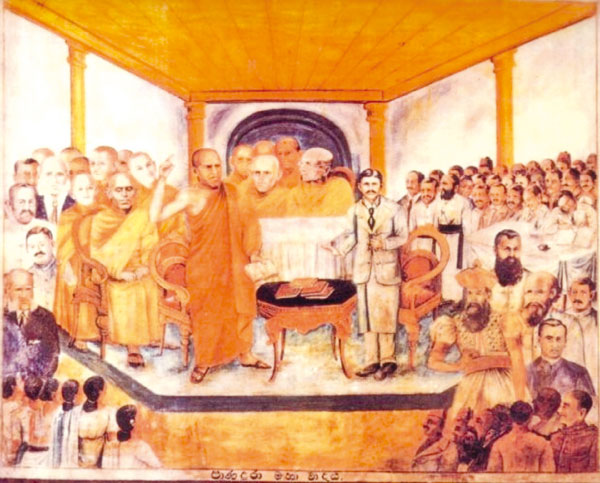
by Dr D. Chandraratna
The important historical fact about the Colonial narrative of Buddhism in Sri Lanka was the ability of Buddhist ideals to survive even when the external political circumstances were highly unfavourable. The Panadura Vadaya signifies in many ways that dogged determination on the part of the educated sangha fraternity to persevere with the struggle, and more importantly in that struggle to delve deeper into scriptures to challenge Christianity at a scholastic level.
When Christianity had state backing it was not surprising for the colonialists to harbour an apocalyptic vision of the eventual triumph of Christianity. Therefore it was not unusual for the Colonial secretary Tennent to assert that the dissociation of the State from Buddhism will only expedite its inevitable decay as Spence Hardy, the Wesleyen missionary, had predicted in his book, The British Government and the Idolatry of Ceylon in 1839.
The educated sangha, on the other hand were acutely aware of the protection that Buddhism needed State patronage to arrest its decline but their pleas to honour the promises made in the Kandyan Convention of 1815 fell on deaf ears. By the middle of the 19th century British authors were cautiously optimistic that ‘Buddhism, shorn of its splendour, unaided by authority, will fall into disuse before Christianity is able to step into its place’ (Forbes, 1839).
The elite Sinhalese Christians like James Alwis while appreciating the colonial powers for propagating Christianity nonetheless lamented that Buddhist decline will erode the language and literature of the Sinhalese which he said is the heritage of Ceylon, maintained mostly by the sangha under whose tutelage even J Alwis acquired his punditry. He wrote that the ‘names of Batuantudawe, Hikkaduwe, Lankagoda, Dodanpahala, Valane, Bentota, Kahave and Weligama amongst a host of others have produced compositions by no means inferior to to those of a Buddhaghosa or a Parakkrama‘. Contrary to the missionary statements and the colonialist assumptions, erudition in Buddhist scriptures and knowledge of Pali, Sanskrit and Sinhalese was no less lacking among the sangha who were many, not the exception.
Monastic (Pirivena) and Missionary education
It was no secret that without state patronage monastic education, which was the mainstay of local knowledge and intelligence, waned drastically. Colebrooke’s insistence on English education with its declared outcomes such as the civilizing potential, secular advantage through state employment, and the pathway to redemption through the Christianizing intent was a blow to vernaculars. It discouraged many to receive the monastic pirivena which was the provider of indigenous language and religious knowledge. Major Davy was correct in his observation in 1815, that in the Kandyan provinces reading and writing is far from the uncommon acquirements and is as general as in England’ (Forbes 1839). But Colebrooke dismissed monastic learning curtly in one sentence. He said, ‘monastic education scarcely merits any notice’. A sub committee of the Legislative Council reported in 1867 that ‘whatever taught is intertwined with error and superstition and if left in the hands of Buddhist and Hindu priests will defeat the aims and objects of all of primary education’.
There was another reason for the neglect and virtual abandonment of Pirivena education in the Kandyan provinces. The Temple Lands Ordinance of 1856 contributed in no small measure to the use of monastic wealth, which earlier was used for pirivena schools, diverted for personal advantage of the incumbent monks. In most places usufruct of the lands became assets to individual monks and not to the institutions that they were in charge. It was noted in the Report of the Commission on the Administration of Buddhist Temporalities that, ‘The Kandyan priesthood lead a life of the careless and sensual…, and the offerings and produce of the lands are devoted for personal enjoyment. C. B Dunuvile, the Diyawadana Nilame and grandson of the Disave of Walapane who signed the Kandyan Convention complained that monks have abandoned their priestly duties and are engaged in temporal pursuits and all but a few are even ignorant of Pali. This statement was given before the Commission by Rambukwelle Sonuttara Thera of the Malwatta Chapter.
The British continued with state assistance to missionary education, as much as the Dutch, right from the beginning with Governor North taking the initiative. A few years into his tenure he wrote to the Colonial Secretary for missionary assistance to education. The Baptists arrived in 1812 and the Wesleyans (1814) and Church of England (1818) and the Americans followed by the London Missionary Society thereafter. In addition the government employed its own colonial chaplains, preachers and catechists in the State Ecclesiastical establishment.
Education no doubt was tied up with diffusion of Christianity and the Schools Commission, the important instrumentality was in the control of the Anglicans. The missionary effort extended beyond mere education for their evangelical zeal was not limited to, ‘making the natives learned men’ but in fact leading them to the Redeemer, i.e., conversion to Christianity. Their greater aim was directed to the larger multitude of ‘heathens’ outside the school, to whom they had to go by taking on the role of the itinerant preacher. John Murdoch set the example by resigning his position as Headmaster of the Government Central School in Kandy. His personal journal reads, ‘I shall require to travel on foot and shelter at night wherever I can; I shall be following the example of the Apostles, yea, of the Saviour Himself’.
Preachers: Christian and Buddhist Styles
The Christians had to face stiff competition from the Buddhists who were skilled preachers from yore. The latter had enduring contacts with the villagers and the missionaries even with state patronage, were handicapped from the start. Their English competency was of no use here. Proficiency in Sinhalese was an absolute necessity. It was an impediment to the foreigner competing with the Buddhist monk who was clearly in a class of his own. The missionary was at times offensive in the use of language and idiom, made worse by the novelty of the Buddhist scriptural content, which he only mastered after arrival in the island.
The complex system of word usage in Sinhala proved virtually an insurmountable hurdle to the foreign missionary. The use of pronouns conjoined with status differentials baffled them no end and often ended up offending the audience. An English author wrote in the preface to the English-Sinhalese dictionary that one Sinhalese singular person equivalent of the term you had fourteen different terms, each in the measure of the status of the person. The missionaries were so confused and virtually gave up by sticking to just one or two, which were less than polite. The word you in addressing a gathering became tho and umbala and the aristocrats in the audience were offended to be addressed as umba or tho in the presence of their subordinates seated alongside. Tho, thopi (you), Varella (come), palayalla (go), karapalla (do) did not please many in the audience. The Buddhist monks consciously avoided all status differentials by the use of the endearing term pinvathni flattering everyone.
To make matters worse the Sinhala translation of the Bible sponsored by the Church missionaries arbitrarily used one simplified term in translating the Sinhala equivalent of you as tho and thopi (meaning thou) was highly offensive to all and sundry. It was on the premise that it followed the simplicity that God had intended. On the use of the pronoun tho, wrote the chief translator Lambrick, ‘to apply tho to a man of respectable class is an actionable offence… a native professor of the Christian community admitted that he shudders whenever he reads that passage where the Devil using the derogatory term tho to our blessed Saviour’. They still retained it in the hope with time it will be weakened and diminished by the ‘mighty power of simplicity and truth’ of the Bible. But after much controversy and ill feeling the church missionaries back tracked and gave into Sinhalese Christians like James Alwis and John Pereira, and a new acceptable version of the Bible appeared in the 1860’s.
The Missionary preachers faced an uphill battle from the outset. Their countenance was problematic. Their unfriendly attitude of superiority, appearance and even personal aloofness were very much unfamiliar to the villager. Most Buddhist villagers therefore refused to attend. The preachers felt it and they complained to the Missions that that they are often taunted, cajoled and met with contempt, opprobrium and laughter. The villagers at times ridiculed the missionaries in demanding payment for attendance or arrack to sit till the end, in the knowledge that Europeans levied heavy taxes on arrack and had a penchant for liquor.
The arrival of the Print word
Religious controversy, proselytization debate and preaching received a boost with the introduction of the printing press. The Dutch firstly established a printing press in 1736 and the Wesleyans under a trained printer Mr. Harvard revived the printing press. They were followed by the Christian Church Mission and Baptists few years later. The Sinhalese Tract Society was organized under John Murdoch in 1849. The missionaries used the press to instruct the Christian believer and furthermore to convert the nominal believer into a devout disciple and in so doing, ‘save the deluded heathen from idolatrous superstition’ of the local faith, seen by the Europeans as ‘a massive evil structure’.
Gogerly, the manager of the Wesleyan Press was convinced that ‘it is by the press that our principal attacks must be made upon this wretched system’. The missionary tracts and pamphlets had an extensive circulation, helped by the fascination of Buddhists to read the printed word. This same development was to assist the Buddhists to counter the Christian effort and retaliate, but with the added benefit of scholarly dialogue and debate for which they were superior to the foreigner. Ultimately it played a major role in the revival of Buddhism and nationalism in the country.
The activities of the missionaries were not taken as a serious matter by the many. The Buddhists in the low country were interested in halting the decline of their religion than competing with the missionaries. Tennent wrote that ‘Active hostility was scarcely visible’ except the enthusiasm to propagate their own religion by erecting ‘banamaduwa’s and holding pinkam’. In fact the low country Sinhalese were quite comfortable with both Buddhism and Christianity having lived through the foreigner and their different faiths for centuries. It was not uncommon for the Sinhala Christians to be tutored by Buddhist monks for whom they showed the greatest respect. In fact many Sinhalese were willing to get their children baptised, with ‘no regard to their worthiness’ as Christians for legalities and secular advancement and also in the hope they become closet Buddhists. The clergy also did not mind fake baptisms in order to bolster the statistics to enhance the incomes to their missions.
(To be continued)

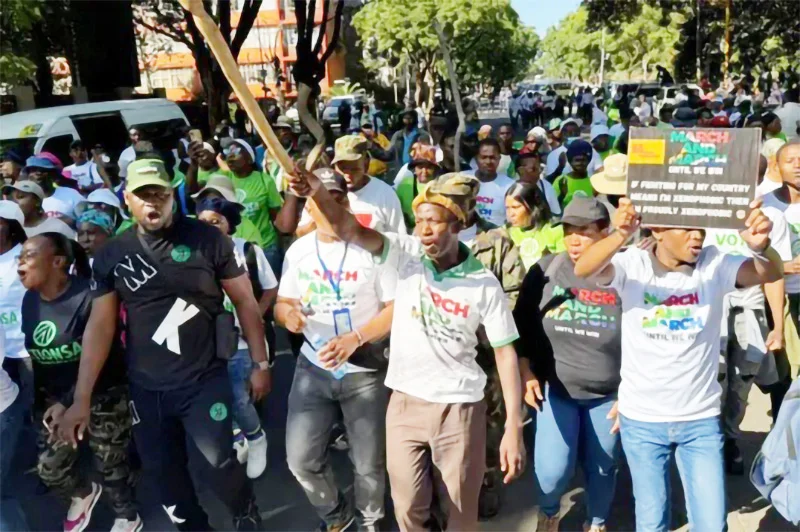
 The current outbreak of anti-immigrant protests in Durban, South Africa is bound to have taken many a subscriber to value-based politics or political idealism quite by surprise. After all, this is evidence that despite the historic accomplishments of nation-builders of the stature of the late President Nelson Mandela it cannot be taken for granted that identity politics, including racism in its worst forms, is no more in South Africa.
At the time of this writing details are scarce on the substantive root causes of the protests but it could very well be that economic grievances, particularly on the part of the majority community in South Africa, are contributing considerably to the disaffection. Shrinking employment and material prospects are likely to figure majorly among the factors igniting the unrest.
Fortunately, the local authorities in Durban are losing no time in calling for peaceful co-existence among the relevant communities and are pointing to the vital importance of stepping-up national integration processes. Apparently, immigrants in sizable numbers from neighbouring countries are present in Durban. However, international TV footage of the protests quoted some local authorities as saying that the majority of the immigrants in some centres that housed them were not illegal migrants and had the documents that entitle them to be in Durban.
In the Durban protests the world has fresh proof of the socially divisive consequences of the gathering globe-wide economic disaffection, touched off particularly by the continuing crisis in West Asia. Going ahead, the world would need to brace for increasing identity-based unrest of the kind it is just witnessing in South Africa.
Considering that the material lot of ordinary people everywhere could only aggravate progressively, with the US and Iran showing no signs of negotiating an end to their confrontation any time soon, it will be left to the more democratic and progressive sections of the world community to initiate positive measures collectively to bring a measure of relief to the discontented.
The swiftness with which such relief will be provided would depend crucially on the importance those sections taking up these undertakings attach to value-based politics as opposed to Realpolitik of power politics.
Going by these yardsticks, Italy could be considered to be moving in the right direction. Recently Italy came to the fore in initiating the collective named, ‘Rome Coalition for Food Security and Access to Fertilizer’, which has as one of its aims the swift provision of fertilizer to economically weak African countries.
In a recent statement Italian Minister of Foreign Affairs and International Cooperation, Antonio Tajani, said that a principal aim of the project was to ensure that the farmers of Africa gained easy access to fertilizer, considering that food security is a growing concern among some of Africa’s economically vulnerable countries.
The statement went on to mention that some 30 countries hailing from the Mediterranean region, the Middle East, the Balkans as well as the FAO had been invited to join the coalition. The venture is far-seeing in that food security is main among the reasons for social discontent which in turn could degenerate into endemic political turmoil and bloodshed. Separatist violence and geographical fragmentation of countries wouldn’t be too far behind these developments, as Africa itself has often proved.
It is hoped that more G7 countries would take the cue from Italy and do what they could to ease the hardships of economically distressed countries, particularly of the global South. In these efforts they would need to break rank with the US, which is today brutally indifferent to the consequences of its policy of making ‘America First’, come what may.
Going by current developments, the Trump administration seems to be blithely oblivious to the wider, deleterious effects of its policy course in West Asia. Besides rendering Iran militarily and otherwise impotent nothing else seems to matter to Washington, as regards West Asia. This is policy short-sightedness of an extreme kind. After all, right now West Asia could be said to be sitting on the proverbial powder keg.
On the other hand, Iran is not giving the world the impression that it is doing anything constructive to get out of the policy straitjacket that it wove for itself decades ago. Rather than enter into a policy of ‘live and let live’ in relation to Israel in particular and initiate a process of reconciliation with the latter, it has chosen to operate within policy parameters that continue to damn Israel. This has put Israel always on the ‘defensive’ so to speak and prevented the opening up of space for meaningful dialogue.
That said, Israel is obliged to explore the possibilities of entering into a negotiatory process with the Arab-Islamic world that could lead to a de-escalation of tensions and bloodshed. It cannot continue to look at its neighbours through lenses that distort them as archetypal enemies who should be ‘wiped off completely from the face of the earth.’
In other words, the need is urgent for Realpolitik to give way to value-based politicks. Italy is beginning to prove that the latter approach could be pursued with some success. May be the EU and the UK could throw their weight behind these initiatives as well and establish that international politics could be refashioned on the basis of humane, civilized norms. The UN would need to be fully supportive of these moves and prove an organizational nucleus of the operations that follow.
In fact the time is ripe for people of conscience to collectively stand up on the side of peace and say ‘No’ to war and violence. Organizations such as the ICRC, the WHO and Medicines Sans Frontiers have already taken up this call. Referring to the widespread destruction of health facilities and their dehumanizing results these organizations have said, among other things, that ‘This is not a failure of the law. It is a failure of political will.’
True, ‘failure of political will’ among those powers that matter accounts for the runaway, uncontrollable nature of war and destruction in contemporary times, but more fundamentally it is a failure of the human conscience. It could very well be that the phenomenal levels to which violence and war have been unleashed today have had the effect of deadening consciences. This is a matter for urgent study and wide discussion.

 I would describe Indunil Kaushalya Dissanayaka as innovative and creative, and she operates under the name of Cuteefly.
Indunil always comes up with something novel to celebrate special occasions, and she does it with candles … and that’s her profession.
She was in the spotlight when she created a happening scene, with candles, for Christmas, Sinhala and Tamil New Year, and Valentine’s Day.
As lanterns light up Sri Lanka for Vesak, the Colombo-based candle maker is quietly turning wax and wick into little pieces of the festival.

Candles reflecting Vesak themes
Her candles reflect Vesak themes – light, peace, remembrance, giving, etc., to enable you to fill your Vesak celebration with devotion and beauty.
Among her Vesak creations is a lotus-shaped soy candle, scented with sandalwood, lavender, etc., meant to burn during this Vesak Poya Day.

Indunil Kaushalya Dissanayaka: Customers
praise her for her creativity
These handcrafted Vesak candles are perfect for offering at the temple, she says.
What makes her creations so novel is that they come in different shapes, scents, themes, and all are handmade.
What’s more, her customers have heaped praise on her for her creativity.
According to Indunil, her creations are perfect as a thoughtful gift … to bring beauty, unity, and light into every moment.
Says Indunil: “Our beautifully handcrafted Unity candles are designed with premium detail and love, making them perfect for celebrations, gifts, and meaningful occasions.”
Cuteefly, says Indunil, is available online.
Readers could contact Indunil on 0778506066 for more details.
He Facebook Page is: Cuteefly.

Handmade with love

 Yes, dark spots do crop up on the skin, especially with sun exposure and, of course, as the skin ages.
However, these tips should be of immense benefit to those who are faced with dark spots.
* Lemon and Honey Glow Mask:
You will need 01 teaspoon lemon juice and 01 teaspoon honey.
Mix the lemon juice and honey well and then apply this mixture, only on the dark spots.
Leave for 10–15 minutes and then rinse with cool water.
Benefits:
Lemon helps brighten pigmentation.
Honey moisturises and heals skin.
Gives a natural glow.
* Aloe Vera Gel Treatment:
All you need is fresh aloe vera gel.
Apply the gel apply on dark spots, before going to bed.
Leave overnight and wash in the morning.
Benefits:
Reduces acne marks and pigmentation.
Soothes irritated skin.
Helps skin repair naturally.
* Turmeric and Yoghurt Paste:
You will need 01 teaspoon yoghurt and a pinch of turmeric
Mix the yoghurt and turmeric into a smooth paste and apply on affected areas.
Leave for 15 minutes and then wash gently with lukewarm water.
Benefits:
Turmeric brightens skin naturally.
Yoghurt removes dead skin cells.
Helps fade dark spots gradually.
Use these packs 02-03 times a week as results are generally seen over time.
You can also try this out: Mix a ripe papaya into a smooth paste and apply to the face, or directly on to the dark spots. Leave for 15-20 minutes and then wash with lukewarm water.

Advisory for strong winds and rough seas for the sea areas extending from Kankasanthurai to Chilaw via Mannar and from Galle to Pottuvil via Hambantota

West Indies to host Sri Lanka, New Zealand and Pakistan in 2026 home season

Hacking claims, mismatched answer-sheets: Controversies rock school exam in India

Iran says it targeted American base after fresh US strikes

Farmers Affected by the Nilwala Salinity Barrier paid Rs. 1.2 Billion in Compensation

State Vesak Festival held with the participation of the President

‘Dates have the highest sugar content to fight Coronavirus’

Sunday Island 27 December – Headlines

#SundayIsland 17th December – Headlines

Sunday Island – 28th March

Sunday Island Headlines – 21 March

Sunday Island – 21st February – Headlines
-

 Business7 days ago
Historic launch of CCWE Fashion Week & International Summit 2026
-

 News5 days ago
All-New GRAVITE launches at LKR 6.99 Mn
-

 Features5 days ago
The NPP’s pivot to the past
-
 News4 days ago
Police probe underway to ascertain links between criminals deported from UAE and local politicians
-
 News3 days ago
Easter Sunday carnage: Court told Maulana’s statement cannot be accepted without cross-examination
-

 Opinion7 days ago
The need to reform Buddhist ecclesiastical order
-
 Features5 days ago
End of Peacekeeping
-
 Opinion3 days ago
Undermining the democratic political framework