
Business
‘Over 85% of Sri Lanka’s estate community receive first jab, 63% fully vaccinated’

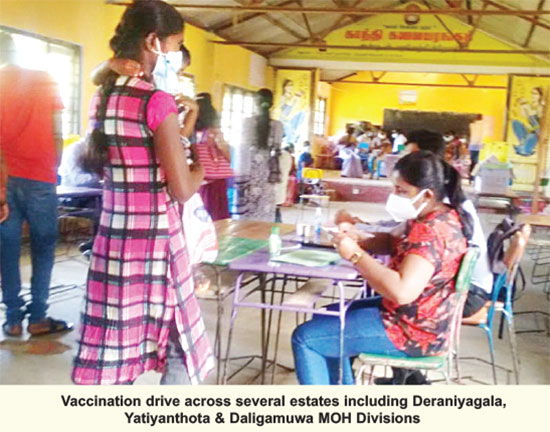
The Planters’ Association of Ceylon (PA) and the Plantation Human Development Trust (PHDT) announced major progress in their collective efforts to safeguard all residents of Sri Lanka’s estate community, with over 85% of the community across 7 regions having received their first dose of a COVID-19 vaccine, and 63% being fully as at 10th September 2021.
Working in close partnership with the Ministry of Health (MoH), Provincial Health Authorities & PHDT, Regional Plantation Companies (RPCs) have been able to fast track the rate of vaccinations for its estate workers and their families.
“With the number of COVID cases on the rise once again, ensuring the safety of our estate workers and their families is a priority for all RPCs. Vaccinations are being carried out systematically while continuous investments are being made to strengthen safety protocols. Our mission is to ensure that all our workers and the community at large, are fully vaccinated by end September 2021.” PA media spokesperson Dr. Roshan Rajadurai said.
“We are deeply grateful to the authorities for their vital assistance in this endeavor and we remain totally committed to ensuring the safety and wellbeing of all our employees.”
As of 10th of September, over 87% of those between the ages of 30-59 received their 1st doses, while over 58% received their 2nd doses thus far. Priority has also been given to those above 60 years, with over 92% having received their first jab and over 79% having received their 2nd jab in the estate sector.
The PA noted that the inoculation drive commenced from the Nuwara-Eliya district (Covering Hatton & Nuwara Eliya) since the largest community of estate workers reside in this area. Over 85% of 30-60 year olds having already received their first dose while over 54% received their 2nd dose. Meanwhile, over 89% of individuals from the other plantation districts belonging to the same age category received their 1st dose while 62% received their 2nd dose.
“The vaccination distribution is held under three phases with priority being given to frontline workers, secondly the factory workers inclusive of community leaders & thirdly, the staff and the wider community. We are pleased to note that we have reached the final half of the third phase. The rate at which vaccinations were conducted could not have been achieved without the assistance of relevant stakeholders.
“Prior to the vaccines being distributed, estate managers worked closely with MoH officials and PHIs in order to raise awareness about the vaccine, and alleviate all doubts. This drastically reduced any hesitancy which the community had towards vaccines, which in turn was instrumental to the successful rollout of vaccines among the estate community,” PHDT Director-General Lal Perera said.
“While we continue to keep up the momentum of the vaccine drive, COVID 19 awareness programmes and basic healthcare/welfare services continue to operate unhindered. Proactive measures like a regional help desks have been set up for the estate community throughout the pandemic. A COVID 19 steering committees with relevant stakeholders along with RPC coordinators have also been appointed to ensure guidelines meted out by the MOH are being adhered to across all factories.” Dr. Rajadurai concluded.



The Cabinet of Ministers has approved the resolution furnished by the Minister of Industries and Entrepreneurship Development to recognize the “Sri Lanka National Export
Development Plan – 2026–2030” as the official strategic framework for export development and promotion of exports in Sri Lanka.
The Sri Lanka Export Development Board, in collaboration with public and private sector stakeholders connected to the export sector, has formulated the National Export Development Plan 2026–2030 by obtaining technical assistance under the Policy-Based Lending Programme of the Asian Development Bank.
The aforementioned Plan provides a comprehensive strategic framework to guide and monitor Sri Lanka’s export development process, with the target of earning US$ 36 billion in foreign exchange through the export of goods and services by the year 2030

Sri Lanka’s long-discussed electricity grid connection with India is gaining renewed momentum, as the Asian Development Bank (ADB) intensifies efforts to promote cross-border energy integration across the region.
At the ADB Annual Meetings in Samarkand, Senior Director for Energy, Priyantha Wijayatunga, identified the proposed India–Sri Lanka grid interconnection as the most promising avenue to strengthen the island’s power sector. The concept dates back to the 1970s, when Sri Lanka, following the completion of the Mahaweli Development Project, even explored the possibility of exporting electricity. However, rapid economic growth and rising domestic demand shifted the country toward energy imports.
Today, with energy security and cost pressures mounting, the idea has regained urgency. “The time is right,” Wijayatunga said, stressing that political will and financing will be decisive. While undersea transmission cables make the link technically viable, costs remain a major challenge. The ADB, he confirmed, stands ready to support Sri Lanka as a development partner in advancing the project.
Sri Lanka’s prospects are closely tied to a broader regional vision being advanced by the ADB through its Pan-Asia Power Grid Initiative (PAGI). The initiative aims to transform how energy is produced, shared, and consumed across Asia and the Pacific by promoting cross-border electricity trade and grid connectivity.
PAGI is designed not merely as a collection of projects, but as a systems-level integration platform that connects national grids into subregional and eventually continent-wide networks. Its core objectives include bridging energy gaps, enhancing energy security, integrating large-scale renewable energy, and strengthening resilience across interconnected systems.
A key pillar of PAGI is leveraging the region’s resource complementarity. Countries in South Asia, for instance, possess uneven but highly complementary energy resources—hydropower in Nepal and Bhutan, and solar and wind potential in India. By linking grids, countries like Sri Lanka could tap into these diverse energy sources, reducing dependence on costly fossil fuel imports while improving reliability.
ADB estimates suggest that deeper regional power trade in South Asia could yield substantial economic benefits, including lower system costs and more efficient energy distribution. The initiative also envisions mobilizing up to $50 billion in investments by 2035, expanding transmission infrastructure, and improving electricity access for millions.
For Sri Lanka, integration into such a regional grid could be transformative. A connection with India would allow the country to import affordable electricity during shortages, stabilize supply, and support its transition toward cleaner energy. It could also open the door to future participation in a wider South Asian power market.
With feasibility studies and policy discussions already underway, and with ADB backing firmly in place, Sri Lanka’s long-envisioned grid connection with India now appears more achievable than ever.
As the Samarkand meetings underscore the urgency of regional cooperation in an increasingly uncertain energy landscape, Sri Lanka stands at the threshold of a new chapter—one where energy security is strengthened not in isolation, but through connection.
by Sanath Nanayakkare in Samarkand, Uzbekistan

Sri Lanka this week finds itself at the centre of a deepening global ocean crisis, as leading scientists, policymakers and conservationists gather in Colombo for Sharks International 2026—a high-profile summit unfolding against mounting evidence that the world is rapidly losing control of its marine ecosystems.
The conference, now underway at the Bandaranaike Memorial International Conference Hall, marks the first time the prestigious forum has been hosted in Sri Lanka. But beneath the diplomatic language and scientific exchanges lies a far more urgent reality: the collapse of shark and ray populations is no longer a distant environmental concern—it is an unfolding economic and food security emergency.
More than 100 million sharks and rays are being wiped out globally each year, largely due to overfishing and illegal, unreported and unregulated (IUU) fishing. In Sri Lanka, the situation is particularly acute. Of the 105 species recorded in local waters, nearly 70 are now threatened with extinction, a statistic that scientists warn should set off alarm bells far beyond conservation circles.
Deputy Minister of Environment Anton Jayakody did not mince words when addressing the gathering, framing the issue not just as an ecological tragedy but as a looming economic shock.
“This is not just about saving species. It is about protecting the foundation of our fisheries, our food systems, and the livelihoods of thousands of Sri Lankans. If shark and ray populations collapse, the consequences will ripple through the entire marine economy,” he said.
Sharks and rays sit at the top of the ocean food chain. Their disappearance disrupts the delicate balance of marine ecosystems, triggering cascading effects that can decimate commercially valuable fish stocks. For a country like Sri Lanka—where coastal communities depend heavily on fisheries—this is not an abstract threat but a direct challenge to economic stability.
Yet despite years of warnings, critics argue that global action has been dangerously slow, fragmented, and often undermined by competing commercial interests.
By Ifham Nizam

Cabinet approves recognition of ‘Sri Lanka National Export Development Plan – 2026–2030’
Cabinet nod to accept the Global Charter for Children’s Care Reform for Sri Lanka
Cabinet grants policy approval to amend the Consumer Affairs Authority Act, No. 9 of 2003
Cabinet approal for Legal Draftsman to prepare a Bill to enable the amendment of Finance Business Act, No. 42 of 2011

M.S. Mahadiulwewa appointed act in the post of Director General of Commerce
Wimal S.K. Liyanagama appointed Director General of Customs

‘Dates have the highest sugar content to fight Coronavirus’

Sunday Island 27 December – Headlines

#SundayIsland 17th December – Headlines

Sunday Island – 28th March

Sunday Island Headlines – 21 March

Sunday Island – 21st February – Headlines
-

 News7 days ago
Rooftop Solar at Crossroads as Sri Lanka Shifts to Distributed Energy Future
-

 News2 days ago
CJ urged to inquire into AKD’s remarks on May 25 court verdict
-
 News6 days ago
“Three-in-one blood pressure pill can significantly reduce risk of recurrent strokes”
-

 News3 days ago
USD 3.7 bn H’tota refinery: China won’t launch project without bigger local market share
-

 News6 days ago
Alarm raised over plan to share Lanka’s biometric data with blacklisted Indian firm
-

 News5 days ago
Ten corruption cases set for court in May, verdict ordered in one case – President
-

 News4 days ago
Easter Sunday Case: Ex-SIS Chief concealed intel, former Defence Secy tells court
-

 News6 days ago
USD 2.5 mn fraud probe: Interdicted MoF official found dead at home