
News
Health Management Consultant promotes remote working beyond the pandemic


By Rathindra Kuruwita
The public and private sectors should encourage their employees to work remotely, even after the pandemic, Pharmaceutical and Healthcare Management Consultant Dr. Sanjaya Perera said yesterday.
Dr. Perera told The Island that one of the main reason why COVID cases had increased after the lifting of the lockdowns was people returning to work. Not only did people travel in congested buses and trains, but also spent eight hours or more in enclosed spaces, most of which were air-conditioned.
“This is a recipe for disaster. If the public and private sectors put in place systems to facilitate work from home, millions of people will not be exposed to the virus and it will have a significant impact on the pandemic prevention,” Dr. Perera said.
Dr. Perera said that remote work had also made a lot of economic sense. In the EU, companies were increasingly closing down physical offices and encouraging people to work from home. Companies had given people a subsidy to convert a room at home into an office space.
“This would also work here. A company must spend a significant amount of money to rent an office in Colombo or any of the main cities. It is also obvious that except factory workers, marketers and a few such categories, most people in any company can work from home. This will not only save millions on rent, but companies can save a lot on utilities, etc.,” he said.
Dr. Perera said that encouraging people to work from home also had a number of positive externalities that would positively impact the environment and the country’s economy. Working remotely reduced private vehicles on the road and congestion in public transport, making travelling to and from work a more pleasurable experience.
“Sri Lanka spends a lot of dollars on importing fuel. Fuel imports can be drastically reduced by having people work from home. There will be less emissions that reduces the impact on the environment and it will reduce congestion, which is a major problem. I consult for a number of hospitals and one of the biggest complaints is that the ambulances get stuck in traffic,” he said.
Working from home also boosted productivity, Dr. Perera added. Research from the US had shown that productivity doubled when employees worked from home.
“Some people have told me that government servants are not working properly when they are at home. That’s because we have not set systems and protocols in place. There are many ways of ensuring that people work, from high tech solutions to just setting targets. President Gotabaya Rajapaksa comes from a computer science background, I think he is the ideal leader to promote remote working,” Dr. Perera said.


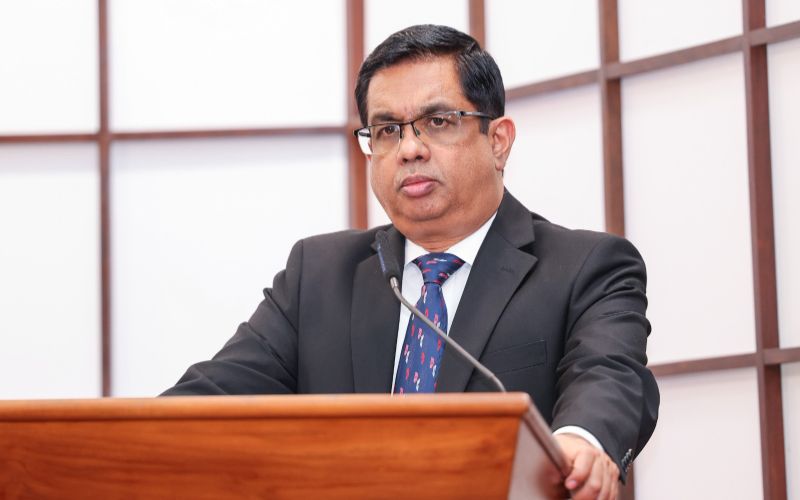
The Memorandum of Understanding (MoU) relating to the project to provide technological solutions to prevent wild elephants from being hit by trains was signed yesterday (01) afternoon at the President’s Media Centre, under the patronage of Secretary to the President Dr Nandika Sanath Kumanayake.
Coordinated through the “Clean Sri Lanka” programme, the project is being implemented as a public-private partnership, with the Railway Department, the Department of Wildlife Conservation and the Forest Conservation Department working together, with full financial support from People’s Bank.
The system consists of three-beam detection, passive infrared (PIR) sensors, automatic temperature sensors and a tamper alarm system to detect animals weighing more than 20 kilogrammes and unauthorised interference. Signal lights (red/yellow/green) installed on either side of the railway tracks, together with a special screen installed inside the locomotive cab, will alert the driver in advance to the exact location of an elephant.
A demonstration test of the system was successfully conducted at the Pinnawala Elephant Orphanage premises in the presence of the relevant officials, following which a report on the system was prepared.
The system will be implemented as a pilot project from next month at 13 locations where wild elephant accidents are frequent. A newly developed website is also scheduled to be launched to enable the progress of the project to be viewed live.
Additional General Manager of Railways P.D.S.B. Chandrasena, Director General of Wildlife Conservation M.S.L.R.P. Marasinghe, Conservator General of Forests S.C. Palamakuumbura and Chairman of People’s Bank Chandana Guniyangoda signed the relevant MoU. Officials from the Clean Sri Lanka Secretariat, including Presidential Additional Secretary (Clean Sri Lanka) Engineer S.P.C. Sugeeshwara, as well as senior officials from the Railway Department, Department of Wildlife Conservation, Forest Conservation Department and People’s Bank, were also present.
[President’s Media Division]

The Commissioner General of Examinations has announced that the results of the 2026 Grade 5 Scholarship Examination have been released online, and can be viewed on the department’s official website: www.doenets.lk

Prime Minister Dr. Harini Amarasuriya departed Sri Lanka on Monday, 31 August, to undertake an official visit to Bhutan to participate in the Global Conscious Food Systems Summit, scheduled to be held in Bhutan.
During her visit, Prime Minister Dr Amarasuriya participated in the opening plenary of the Summit on 1 September, where she delivered a keynote address under the theme “Rising to the Moment: Igniting Consciousness to Address the Polycrisis.”
The Prime Minister will also engage in discussions with international leaders and representatives on strengthening cooperation towards sustainable food systems, food security and resilient communities.

[Prime Minister’s Media Division]

Nilakshika fifty, Athapaththu seven-for rescue Sri Lanka against Indonesia

Winners to receive medals at Western Province School Games after many years

MoU signed for technology to prevent wild elephant-train collisions

Grade 5 scholarship exam results released

Prime Minister participates in Global Conscious Food Systems Summit in Bhutan

Bouchier century sets England up for record 282-run chase against Ireland

‘Dates have the highest sugar content to fight Coronavirus’

Sunday Island 27 December – Headlines

#SundayIsland 17th December – Headlines

Sunday Island – 28th March

Sunday Island Headlines – 21 March

Sunday Island – 21st February – Headlines
-

 News6 days ago
Eight politicians in drug kingpin probe
-

 Features4 days ago
“Wrap Me Up in My Blazer”— A Gentlemanly Bradby Reminiscence
-

 Business6 days ago
Sri Lanka opens up: A new season of direct connectivity
-

 Features3 days ago
When Sri Lankan stories find their own voice
-
 Features6 days ago
Redefining ageing in Sri Lanka
-
 Latest News7 days ago
Nepal-Tibet floods: What happened, what caused them and who is missing?
-

 Editorial7 days ago
Unfolding El Niño and burning issues
-

 Editorial6 days ago
The toxic legacy of two lakes