
News
Focus on growing threat within as Taliban expands its hold

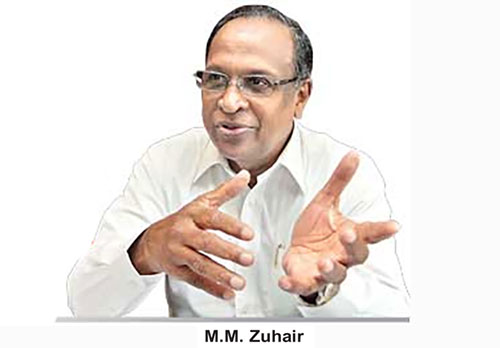
Lanka’s former Amb. in Teheran discusses Afghan crisis
The latest US State Department announcement, quoted by Washington Examiner indicates that 99 countries, including the US, EU and NATO have worked out a deal with the Taliban, while honouring the 31st August evacuation deadline, to permit all foreign nationals, employees and Afghans who had worked with the foreign forces and missions and Afghans at risk, to leave freely, even after the deadline,in a safe and orderly manner, to any destination providing travel authorisation, Sri Lanka’s former Ambassador in Iran M.M. Zuhair, PC told The Island yesterday.
Sri Lanka, though not in the list of 99 countries, and international entities named in the joint agreement with the Taliban, was unlikely to face problems, in view of Sri Lankan Prime Minister Mahinda Rajapaksa’s post August 15 initiatives with the Taliban for a working arrangement with Afghanistan pending the formation of a care taker government, the former MP said.
“It is clear that the Taliban is in the process of enhancing its global credentials but dangerously constrained by possible terror attacks from Afghan violent extremist entities, like the Afghan Khorasan (IS-K) and to a lesser extent Ahmed Massoud’s National Resistance Front (NRF), believed to be under British handlers,” he said.
Zuhair said: “Meanwhile agents of the Western arms industry, operating from the US as well as Scandinavian countries, and Singapore, are decrying even a working relationship with the Taliban, raising issues of electoral legitimacy of the Taliban, obviously irrelevant at the moment. They continue to label Taliban as a “terrorist” outfit, ostracizing and alienating the freedom fighter movement’s efforts to regain the transitional administration of the country, ignoring the several positive statements of the new Taliban leadership that have come out of Kabul since August 15.”
“Some among them have gone far in fake fear mongering that dealing with the new Taliban will send wrong signals to the Tamil and Muslim minorities here, looking at all minorities divisively and thereby creating distrust and conflict at the expense of Sri Lanka’s national interest. They have also attempted to link the 2019 Easter Sunday attacks to the ISIS and Al-Qaeda, which terror outfits are widely believed to be linked to Western handlers. For more on this please see my article in The Island/Features of 30 August 2021 titled, AL Qaeda and ISIS will get buried if US and NATO stop invading other nations.
“These prophets of doom and gloom must stop fear-mongering that the Sri Lankan minorities are inimical to Sri Lanka. If this country had taken the advice of these prophets, Sri Lanka would have got isolated as against the 99 countries who have thought it fit to deal with the Taliban, the movement which is exercising power in Afghanistan today.
“However the The Island of 27.08.2021 has stood out with a commendable editorial, “Afghans deserve help” and may I add “not hate”.
Responding to The Island questions Zuhair said:
*Both the US and Sweden, according to Western media reports, had received intelligence of a likely attack at the Kabul airport, prior to the August 26 carnage that killed close upon 200 persons in the airport. Having resumed control of almost all parts of Afghanistan, the Afghan Taliban on August 15, resumed control of the Afghan capital Kabul, following Afghanistan’s US-backed President Ashraf Ghani abdicating post unannounced and escaping overseas, leaving the country without a government or facilitating a transitory administration. The US contingent expedited their departure from Kabul even faster.
According to the head of the US Central Command, Marine Gen. Kenneth F McKenzie Jr, the Taliban had thwarted several attacks in Afghanistan since resuming control of the country in mid-August. While the US forces were in full control of the Karzai airport, reports indicate that Taliban had enhanced security checks and posts, outside the airport, possibly aware of likely attacks targeting those flying off from the country.
The Afghan- Khorasans, identified by Western media as ‘IS-K’ and described as a sworn enemy of the Talibans, with an estimated 2000 fighters said to be operating to the North East of Kabul, had been identified as responsible for the deadly August 26. With the threat of a further attack, targeting the airport, both the US and the Taliban had been seen anxious to complete the exit of primarily foreign forces, before the August 31st deadline expires on Tuesday. Taliban has also announced that others wanting to leave could leave thereafter on commercial flights.
* The Afghan-Khorsans attack must be condemned. I do not claim any expertise on the dastardly events in Afghanistan but two possibilities must be considered. The Khorsans, much weaker than the Taliban, may want to strengthen their cadre, by showing that the Taliban were betraying the Afghans in allowing the free exit of those who treasonably worked for the country’s “enemies”. The other possibility for launching the attack may be to show the world that the Taliban, though in the seat of power, are not in effective control of the country and possibly will not be allowed to have their own way. With Western powers invariably keeping their options open, the Khorsans may be hoping desperately to gain Western attention to serve as a counterweight to the Taliban.
A good example is the 32-year-old Ahmed Massoud, anti -Taliban leader of the National Resistance Front (NRF) based in the Tajik ethnic stronghold of Panjshir valley, 33 miles to the North of Kabul. Massoud was quoted in the Washington Post this month seeking Western support for him to lead the fight against the Taliban. Ahmed Massoud is the son of the legendary leader of the Panjshir valley Shah Massoud who successfully thwarted the Russians from the valley in the 1980s. He was killed in 2001 and was succeeded by his son; picked up by the British, educated at King’s College, London and trained at the Royal Military Academy in Sandhurst!
* Massoud’s offer for the West to back him against the Taliban may be seen as another attempt to serve as a counterweight to the Taliban. There is no doubt that the 20 year US-NATO rule of Afghanistan has led to widespread corruption in a country doomed for years to come economically. The US pull out will close the insidious pipelines of corruption and Massoud needs to show that his Sandhurst training must be put to good use. Massoud may thereafter either follow the footsteps of run- away President Ashraf Ghani or follow his own father’s footsteps.
* The Easter Sunday carnage has no comparison to the developments in Afghanistan. Easter Sunday carnage appears to centre around majoritarian discrimination over the minorities, according to the Parliamentary Select Committee report as well as the Presidential Commission of Inquiry. Afghanistani issues centre on unceasing foreign invasions of a country under various unsubstantiated pretexts. The twain will never meet! In the war in Afghanistan the Taliban were left with an economically crashing country while the Western arms industry is the solitary winner. There is nothing in Afghanistan for anyone to admire or be inspired by. These are dangerous fear mongering against the Sri Lanka Muslims, the only community that stood with the majority against LTTE terrorism.
* One needs to look dispassionately at Norway’s role in Sri Lanka which led to then Prime Minister Ranil Wickramasinghe signing a peace accord not with the moderate TNA but with the terrorist LTTE and Norway’s likely disappointment with the defeat of the LTTE in 2009. We need also to look at the role of Norway and possibly its Oslo University, in brainwashing BBS against the Muslims in 2011/12, which led to the exposure of the Norwegian’s despicable role in pitting the majority community against the country’s demonstrably loyal Muslim minority. Muslims in Sri Lanka today are an utterly disappointed community and that is not good for the economic advancement of the country (SF)


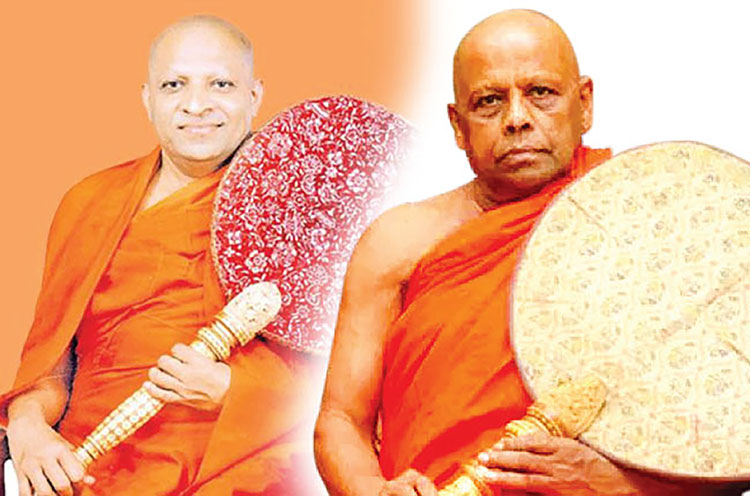
MONETABRIEF– Sri Lanka’s two most senior Buddhist chapters, Malwatte and Asgiriya, demanded special concessions for monks serving prison sentences, following the disrobing of convicted monk Ven. Galagodaatte Gnanasara in line with established procedures.
The chief prelate of the Asgiriya chapter, Most Venerable Warakagoda Sri Gnanarathana, told Prisons Commissioner Senaka Palletenna that Ven. Gnanasara, who is serving a six-year sentence for contempt of court, must be released immediately.
Prison authorities have no power to release or pardon convicts, but Palletenna told the monk in Kandy on Friday that he would convey his request to the relevant government authorities.
“There is no point in talking about this and that… The entire country has been shaken (??????? ) . He must be released,” the Asgiriya chief prelate said.
The Malwatte chief prelate, Most Venerable Thibbatuwawe Sri Siddhartha Sumangala, appeared to accept the court verdict against Ven. Gnanasara, but asked the prisons chief whether a separate section could be established for convicted monks.
Palletenna noted that a special ward for the clergy already existed at Welikada Prison.
At least 63 convicted Buddhist monks are currently incarcerated within Sri Lanka’s criminal justice system.
Meanwhile, a group of 34 Buddhist monks named in a Colombo Fort Magistrate’s Court order to vacate the vicinity of the Presidential Secretariat ended their protest and dispersed after lunch on Friday.The monks are demanding an unconditional pardon for Ven. Gnanasara, who has previously been imprisoned, making him a reconvicted prisoner.
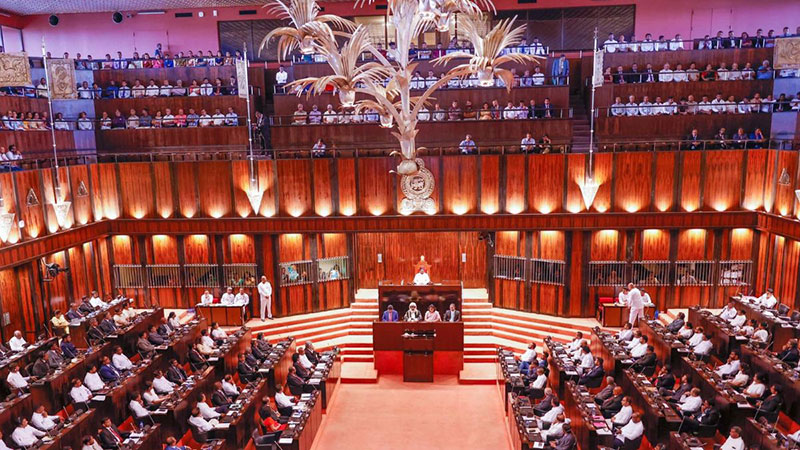
The debate on the no-confidence motion against Speaker Dr. Jagath Wickramaratne, submitted by the Samagi Jana Balawegaya (SJB), has been postponed indefinitely pending the Attorney General’s opinion on certain technical issues in the motion.
Government representatives raised the matter at a meeting of the Committee on Parliamentary Business, pointing out that several provisions of the motion required clarification and that the Attorney General’s advice should be obtained.
As obtaining the opinion would take time, the debate could not be scheduled for the next parliamentary week, parliamentary sources said.
Chief Opposition Whip Gayantha Karunatilaka said a date for the debate would be decided after the Attorney General’s advice was received.
Meanwhile, Parliament is scheduled to meet from October 20 to 23, Secretary General of Parliament Kushani Rohanadeera announced.
The parliamentary business for the week was finalised at a meeting of the Committee on Parliamentary Business held on Friday (16) under the chairmanship of Deputy Speaker Dr. Rizvie Salih.
On each sitting day, the period from 9.30 a.m. to 10 a.m. will be allocated for parliamentary business under Items 1 to 6 of Standing Order 22. Questions for Oral Answers will be taken up from 10 a.m. to 11 a.m., followed by questions under Standing Order 27(2) from 11 a.m. to 11.30 a.m.
On Tuesday, October 20, an Opposition-sponsored Adjournment Motion will be debated from 11.30 a.m. to 5.30 p.m.
On Wednesday, October 21, a resolution under the Public Debt Management Act and a Supplementary Estimate will be taken up for debate and approval from 11.30 a.m. to 5 p.m. The annual reports of five statutory institutions will subsequently be presented for approval without debate, while questions at the Adjournment Time will be taken up from 5 p.m. to 5.30 p.m.
On Thursday, October 22, the Second Reading debates on two Bills to amend the Poisons, Opium and Dangerous Drugs Ordinance (Bills Nos. 79 and 80) will be held from 11.30 a.m. to 5 p.m.
The annual reports of five statutory institutions will then be taken up for approval without debate, followed by an Opposition-sponsored Adjournment Motion from 5 p.m. to 5.30 p.m.
On Friday, October 23, the Second Reading debate on the Elimination of Rabies and Registration of Dogs Bill will be held from 11.30 a.m. to 5 p.m. A Government-sponsored Adjournment Motion will be debated during the final half-hour of the sitting.

Former Navy Commander Admiral Wasantha Karannagoda had, by letter dated May 19, 2014, requested the Secretary to the Ministry of Defence to approve the funds required for former Navy Lieutenant Yoshitha Rajapaksa, son of former President Mahinda Rajapaksa, to attend the Royal Navy Young Officers Course at the Royal Navy Training College in the United Kingdom, the Colombo High Court was told on Thursday (15).
The court was informed that £24,536 in public funds had been spent on the training programme. The details emerged during testimony by a Navy representative appearing on behalf of former Navy Commander Admiral Travis Sinniah before Colombo High Court Judge Udesh Ranatunga, when the money laundering case against Rajapaksa was taken up for hearing.
Responding to questions during cross-examination, the witness explained that payments for Navy officers attending overseas training programmes were generally made in foreign currencies, including US dollars and British pounds.
Meanwhile, Navy Captain Nuwan Thushara Arangala, testifying for the prosecution, told court that Rajapaksa had received a total of Rs. 5,159,626.37 in salaries and allowances during his nine years of service in the Navy.
The court was informed that Rajapaksa had served as a Navy Lieutenant from December 14, 2006, to February 28, 2017, although his service had been suspended on February 28, 2016.
According to the testimony, his monthly gross salary was Rs. 16,390, in addition to allowances for food, uniforms, housing and special duties.
The witness clarified that these allowances did not include payments made for overseas training programmes or participation in sporting events while representing the Navy.
During the proceedings, the prosecution also submitted Rajapaksa’s annual declarations of assets and liabilities for the period from 2009 to 2015.
A National Savings Bank official also testified regarding savings accounts and fixed deposits maintained by Rajapaksa, stating that no withdrawals had been made from the accounts since they were opened.
Rajapaksa is facing charges under the Prevention of Money Laundering Act over his alleged failure to explain the source of nearly Rs. 735 million acquired between August 1, 2012, and August 29, 2013, in Rajagiriya and Bambalapitiya.
The prosecution alleges that funds suspected to have been derived from unlawful activities were deposited in bank accounts and fixed deposits.
The court also heard testimony concerning the appointment of a guardian for Daisy Forrest, the second defendant in the case, and matters relating to the clearance of an imported outside broadcasting (OB) truck associated with CSN television.
Further examination of witnesses was scheduled for October 30, with the court directing 11 prosecution witnesses to appear on that date.

Showers or thundershowers will occur in most parts of the island after 1.00 p.m.

Buddhist hierarchy demands prison perks for monk convicts

Debate on NCM against Speaker postponed indefinitely

Karannagoda pushed for £24,536 for Yoshitha’s UK training, Court told

Flu cases surge across Lanka

Lankan rubies among treasures of London’s Cheapside Hoard

‘Dates have the highest sugar content to fight Coronavirus’

Sunday Island 27 December – Headlines

#SundayIsland 17th December – Headlines

Sunday Island – 28th March

Sunday Island Headlines – 21 March

Sunday Island – 21st February – Headlines
-

 Latest News5 days ago
Nissanka’s return headlines Sri Lanka’s Test squad against Pakistan
-

 Latest News6 days ago
Farhan and Sadaqat help Pakistan seal series in style
-
 Features6 days ago
Intake 16: 45 years of duty and honour
-
 News6 days ago
Malwathu Chapter issues statement on talks with President over Gnanasara Thera’s robes
-
 News6 days ago
CP alleges NPP has taken the blame for illegal US sanctions on Iranian vessels
-

 News4 days ago
Sri Lanka, India caught in US-Iran ship crisis
-

 Opinion6 days ago
How long can Sri Lanka remain silent on its demographic crisis?
-

 Latest News4 days ago
Kusal Mendis’ unbeaten 87 hands Sri Lanka consolation win