
Sports
So brightly fades the skipper

by Rex Clementine
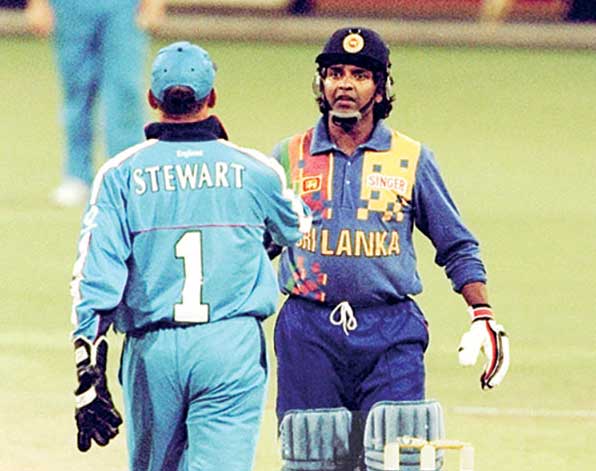
In Australia, they run cricket like a business. In Sri Lanka there was a man who ran cricket like a family. Arjuna Ranatunga is his name and on a day like this, 19 years ago, he retired from the game with his swansong being at the ground that has been home for him for many decades – SSC.
It was an end of an era. Arjuna captained 56 of the 93 Tests he played. He ran the sport with an iron fist.
There was one golden rule in cricket. Never cross Arjuna’s path. He only knew two ways; my way or the highway.
Those whom he thought had a future had to comply and he would back them come hell or high water. Take the case of Sanath Jayasuriya. He was the original ‘bits and pieces cricketer’ having managed just one half-century in his first 50 innings. But the faith and perseverance that Arjuna had shown was such that once he found his feet in the internatioanl arena, he unleashed hell ending the careers of many a cricketer from Manoj Prabhakar to Kabir Ali. They never played cricket again. Arjuna had created a monster.
Not all players he backed were successful. Pramodaya Wickremesinghe for example. He played in more games than the wickets he took! But for Arjuna those players who made the team into a family mattered, more than match winners. Even those who were average cricketers played for Sri Lanka; Eric Upashantha and Suresh Perera to name a few. The only reason they played was they were in the good books of the captain.
Pity those who didn’t fall in line with Arjuna’s thinking. They hardly got a look in. It mattered to him that everyone who took the field with him was on the same wavelength. If he’d asked them to go through a brick wall, they would do it.
Of course, Arjuna could bat. Test runs he has over 4000. Some 1000 more he walked to finish with over 5000 runs.
His battles with leading fast bowlers of his generation were a treat to watch. He was comfortable with pace. Rather than taking them apart, he relied on using the pace to his advantage; nudging boundaries through third man or fine-leg with those late cuts and flicks. Alan Donald or Waqar Younis, the quickest of his generation never bothered him. Wasim Akram with his swing did. Usually, when the opponent was better than him, Arjuna had another way to win the contest; to get under his skin.
Against spin; sweep was his staple diet. Easily, he was the best sweeper of his generation. Of course there was Waruna Waragoda. But he committed a blunder. He had crossed Arjuna’s path, during a mercantile game involving HNB and Union Assurance. And he never played for Sri Lanka.
Arjuna had this knack to identify good potential. He picked Mahela Jayawardene soon after school at the age of 20. Sanath Jayasuriya isn’t the only monster he created.
Arjuna is the only player to feature in a nation’s first Test and its 100th. In between he had missed a dozen Tests. He had his share of injuries but a fair share of fights with the establishment too for which he was axed. In the end, he finished on 93 Tests.
The Board’s CEO was his elder brother and his father was right-hand man of President Chandika Kumaratunga. Had he wished, he could have gone onto play 100 Test matches, becoming the first Sri Lankan to do so. Instead, he opted to go on his terms having played two stunning knocks just before retiring.
In his last tour, in Rawalpindi, Waqar left him with a broken thumb. With the side in peril, with a Test match to be won, Arjuna walked in having taken a pain killer injection and saw Sri Lanka over the line in what was one of the most exciting Test matches ever. He was tough like Allan Border, cunning like Diego Maradona and skillful like Michael Jordan.
Then in his penultimate Test at Asgiriya against Proteas when the team had collapsed to 133 for six chasing 177, he produced another masterclass scoring 88 runs. The old fox had not lost his guile.
He was too good a player to have not scored more than four Test hundreds. But then, in his generation only Aravinda had won more matches than him.
Not everyone agreed with Arjuna’s thinking. But he commands huge respect. Even today, if he tells his team mates to be at his house for a meal on Friday at 7pm, Asanka Gurusinha would make sure he flies all the way from Melbourne to be there on time.






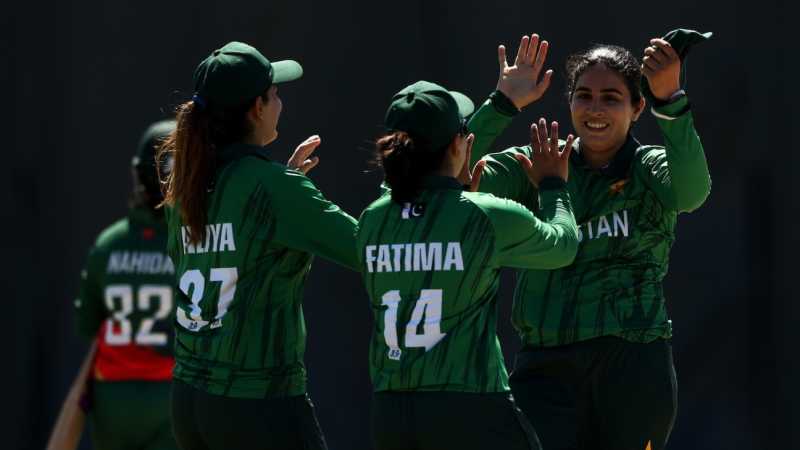
At 67 for 5 in the 12th over, Pakistan were under the cosh against Bqngladesh in their bronze-medal playoff at the Asian Games women’s competition. That’s when Fatima Sana walked out, slammed 45 in 30 balls, and gave Pakistan 145, which was 31 too many for Bangladesh, especially after Umm-e-Hani picked up three top- and middle-order wickets to end with 3 for 10 from her four overs.
Bangladesh’s big concern, of late and in general, has been the number of dot balls they play out in a typical T20 innings. In this game, it was a marginal improvement from the loss to India in the semi-final – they had 43 dot balls here compared to 61 in that game. But it was still fewer than the 48 they bowled to Pakistan in the first half. The difference was Sana, who scored at 150.00 to change the complexion of the contest.
Pakistan’s start had been decent, thanks to Gull Feroza, after they won the toss and opted to bat. Feroza and Shawaal Zulfiqar added 46 in 41 balls before being separated in the seventh over. The one to be dismissed was Feroza, who had scored 31 in 23 balls. Zulfiqar batted on before becoming the third batter to fall, having struggled to 17 off 27 balls. And the wickets kept falling, Shorna Akter picking up two of them to leave Pakistan in a mess with five batters gone.
Sana had a solid stand for the sixth wicket with Aliya Riyaz, who scored 25 in 22 balls and added 67 with Sana in just 43 balls. The control Bangladesh had was gone with the two hitting five sixes between them.
The target for Bangladesh, which looked like it might be in the region of 100, was suddenly closer to 150. And the chase never took off. Umm-e-Hani struck in the third over, then in the fifth over, and again in the 16th over. By then, Bangladesh were floundering: 77 for 5 with under five overs to go.
The resistance came from senior pro Sharmin Akther, who scored an unbeaten 46 in 45 balls, but there was nothing around her, and Pakistan ran out comfortable, 31-run victors.
Scores:
Pakistan women 145 for 8 in 20 overs (Shawaal Zulfiqar 17, Fatima Sana 45, Gull Feroza 31, Aliya Riyaz 25; Sanija Akter Meghla 1-28, Nahida Akter 2-21, Shorna Akter 2-16, Ritu Moni 2-27) beat Bangladesh women 114 for 7 in 20 overs (Dilara Akter 12, Nigar Sultana 25, Sharmin Akhter 46*, Nahida Akter 10*; Tasmia Rubab 1-25, Fatima Sana 1-25, Umm-e-Hani 3-10, Nashra Sandhu 1-19, Ayesha Zafar 1-10) by 31 runs
(Cricinfo)

India Women won the toss and chose to bat first in the Asian Games women’s cricket final in Nishin, Japan.
India: Smriti Mandhana, Shafali Verma, G Kamalini, Harmanpreet Kaur (capt), Richa Ghosh (wk), Bharti Fulmali, Deepti Sharma, Shreyanka Patil, Kranti Gaud, N Shree Charani, Nandani Sharma
Sri Lanka: Imesha Dulani, Chamari Athapaththu (capt), Hasini Perera, Kavisha Dilhari, Harshitha Samarawickrama, Hansima Karunaratne, Kaushini Nuthyangana (wk), Kawya Kavindi, Mithali Ayodhya, Chamudi Praboda, Sugandika Kumari
(Cricinfo)
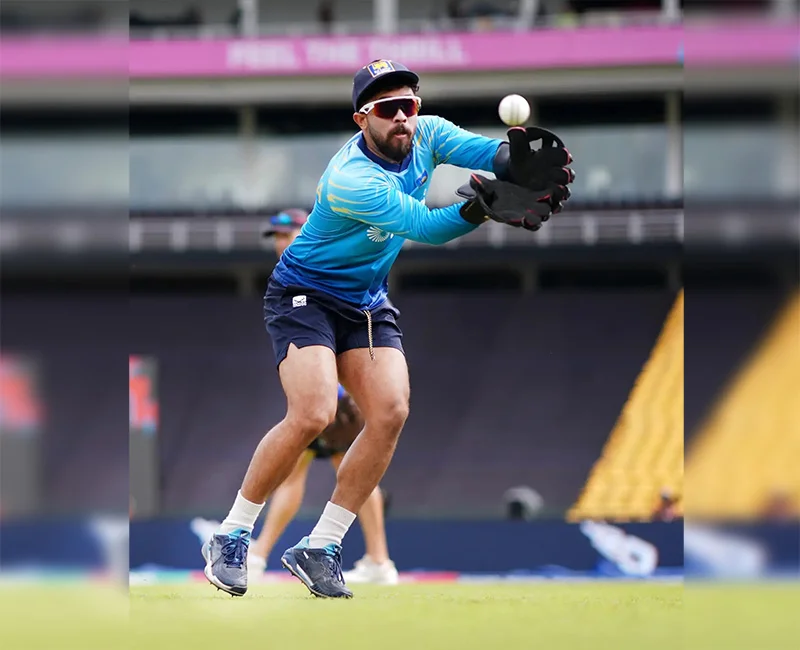
The reins of Sri Lanka’s ODI captaincy will return to Kusal Mendis as the wicketkeeper batter makes his international comeback following a lengthy injury lay off.
Mendis, a regular across all three formats for much of the last decade, was forced into a rare spell on the sidelines after suffering a hamstring injury during the LPL.
The injury ruled him out of the home Test series against India and he subsequently missed the T20I leg of the tour of England, with Charith Asalanka taking over the captaincy. Mendis will lead the side today in the first ODI against England.
 Mendis had returned to action for SSC in last week’s domestic T20 tournament, featuring in both the semi-final and final. He struck a crucial half-century in the semi-final against NCC to help SSC book their place in the final and having proved his match fitness, was flown to England to take charge of the ODI side.
Sri Lanka will hope his return can provide the spark that was conspicuously absent during a chastening T20I series, where the tourists were swept 3-0.
More worrying than the scoreline was the manner of the defeats. Sri Lanka barely landed a punch, with the batting repeatedly folding and the side often failing to use its full quota of 20 overs. It is hardly a new headache either. The shortcomings of the batting unit in the shortest format have been evident for some time, but a remedy remains elusive.
The fact that not a single Sri Lankan batter managed a half-century throughout the three match series only underlined the scale of the problem.
Today’s game will be played at Chester-le-Street in Durham, the northernmost international cricket venue in England. A short drive from Scotland, Durham was also once home to Sri Lankan great Kumar Sangakkara, who had a stint in county cricket with the club.
All-rounder Janith Liyanage, who has developed into a steadying influence in the middle order, is expected to feature, while prolific young run scorer Pavan Rathnayake is also pushing strongly for a place.
Sri Lanka also have the option of promoting Kamil Mishara to open alongside Pathum Nissanka, which would preserve the left-hand, right-hand combination at the top of the order.
Asitha Fernando, who did not feature in the T20I series, returns for the ODIs and is tipped to share the new ball with Dushmantha Chameera. The third seamer’s berth appears to be a toss up between Dilshan Madushanka and Eshan Malinga.
There is no shortage of spin either, with Sri Lanka having to choose from Maheesh Theekshana, Dunith Wellalage and uncapped leg-spinner Sachindu Colombage.
Today’s game gets underway at 5pm Sri Lanka time.
The second match will be played at Headingley on Thursday before the tour concludes in London on Sunday, with The Oval hosting the final ODI, a day game beginning at 3pm Sri Lanka time.

Fatima Sana and Umm-e-Hani secure bronze for Pakistan in Asian Games

India bat first in Asian games womens cricket final

Showers about 100mm will occur in the Western, Sabaragamuwa, Central and North-western provinces and in Galle and Matara Districts

Govt. confident of 2/3 majority despite NPP split speculation

Justice Corea appointed Acting President of the Court of Appeal

Protest against setting up of cement factory in highly populated area near BIA

‘Dates have the highest sugar content to fight Coronavirus’

Sunday Island 27 December – Headlines

#SundayIsland 17th December – Headlines

Sunday Island – 28th March

Sunday Island Headlines – 21 March

Sunday Island – 21st February – Headlines
-

 News5 days ago
US embassy won’t comment on IGP’s probe into joint drug raid
-

 News4 days ago
Bid for Basil’s extradition nears final stage: Police
-

 News3 days ago
Shanakiyan urges urgent action over reported death sentence for Lankan in Saudi Arabia
-

 Business5 days ago
All-new Bolero MaXX unveiled in Sri Lanka
-

 News2 days ago
Namal Rajapaksa Buddhist gambit fails, bail denied
-

 Opinion5 days ago
A journalist who wrote across the divide
-

 Editorial6 days ago
More fuel price shocks shrouded in secrecy
-
 Sports6 days ago
MAS Holdings, official clothing sponsor of Sri Lanka team at Aichi–Nagoya 2026 Asian Games