
News
Steep increase in Covid deaths and cases demand urgent action by whole community

The Covid-19 pandemic is gathering momentum at an alarming rate. There has been a steep rise of deaths and cases specially after the Delta strain became widespread not only due to the more rapid spread but also the increased severity of the Delta strain. But efforts are being made to downplay this danger.
The Government report of July 29 states that up to then the total confirmed cases was 304,202, and that 26,448 active cases were in hospitals. On that day, there were 2,329 new cases and 66 deaths. The total deaths recorded up to then was 4,324.
Even the daily figures up to then showed an increasing trend of both deaths and new cases. But as everyone knows many more people are falling ill and dying at home, without going to hospital. One can speculate that the real number is two or three times more than the official figures. It is also estimated that about 80% of those who are infected are asymptomatic (that is they do not show any illness), but they too are infectious. Thus, the situation is explosive, but our society is functioning near normal, and people are collecting in large groups at parties, weddings, meetings, and public transport like buses are overloaded. This is mainly in towns, specially in Colombo and the Colombo district.
In the last 10 days, the tendency for people to gather in groups of 10 or more has also increased. If this is allowed to continue, there will be an explosive pandemic with many thousands of deaths.
Suitable Plan for Sri Lanka – The situation will get out of hand unless the whole Sri Lankan community and the Government act with vigour strictly according to a precise plan. Everyone will have to fall in line with this plan. Given below are some highlights of a suitable plan.
(a)
Make everyone aware that the virus is in the whole community and that each person can be infected by any other person. Therefore, each person is in danger and must protect him/herself. To get this across, an intensive program of health education must be carried out by every available communication channel.
(b)
To achieve this objective every person must avoid crowds. (10 people or more)
(c)
Social distancing – ensure that the distance between any two people exceeds one meter (preferably two meters).
(d)
Ensure that everyone wears a proper mask whenever he/she leaves their home. Even at home, if there is a visitor the mask should be worn.
(e)
Any article touched by another person may have live virus. Anyone else who touches that article should promptly wash his/her hands applying soap for at least 20 seconds.
(f)
To ensure that the above objectives are observed, Covid Committees should be set up in all villages, groups of slum dwellings, offices and work places.
(g)
The above Covid Committees should also spot any sick persons who might be having Covid symptoms and promptly dispatch them to a doctor or hospital. They must obtain the PCR report as soon as it is ready and if it is positive ensure that all contacts are quarantined in the house.
(h)
The Covid Committee must carry out intensive health education among all the people. This should be supported by colorful easily understood messages about the virus and its behavior and how to safeguard oneself illustrated by cartoons.
Vaccines
– If an effective safe vaccine becomes available, it should be used widely and selectively. Unfortunately, this has not yet been achieved because, on an average, it takes 5-7 years of research to produce an effective and safe vaccine.
(a)
As there was a big demand for vaccines, many have been put into the market within a short period of less than one year without adequate safety and efficacy testing.
(b)
Vaccines like AstraZenica, Covishield and Sputnik-V use a proven vaccine technology based on the Adeno virus as a vector, and should be safe and have reasonably high efficacy.
(c)
The Chinese vaccines are based on use of killed virus or attenuated virus like Sinopharm, which use the whole virus but without there being alive or able to cause infection. These are safe but the efficacy may be lower. This is also a well tried technique in vaccine production.
(d)
The Pfizer and Moderna vaccines produced in the USA are mRNA vaccines. This is a new technology which has not been used before in vaccine production and also transfers viable genetic material. These have been shown to give good protection. But their safety is questionable. The introduction of genetic material through the vaccine may lead to and have an effect on our genes, even several generations later, that can be harmful. I am not in favor of their use.
4. Vaccine schedule for Sri Lanka- if Sri Lanka was a rich country, it could have given two doses of any of the above recommended vaccines. However, we have limited resources. The WHO gave us sufficient recommended vaccines as a gift to immunize 20% of our population. It would be best to give these vaccines to the vulnerable groups (that is the groups that are liable to develop severe disease and even die). The vulnerable groups are,
(a)
Frontline workers – such as doctors, nurses, attendants, ambulance drivers etc. (b) Those over 60 years of age. (c) Those with comorbidities (severe chronic lung & heart diseases, diabetes etc.)
There may be those over 60 years, over 30 years, under 30 years or children in that order according to availability of vaccine. (The above vulnerable group of three categories must be given the vaccine even if it is necessary to be bought from the manufacturers).
5. Non-vulnerable group – All the others need not be vaccinated at state expense. Those who can afford could get vaccinated. But for children under 12 years vaccination is not indicated.
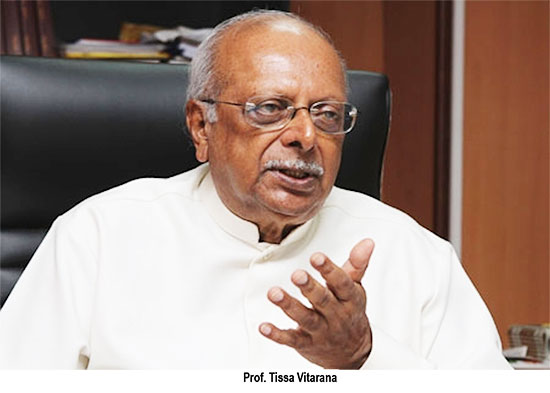
Prof. Tissa Vitarana


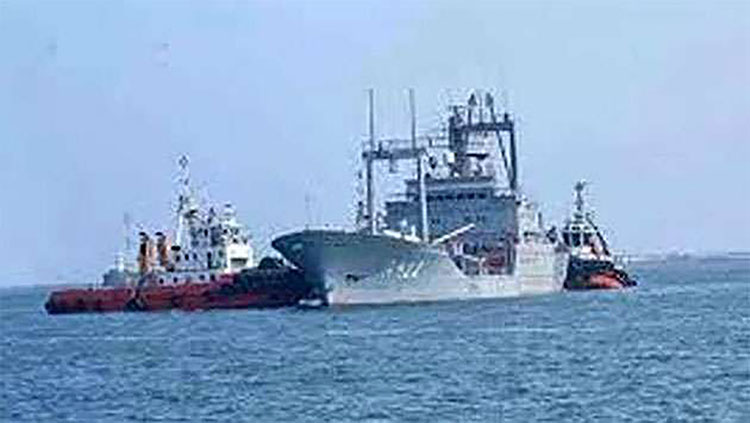
‘Companies may face US sanctions’: Lanka to put ‘national interest’ first as 19 Iranian vessels seek help
(ToI) Sri Lanka said on Friday it would “prioritise our national interests” before providing assistance to the crews of 19 Iranian ships anchored in international waters near the island nation.The crews are facing shortages of food, water and fuel. A foreign ministry spokesperson cited the risk of US sanctions against Sri Lankan companies supplying the vessels as a key concern.
The United States and Iran have been at war since February 28, when the US and Israel launched joint strikes against the Islamic Republic.
“Sri Lanka will put its national interest first before considering any help, and the companies that supply ships are aware of possible secondary sanctions from the United States,” spokesperson Thushara Rodrigo told reporters, ruling out any immediate assistance to the vessels.
Rodrigo clarified, however, that Sri Lanka had received no communication from the United States warning of repercussions if it decided to assist the vessels.According to Rodrigo, the ships are stationed 24 nautical miles off Sri Lanka’s coast.The Iranian Embassy said it had no information on the matter.
In March, a US torpedo attack sank the Iranian naval vessel IRIS Dena in Sri Lankan waters, killing 87 sailors.
The ship was returning to Iran after participating in a naval exercise at India’s invitation. A second Iranian vessel was brought to a Sri Lankan port after its crew reported technical problems.
Wounded sailors were treated at Sri Lankan hospitals, while those rescued from the second vessel were safely repatriated to Iran.
Sri Lanka is still recovering from an economic crisis, with both the United States and Iran serving as important trading partners. Washington played a key role in securing an International Monetary Fund bailout and supporting Sri Lanka’s agricultural sector to help avert a food crisis.

Sri Lanka CERT has warned the public of fraudulent social media advertisements offering admission to foreign universities after receiving complaints from parents and students who have lost hundreds of thousands of rupees to scammers.
The fraudsters reportedly pose as representatives of reputed foreign universities, promising admission, student visas, work permits and even eventual citizenship in return for registration fees and initial tuition payments.
They use convincing videos, photographs and documents circulated via email and WhatsApp to gain the confidence of unsuspecting victims before asking them to transfer money to foreign bank accounts. The scammers then disappear after receiving the payments, Sri Lanka CERT said.
The agency has urged prospective students and their parents to verify the authenticity of university representatives, documents and bank account details before making payments, and to seek overseas education opportunities only through legitimate and recognised channels.
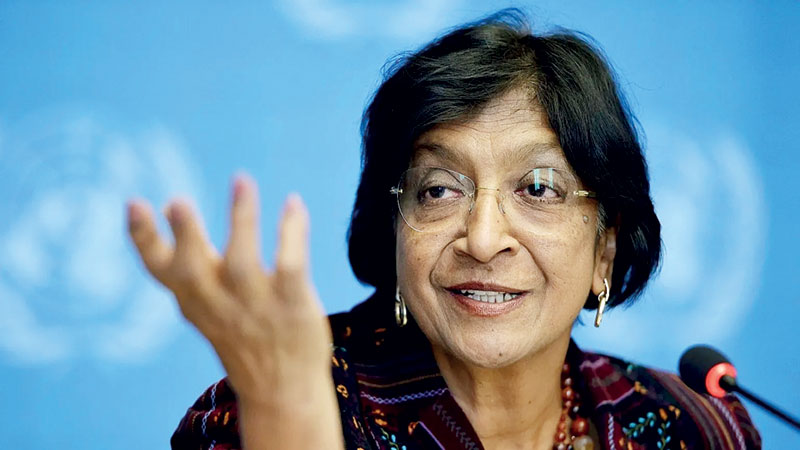
Former UN High Commissioner for Human Rights and International Court of Justice judge Navanethem “Navi” Pillay has won the 2026 Nobel Peace Prize for her contribution to international law and efforts to promote peace, the Norwegian Nobel Committee announced in Oslo on Friday.
Announcing the award, committee chairman Jørgen Watne Frydnes said Pillay had “significantly enlarged the scope and impact of international law” and helped advance “a more comprehensive global legal order” with exceptional courage. He also praised her long career, which began as a lawyer confronting deep-rooted discrimination in South Africa, and described her as a person with a “firm moral compass”.
Pillay, 85, served as the UN High Commissioner for Human Rights from 2008 to 2014. Her tenure brought her into sharp focus in Sri Lanka, particularly over her assessment of the country’s human rights situation in the aftermath of the decades-long civil war.
During an official fact-finding visit to Sri Lanka from August 25 to 31, 2013, Pillay travelled to areas including Jaffna, Kilinochchi and Trincomalee, where she met civil war survivors, families of the disappeared and local communities.
Following the visit, she warned that Sri Lanka was moving towards authoritarianism and highlighted what she described as a persistent climate of fear.
She also reported intimidation and harassment of people who had sought to meet her during the mission.
Pillay urged the UN Human Rights Council to establish an international inquiry mechanism to investigate alleged war crimes and crimes against humanity committed by both government forces and the LTTE during the final stages of the 26-year civil war.
Her observations and recommendations became a significant part of international scrutiny of Sri Lanka’s post-war human rights record.
The Norwegian Nobel Committee received 287 nominations for this year’s Peace Prize, slightly more than a quarter of them being organisations. The committee traditionally considers efforts to promote peace, international fraternity and institutions that contribute to lasting stability.
Last year, Venezuelan opposition leader Maria Corina Machado won the prize for her campaign for a democratic transition in Venezuela. She was praised as a woman who kept the flame of democracy burning amid growing darkness.
The 2026 award marks the 125th anniversary of the Nobel Peace Prize, first presented in 1901. Over its history, the prize has recognised prominent figures and organisations involved in advancing peace, human rights and international cooperation.

Rahmat, Malik fifties lead Afghanistan’s strong reply

Showers above 75 mm are likely at some places in the Western, Sabaragamuwa, Central, Uva and North-Western provinces and in Galle, Matara, Anuradhapura and Mannar districts.

Iranian ships stranded, Lanka fears US sanctions

Sri Lanka CERT warns of overseas university admission scams

Navi Pillay’s Lankan affairs in focus as she wins 2026 Nobel Peace Prize

Lanka welcomes Indian SC remarks on Katchatheevu dispute

‘Dates have the highest sugar content to fight Coronavirus’

Sunday Island 27 December – Headlines

#SundayIsland 17th December – Headlines

Sunday Island – 28th March

Sunday Island Headlines – 21 March

Sunday Island – 21st February – Headlines
-

 News7 days ago
Geneva takes up Sallay’s case and govt. ignores opportunity to answer accusations
-
 Features6 days ago
Preventing grievances from becoming communal
-

 Features4 days ago
The Sri Lankan who made Scottish history
-

 Sports4 days ago
Nissanka absence opens door for Sri Lanka’s young guns
-
 News5 days ago
Gnansara Thera to be assigned to prison printing section: Officials
-

 News3 days ago
NDB fraud Rs 60mn more than reported
-

 Features7 days ago
Sri Lanka Cricket Bill: Governance reform is not yet a cricket strategy
-
 Features4 days ago
Future of Sri Lanka’s state university system: Should it be shut down and reopened?