
Sports
Perseverance pays off for Nimali

Tokyo Olympics- 12 days to go
by Reemus Fernando
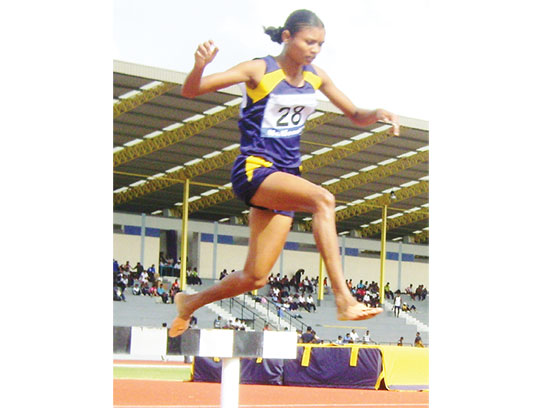
No runner has excelled in multiple track events like Nimali Liyanarachchi during the last one and half decades in Sri Lanka. Except the sprint events of 100 and 200 metres and the track’s longest event the 10,000 metres, Liyanarachchi has competed in all other distances and achieved success at national level in all. As her fellow track and field athletes and coach Sujith Abeysekara would vouch for, it was the perseverance and the dedication that powered Liyanarachchi to achieve success at national and at Asian level. The ‘universality place’ that Liyanarachchi received from World Athletics to take part in the Tokyo Olympics is the ultimate reward for her perseverance.
The middle distance runner from Sooriyawewa alongside Gayanthika Abeyratne were the biggest medal hopes for Sri Lanka at Asian level in the women’s category during the latter part of the last decade. The country was experiencing a medal drought after the retirement of the likes of Susanthika Jayasinghe, Damayanthi Dharsha and Sriyani Kulawansa. With the country experiencing a dearth of medals in sprint events at international events,  coaches were starting to focus on middle distance events for success at regional events when Sujith Abeysekara unearthed a gem of an athlete from Sooriyawewa. First trained for endurance events, Liyanarachchi’s initial success came in the 3,000 metres steeplechase, a discipline not many female athletes were willing to persevere a decade ago.
The event was not even a fixture in the regional South Asian Games. The highest a steeplechaser could achieve was the national title. It was on this back drop that Liyanarachchi took it upon herself to make the event one of the look forward to events. She breathed the event a new life in 2008 when she slashed nearly 30 seconds off the then National record to hog limelight. Former national record holder C.G.K. Abeyratne and Eranga Dulakshi entered the fray as the national record changed hands during the next few years. In 2011 she became the first Sri Lankan woman to run the 3,000 metres under 11 minutes as she clocked 10:44.92 seconds to create a new national mark. By the time she gave up the discipline to concentrate on 800 metres, the 3,000 metres steeplechase national record had improved by more than one minute. Incidentally, Nilani Ratnayake who missed the Tokyo Olympic qualifying mark by the thinnest of margins recently had entered the arena by that time.
Of all disciplines, Liyanarachchi’s best achievements have come in the 800 metres, 1,500 metres and the 4×400 metres relays, though she has also competed in the 5,000 metres and the 400 metres hurdles with moderate success. In fact Liyanarachchi is the current national record holder of the 1,500 metres and the 4×400 metres relay (2019 Asian Championship). Liyanarachchi hinted that she was one of the country’s top international medal prospects when she broke Dhammika Menike’s more than two decades old national record in 2016 though she did not get due recognition for it then. The record lasted just one year before fellow athlete Gayanthika Abeyratne claimed it after a close duel with her.
Liyanarachchi has South Asian Games (2016) and Asian Athletics Championship (2017) golds against her name for prowess in the 800 metres. By March this year she was the third ranked Asian in her discipline and was ranked among the top 60 athletes in the world in the ‘Road to Olympics’ rankings. That was despite missing competitions in 2020. She was injured in a road accident on the eve of the team’s departure for the South Asian Games in 2019. After spending months in rehabilitation she returned to competition later in 2020 and had earned a top ranking in Asia by March this year. However Olympics is a different story. She is not among the best in the world to have hopes of a final berth. A good performance in a semi final, a feat closer to the national record could be expected..


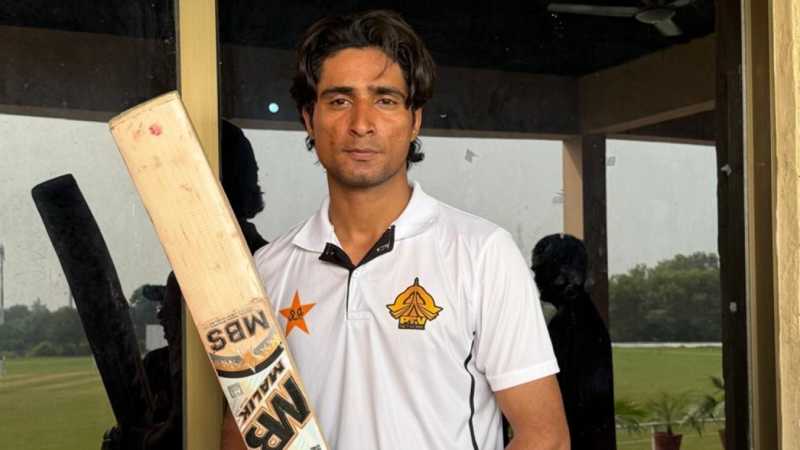
Muhammad Shazad has broken the record for the fastest first-class century by a Pakistani batter, reaching the mark in just 49 balls.
The right-hander smashed eight sixes and 12 fours in his innings of 114 off 62 balls for Pakistan Television against Kingsmen Academy at the Diamond Cricket Ground in Islamabad on the opening day of the third round of the President’s Trophy.
This is Shahzad’s sixth first-class century in 21 matches. Batting at No. 5, he walked out when PTV were struggling at 34 for 3 and struck a 143-run stand with Mohammad Taha, who made 43. Shahzad has also played 22 List A matches and 26 T20s. He made his PSL debut for Islamabad United in the 2025 season, playing six matches.
Misbah-ul-Haq previously held the record for the fastest first-class century by a Pakistan batter for his 56 ball effort against Australia in the second Test at Abu Dhabi in 2014. Misbah, at the time, levelled Viv Richards’ record for the fastest Test century. But that record was broken two years later by Brendon McCullum, when he made a 54-ball century against Australia in Christchurch in the second Test of the series.
Shahzad has come through the PCB’s age-group programme, playing for Pakistan’s Under-16 and Under-19 sides. He played in the 2020 Under-19 World Cup in South Africa.
(Cricinfo)
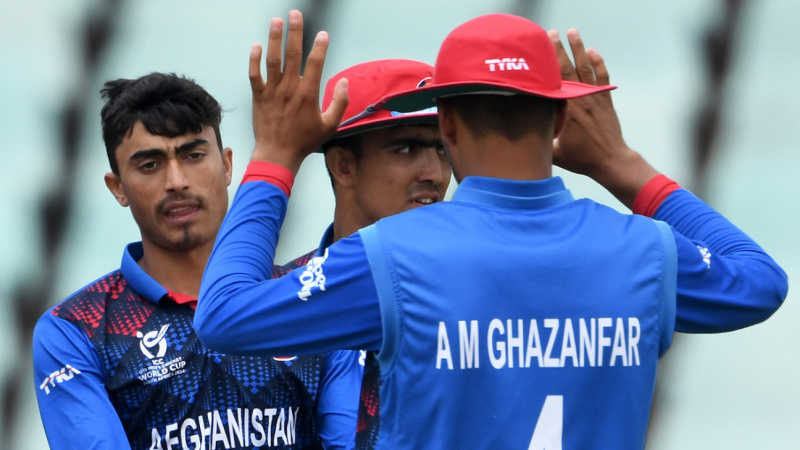
Right-arm wristspinner Arab Gul, took 4 for 8 on T20I debut and left-arm spinner Nangeyalia Kharote picked up 3 for 19 as Afghanistan successfully defended a modest 129 against Japan to open their Asian Games men’s competition campaign with two points in Group A.
Two days after nearly beating India in a rain-shortened game in Sano, hosts Japan made a steady start to the chase and reached 53 for 2 in the eighth over before losing their way.
Gul did much of the damage, taking two wickets apiece in the 12th and 14th overs as Japan slid from 60 for 4 to 63 for 8. Abdollah Ahmadzai and Kharote then finished off the lower order, with Japan bowled out for 81 in 19.3 overs.
Asked to bat first, Afghanistan had posted 129 for 6, with Mohammad Akram making 34, captain Darwish Rasooli 29 and Karim Janat 21.
But it was Mohammad Ishaq’s unbeaten 25 off 17 balls from No. 6 that provided the late impetus after Japan had kept Afghanistan to under six an over for the first 15 overs. Right-arm seamer Shoma Sugaya-Slater and offspinner Ibrahim Takahashi took two wickets apiece for Japan.
The two sides have games against Nepal lined up in Group A. The top two teams from the group will proceed to the quarter-finals.
Scores:
Afghanistan 129 for 6 in 20 overs (Mohhamad Akram 34, Karim Janat 21, Darwish Rasooli 29, Mohammad Ishaq 25*; Reo Sakurano Thomas 1-05, Shoma Sugaya-Slater 2-18, Ibrahim Takanashi 2-19) beat Japan 81 in 19.3 overs (Reo Sakurano- Thomas 23, Kendel Kadowwaki Fleming 14, Benjamin Ito Davis 17; Arab Gul 4-8, Abdullah Ahmadzai 2-13, Nangeyalia Khan 3-19, Najibullah Zadran 1-07 ) by 48 runs
(Cricinfo)
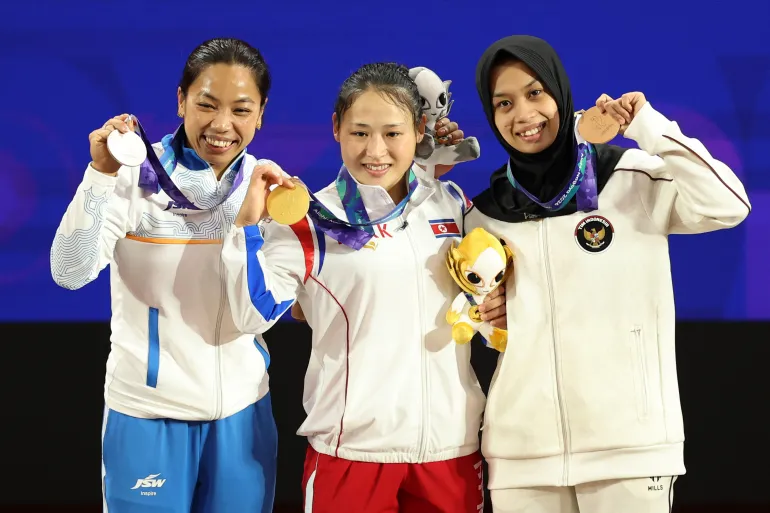
North Korean weightlifter Ri Song Gum has broken three world records en route to winning gold in the women’s 49kg (108lbs) competition, which saw India’s Mirabai Chanu win an elusive Asian Games medal by finishing second.
Ri gave North Korea its first gold of the games in Nagoya, Japan, on Wednesday, joining an elite club of four weightlifters who have won three Asian Games gold medals.
The 28-year-old hauled 94kg above her head in the opening snatch discipline – the first official segment of the competition where athletes lift a barbell from the floor to an overhead position in a single motion. The lift was 1kg heavier than the previous world record of 93kg.
Ri followed it up by breaking the world record twice in the 115kg clean and jerk – a two-part movement where a barbell is lifted from the floor to the shoulders and then pushed overhead. The 4ft-7in (139.7cm) weightlifter hoisted 116kg and 121kg above her head.
Ri’s total lift of 215kg obliterated the old world record total by 7kg.
She is the fourth lifter, and first woman, to win three Asian Games weightlifting golds and joined Iran’s Mohammad Nassiri (1966-74), South Korea’s Kim Tae-hyun (1990-98) and Iran’s Behdad Salimi (2010-18), who all won three gold medals. No athlete has won four weightlifting gold medals.

In the same category, India’s Chanu finally won an Asian Games medal at the third time of asking. She won a silver medal at the Tokyo Olympics in 2021.
The 32-year-old is India’s most decorated weightlifter, with three Commonwealth gold medals and a silver to her name, along with multiple global titles.
She lifted a total of 198kg after a snatch of 87kg and a clean and jerk of 111kg, while Indonesia’s Diana Tri Wijayana took bronze with a total of 191kg, comprising 88kg and 103kg.
Chanu’s silver also ended India’s 28-year wait for a weightlifting medal at the games since Karnam Malleswari won silver in 1998.

(Aljazeera)

Muhammad Shahzad smashes fastest first-class hundred by a Pakistani batter

Gul, Kharote spin Afghanistan to victory over Japan in Asian Games opener

Showerss above 100 mm are likely at some places in the Western, Sabaragamuwa, Central and North-western provinces and in Galle and Matara Districts

Mirabai Chanu wins Asian Games silver as Ri breaks weightlifting record

Trump greets China’s Xi Jinping on arrival for three-day US

BASL calls for conscience vote on 22nd Amendment

‘Dates have the highest sugar content to fight Coronavirus’

Sunday Island 27 December – Headlines

#SundayIsland 17th December – Headlines

Sunday Island – 28th March

Sunday Island Headlines – 21 March

Sunday Island – 21st February – Headlines
-

 News6 days ago
Shanakiyan urges urgent action over reported death sentence for Lankan in Saudi Arabia
-

 News7 days ago
Bid for Basil’s extradition nears final stage: Police
-

 News5 days ago
Namal Rajapaksa Buddhist gambit fails, bail denied
-

 Features5 days ago
Why the spelling Sri Lankan names in English vary
-

 Features5 days ago
Three bands, a new identity: Sri Lankan wolf snake recognised as distinct species
-
 Business5 days ago
SLIIT holds largest-ever convocation
-

 News5 days ago
Govt monitors reported Saudi death sentence – Foreign Ministry
-

 News5 days ago
Vehicle prices drop by up to Rs. 1 mn, says importers’ body